SAT vs ACT: How to decide which test to take in 2026

Date:

Date:

TL;DR

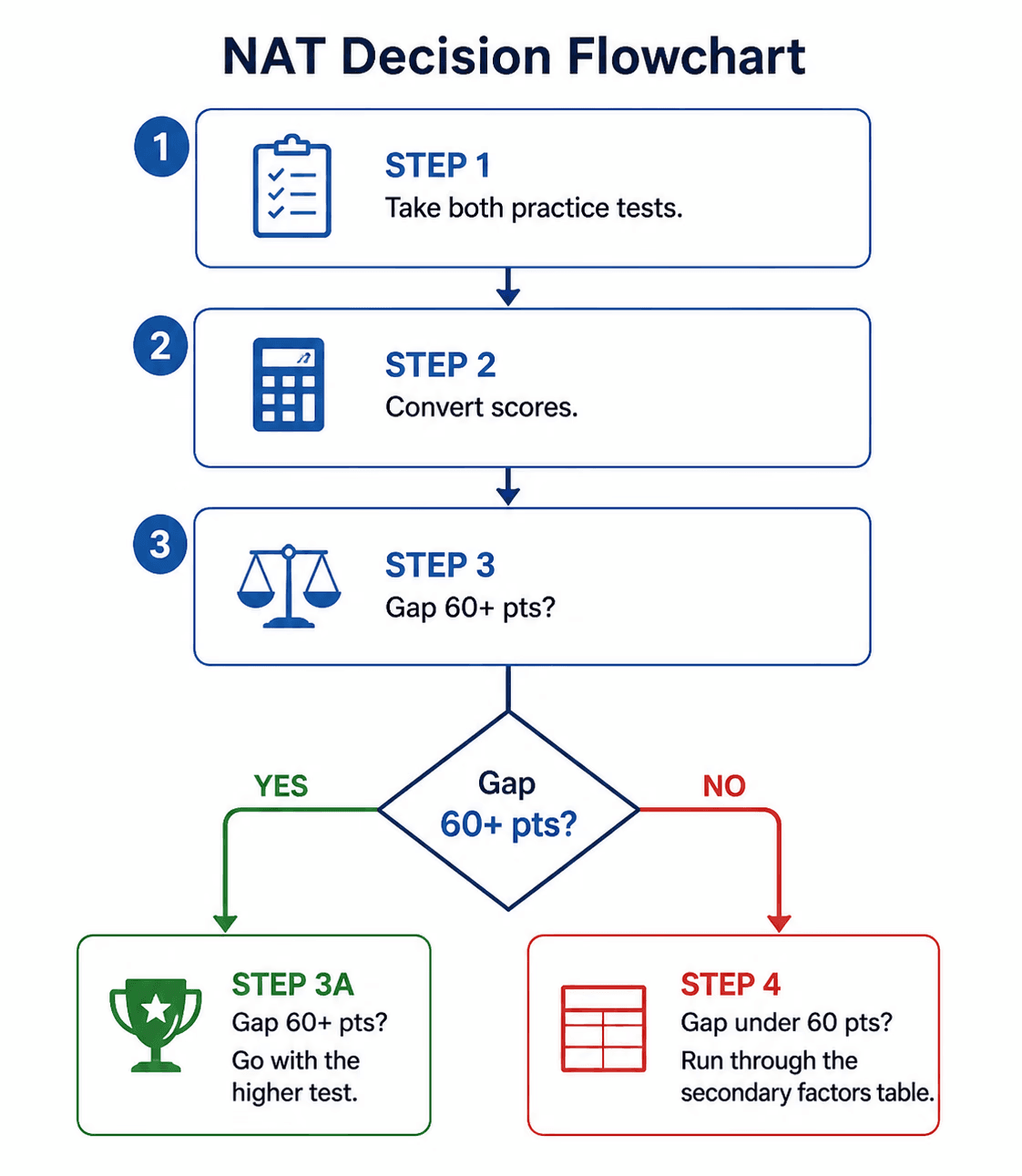
The ACT and SAT are equally accepted at every U.S. college. Take one timed practice test of each, convert your scores using the official concordance, and compare. If one score converts 60 or more SAT points higher, choose that test. If your scores are close, let your strengths guide you: the SAT favors math-heavy students, and the ACT favors strong English and reading performers. The 2025 Enhanced ACT is now shorter and no longer includes science in its composite score.

TL;DR

The ACT and SAT are equally accepted at every U.S. college. Take one timed practice test of each, convert your scores using the official concordance, and compare. If one score converts 60 or more SAT points higher, choose that test. If your scores are close, let your strengths guide you: the SAT favors math-heavy students, and the ACT favors strong English and reading performers. The 2025 Enhanced ACT is now shorter and no longer includes science in its composite score.

TL;DR

The ACT and SAT are equally accepted at every U.S. college. Take one timed practice test of each, convert your scores using the official concordance, and compare. If one score converts 60 or more SAT points higher, choose that test. If your scores are close, let your strengths guide you: the SAT favors math-heavy students, and the ACT favors strong English and reading performers. The 2025 Enhanced ACT is now shorter and no longer includes science in its composite score.

If you've spent an hour reading SAT vs ACT comparison charts and still don't know which test to take, you're not doing anything wrong. Most guides give you a list of differences and leave you to figure out the rest. That's not a decision framework. It's a vocabulary lesson.

Here's the reality: the ACT and SAT are equally accepted at every U.S. college, including the Ivy League. Colleges don't prefer one over the other. What matters is which test lets you score higher, not which one sounds more rigorous.

The 2025 testing season also changed the comparison in ways most guides haven't caught up to yet. The Enhanced ACT is now shorter, gives more time per question, and no longer counts science in its composite score. Students making decisions based on older articles are working from outdated information.

This post gives you a concrete way to decide: two practice tests, one score comparison, and a clear rule for what to do next.

What is the actual difference between the SAT and ACT in 2026?

The ACT and SAT test the same core skills: reading, writing, and math. Every U.S. college accepts both equally. The differences come down to format, timing, and what each test emphasizes.

The Digital SAT, delivered through the College Board's free Bluebook app, is fully digital, adaptive, and runs 2 hours and 14 minutes across 98 questions. Math counts for 50% of your total SAT score. There's no paper option.

The Enhanced ACT, updated in 2025 by ACT Inc., runs 2 hours and 5 minutes for the core test across 131 questions. The composite score now averages English, math, and reading only on the familiar 1–36 scale. Science is optional and reported separately. Unlike the SAT, the ACT offers both digital and paper-and-pencil formats.
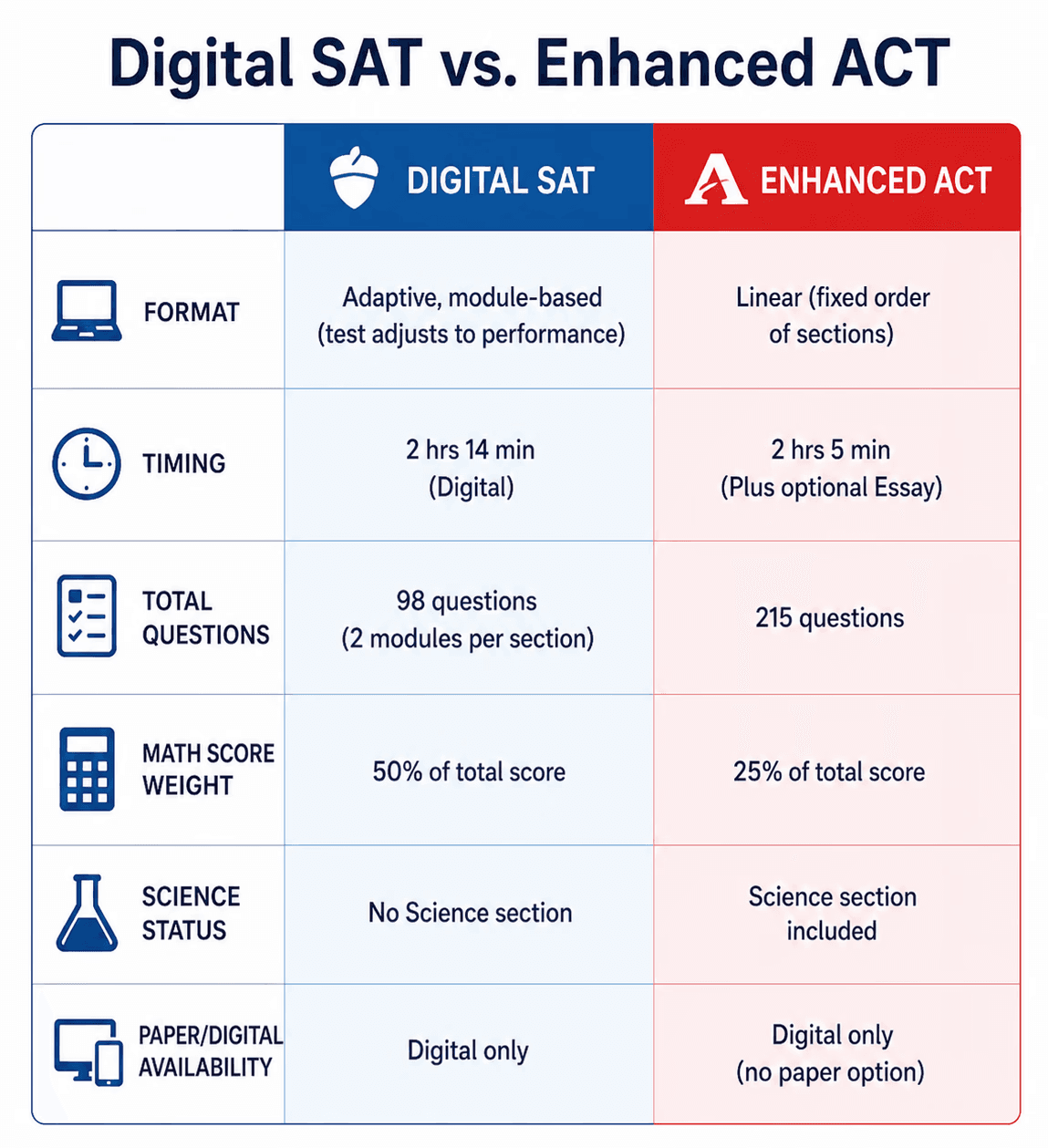
Comparison table of Digital SAT and Enhanced ACT showing format, timing, question count, math weight, science status, and digital availability.

Which test gives you more time per question, the ACT or the SAT?

The SAT gives you more time per question. College Board data shows the SAT provides 41–44% more time per question than the old ACT format. The 2025 Enhanced ACT closed much of that gap, adding 22% more time per question across all sections. Even so, the SAT averages about 1 minute 27 seconds per question compared to roughly 1 minute 14 seconds on the Enhanced ACT.

That difference matters if you're a slow, deliberate reader. For most students, though, pacing is no longer the decisive factor it used to be. If time pressure is your main concern, the SAT is still the safer choice. If you work efficiently under timed conditions, don't let timing data alone drive your decision.

NAT tutor insight: In sessions with students who struggle under timed conditions, Uju K. finds out, 

“I have noticed that the ACT's pace rarely causes the score drop that students expect. The bigger issue tends to be careless errors from rushing, which appear on both tests equally.”

“I have noticed that the ACT's pace rarely causes the score drop that students expect. The bigger issue tends to be careless errors from rushing, which appear on both tests equally.”

“I have noticed that the ACT's pace rarely causes the score drop that students expect. The bigger issue tends to be careless errors from rushing, which appear on both tests equally.”

How to use a practice test score to decide: ACT or SAT?

This is the step most guides skip entirely. They tell you to take practice tests but don't tell you what to do with the results.

Here's the framework NAT tutors use. Start by taking one full-length timed practice test for each test. Use College Board's free Bluebook app for the SAT and ACT's official practice PDF for the ACT. Replicate real testing conditions: no extra breaks, no phones, no looking things up.

Then convert your scores. Use the NAT's ACT to SAT conversion chart or the SAT to ACT conversion chart, both built from the official concordance published jointly by College Board and ACT Inc. Then compare your two converted scores side by side.

One of our SAT tutors, Kurtis L, who scored 1570 on the SAT and 36 on the ACT, applies a score-gap rule in one-on-one sessions: 

“If your converted practice scores differ by 60 or more SAT points, choose the higher-converting test. A gap that large likely reflects a genuine fit difference, not random variation from one practice session.”

“If your converted practice scores differ by 60 or more SAT points, choose the higher-converting test. A gap that large likely reflects a genuine fit difference, not random variation from one practice session.”

“If your converted practice scores differ by 60 or more SAT points, choose the higher-converting test. A gap that large likely reflects a genuine fit difference, not random variation from one practice session.”

If your scores land within 60 points of each other, secondary factors should make the call:

Factor

Choose SAT

Choose ACT

Math vs. verbal strength

Math is your strongest subject

English and reading are your strengths

Format preference

Prefer fully digital, adaptive testing

Prefer paper option or non-adaptive format

Score reporting

One test submission is cleaner for your application

Want to superscore across multiple sittings

State testing

SAT is offered free at your school

ACT is offered free on school day in your state

Math topic range

Prefer formula support and fewer topics

Comfortable with matrices, trig, and geometry

Image explaining the lowest SAT score and its implications for college admissions and academic readiness.

ACT vs SAT math: Which section is harder?

The SAT math and ACT math test different strengths, not different difficulty levels. The SAT math section, which counts for 50% of your total score, focuses on algebra, data analysis, and multi-step reasoning. College Board provides a formula reference sheet during the SAT math section. The ACT provides no formula sheet.

ACT math covers a broader range of topics: matrices, logarithms, graphs of trigonometric functions, and geometry, which makes up 30–45% of the ACT math section. But ACT math questions tend to be more direct. SAT math questions tend to be more contextual and multi-layered. If you prefer reasoning through problems with formula support, the SAT math section is likely your better fit.

For students with a strong pre-calculus or trigonometry background who prefer straightforward questions, the ACT math section rewards that foundation well. Read more about how these differences play out for STEM-focused students deciding between the two tests.

Ready to Ace Either Test?

Work with elite ivy league tutors who have walked the path you are on and aced it. Get a personalised strategy for extraordinary results.

Book a FREE consultation

Ready to Ace Either Test?

Work with elite ivy league tutors who have walked the path you are on and aced it. Get a personalised strategy for extraordinary results.

Book a FREE consultation

Ready to Ace Either Test?

Work with elite ivy league tutors who have walked the path you are on and aced it. Get a personalised strategy for extraordinary results.

Book a FREE consultation

Does the ACT science section still matter for college admissions?

As of 2025, ACT science is optional and no longer included in the ACT composite score. The ACT composite now averages only English, math, and reading on the 1–36 scale. ACT Inc. confirmed that the science score appears separately on your score report, alongside a STEM score that averages math and science combined. Taking the core ACT without science costs $65. Adding the science section costs $69.

That said, some colleges, particularly those with competitive STEM and pre-med programs, still request or recommend a science score. Check each college's admissions page before you register, not after. If you're applying to engineering, natural sciences, or pre-med programs, taking the science section is still worth the extra 35 minutes. If you're not pursuing a STEM field, you can skip it without any impact on your composite.

If you've read anywhere that ACT science counts toward your composite score, that information is outdated as of 2025.

The bottom line on SAT vs ACT

The decision between the ACT and SAT doesn't have to be a coin flip. Take two timed practice tests. Convert your scores. If one comes out 60 or more SAT points higher, you have your answer. If the scores are close, let your math-to-verbal ratio, your state's school-day testing options, and your format preference make the call.

Two things worth knowing that most comparison guides miss: the SAT still gives more time per question, and the Enhanced ACT no longer counts science in its composite score. A lot of conventional wisdom about these tests reflects formats that no longer exist.

If you'd rather skip the guesswork, a one-on-one session with a NAT tutor can run a diagnostic and tell you exactly where you stand on both tests. Start with NAT's SAT tutoring resource hub or the ACT tutoring resource hub, and book a free strategy session to get matched with the right tutor for your test. Your grades are now our responsibility.

Ready to boost your score?

Ready to boost your score?

Ready to boost your score?

Schedule a free consultation with our Ivy League experts and get a personalized study plan.

Schedule a free consultation with our Ivy League experts and get a personalized study plan.

Schedule a free consultation with our Ivy League experts and get a personalized study plan.

Schedule Consultation

Schedule Consultation

Schedule Consultation

Join 5,000+ Students

Join 5,000+ Students

Join 5,000+ Students

Get weekly academic tips and test prep resources delivered to your inbox.

Get weekly academic tips and test prep resources delivered to your inbox.

Get weekly academic tips and test prep resources delivered to your inbox.

Frequently Asked Questions

Do colleges prefer the SAT or ACT? 

Colleges do not prefer the SAT over the ACT, or vice versa. Both tests are treated equally in the admissions process, and almost all US colleges accept either test. The best choice depends on which test format fits your strengths, as colleges primarily care about the final score submitted rather than the test type.

Do colleges prefer the SAT or ACT? 

Colleges do not prefer the SAT over the ACT, or vice versa. Both tests are treated equally in the admissions process, and almost all US colleges accept either test. The best choice depends on which test format fits your strengths, as colleges primarily care about the final score submitted rather than the test type.

Is the ACT or SAT easier? 

Neither test is objectively harder. Difficulty depends on your individual strengths. The SAT favors students who are strong in math and prefer more time per question. The ACT rewards strong English and reading skills, and with the 2025 Enhanced ACT changes, the pace is now more manageable than it used to be. 

Is the ACT or SAT easier? 

Neither test is objectively harder. Difficulty depends on your individual strengths. The SAT favors students who are strong in math and prefer more time per question. The ACT rewards strong English and reading skills, and with the 2025 Enhanced ACT changes, the pace is now more manageable than it used to be. 

Can I submit both SAT and ACT scores to colleges? 

Yes, you can submit both SAT and ACT scores to colleges, but it is generally only recommended if both scores are high and comparable. Most colleges do not require both and will only consider the higher score, allowing you to use College Raptor to find schools that accept either. While sending both can show academic breadth, most applicants should send only their best score, according to Reddit users. 

Can I submit both SAT and ACT scores to colleges? 

Yes, you can submit both SAT and ACT scores to colleges, but it is generally only recommended if both scores are high and comparable. Most colleges do not require both and will only consider the higher score, allowing you to use College Raptor to find schools that accept either. While sending both can show academic breadth, most applicants should send only their best score, according to Reddit users. 

What is a good ACT score compared to a good SAT score? 

A "good" score is generally defined as the 75th percentile or higher for your target colleges, but broadly, an ACT score of 24–28 is considered strong (top 25%), while a 30–36 is elite (top-tier schools). Comparatively, a 24–28 ACT roughly corresponds to a 1190–1340 SAT, and a 30–36 ACT corresponds to a 1360–1600 SAT.

What is a good ACT score compared to a good SAT score? 

A "good" score is generally defined as the 75th percentile or higher for your target colleges, but broadly, an ACT score of 24–28 is considered strong (top 25%), while a 30–36 is elite (top-tier schools). Comparatively, a 24–28 ACT roughly corresponds to a 1190–1340 SAT, and a 30–36 ACT corresponds to a 1360–1600 SAT.

Should I take the ACT science section? 

As of 2025, ACT science is optional and not included in the ACT composite score. You can skip it and still receive a full composite based on English, math, and reading. If you're applying to STEM programs, some colleges may still recommend or request a science score, so check each school's admissions policy before you register.

Should I take the ACT science section? 

As of 2025, ACT science is optional and not included in the ACT composite score. You can skip it and still receive a full composite based on English, math, and reading. If you're applying to STEM programs, some colleges may still recommend or request a science score, so check each school's admissions policy before you register.

Get the Ivy League Advantage

Get the Ivy League Advantage

Work with elite tutors who have walked the path you are on. Personalised strategy for extraordinary results.

Work with elite tutors who have walked the path you are on. Personalised strategy for extraordinary results.

Book a free consultation

Book a free consultation

Related Articles

When to take the SAT grade by grade timeline for 2026 showing junior spring first attempt and senior fall retake windows for college admissions.

SAT

Average SAT score by state: what the class of 2025 data means

Average SAT score by state: what the class of 2025 data means

Read article

Highest SAT score 1600 rarity guide 2026. Learn how rare a perfect digital SAT score is and whether 1500 is close enough for top colleges.

SAT

What is the highest SAT score, and is a 1600 worth it?

What is the highest SAT score, and is a 1600 worth it?

Read article

What is a good SAT score 2026 guide showing score ranges by college selectivity tier from 400 to 1600 scale and percentile benchmarks for admissions.

SAT

What is a good SAT score?

What is a good SAT score?

Read article

When to take the SAT grade by grade timeline for 2026 showing junior spring first attempt and senior fall retake windows for college admissions.

SAT

Average SAT score by state: what the class of 2025 data means

Read article

Highest SAT score 1600 rarity guide 2026. Learn how rare a perfect digital SAT score is and whether 1500 is close enough for top colleges.

SAT

What is the highest SAT score, and is a 1600 worth it?

Read article

What is a good SAT score 2026 guide showing score ranges by college selectivity tier from 400 to 1600 scale and percentile benchmarks for admissions.

SAT

What is a good SAT score?

Read article

How to ace the digital SAT cover infographic with Desmos calculator, adaptive modules, and score goals for 2026 college admissions prep.

SAT

How to ace the SAT: a complete guide to digital SAT prep

Read article

Get Notifications For Each Fresh Post

Get Notifications For Each Fresh Post