How to choose a graduate program that supports your career goals

A graduate degree takes years of study, a significant financial investment, and a real commitment of your time and energy. Those costs make it important to look beyond a program's ranking or convenience and ask a more specific question: does this program actually move me toward the career I want?
According to the Education Data Initiative, 61.4% of high school graduates from 2023 were enrolled in college by October of that year. In many professions, that undergraduate degree is a foundation rather than a final credential. For professionals looking to take on advanced roles and specialized responsibilities, graduate education provides the next layer of qualifications. But the wrong program can set a career back rather than push it forward.
Whether you are advancing in your current profession or changing direction entirely, what follows is a practical framework for making a graduate school decision you will not regret.
Start by clarifying what you actually want
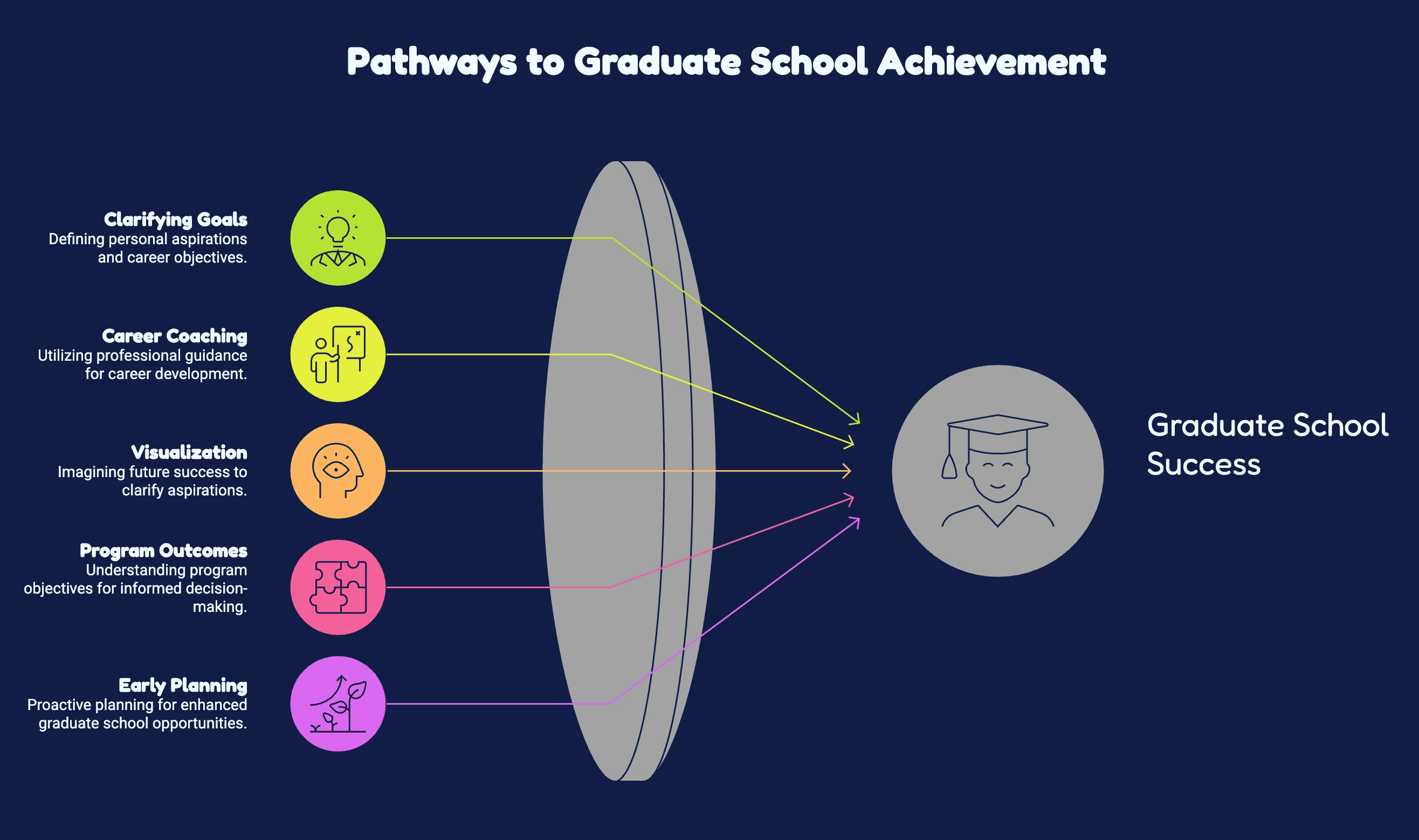
Most people approach graduate school research before they have done the harder work of defining what they want from it. The result is that they optimize for the wrong things: program rankings, school name recognition, or what their peers are doing.
Career coaches who work with professionals at this stage often begin with a straightforward question: "Why do you do what you do?" The Forbes Coaches Council notes that some coaches also use visualization exercises to help clients imagine what their future might look like in concrete terms. Imagining a specific day in your future working life, who you are working with, what problems you are solving, and what kind of impact your work produces, can make it easier to understand what success actually means to you.
That clarity matters because graduate programs are designed for specific outcomes. A program built for clinical practice is not the same as one built for research. A program designed for management is not the same as one designed for policy. Before you compare programs, understand which type of outcome you are pursuing.
The earlier you build this clarity, the better positioned you are to make every subsequent decision well. Students who begin working on academic preparation and career planning early in high school and college arrive at this stage with more options and fewer constraints. NAT's college admissions tutors work with students on exactly this kind of long-range planning, from undergraduate preparation through graduate school readiness.
Research the actual requirements for your target career
Once you have a direction, research the qualifications that field genuinely requires. Do not assume that any graduate degree in a related subject will get you where you want to go. Look at job descriptions for positions you want to hold in five to ten years, and pay attention to what credentials, licenses, and certifications appear consistently.
For someone pursuing a specialized behavioral health career, for example, the path might involve an advanced nursing credential. According to Cleveland State University, enrolling in an online MSN psychiatric nurse practitioner programtypically requires a Bachelor of Science in Nursing, a 3.0 or above GPA, an active unencumbered registered nurse license, and letters of recommendation, among other criteria. Online options for this credential offer 100% online coursework, giving working professionals the flexibility to continue in their roles while completing the program.
The point is not the specific example. The point is the process: understand what a particular credential contributes to your career plans before enrolling in the program that offers it. Many students choose programs based on general subject area without confirming that the credential the program awards actually meets the requirements of the specific role they are pursuing.
Research this early. It will narrow your list of viable programs considerably, and it will also help you identify the academic gaps you need to close before you can apply.
For students still at the undergraduate stage who are heading toward careers that require graduate credentials, building a strong academic foundation now is the most important early investment. NAT's MCAT tutors support pre-med and pre-health students who are working toward the graduate-level entry credentials their fields require.
Evaluate career support and professional opportunities
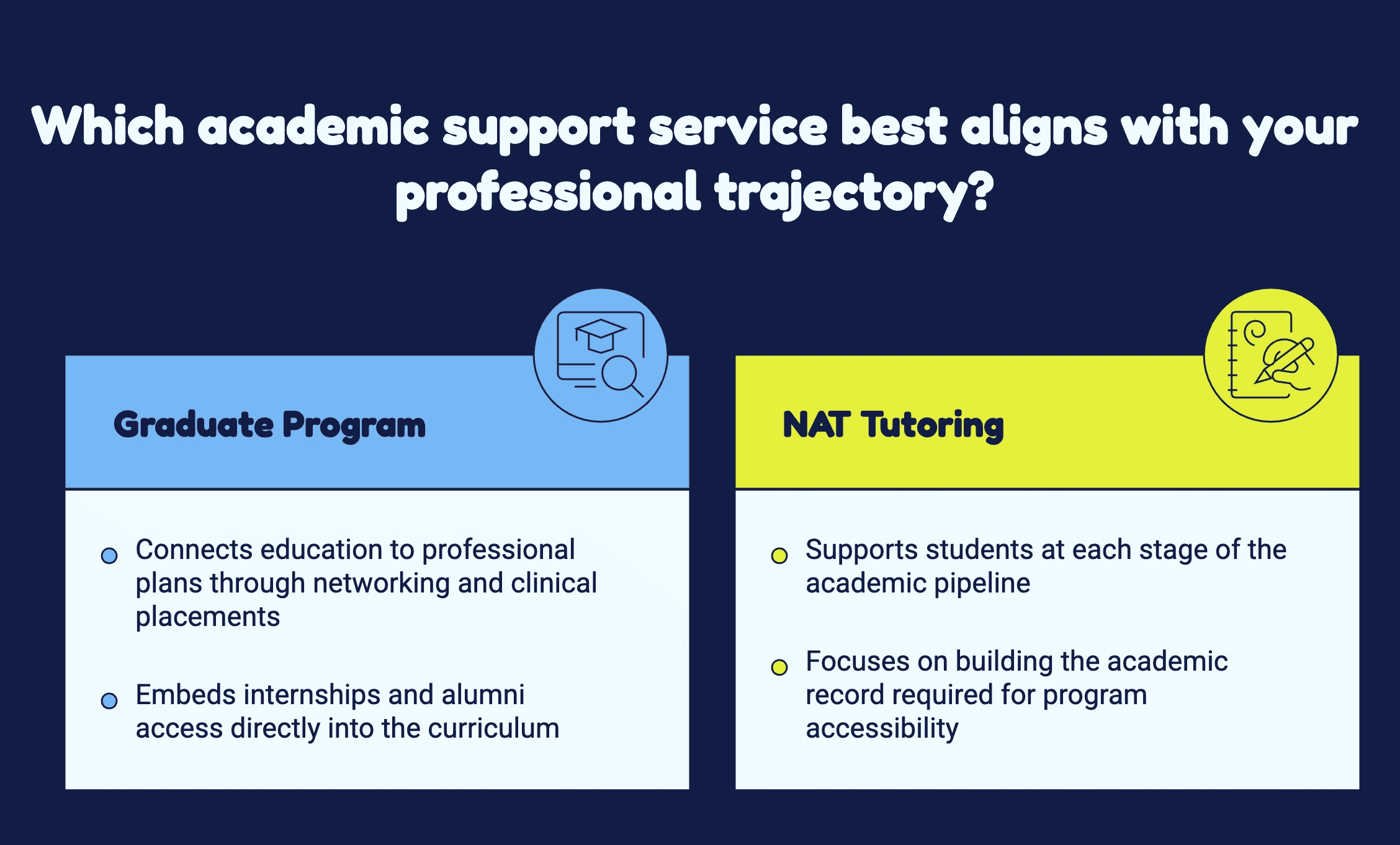
A graduate program should connect your education to your professional plans, not just award a credential at the end. During your research, look at whether each program offers career counseling, networking opportunities, alumni access, internships, practicums, or clinical placements.
These elements matter because graduate education is not complete until you are working in the field. Programs that treat career support as an afterthought often leave graduates with strong knowledge and limited professional connections. Programs that build those connections into the curriculum itself give graduates a real advantage when entering or advancing in the job market.
Consider the nursing profession as an example of how career support intersects with field growth. The Bureau of Labor Statistics projects 40% employment growth in nursing between 2024 and 2034, with a cited median annual pay of $129,210. Nursing is the third fastest-growing occupation in the United States. A graduate program in that field with strong clinical placement infrastructure and active alumni networks gives graduates access to that growth in a way that a program with weak career support simply does not.
When you evaluate programs, ask where recent graduates are working, what types of positions they hold, and how quickly they moved into roles after graduation. Past outcomes do not guarantee your own, but they reveal a great deal about how a program connects to the real professional world.
For students still building the academic record that makes graduate programs accessible, strong test preparation is part of that process. NAT's SAT tutoring and MCAT prep support students at each stage of the academic pipeline leading toward graduate school entry.
The program-fit audit: five questions to ask before you apply
Most applicants research programs by comparing rankings, tuition, and location. Those factors matter, but they do not tell you whether a program will actually move your career forward. Here are five questions that do.
Question 1: Does this program produce graduates who hold the roles I want?
Look at where recent alumni work. If you want to practice clinical psychiatry and the program primarily places graduates in administrative roles, that is a mismatch worth knowing before you enroll.
Question 2: Does the curriculum match the skills my target role actually requires?
Look beyond the program name and examine the actual course requirements. Read course descriptions and capstone requirements. Ask whether the core courses build the specific competencies that appear in job descriptions for your target role.
Question 3: Does the program's timeline fit your professional situation?
If you are currently working, a program that requires full-time on-campus attendance may force you to leave a job before you are ready. Many fields now offer online or hybrid options that allow working professionals to continue earning while completing credentials. Matching the program format to your current situation is as important as matching it to your career goals.
Question 4: What does the financial commitment actually look like?
Total cost is not just tuition. Add fees, books, technology, transportation, and housing if applicable. Then calculate what your monthly loan payment would be at graduation, and check whether your projected starting salary after the program makes that payment manageable. Programs with strong scholarship support or employer assistance programs may reduce this burden significantly.
Question 5: What does your plan look like after you graduate?
A graduate degree is a milestone, not an endpoint. Before enrolling, write down where you want to be two, three, and five years after graduation. What internships, certifications, leadership roles, or specialized training should you pursue during the program? Having a clear plan for the years inside the program makes the degree far more productive than completing it without one.
Students who want help thinking through this kind of long-range academic and career planning can schedule a free consultation with North American Tutors, where Ivy League-educated tutors work with students on both academic preparation and the strategic planning that shapes what comes next.
Understand the full financial commitment
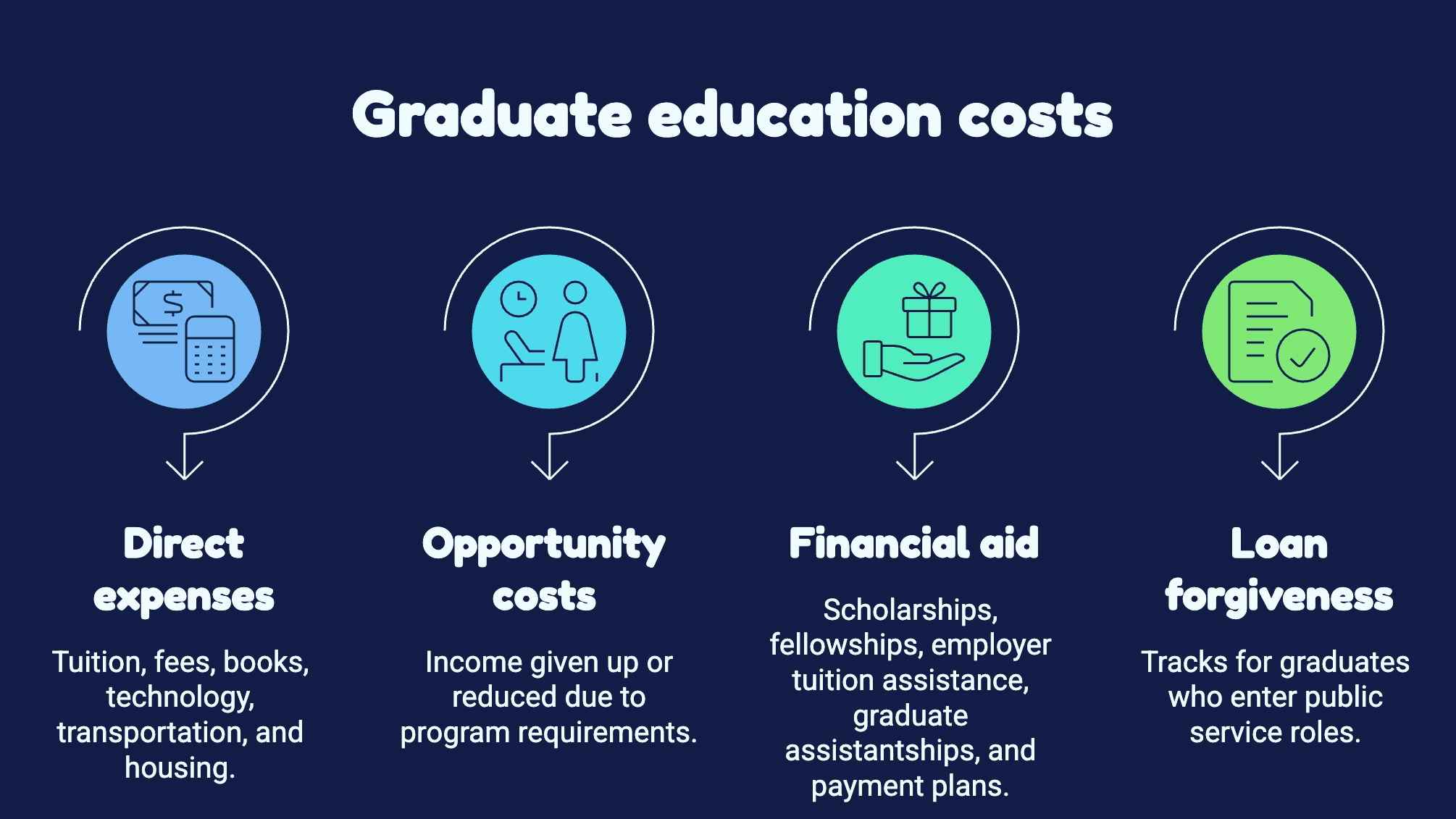
Tuition is only one part of the total cost of graduate education. Fees, books, technology, transportation, and housing all contribute to the real number. So does the income you may give up or reduce if the program requires you to cut back on work.
The financial stakes are significant at a national level. A 2025 report notes that around 43 million Americans carry federal student loan debt, totaling more than $1.6 trillion. "College costs are just exorbitant. Students are burdened with debt," says Linda McMahon, U.S. Secretary of Education. "We really have to do something to bring down the cost of college."
Before you borrow, research every financial aid option available: scholarships, fellowships, employer tuition assistance, graduate assistantships, and payment plans. Many professional and healthcare programs offer loan forgiveness tracks for graduates who enter public service roles. Calculate your total debt burden before enrolling and verify that your projected post-graduation income makes the repayment realistic.
The cost question also connects to career outcome research. A program that costs significantly more than a comparable alternative and produces similar employment outcomes is rarely the better investment. Use financial data alongside career outcome data when making comparisons.
Build a plan that goes beyond enrollment
Being accepted into a graduate program is only the first step. Long-range progress depends on having a plan that extends well past graduation day.
Times Higher Education notes that one of the biggest challenges in career planning is imagining what your ideal future self looks like several years from now. Researchers who develop five-year plans often identify two to five goals that are both ambitious and realistic. That same framework applies to graduate education: treat the degree as one milestone in a longer sequence, not as the destination itself.
Your plan should account for the skills and experiences you want to build during the program, not just the courses you will complete. Think about internships, certifications, research projects, leadership roles within professional associations, and networking events that connect you to practitioners in your target field. Students who map these milestones before they enroll arrive at graduation with a professional profile that reflects deliberate choices, not just coursework.
For students who want to strengthen the academic foundation that makes graduate program applications competitive, including test scores, writing, and subject knowledge, NAT's college admissions tutors and subject specialists work one-on-one with students at every stage of that preparation.
Key facts at a glance
Data point | Figure |
|---|---|
High school graduates from 2023 enrolled in college by October of that year | 61.4% |
Projected employment growth for nursing, 2024 to 2034 | 40% |
Cited median annual pay for nurses | $129,210 |
Americans with federal student loan debt | 43 million |
Total federal student loan debt | Over $1.6 trillion |
Recommended number of goals in a five-year career plan | 2 to 5 |
Choosing a graduate program means balancing personal goals, market demand, and practical requirements. There is no single program that is the right choice for everyone. The best option is the one that connects your career direction, your current professional situation, and your realistic financial picture.
Take time to evaluate your options with specific data, ask the questions that rankings cannot answer, and look clearly at where you want to be several years from now. That approach will serve you far better than choosing based on reputation alone.