How to write a strong college application

College enrollment in the United States keeps climbing. According to the Education Data Initiative, undergraduate enrollment reached 19.28 million students in Fall 2024, with projections pointing to 19.57 million for Fall 2025. More students means more applications, and more applications means more competition for the same number of seats at selective schools.
A strong application does not cut through that competition by being louder or longer. It cuts through by being specific. The students who get into their target schools are not always the ones with the highest scores. They are the ones who made admissions readers feel like they already knew them after closing the file.
This guide walks through the four areas that matter most: building your personal profile, presenting your academic and extracurricular experiences, connecting your interests to long-term goals, and tailoring each application to the school you are actually writing for.
Build a compelling personal profile
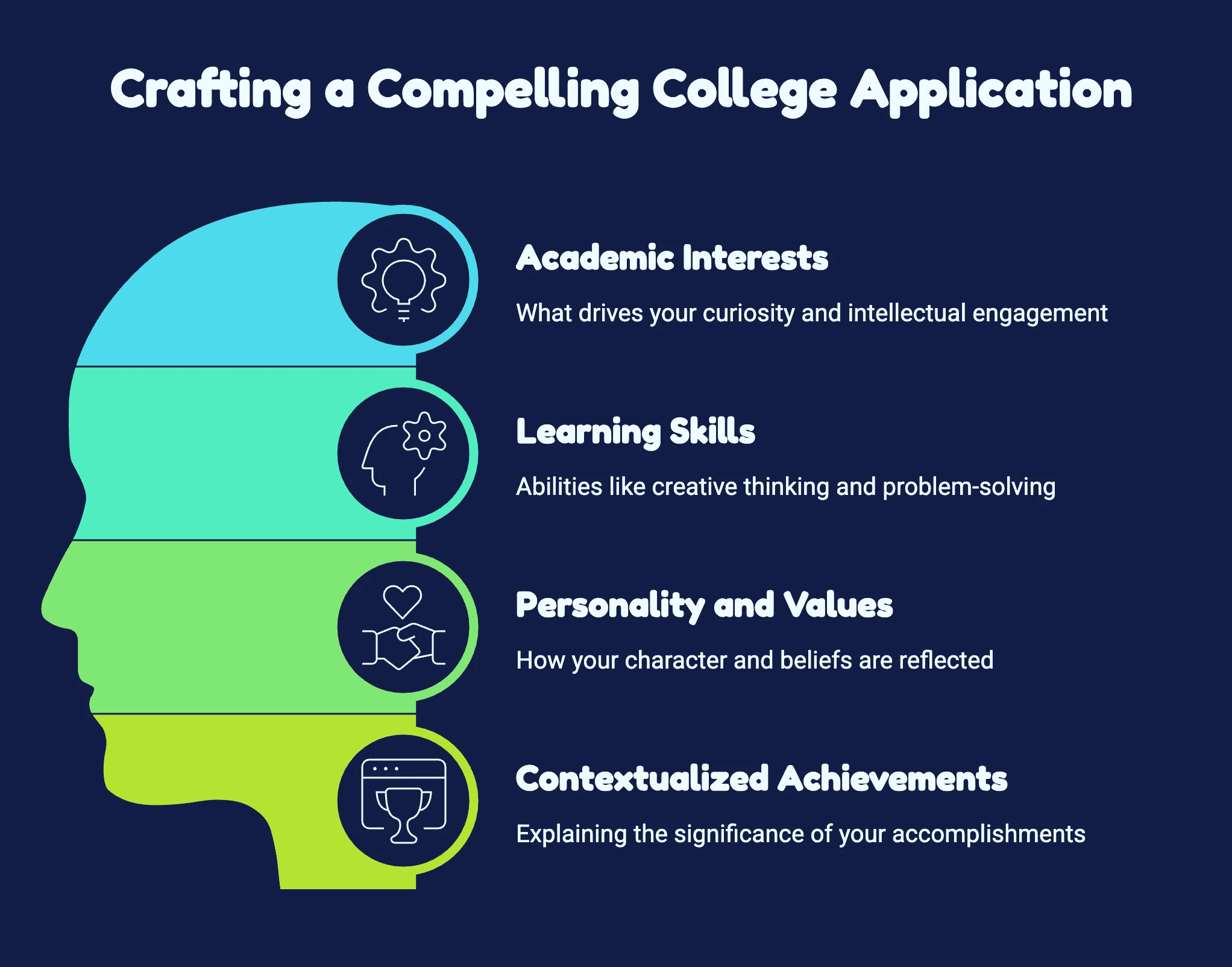
Your application should give admissions officers a clear sense of who you are beyond your grades. That starts with your academic interests: what genuinely drives your curiosity, what questions you find yourself thinking about outside of class, and what kind of intellectual work energizes you.
According to Indeed, developing strong learning skills, the ability to think creatively, solve problems under pressure, and communicate ideas clearly, is one of the most important things a student can do to prepare for both college and the years that follow. These are exactly the qualities that admissions readers are looking for signals of, because they predict how a student will perform once they arrive on campus.
Your personality and values should also come through naturally in your application, not through statements about who you are, but through the specific experiences you choose to discuss and what you say about them. A student who writes "I am a natural leader" has told the reader nothing. A student who describes exactly what changed in their team when they took on a specific responsibility has shown something real.
Avoid listing achievements without context. Every item on your application becomes more meaningful when you explain why it mattered to you and what it taught you.
Highlight experiences that actually shaped you
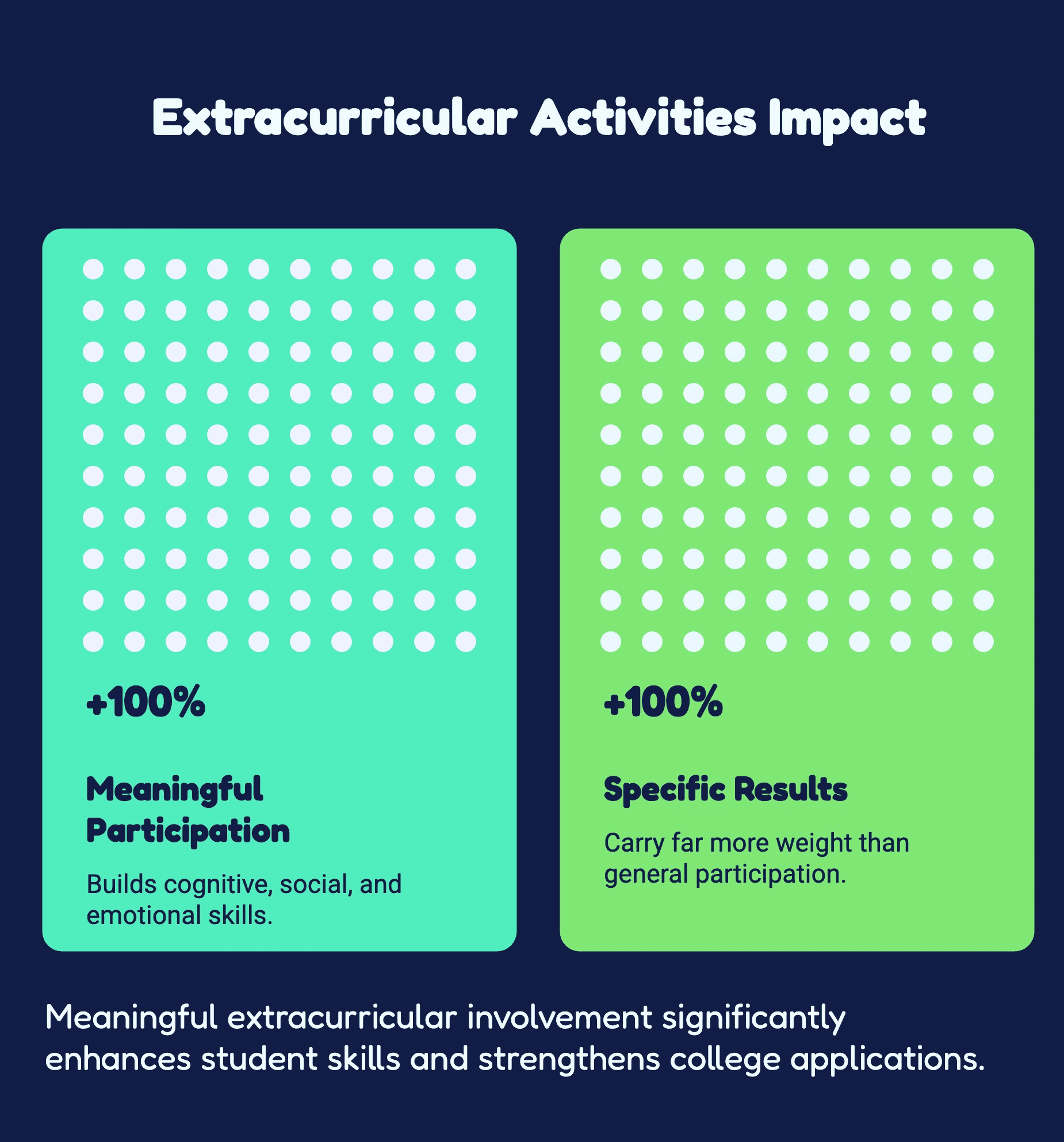
A ResearchGate study on extracurricular activities found that meaningful participation in activities outside the classroom builds cognitive, social, and emotional skills that academic coursework alone cannot produce. Admissions readers know this, which is why they read the activities section carefully rather than skimming it.
The key word is meaningful. A list of clubs you joined is not the same as a record of experiences that changed how you think or what you are capable of. Admissions officers at selective schools read thousands of applications. They can tell within a few lines whether a student was genuinely involved in something or simply present for it.
Focus on two or three experiences that actually influenced you and discuss them with specificity. What did you do, and what was different because of it? What challenge did you face, and how did you handle it? What responsibility did you take on that you had not carried before? What skill did you develop that you can now use?
Wherever you have a concrete outcome to point to, include it. A workshop you organized that trained 30 younger students. A project that is still running after you left. A research dataset that an organization now uses. Specific results carry far more weight than general participation.
NAT's post on the 5 best extracurriculars for Ivy League admissions goes deeper on what kinds of activities send the strongest signals to top schools, and how to frame your involvement in ways that show depth rather than just duration.
For students who want guidance on how to present their activities and experiences strategically, NAT's college application and essay tutors work one-on-one with students to help them identify their strongest stories and translate those stories into compelling application writing.
Connect your interests to your future goals
Admissions officers want to understand where you are headed, not because you need a fixed career plan, but because a student who can articulate a clear direction demonstrates maturity and self-awareness that vague applicants cannot.
You do not need to have your entire career mapped out. You do need to show that your interests are genuine, that your experiences connect to those interests, and that you have thought about how college fits into the larger picture.
For instance, a student drawn to social work might discuss what first sparked that interest, which experiences have deepened it, and how they see their college years building the knowledge and skills they will need for the work they want to do. Master's in Social Work programs, such as the program at the University of the Pacific, offer one clear pathway for students who want to advance in that field after entering the workforce. Showing that you understand the full arc of your intended path, including what comes after college, tells admissions officers that your interest is real and your thinking is serious.
Show how the specific college you are applying to fits into that plan. Mention programs, courses, research opportunities, or practical experiences that connect directly to your goals. When you can point to a specific lab, clinic, studio, or concentration that does not exist in the same form anywhere else, your "why this school" answer becomes genuinely convincing rather than generic.
You can also name the skills you expect to develop: through coursework, internships, research, or hands-on experience. An application that connects past experiences to present interests to future goals reads like a coherent story. One that does not reads like a list.
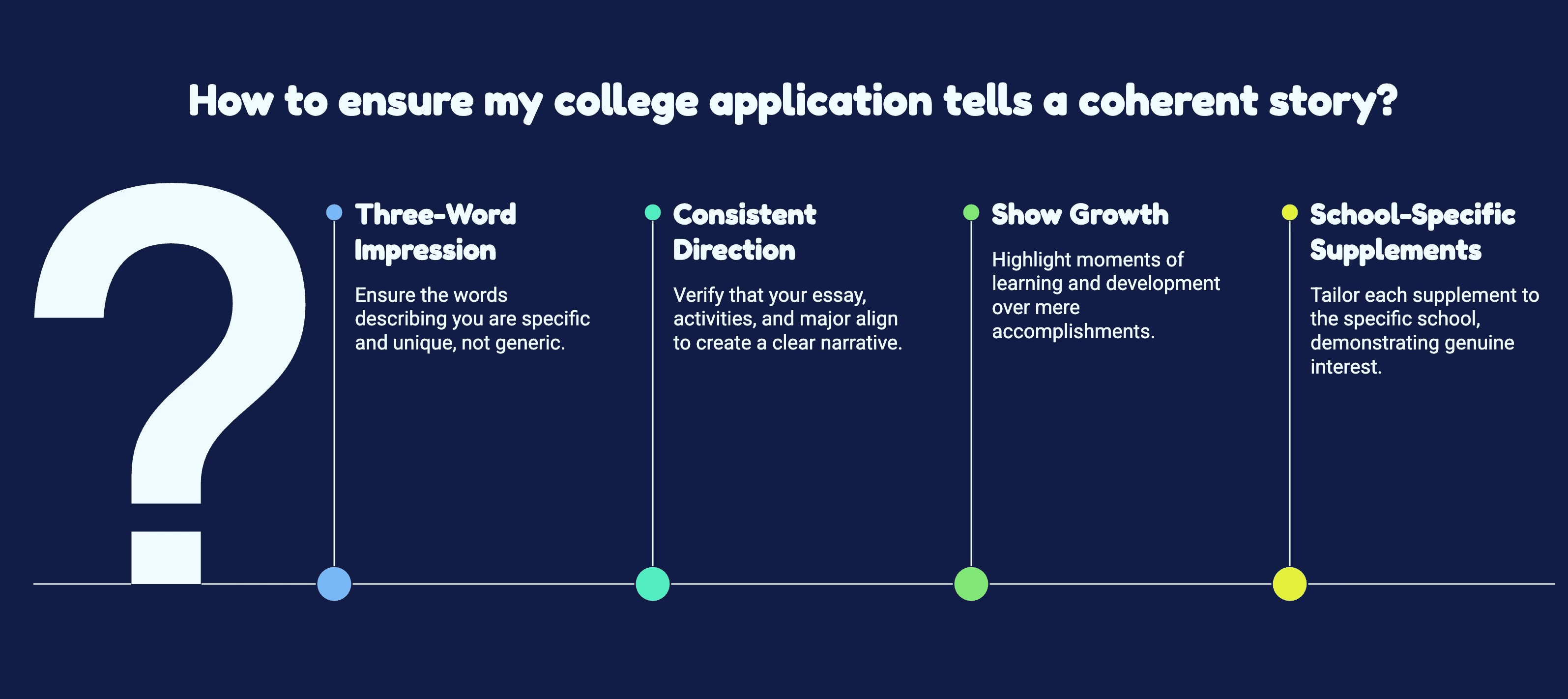
The four-question application audit: how to check whether your application tells a coherent story
Most students review their applications for errors before submitting. Fewer check whether the application actually works as a whole. Here is a four-question audit NAT's college admissions team uses with students in the final weeks before submission.
Question 1: If an admissions officer read your entire application and had to describe you in three words, what would those words be?
If you are not sure, or if the three words that come to mind are generic ("hard-working, passionate, dedicated"), your application may not be telling a clear enough story yet. The strongest applications leave readers with a specific impression that could only describe one person.
Question 2: Do your essay, activities, and intended major all point in the same direction?
A student who says they want to study environmental policy, writes a personal statement about a local conservation project they led, and lists relevant research and community work in their activities section has a coherent application. A student whose essay, activities, and major all point in different directions gives readers nothing to hold onto. Check each section against the others and ask whether they confirm the same picture.
Question 3: Have you shown growth, or just accomplishment?
Admissions officers at selective schools see thousands of accomplished students. What they find more interesting is a student who can describe a specific moment when their thinking changed, a challenge that forced them to develop a skill they did not have before, or a mistake they learned from. Accomplishment tells readers what you did. Growth tells them how you think.
Question 4: Does each school-specific supplement feel like it was written for that school only?
A supplement that could be copied and pasted into any application signals to readers that you are not genuinely interested in their school. A supplement that references a specific course, professor, research center, or campus opportunity, and connects it directly to your own goals, signals that you have done the work to understand why this particular school is the right fit for you specifically.
Students who want to work through this audit with an expert before submitting can connect with NAT's college admissions team for a one-on-one session. The conversation is free and does not require a commitment.
Research each school and tailor your application
Generic applications do not work at selective schools, and they do not need to. Tailoring takes time, but it is the most reliable way to show admissions readers that your interest is genuine.
"Students must tailor their applications to resonate with their chosen schools," says Aviva Legatt, a college admissions expert, in Forbes. She recommends researching each college's mission, department strengths, and culture before shaping the application.
Start with the academic side. Look at the specific courses, concentrations, research centers, and faculty whose work connects to your interests. If you find a class, a lab, or a professor whose work you have actually read and can speak to specifically, mention it. That level of specificity is difficult to fake, which is exactly why it works.
Then look at the campus side. What organizations, communities, or experiences at this school could you contribute to and grow from? The strongest "why us" answers are specific in both directions: here is what I bring to your campus, and here is what I cannot get anywhere else.
For a fuller breakdown of what selective colleges specifically look for in applications, NAT's guide on how to get into the Ivy Leagues covers the admissions factors that matter most at the most competitive schools. For students targeting specific schools and wanting to strengthen their written materials, NAT's post on top college application mistakes that cost Ivy League admission is also worth reading before submission.
Common mistakes that weaken otherwise strong applications
Even students with strong profiles and genuine stories submit applications that fall short because of avoidable errors. Here are the most common ones.
Starting too late. The personal statement and supplemental essays take longer than most students expect, especially when done well. Starting in late September of senior year for November deadlines leaves almost no time for revision. Start the summer before senior year.
Writing a generic personal statement. An essay that could describe any motivated student tells the reader nothing distinctive about you. Write about something specific, personal, and honest. The goal is for the reader to feel like they know you after finishing the first page.
Not proofreading carefully. Typos, grammatical errors, and formatting issues in a college application signal carelessness to readers who are looking for evidence of attention to detail. Read every section out loud before submitting. Then ask someone else to read it.
Ignoring financial aid deadlines. Missing the FAFSA deadline or scholarship application windows can cost students significant money that has nothing to do with their admissions outcome. Build a financial aid calendar alongside your application calendar.
Submitting the same supplements to every school. Copying and pasting supplement responses is one of the fastest ways to signal to a school that it is not your priority. Even minor tailoring, where you replace generic phrases with school-specific references, is better than submitting the same answer to every school.
Students working on their application essays who want expert feedback on structure, voice, and content can schedule a free consultation with North American Tutors. NAT's Ivy League-educated tutors work one-on-one with students through every stage of the writing and revision process.
Key takeaways
Area | What to focus on |
|---|---|
Personal profile | Authentic interests, specific experiences, genuine values |
Academic and extracurricular record | Depth over volume, specific outcomes, real growth |
Career direction | Connect past to present to future, show purposeful thinking |
School research | Specific programs, courses, and communities, tailored for each school |
Common mistakes | Start early, proofread carefully, tailor every supplement |
A strong college application is ultimately about presenting your readiness for the next chapter with clarity and confidence. Give yourself enough time to think carefully about what you want to communicate. Review every requirement, stay attentive to details, and make choices throughout the process that reflect who you actually are.
Your application is not just a form to complete. It is your opportunity to approach an important transition with intention and a clear sense of what you hope to achieve.