ACT tips and tricks: test-taking strategy, section by section
Most ACT tips guides are outdated. The test you're preparing for looks different from what most online advice describes: the ACT now offers Science and Writing as optional sections, and the core section lengths have changed. If you've been working from a guide that lists 75 English questions or 40 Reading questions, you've been prepping for a version of the test that no longer exists.
The bigger issue is that most ACT prep starts with the wrong move. Students pick up a list of tips and begin drilling whatever looks difficult, not what's actually costing them points. Your weakest sections lift your composite score first, not your strongest. A student who scores 30 in English, 28 in Math, and 24 in Reading doesn't need another English drill. She needs three weeks to read.
NAT tutors who scored 34 to 36 on the ACT have seen this pattern repeatedly. The average composite gain for NAT students is 5+ points, and that number comes from a diagnostic-first process, not a generic tip sheet. This guide walks through that process and then gives you section-by-section ACT tips and tricks built on the current format, tutor expertise, and what the research actually says about how scores improve.
You'll find a study plan, a universal test-taking strategy, section-specific tips for English, Math, Reading, Science, and Writing, and a checklist for the final days before your test.
The ACT tips and tricks that matter start with a leak map
Most students spend their prep time on what they already do reasonably well. That's not a character flaw; it's human nature to practice what feels familiar. But the ACT composite is the average of your four required section scores, which means your ceiling is set by your lowest section, not your highest.
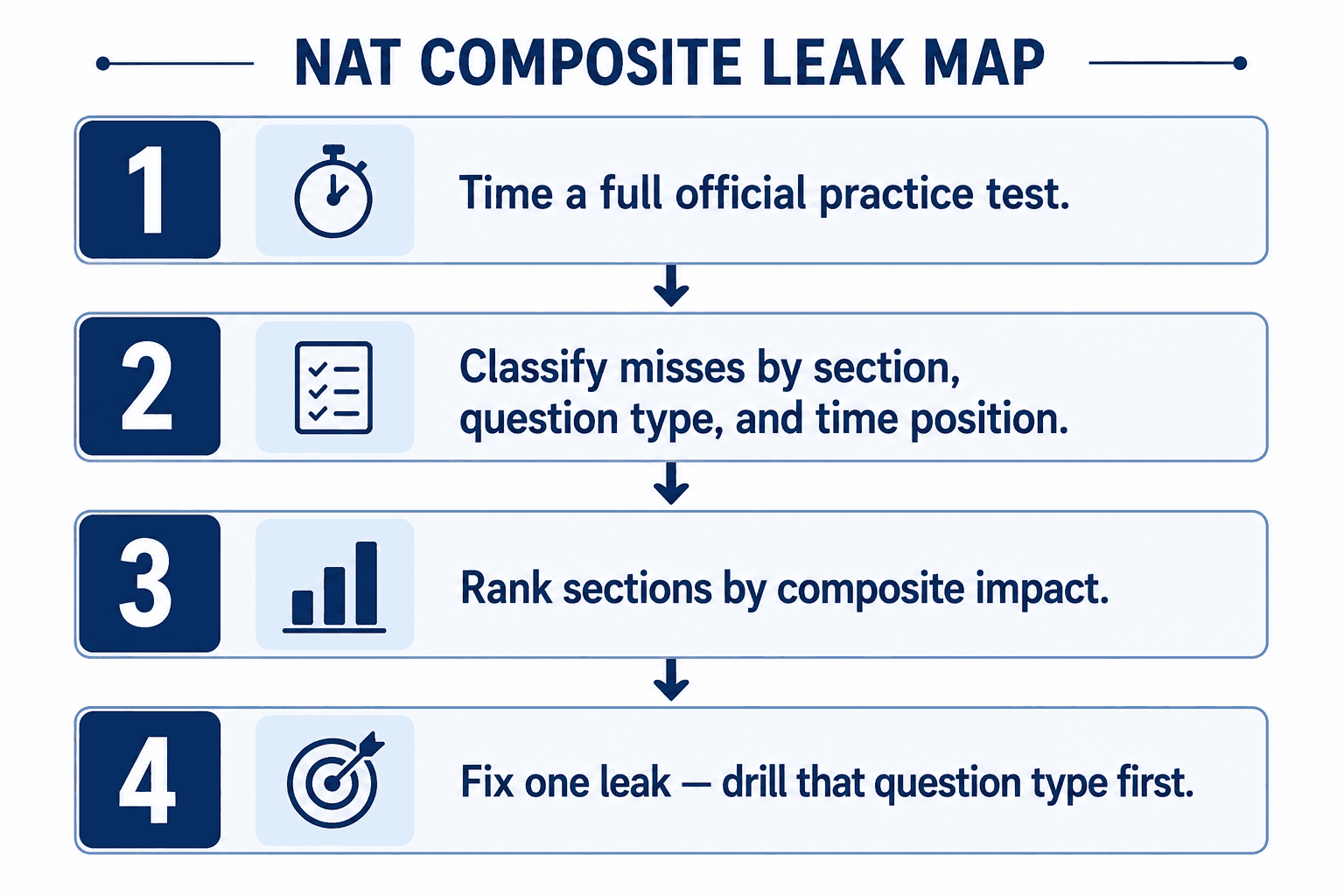
Before you apply any of the tips below, run Phase 1 of NAT's Composite Precision Method: the composite leak map. It takes about a week of deliberate work, and it changes everything that comes after.
The four-step composite leak map:
Time a full official practice test. Use one of the official ACT free practice tests under real conditions: timed, no breaks beyond the official ones, no looking up answers mid-section. Score it the same day.
Classify every miss. For each wrong answer, record the section, the question type (grammar rule, algebra, data interpretation), and where the question fell in the section. Some students run out of time on questions 30 to 36 in Reading; others miss geometry reliably and breeze through algebra. The pattern matters more than the raw count.
Rank sections by composite impact. A 2-point gain in your lowest section adds 0.5 points to your composite. A 2-point gain in your highest section adds the same. Fix the section where you have the most room to move, not the section you feel best about.
Pick one leak to fix first. Most students can improve one section by three to five points within four to six weeks of focused drilling. That gain is compounding: it raises the floor that's been holding your composite down.
Octavia M. scored a 35 on the ACT, including a perfect 36 on the English section. Her result shows what focused, section-level work produces. English, with its repeating grammar rules, is often the highest-leverage section to target first. See more student results that follow the same pattern.
If you want a written leak report before you begin drilling, book a free ACT strategy session. NAT tutors use the Composite Precision Method to identify your highest-leverage section and hand you a prioritized prep plan in one session. There's no commitment required. You can also explore the full ACT tutoring resource to see how the process works.
How to study for the ACT before you need tricks
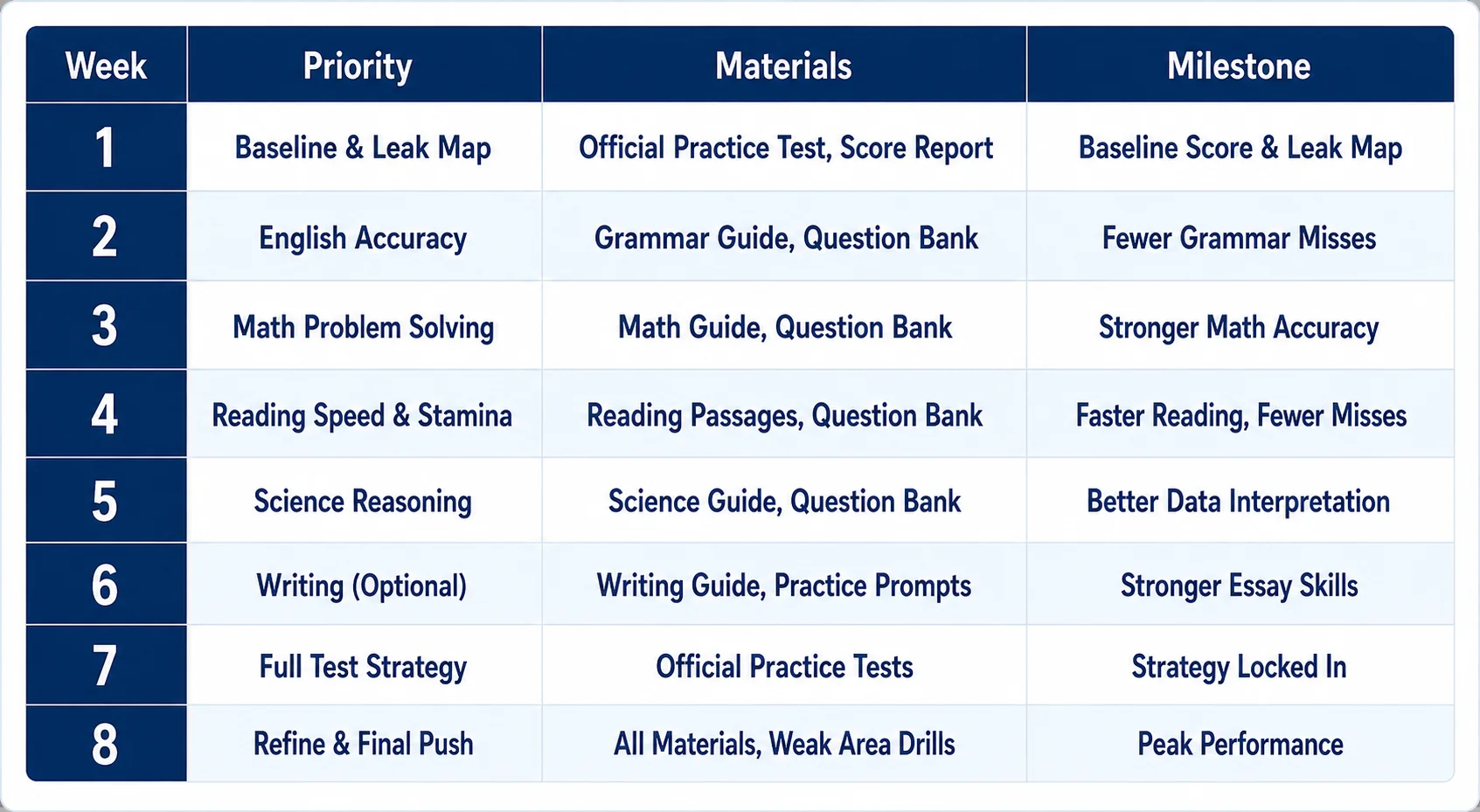
Tricks without a plan quickly reach their limit. The students who see the largest composite gains combine a structured prep schedule with the section-specific tactics below. Here's a practical eight-week framework.
Week | Focus | Materials |
|---|---|---|
1 | Baseline test + leak map | Official ACT free practice test; classify every miss |
2 | Weakest section: concept review | Official ACT prep; section-specific drills |
3 | Weakest section: timed drilling | Official practice questions under section time limits |
4 | Second-priority section: concept review | Official prep; formula review for Math |
5 | Second-priority section: timed drilling | Timed section practice; error log |
6 | Full practice test under test conditions | Official test; re-score and re-classify |
7 | Third section + pacing drills | Focus on question-triage pacing; test-day simulation |
8 | Final review + test-day prep | Light review; logistics; rest the final two days |
The most common mistake in ACT prep is skipping Week 1 and going straight to drilling. Without a scored baseline, you're guessing what to fix. The official ACT offers free practice test materials that mirror the real test format exactly.
For a broader look at how to build a full prep strategy around your composite target, see how to ace the ACT. That article covers the big-picture decisions; this one focuses on the tactics.
ACT test-taking tips that work on every section
Before the section-specific strategies, four habits move scores regardless of which part of the test you're on. These aren't shortcuts. They're structural decisions that change your expected score even before you strengthen your content knowledge.
Know the current ACT format
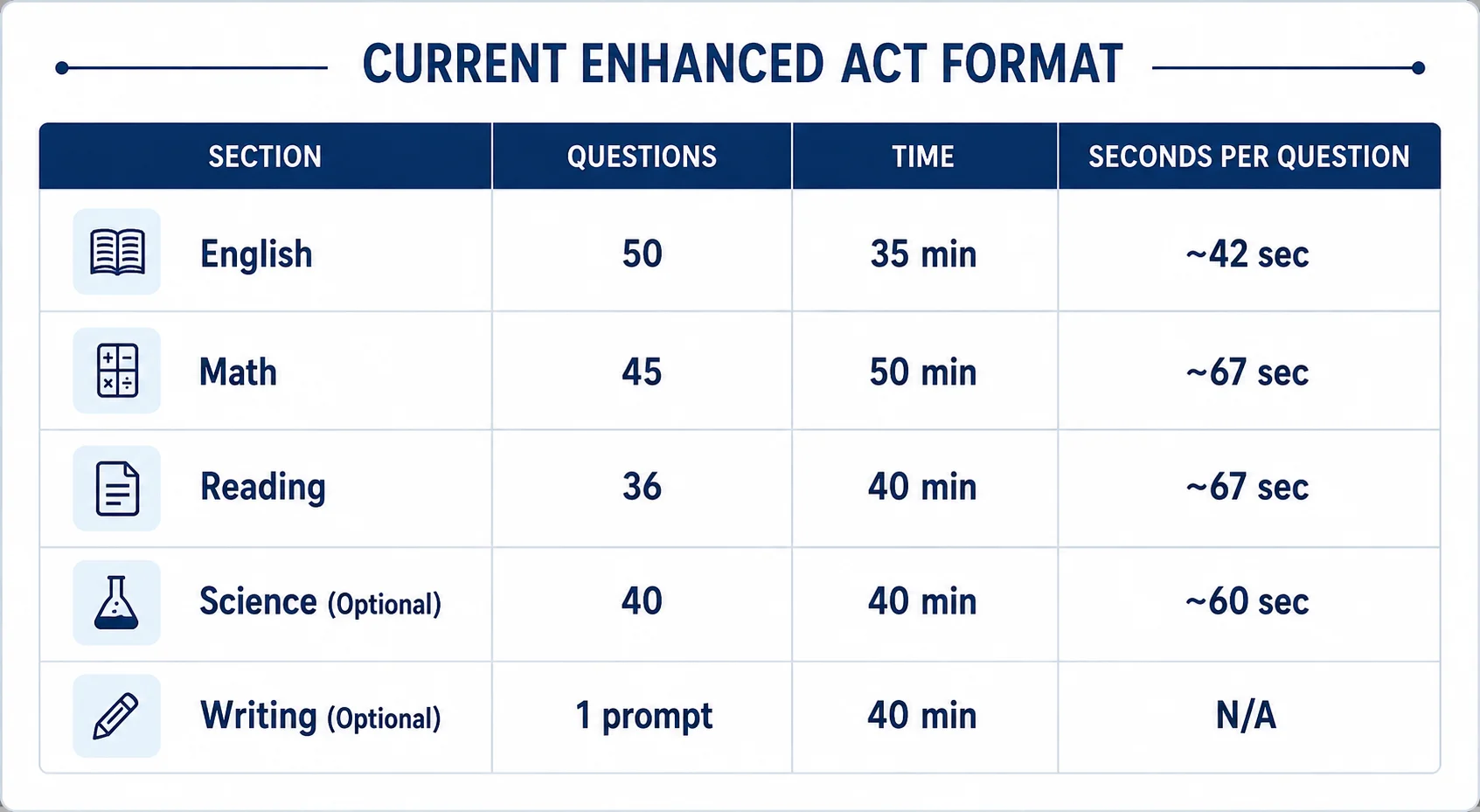
The ACT changed its format for 2025 and beyond. Science and Writing are now optional sections that do not affect your Composite score. The core sections are shorter and faster. If you've been practicing with old timing, you're carrying the wrong pacing assumptions into the test.
Here is the current ACT format, per ACT, Inc.:
Section | Questions | Time (minutes) | Optional? | Seconds per question |
|---|---|---|---|---|
English | 50 | 35 | No | 42 |
Math | 45 | 50 | No | 67 |
Reading | 36 | 40 | No | 67 |
Science | 40 | 40 | Yes | 60 |
Writing | 1 prompt | 40 | Yes | N/A |
The Composite score is the average of English, Math, and Reading only. Science and Writing are scored separately. For a deeper look at how section times compound across the full test, see the ACT timing guide.
Use question triage on every section
The ACT does not penalize you for skipping a question and returning to it. Use a three-pass approach on every section:
Now: Answer questions you can solve quickly and confidently.
Later: Circle questions that need more work and skip them.
Never: Some questions are not worth the time they'd take. Use your guess letter and move on.
This triage approach sounds simple, but most students don't practice it. They spend three minutes on a hard question early in a section and then rush the last eight questions they could have answered easily. Princeton Review calls it "Now/Later/Never," and it appears in most serious test prep for a reason: it works.
Never leave a blank
The ACT has no guessing penalty. A wrong answer and a blank both receive zero points. Pick one consistent two-letter combination before your test (A/F is common, since A is the first letter in rows 1 through 4 and F is the first in rows 5 through 9 on the answer sheet). Any time you hit a "Never" question, bubble your letter without hesitation and move on. Spending even 30 seconds on a question you can't solve costs you the next question you might have gotten right.
Use the process of elimination before you guess
Even a partial elimination changes your odds. If you can rule out two of four choices, you've gone from 25% to 50%. On questions that look challenging, spend 20 seconds eliminating the clearly wrong options before you commit to your guess letter. This single habit is worth several points to most students.
ACT English tips and tricks
The ACT English section tests a specific, finite set of grammar, punctuation, and rhetoric rules. The rules repeat. They are not testing everything you learned in high school English; they're cycling through the same question types at different difficulty levels. Once you can name the rule a question tests, the answer becomes predictable, not a matter of taste.
The most common English question types:
Subject-verb agreement
Pronoun agreement and case
Comma usage (especially with dependent clauses)
Semicolons and colons
Apostrophes and possessives
Parallel structure
Wordiness and redundancy
Transition words and logical order
Relevance (does a sentence belong?)
Work through the ACT grammar and punctuation rules so you know the exact categories. Once you've drilled them, your job on the English section changes from "which answer sounds right?" to "what rule is this testing?"
A worked example: Suppose a sentence reads: "The students, who studied every night, was exhausted by exam week." Four answer choices vary the verb. The rule being tested is subject-verb agreement. The subject is "students" (plural), so the verb must be "were," not "was." The intervening phrase "who studied every night" is a distractor. Students who answer by ear often pick the answer that sounds locally correct next to "night." Students who name the rule get this right every time.
Here's what Gracie Wallace, who graduated summa cum laude in English from Oglethorpe University and spent more than a decade as Lead SAT/ACT Teacher at The Learning Island, observes about the single mistake that costs students the most English points. Gracie has worked for over 5 years, and she says this pattern shows up in nearly every session.
You can also drill vocabulary in context using the ACT vocabulary tool to reinforce the word-choice and redundancy question types that appear throughout the section.
If English is your highest-leverage section, working with a specialist can make rule classification faster and drilling more targeted. You can browse ACT tutors to find one whose background matches your specific gaps.
ACT Math tips and tricks
The ACT Math section covers pre-algebra through basic trigonometry. No formula sheet is provided. Most of the concepts are things you've already learned; the section tests whether you can recall them quickly and accurately under time pressure.
The most commonly tested Math topics:
Pre-algebra and algebra (proportions, linear equations, inequalities)
Geometry (area, perimeter, angles, coordinate geometry)
Functions and basic statistics
Trigonometry (basic ratios, unit circle)
Review the free ACT math formula sheet before your next practice test. The formulas you'll need most often (slope, area, the Pythagorean theorem, and basic trig identities) should come back immediately under time pressure. If any of them take more than two seconds to recall, add them to a flash-card drill.
The ACT's calculator policy allows calculators on the Math section only. Know which models are permitted and bring one you've practiced with, not a borrowed one you haven't.
Isaiah Fuji Brensihan studied computer science at Harvey Mudd College and has spent more than nine years tutoring ACT Math, Calculus, Physics, and computer science. His students often arrive knowing the material but still finishing the section with unanswered questions. In his experience, the problem isn't the math.
The practical application of Isaiah's point: in your first pass through the section, answer everything that comes quickly. On your second pass, return to the questions you marked. On your third pass, use your guess letter on anything remaining. A student who answers 38 of 45 questions correctly and guesses on the rest will almost always outscore a student who attempts all 45 in order and rushes the last eight.
If you want to work through the Math section with someone who specializes in ACT pacing, explore our ACT tutors.
ACT Reading tips and tricks
The Reading section gives you 36 questions in 40 minutes, covering four passages: literary narrative, social science, humanities, and natural science. That's about 67 seconds per question, which feels tight when you've also spent time on the passage.
The key pacing decision: Most students read the passage fully, then answer questions. That approach works for some people and fails for others. Try both of these methods on practice tests and track which produces more correct answers per minute.
Passage-first: Read the full passage, then answer questions. Works well for literary narrative, where inference questions require context.
Questions-first for detail items: Skim the passage structure, answer the direct-evidence questions first, then return to inference questions. Works well for the social science and natural science passages, where most questions send you back to a specific paragraph anyway.
Structural reading habits that improve Reading scores:
Read topic sentences of each paragraph before the full passage.
Note the function of each paragraph (argument, counterargument, evidence, conclusion) as you go.
Mark line numbers when you see specific facts or transitions.
Use the passage order for your Now/Later/Never triage: answer detail questions (which cite a line) on the first pass, inference questions on the second.
The most common Reading mistake is spending too long on the first passage and rushing the last two. Time yourself by passage: 10 minutes per passage leaves time to check answers at the end. If you find yourself regularly going over on one passage type, prioritize it for your next practice session.
For a full breakdown of Reading section timing, see the ACT timing guide.
ACT Science tips and tricks
Is the ACT Science section optional?
Yes. In the current ACT format, Science is an optional add-on and does not affect your Composite score. Whether to take it depends on your target schools' requirements. If a school you're applying to requires or strongly recommends the Science section, take it. If not, check the admissions requirements before deciding. See the full breakdown of what changed with the ACT Science section.
If you do take Science, here's what the section actually tests.
Sal Carlson is a rising senior at Duke University studying Biology, Marine Science, and Conservation. He scored 520 on the MCAT, placing him in the 97th percentile, carries a 4.0 GPA, and conducts research in the Somarelli Lab. He has worked with 40+ students on 3 years of ACT prep, and his advice to every student who feels anxious about the Science section is the same thing he tells his pre-med peers.
Sal's point holds up in the data. The vast majority of ACT Science questions ask you to read a value off a graph, compare two data sets, or identify what a table shows. They do not require you to know biology, chemistry, or physics from memory. A student who has never taken an advanced science class can score well in this section if she reads figures quickly and accurately.
The Science data-first method:
Scan the figure titles and axis labels before you read the passage text.
Note the variables being measured and what the trend lines show.
Read the question and go straight to the relevant figure.
Use the passage text only when a question asks you to interpret a conflicting viewpoint or to evaluate a hypothesis.
Time pressure is the main enemy in Science. The passage text is usually long and detailed, and reading it fully before answering questions costs you five to eight minutes you don't have. Go to the figures first on every data representation set.
If Science is your section or you need help reading scientific arguments under time pressure, browse our ACT tutors to find someone with a strong science background.
ACT writing tips for the optional essay
The ACT Writing test is optional and scored separately from your Composite. If your target schools require or recommend it, take it. If they don't, there's no reason it should affect your preparation for the core sections.
The Writing section gives you 40 minutes to write a persuasive essay in response to a prompt that presents three perspectives on a social issue. You're expected to develop your own position and analyze how it relates to at least one of the three given perspectives.
The core structure that works under time pressure:
Paragraph 1 (Introduction): State your position clearly. Don't hedge. Pick a side and commit.
Paragraph 2: Develop your argument with a specific example or reason.
Paragraph 3: Address one of the three given perspectives, either by agreeing with it, disagreeing with it, or refining it.
Paragraph 4 (Conclusion): Restate your position in light of the analysis above.
Graders are looking for a clear claim, organized development, and specific reasoning. A well-organized essay that commits to a position almost always outscores a more sophisticated essay that hedges or stalls. Spend the first three minutes outlining and the last two minutes proofreading.
The ACT Writing test score appears on your score report but does not change your 1 to 36 Composite. Check the current ACT format on act.org to confirm your target schools' requirements before registering.
Last-minute ACT tips for the final days
The 72 hours before your ACT test are not the time for new material. Students who discover a topic they haven't studied and try to master it the night before the test almost always hurt their performance. What you've built over your prep cycle is what you bring in.
Here's what to do in the final three days:
72 hours out:
Do one short, timed section drill (one section only) to keep your timing calibrated.
Review your error log from the last full practice test. Look at the patterns, not every individual question.
Confirm your test center location and travel time.
24 hours out:
Do no timed practice. Your brain needs recovery, not more input.
Lay out everything you need for test day: admission ticket, acceptable photo ID, approved calculator and fresh batteries, No. 2 pencils, snacks, water.
Go to sleep at a normal time. Staying up late to review guarantees fatigue and costs you more points than any review would gain.
The night before:
Avoid a heavy meal or alcohol (for older students).
Screen time before bed raises cortisol and disrupts sleep. Read a book instead.
Remind yourself that your prep is done. The work is already in the bank.
ACT test-day tips: what to bring and how to pace yourself
What to bring on test day
According to ACT's official test-day checklist, you need:
Item | Notes |
|---|---|
Admission ticket | Print or access digitally per your test center's instructions |
Acceptable photo ID | School ID, passport, or government-issued ID |
No. 2 pencils | Several sharpened; bring extras |
Approved calculator | Check the ACT calculator policy; no phones |
Snacks and water | For breaks |
Watch (non-smart) | Optional but useful for pacing; phones must be off |
Do not bring a phone out during the test. It will be confiscated and your scores may be canceled.
How to pace yourself on test day
Your pacing plan should already be built from your practice tests, not invented on the day. These reminders apply to every section:
Glance at your watch at the midpoint of each section. If you're behind, accelerate your "Now" pass and be more aggressive about triage.
If you finish a section early, go back to your "Later" questions first, then check your "Now" answers.
Don't change an answer unless you have a specific reason. First-instinct answers are correct more often than second-guessed ones.
Between sections, take a breath. Each section resets the clock.
For the full expert ACT tutoring process at NAT, including how tutors use the Composite Precision Method to build session-by-session prep plans, the ACT hub explains it in detail.
Conclusion
The ACT tips and tricks that actually move scores follow a consistent order. Start with a timed official practice test and a real leak map. Then fix your weakest section first, using current-format pacing and the question-triage method on every section. Section-specific work, whether that's naming grammar rules in English, allocating time by difficulty in Math, reading figures before passages in Science, or choosing your Reading passage order, stacks on top of that diagnostic foundation.
Most students skip the diagnostic and go straight to drilling. That's the difference between prep that plateaus and prep that produces a measurable composite gain.
If you want to know exactly which section is holding your composite down, and leave with a written plan for what to fix first, book a free ACT strategy session. Sessions are one-on-one, there's no long-term commitment required, and you can change tutors if the fit isn't right. The session takes about an hour; the leak report you walk away with is yours to keep.