What Is the ACT Test? Sections, Questions, Scoring & More
Introduction
Ask three people how many questions are on the ACT, and you'll get three answers: 215, 131, or "wait, isn't Science optional now?" All three people are partially right about different versions of the same test.
That's the core confusion. The ACT changed its format in 2025, and most of the internet hasn't caught up yet. If you've been researching the ACT and getting contradictory information, you're not missing something. You're just finding stale content.
Here's what most "what is the ACT" guides miss: the test you're looking at today is shorter, more modular, and scored differently than the test described in the top Google results. The composite score no longer averages four sections. Science is now an add-on you choose.
Our tutors at North American Tutors have scored 36 on the ACT and work with students preparing for the current format every week. In this guide, we'll explain what the ACT is, what changed in 2025, how many questions it has, how it's scored, what it costs, and whether you still need to take it.
What Is the ACT Exam?
The ACT is a standardized college admissions test accepted by 100% of U.S. colleges. Administered by ACT, Inc. since 1959, it measures college readiness in English, math, and reading, with optional science and writing sections, scored on a 1–36 composite scale. Roughly 2 million students take it each year.
The full original name was American College Testing. ACT, Inc. quietly dropped the spelled-out name in 1996, and the test has been known simply as the ACT ever since. The company that makes it is technically a not-for-profit organization headquartered in Iowa City, Iowa, and it's been running this test since the Space Age.
What exactly does the ACT measure? It does not measure raw intelligence or subject-specific knowledge that you could memorize from a textbook. The ACT tests the academic skills colleges expect you to bring on day one: how well you analyze written passages, apply mathematical reasoning, interpret data, and construct a logical argument. It's a readiness signal, not a report card.
The ACT is accepted at 100% of U.S. four-year colleges, and it's used as a criterion for over 10,000 score-based scholarships. That's the practical reason millions of students take it each year.
What Changed in the 2025 ACT?
Since September 2025, the ACT has three required sections (English, Math, and Reading); an optional Science section that doesn't affect your composite; and an optional Writing essay. The test is roughly 50 minutes shorter at its core than it used to be, and online testing with faster score release is now available in more markets.
If you've been reading conflicting things about the ACT, here's the reason: most major prep sites describe a test that no longer exists. The table below shows what actually changed.
Feature | Legacy ACT (pre-2025) | Current ACT (Sept 2025+) |
|---|---|---|
Required sections | English, Math, Reading, Science | English, Math, Reading |
Science status | Required (4th core section) | Optional add-on |
Total core questions | 215 | 131 |
Questions with Science | 215 | 171 |
Core test time | 2h 55m | 2h 05m |
Composite score | Average of E + M + R + Science | Average of E + M + R only |
Writing (essay) | Optional add-on | Still optional add-on |
Testing format | Paper only | Paper + online (select markets) |
Score release | 2–8 weeks | Faster (online: select markets) |
The single most important change: Science no longer counts toward your composite. If a college sees a 31 composite on your score report, that 31 came from your English, Math, and Reading performance alone. Your Science score appears separately.
For a deeper look at the Science change and which colleges still want it, see our full guide on the Science section now being optional.
How Many Questions Are on the ACT?
The current ACT has 131 questions across three required sections: 50 English, 45 Math, and 36 Reading. Adding the optional Science section brings the total to 171 questions. The optional Writing section adds one essay prompt. The previous ACT had 215 questions, a figure you'll still see on most prep sites, but one that hasn't applied since September 2025.
Here's the full breakdown, including the field-test (unscored) questions that almost no guide mentions:
Section | Status | Total Questions | Scored (Operational) | Unscored (Field-test) | Time | Seconds per Question |
|---|---|---|---|---|---|---|
English | Required | 50 | 40 | 10 | 35 min | 42 sec |
Math | Required | 45 | 41 | 4 | 50 min | 67 sec |
Reading | Required | 36 | 27 | 9 | 40 min | 67 sec |
Core Total | 131 | 108 | 23 | 2h 05m | ||
Science | Optional | 40 | 34 | 6 | 40 min | 60 sec |
With Science | 171 | 142 | 29 | 2h 45m | ||
Writing | Optional | 1 essay | 1 | 0 | 40 min | , |
A note on field-test questions: ACT, Inc. embeds a handful of unscored questions in each section to test potential future questions. You can't tell which ones they are during the test. They don't affect your score, and there's no guessing penalty on the ACT, so answer every single question.
Maya Campbell, who tutors students targeting 32+ on the ACT, explains:
How Long Is the ACT?
The core ACT takes 2 hours and 5 minutes. Adding the optional Science section brings it to 2 hours and 45 minutes. Adding both Science and Writing brings the total test time to approximately 3 hours and 25 minutes, not counting check-in time and breaks.
Configuration | Sections | Test Time |
|---|---|---|
Core only | English + Math + Reading | 2h 05m |
Core + Science | + Science | 2h 45m |
Core + Science + Writing | + Writing | ~3h 25m |
Core + Writing (no Science) | + Writing | ~2h 45m |
When test-day logistics are included (check-in, instructions, breaks), most students are at the testing center for 3.5–4 hours, even for the core-only version.
One practical implication: the new ACT is measurably shorter than it used to be. For students who struggle with test-day stamina, the core-only version is now a genuine option without sacrificing their composite score. That's a meaningful shift from the old format.
How Is the ACT Scored?
The ACT composite score is the average of your English, Math, and Reading section scores, rounded to the nearest whole number, on a 1–36 scale. Science is scored separately and does not affect the composite. There is no penalty for wrong answers, so you should answer every question.
Here's exactly what your ACT score report includes:
Score Type | What It Covers | Scale |
|---|---|---|
Composite | Average of English + Math + Reading | 1–36 |
English section score | Grammar, usage, rhetoric | 1–36 |
Math section score | Algebra, geometry, statistics, trig | 1–36 |
Reading section score | Passage analysis, inference | 1–36 |
Science section score (if taken) | Data interpretation, scientific reasoning | 1–36 |
STEM score | Average of Math + Science (if taken) | 1–36 |
ELA score | Average of English + Reading + Writing (if taken) | 1–36 |
Writing score (if taken) | Essay analysis | 2–12 |
Superscore | Highest section scores across multiple test dates | 1–36 |
Superscore is worth understanding before you sign up. Many colleges will take your highest English score from one test date, your highest Math from another, and so on, then calculate your best possible composite. That changes the retake calculus entirely: instead of hoping to improve everything in one day, you can strategically target your weakest section.
The national average ACT composite is 19.4. ACT, Inc. also publishes College and Career Readiness Benchmarks, which represent the minimum score in each section associated with a 50% chance of earning a B or higher in a first-year college course. Those benchmarks are built from data from 214 institutions and over 230,000 students.
Isaiah Fujii Bresnihan, who scored 36 on the ACT and tutors students at Harvey Mudd, explains:
For a full explanation of the scoring system, scoring tables, and score-to-percentile conversions, see our complete guide on how the ACT is scored.
How Much Does It Cost?
The ACT costs $68 for the core test (English, Math, and Reading) as of the 2025–2026 testing year. Adding the Science section costs an additional $4. Adding the Writing essay costs an additional $25. Late registration adds roughly $36 to any configuration.
Configuration | Base Price |
|---|---|
Core (English + Math + Reading) | $68 |
Core + Science | $72 |
Core + Writing | $93 |
Core + Science + Writing | $97 |
Late registration fee | +~$36 |
Students who qualify for financial need can apply for an ACT fee waiver through their school counselor, which covers the full registration cost for eligible juniors and seniors. Check the ACT registration page for current dates, deadlines, and waiver eligibility.
One number to flag: fee structures change year to year. Verify the exact fees on act.org when you register. The $63 fee you'll see on several major prep sites hasn't been accurate in years.
Do You Still Need to Take It?
Not always, but usually yes if you want maximum college options and scholarship access. The test-optional movement expanded significantly after 2020, but the ACT still matters for a large and specific subset of students.
Here's an honest breakdown:
Profile | ACT Recommendation |
|---|---|
Applying to test-optional schools only | Optional, but a strong score helps |
Applying to schools that still require standardized tests | Required, no workaround |
Applying to military academies (USNA, USAFA) | Required |
Targeting score-based merit scholarships | Strong recommendation to take it |
Applying to schools that recommend (not require) scores | Worth taking if you score competitively |
International students applying to U.S. colleges | Usually required or strongly recommended |
Over 800 colleges remain test-optional, but test-optional doesn't mean test-blind. Most of those schools will still consider scores if you submit them. A composite above the school's median admitted-student score is rarely a negative.
The other factor most students overlook: merit scholarships. Many automatic scholarship programs at state universities are tied to ACT score thresholds. A student who skips the ACT because their school is test-optional might miss out on tens of thousands of scholarship dollars.
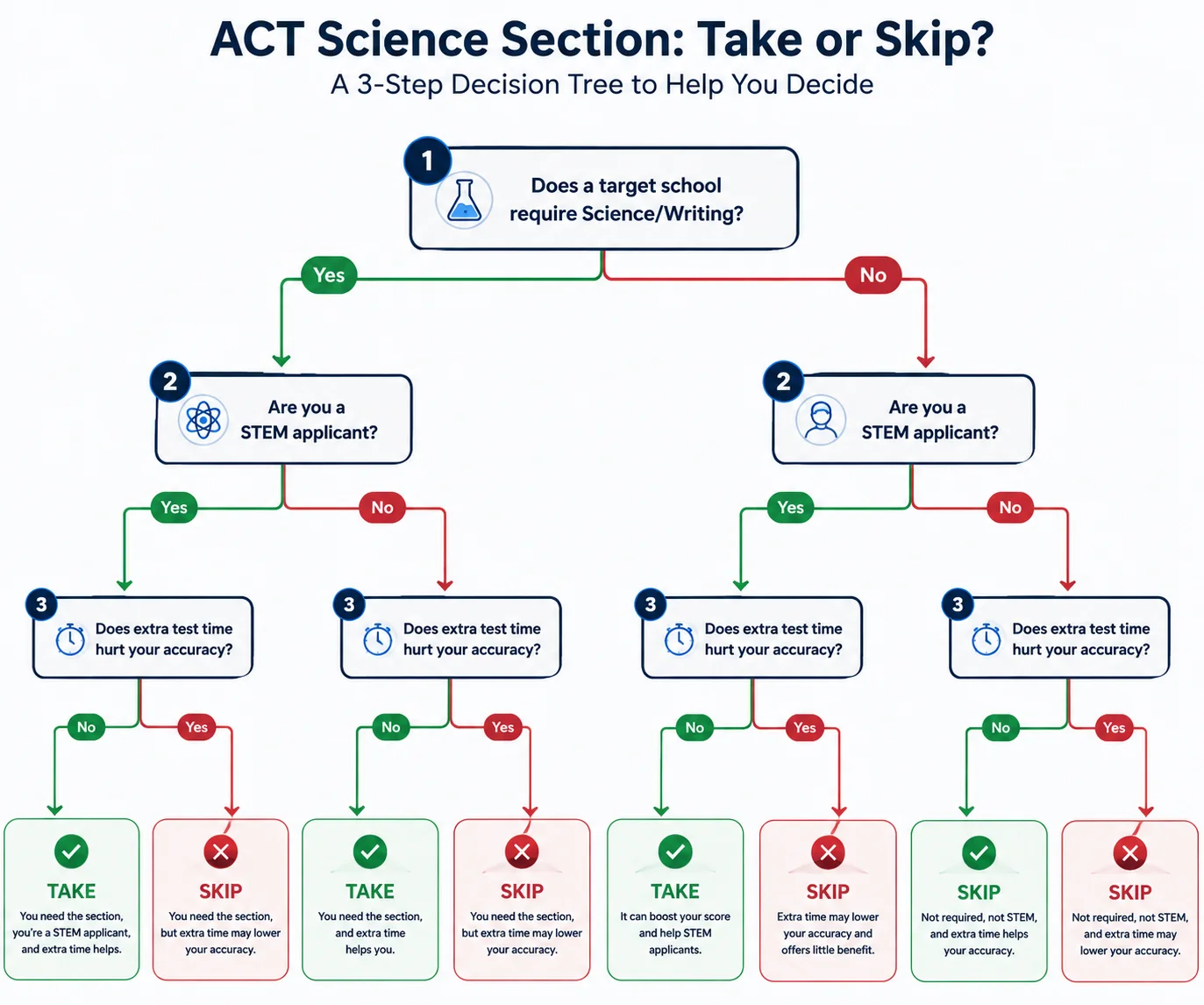
Should You Take Science and Writing? The ACT Choice Framework
The ACT is now modular. You choose your configuration on registration day, not on test day, so this decision needs to happen before you sign up, not after.
Use this three-question framework to decide:
The ACT Choice Framework
Question 1: Do any of your target colleges require or recommend a Science or Writing score?
Some schools go beyond the composite. Boston University, Georgetown, and the U.S. Naval and Air Force Academies require the ACT Science section. Schools like Duke, Johns Hopkins, and the University of Michigan have recommended it. Check each school on your list against our guide on the Science section being now optional, and tracks current policies. If any target school requires Science, register with Science. The answer to Question 1 overrides everything else.
Question 2: Are you a STEM applicant or pursuing scholarships that use section scores?
If you're applying to engineering programs, pre-med tracks, or institutions where a strong STEM score strengthens your application, adding Science for $4 is almost always worth it. At just four dollars above the base registration fee, it's the cheapest additional credential you can add to your application.
Question 3: Would a shorter test meaningfully improve your pacing and accuracy on the core sections?
Some students genuinely test better when the finish line is closer. If you've taken practice tests and found that your Reading and English scores drop significantly in the final stretch of a long session, the core-only format may produce a better composite, even without Science.
Aryan Waghmode, who scored 36 on the ACT and tutors students at Johns Hopkins, explains:
For Writing: unless a target school specifically asks for it, the Writing essay is less widely used than it was five years ago. Check your school list. When in doubt, skip Writing and direct your prep time toward the three sections that build your composite.
How Is the ACT Different from the SAT?
The ACT and the SAT test similar academic skills but in different formats, and neither is objectively harder. The ACT is scored 1–36; the SAT is scored 400–1600 by the College Board. The ACT has a Science section (now optional); the SAT does not. The digital SAT is adaptive and shorter; the ACT is still a fixed-format test.
Feature | ACT | SAT |
|---|---|---|
Score scale | 1–36 | 400–1600 |
Administrator | ACT, Inc. | College Board |
Required sections | English, Math, Reading | Reading and Writing; Math |
Optional sections | Science, Writing | None |
Format | Paper + limited online | Digital (adaptive) |
Time (core) | 2h 05m | 2h 14m |
Frequency | 7 times per year | 7 times per year |
Calculator policy | Permitted on Math | Permitted (all Math) |
Science reasoning tested? | Yes (optional) | No |
The most honest advice: take a full-length practice version of both, then prep for the one where your raw, unprepped score is higher. That score gap almost always widens with prep rather than closes. For a complete breakdown of both tests, see our guide on SAT vs ACT.
How to Get Ready (and Get a Great Score)
Most students start ACT prep the wrong way: they buy a book, read it, and then take a practice test. That's backward. The practice test should come first.
Here's the approach our 36-scoring ACT tutors use with every new student:
Step 1: Take a full-length official practice test first. Download one from act.org's free practice test page. No prep beforehand. You need an honest baseline, not an inflated one.
Step 2: Target your weakest required section. Your composite is the average of English, Math, and Reading. A four-point jump in Math matters more than a one-point jump in each section. Use your practice test results to identify where you're losing the most points, and build your prep plan around that section first.
Step 3: Build a structured plan. Generic studying leads to generic improvement. If you're targeting a specific score for a particular school or scholarship, work backward from that goal. Our free ACT resources include practice sets, timing drills, and section-specific guides. If you want personalized guidance, one-on-one ACT tutoring with a tutor who's scored 36 is the fastest way to close the gap.
Across our students, structured tutoring leads to an average composite improvement of over 5 points. That's not a marketing claim; it's the pattern we see consistently when students commit to targeting their weakest required section rather than reviewing the whole test at once.
Conclusion
Here's what the current ACT actually looks like: 131 questions at its core, three required sections, an optional Science add-on for $4, a 1–36 composite that now averages English, Math, and Reading only, and a national average of 19.4. About 2 million students take it each year, and every four-year U.S. college accepts it.
The internet is full of 215-question advice that doesn't apply anymore. This guide is built on the current test, verified against the source.
If you're ready to build a real prep plan, schedule a free consultation with a NAT tutor. You'll leave the first session with a target score, a section-specific strategy, and a clear timeline.