What Top Colleges Actually Look for in Academic Extracurriculars
Key Points
Colleges read academic extracurriculars for depth, ownership, fit with the rest of the application, and impact. The number of activities barely registers.
The Common Application gives students ten activity slots. MIT asks for four. Neither number is a target to hit.
Owning a project beats contributing to one, and it's the fastest available upgrade to most activity lists.
Academic extracurriculars don't replace test scores. Admissions officers weigh both, and a strong project alongside a strong score is the combination that works.
The short version: colleges are looking for a few activities a student has stayed with long enough to get genuinely good at, took real ownership of, and can connect to the rest of the application. Quantity doesn't do much on its own. A reader can usually tell within seconds whether a student built something or just showed up.
The Myth: More Activities Are Always Better
Almost every family starts in the same place. If ten activities are good, twelve must be better, so the goal becomes filling every line on the application.
The application itself disagrees. The Common Application gives students ten activity slots, and MIT asks applicants to describe only the four activities that matter most to them.Those caps aren't administrative housekeeping. They're a signal that selective schools would rather see a short list a student can talk about with real authority than a long one they can't.
The numbers make the same case. Common Application members received more than 10.1 million first-year applications in the 2024-25 season, up 8% over the year before, with students applying to more schools than ever. When nearly everyone in the pool turns in a full activity list, length stops telling admissions officers anything. What happened inside those activities becomes the whole story. Our breakdown of the 5 best extracurriculars for Ivy League admissions shows exactly what that looks like in practice.
What Colleges Are Actually Reading For
Four things do most of the work.
1. Depth
Depth is time plus progression. Two years in one subject, with visible movement from beginner toward something closer to practitioner, reads very differently from six months each across four unrelated clubs.
Depth is also what makes everything else in the application possible. A student who has spent eighteen months on one research question has something specific to write about, and a teacher or mentor who can write a recommendation with actual detail in it. A long list of memberships rarely produces either.
Here's a test we use with our own students: could you talk about this activity for fifteen minutes with someone who works in the field, and tell them something they didn't already know? If not, it's probably still at the participation stage.
2. Ownership and Initiative
This is the fastest way to strengthen an activity list, and it's the one most students skip.
Contributing to a project means somebody else decided what the problem was, when it was due, and what finished looked like. Owning a project means the student made those calls. Colleges read for that difference constantly, because it's the closest thing they have to a preview of how a student will behave on a campus where nobody assigns the work.
Contributing | Owning |
Joined the school science club | Started a research group and recruited five members |
Volunteered at a tutoring center | Designed a math curriculum the center still uses |
Attended a coding bootcamp | Built and shipped an app that has real users |
Helped out with a professor's study | Wrote an original paper as sole first author |
Ownership doesn't mean founding a nonprofit. It means being the person who decided what the work was for.
3. Connection to the Rest of the Application
Admissions officers read an application as one document, not a stack of separate sections. The activities, the intended major, the essays, and the recommendations either point somewhere together or they don't.
We think of that as the application persona: the two or three words a reader would use to describe a student after closing the file. A student with a research project in environmental economics, a policy-focused essay, and a summer at a local planning office has one. A student with a debate award, a robotics club, a hospital volunteer shift, and an intended major in classics has four unrelated facts.
Coherent doesn't mean narrow. Interests can be interdisciplinary, unusual, hard to categorize. They just have to be recognizably the student's own, which is why chasing whatever looks impressive tends to backfire. It produces a file that could belong to anyone. For a fuller picture of how admissions officers weigh all the pieces together, see NAT's guide on how to get into the Ivy Leagues.
4. Impact
The last question a reader asks is the simplest one: did this matter to anybody besides the student?
The practical way to check: for each activity, write down what would be different if your student had never done it. Anywhere the honest answer is "nothing," that's an activity to either go deeper on or let go. NAT's free college admissions calculator can also help you assess how your extracurricular profile stacks up against the activity scores that Ivy League readers actually respond to.
The practical way to check: for each activity, write down what would be different if your student had never done it. Anywhere the honest answer is "nothing," that's an activity to either go deeper on or let go.
Academic Extracurriculars Don't Replace Test Scores
This one deserves saying out loud, because a lot of extracurricular advice quietly implies otherwise.
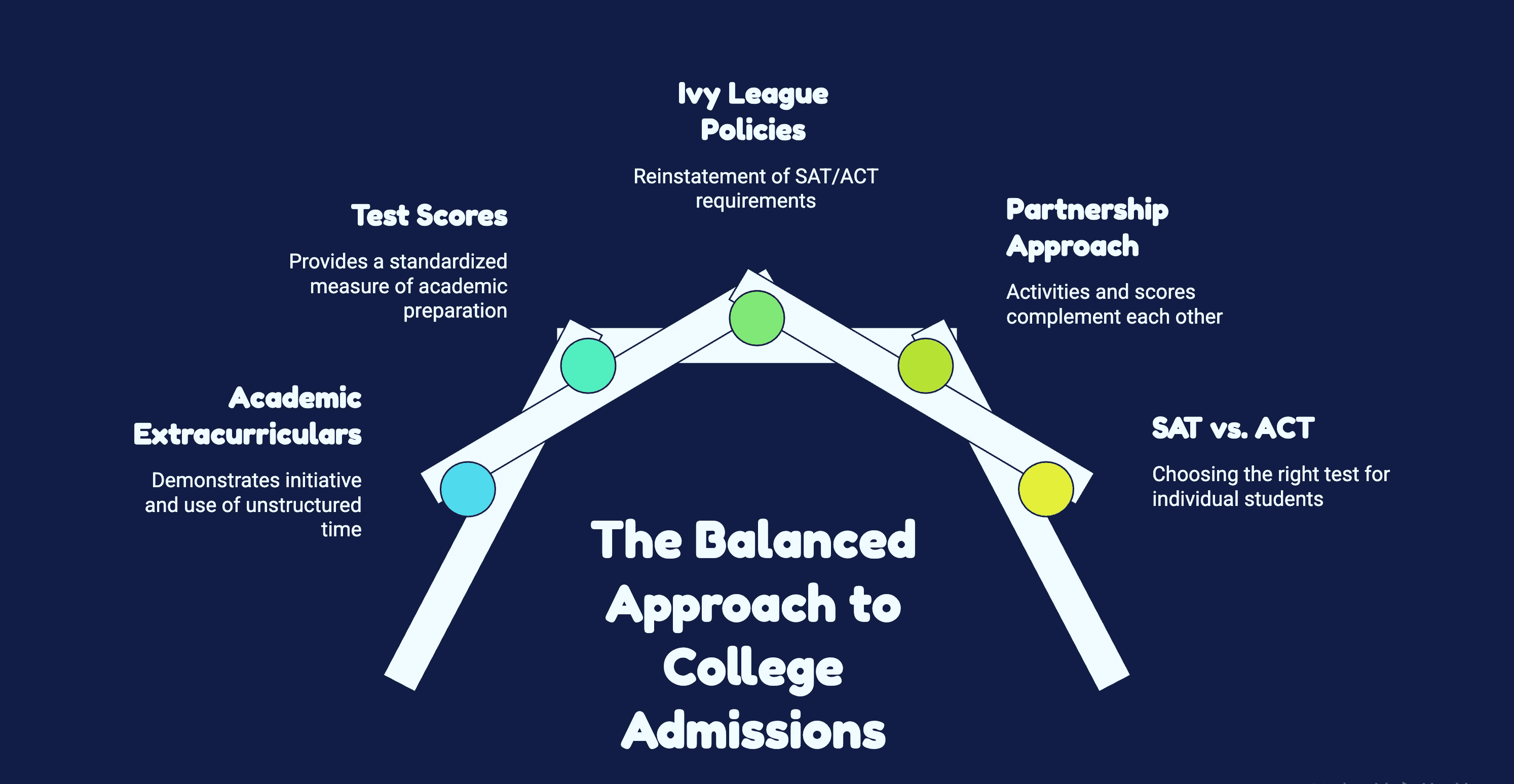
Strong activities and strong scores answer different questions. Extracurriculars show what a student does with unstructured time and their own initiative. A test score gives admissions officers a standardized read on academic preparation, one they can compare across thousands of high schools that grade very differently. Officers weigh both, and no research portfolio offsets a score sitting outside a school's range. For a direct look at what do extracurriculars matter more than grades actually means in admissions, NAT's post on that question walks through the research clearly.
The landscape has moved on this, fast. Every Ivy League university has now returned to requiring the SAT or ACT, with Columbia the last to announce the change, pointing to a multi-year faculty review that found scores to be a useful indicator of student success. [3] If your student is in the Class of 2028 or later, plan on testing as a requirement rather than a choice.
The way we'd frame it for families: activities and scores are partners, not substitutes. A deep, original project makes a strong score mean something, because it shows what the student does with that ability. A strong score makes the project credible, because it confirms the academic foundation underneath it. If you're deciding between the SAT and ACT, NAT's SAT vs. ACT comparison breaks down which test fits which type of student.
For the testing half of that equation, you're in the right place. North American Tutors works one-on-one with students on the SAT, ACT, PSAT, AP, and IB, building a plan around where a student is starting and where they're trying to go. Getting testing handled early also frees up junior year for exactly the kind of sustained project work that admissions readers respond to.
Where Scholar Launch Comes In
Depth, ownership, coherence, impact. Easy to describe, genuinely hard to build on your own. Most students don't have a professor who will mentor them, a research methodology to follow, or a realistic path to a finished piece of work.
That's the gap we built Scholar Launch to close. Our students work directly with professors and scholars from top universities across STEM, the social sciences, business, the humanities, and the arts, in one-on-one or small group formats. Over a program, a student moves from a broad interest to a real research question to an original paper they own outright and can submit for publication as sole first author.
The useful part is that the process produces all four qualities at once. The timeline builds depth. The question belongs to the student, which is ownership. The topic is chosen to fit where they're headed academically, which is the persona piece. The finished paper, and often a recommendation letter from the professor who supervised it, is the impact.
We'll say the same thing here we say to our own families: the best program isn't the one with the most impressive-sounding title. It's the one built around a question your student actually wants to spend a few months answering. Admissions officers can tell the difference.
One Real Project Beats Five More Clubs
If your student is deciding between adding a fifth club and going deep on one real project, take the project nearly every time. It's the harder choice, which is exactly why it stands out.
Curious where their interests might lead? Our Research Interest Exploration Program is built for students who aren't locked into a direction yet. If they already know what they want to dig into, you can start an application or reach out to us about which format fits their grade level and timeline. Admission is rolling, and individual programs do fill.