Free ACT Science Practice Questions & Cheat Sheet (Printable PDF)
No signup needed. Just click to download
Click to download the free 40-question ACT Science practice set and one-page strategy cheat sheet. No email. No signup. Just download and start.
Students who plateau on ACT Science almost always describe the same problem: they know the science material, but their scores still stay the same. A parent will say their child reviewed biology notes for weeks and moved two points. A student will say they ran through four practice tests and can't figure out what they keep missing.
Here's what most prep resources don't say clearly: ACT Science is not a science content test. It's a graph-reading and speed test that happens to use scientific passages. Most missed questions trace back to one of four diagnosable errors, not to gaps in biology or chemistry knowledge.
NAT's ACT tutors have scored 35 and 36 on the ACT. One student, Everleigh, improved her Science score from 22 to 32 by making sure every answer was based on specific data from the passage, rather than just reviewing content. NAT reports an average ACT composite gain of 5 points or more.
This guide explains the current Enhanced ACT Science format, the new optional rules from 2025, and includes six sample practice questions from all three passage types. You'll also get a one-page strategy cheat sheet, the four-error framework NAT tutors use to find out why students miss questions, a three-step practice method, score context for STEM, and answers to the most common student questions.
What's inside this free ACT Science practice pack
You will receive three resources in this download. All are free and do not require signup.
40-question ACT Science practice set (PDF). The questions cover all three passage types in about the same proportion as the real Enhanced ACT: three Data Representation passages, two Research Summaries, and one Conflicting Viewpoints. A 40-minute timing guide is included so you can use it as a timed section.
Answer key with worked explanations (PDF). Each question comes with a step-by-step solution and an error-type tag, not just the final answer. Wrong answer choices are explained, since understanding why B is wrong can be more helpful than just knowing why C is right.
One-page strategy cheat sheet (PDF). This is a strategy and process guide, not a list of science facts. It covers the 3-passage reading routine, the four error types and how to fix them, a Conflicting Viewpoints mapping template, five common traps to watch for, a 40-minute pacing plan, and a reminder to answer every question.
For a full-length official practice experience alongside this diagnostic set, ACT.org's free prep tools include official sample questions and a complete prep guide. Using official material for full-length timed runs and this set for error-diagnosis practice gives you both scoring validity and diagnostic detail.
ACT Science is now optional. Here's the current format.
Before you start the practice set, make sure you know the current rules. Many prep materials still use the old version of the test, and practicing with the wrong format can hurt your score calibration.
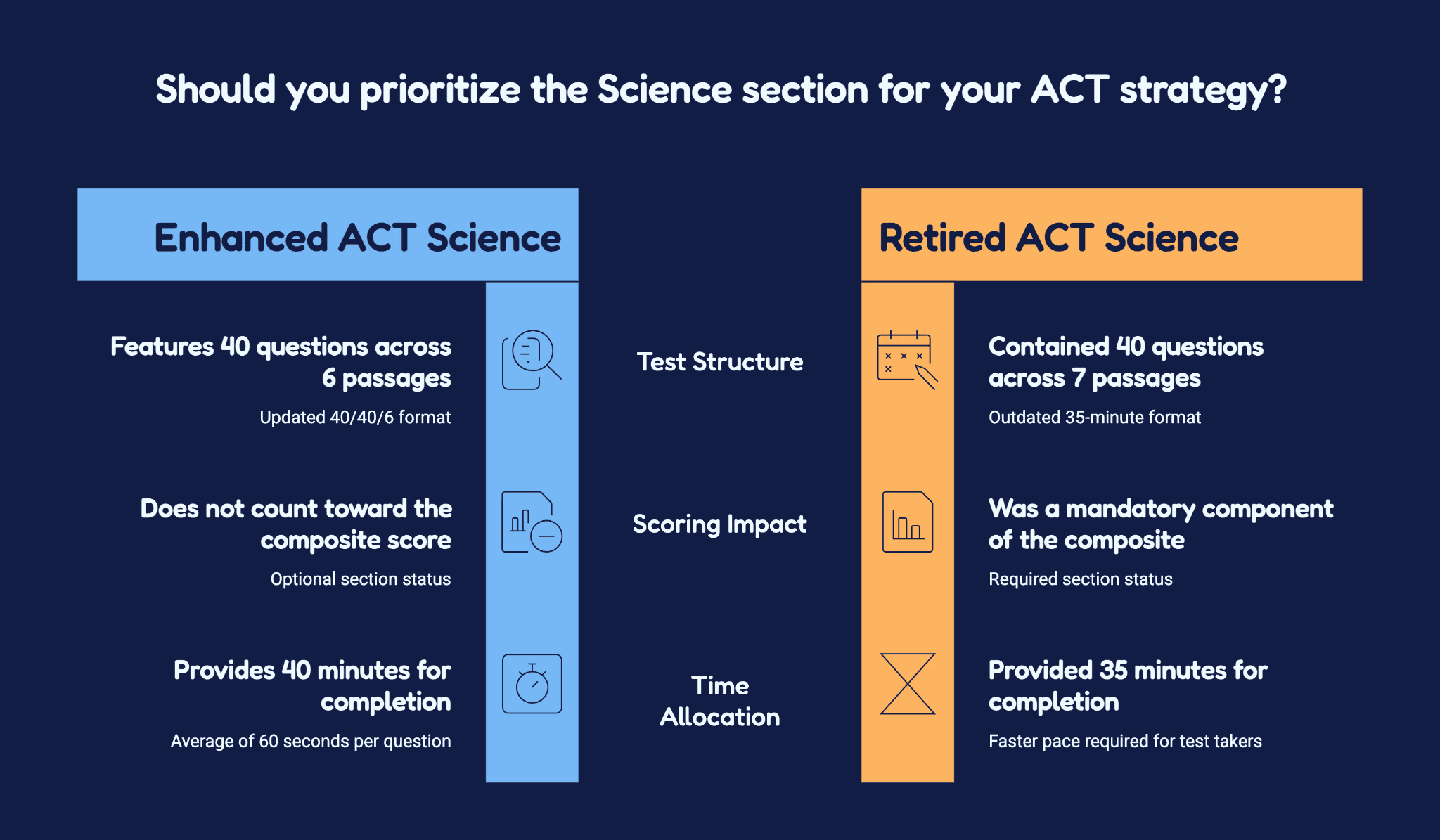
ACT Science became optional with the Enhanced ACT rollout, digital tests starting in spring 2025, and paper tests starting in September 2025. It no longer counts toward the composite score. The composite is the average of English, Math, and Reading only. If you choose to take Science, you receive a separate 1-36 Science score and a STEM score combining Math and Science.
For a full breakdown of the 2025 changes and a framework for deciding whether to take the optional section, NAT's guide to the 2025 ACT Science changes covers the policy in detail.
Current Enhanced ACT Science format at a glance:
Feature | Current Enhanced ACT |
|---|---|
Optional? | Yes (since spring 2025 digital; Sept 2025 paper) |
Total questions | 40 |
Time allowed | 40 minutes |
Operational passages | 6 |
Average time per question | ~60 seconds |
Calculator permitted? | No |
Wrong-answer penalty? | No |
Counts toward composite? | No |
Reported score | Separate 1-36 Science score |
STEM score | Math + Science combined (when Science is taken) |
If your prep materials say "35 minutes" and "7 passages," they describe the retired format. Everything in this guide and the downloadable PDFs reflects the current 40/40/6 format.
For more details on the Enhanced ACT structure and help deciding if the Science section fits your goals, check out NAT's ACT Science section guide. If you are deciding between the SAT and ACT for STEM programs, the digital SAT vs. ACT for STEM comparison covers both options.
What does ACT Science actually test?
The biggest misconception about ACT Science is the one that wastes the most study time: the belief that reviewing biology, chemistry, and physics content will move the score.
Usually, it will not.
Uju Kim scored a 35 on the ACT and a 1590 on the SAT. He studies Neuroscience and Computer Science at Northwestern University, where he graduated Phi Beta Kappa. He also teaches AP Biology, AP Psychology, and AP Calculus BC. After 7 years tutoring ACT Science and working with different students, the misconception he corrects most often has nothing to do with content knowledge.
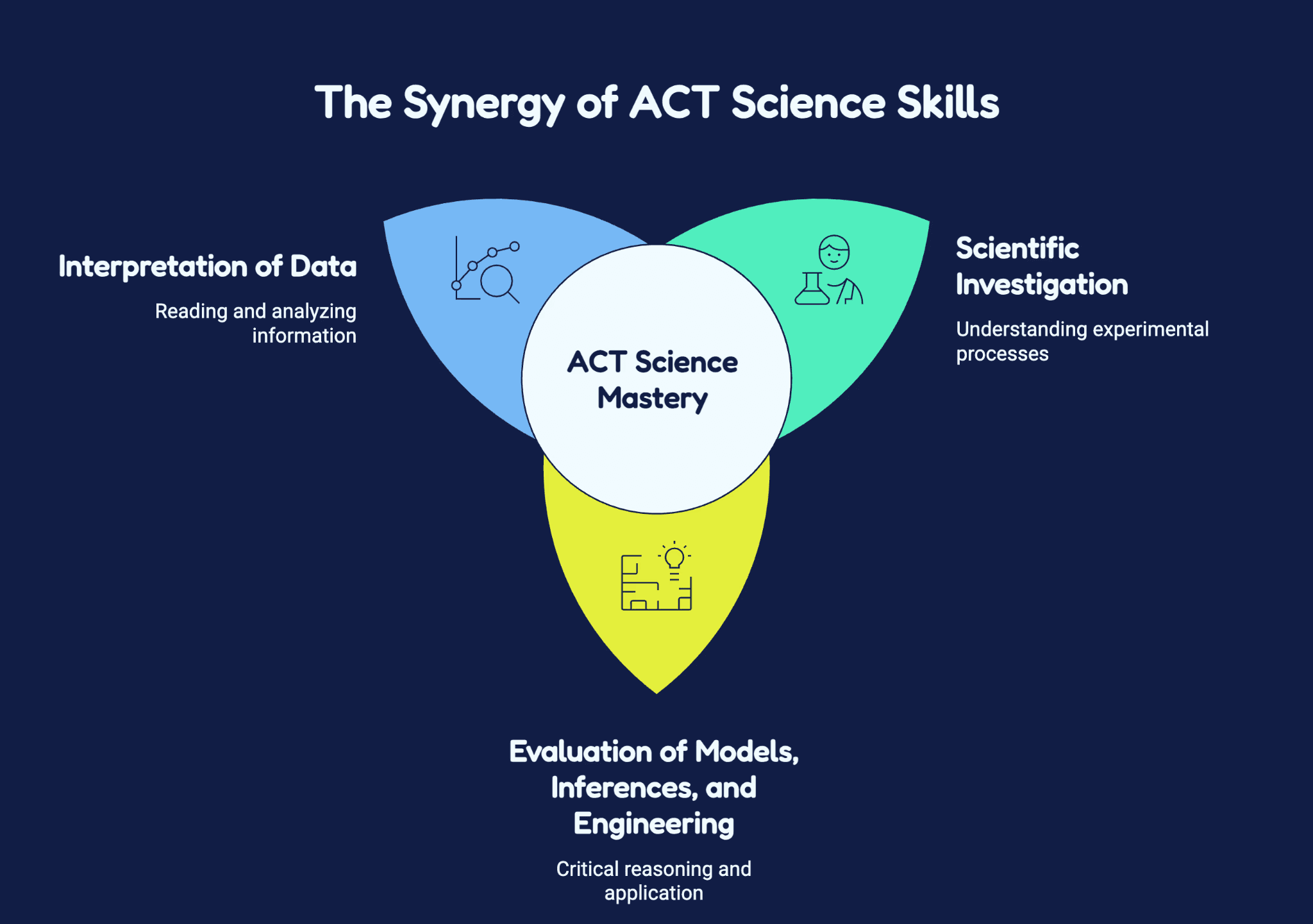
What ACT Science actually measures is your ability to read and interpret data under time pressure. ACT, Inc. describes this through three overlapping skill areas:
Interpretation of Data: Reading graphs, tables, and scatter plots; identifying trends; interpolating between data points.
Scientific Investigation: Evaluating experimental design, identifying variables, and comparing experimental results.
Evaluation of Models, Inferences, and Experimental Results / Engineering and Design Thinking: Judging whether a conclusion is supported, comparing competing explanations, and applying reasoning to new scenarios.
You can answer all of these questions using only the information given in the passage. You do not need to know the nitrogen cycle or the periodic table. What matters is finding the right row, column, or axis quickly and avoiding conclusions that the data does not support.
Try these free ACT Science practice questions
The six questions below come from the full 40-question set in the downloadable PDF. They span all three passage types: Data Representation, Research Summaries, and Conflicting Viewpoints. Each is tagged with the error type it most commonly reveals; those tags matter once you reach the four-error framework below.
Try to answer each question before you look at the solution.
Passage 1 (Data Representation) Boiling point and altitude
Altitude (m) | Boiling point of water (°C) |
|---|---|
0 | 100.0 |
1,000 | 96.7 |
2,000 | 93.4 |
3,000 | 90.2 |
4,000 | 86.9 |
Q1. As altitude increases from 0 m to 4,000 m, the boiling point of water:
A) Increases steadily
B) Decreases steadily
C) Remains constant
D) Decreases, then increases
Answer: B. Each 1,000 m row shows a lower boiling point: 100.0 → 96.7 → 93.4 → 90.2 → 86.9. Students who choose D often read the table from bottom to top or misread the direction of change. Error tag: axis/header misread.
Q2. Based on the table, the boiling point of water at 500 m would most likely be closest to:
A) 94 °C
B) 98 °C
C) 99 °C
D) 100 °C
Answer: B. Interpolating between 100.0 °C at 0 m and 96.7 °C at 1,000 m gives roughly 98 °C at the midpoint. Students who choose C or D apply the endpoint rather than interpolating between the two nearest rows. Error tag: overreading the data.
Passage 2 (Research Summaries) Plant growth and salt
Experiment 1: 20 bean plants were watered daily with 100 mL of fresh water and grown at 25 °C for 14 days. Average final height: 12 cm.
Experiment 2: A separate group of 20 bean plants was watered daily with 100 mL of a 5% salt solution, grown at 25 °C for 14 days. Average final height: 6 cm.
Q3. The independent variable in these experiments is:
A) The number of plants
B) The average plant height
C) The salt concentration of the water
D) The temperature
Answer: C. Salt concentration is what the researchers changed between experiments. Plant height is the measured outcome. Plant count and temperature were held constant. Students who choose B are identifying the dependent variable rather than the manipulated variable. Error tag: variable confusion.
Q4. Which conclusion is best supported by these results?
A) Salt water caused plants to grow taller.
B) Salt water reduced plant growth compared with fresh water.
C) Temperature affects how much plants grow.
D) The number of plants determines final height.
Answer: B. All other conditions were identical, so the lower average height in Experiment 2 is best explained by the salt concentration difference. Choices C and D introduce factors the experiments did not test. Error tag: overreading the data.
Passage 3 (Conflicting Viewpoints) Lake algae bloom
Scientist 1: The recent algae bloom is mainly caused by fertilizer runoff from nearby farms. The lake sits in a farming valley, and blooms have historically followed heavy-rain years.
Scientist 2: The bloom is mainly caused by warmer summer temperatures. Blooms grew in years without notable fertilizer changes, and growth peaked during the warmest weeks.
Q5. The two scientists most directly disagree about:
A) Whether an algae bloom occurred
B) The main cause of the algae bloom
C) Whether algae grow in lakes
D) How the bloom was measured
Answer: B. Both scientists accept the bloom happened. Their disagreement is about its primary cause fertilizer runoff versus warmer temperatures. Students who choose A or D often read the passage for isolated facts rather than mapping each scientist's position before touching the questions. Error tag: viewpoint mix-up.
Q6. Scientist 2 would most likely agree with which statement?
A) Heavy-rain years caused the bloom.
B) Bloom growth peaked during the warmest weeks of the year.
C) Fertilizer runoff is the main cause of the bloom.
D) The bloom was caused by several unrelated factors.
Answer: B. It directly matches Scientist 2's stated position. Choice A is Scientist 1's evidence. Choice C is Scientist 1's conclusion. Students who choose C are attributing Scientist 1's position to Scientist 2. Error tag: viewpoint mix-up.
The full 40-question PDF matches the Enhanced ACT's passage distribution: three Data Representation, two Research Summaries, and one Conflicting Viewpoints. It includes the same error tags and complete worked solutions for every question.
Free ACT Science cheat sheet: what to review the week before your test
The one-page cheat sheet in this pack is a strategy guide. It tells you what to do during the test, not a summary of biology or chemistry topics.
Here is what it includes:
The 3-passage read
Skim the passage structure first: title, column headers, axis labels, legend.
Do not read every word of the passage before you look at the questions.
Go to the question, find the specific data point it mentions in the passage, and then choose your answer.
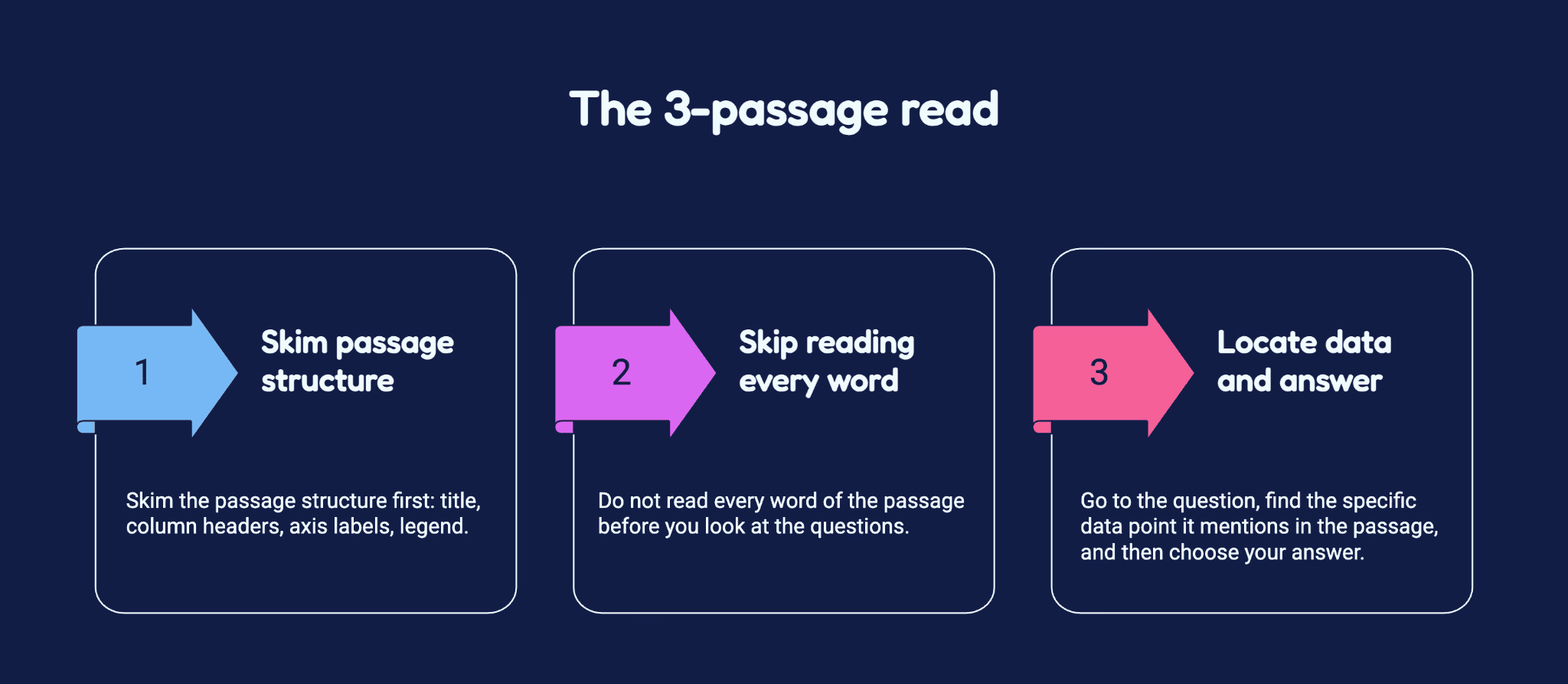
If you skip the first step, you may run out of time on the sixth passage. You need to know where the data is before the questions ask you to find it.
The 40-minute pacing plan
Checkpoint | Target time remaining |
|---|---|
After passage 2 | ~27 minutes |
After passage 4 | ~14 minutes |
5 minutes remaining | Bubble every unanswered question |
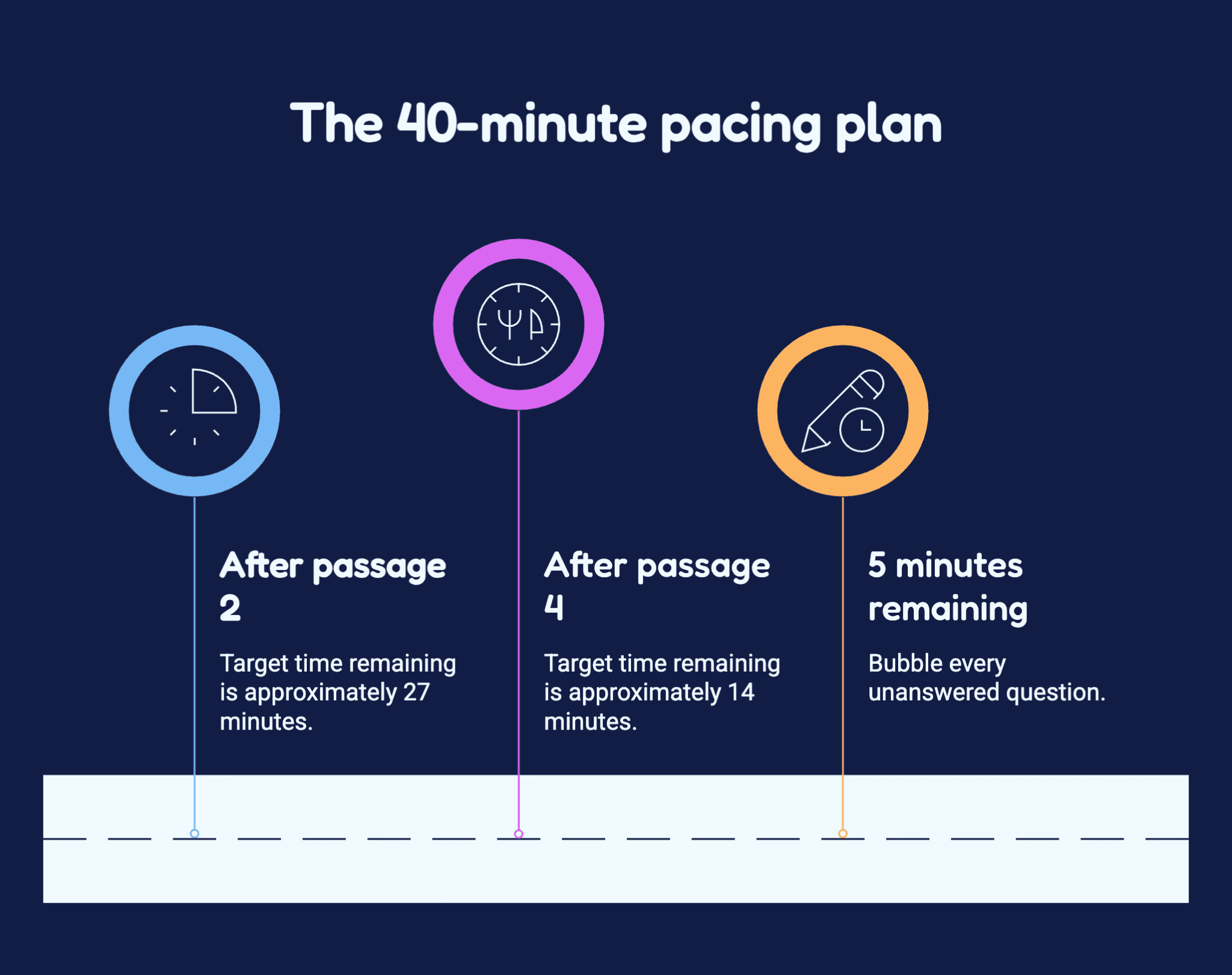
There is no wrong-answer penalty on ACT Science. A blank answer is a guaranteed zero. A guess is at minimum a 25% chance. Never leave a question blank.
Conflicting Viewpoints mapping template
Before you read any questions in a Conflicting Viewpoints passage, write one line for each viewpoint that explains the specific disagreement. This takes about 30 seconds. Doing this makes the questions much easier, since you will not need to re-read the passage for every question.
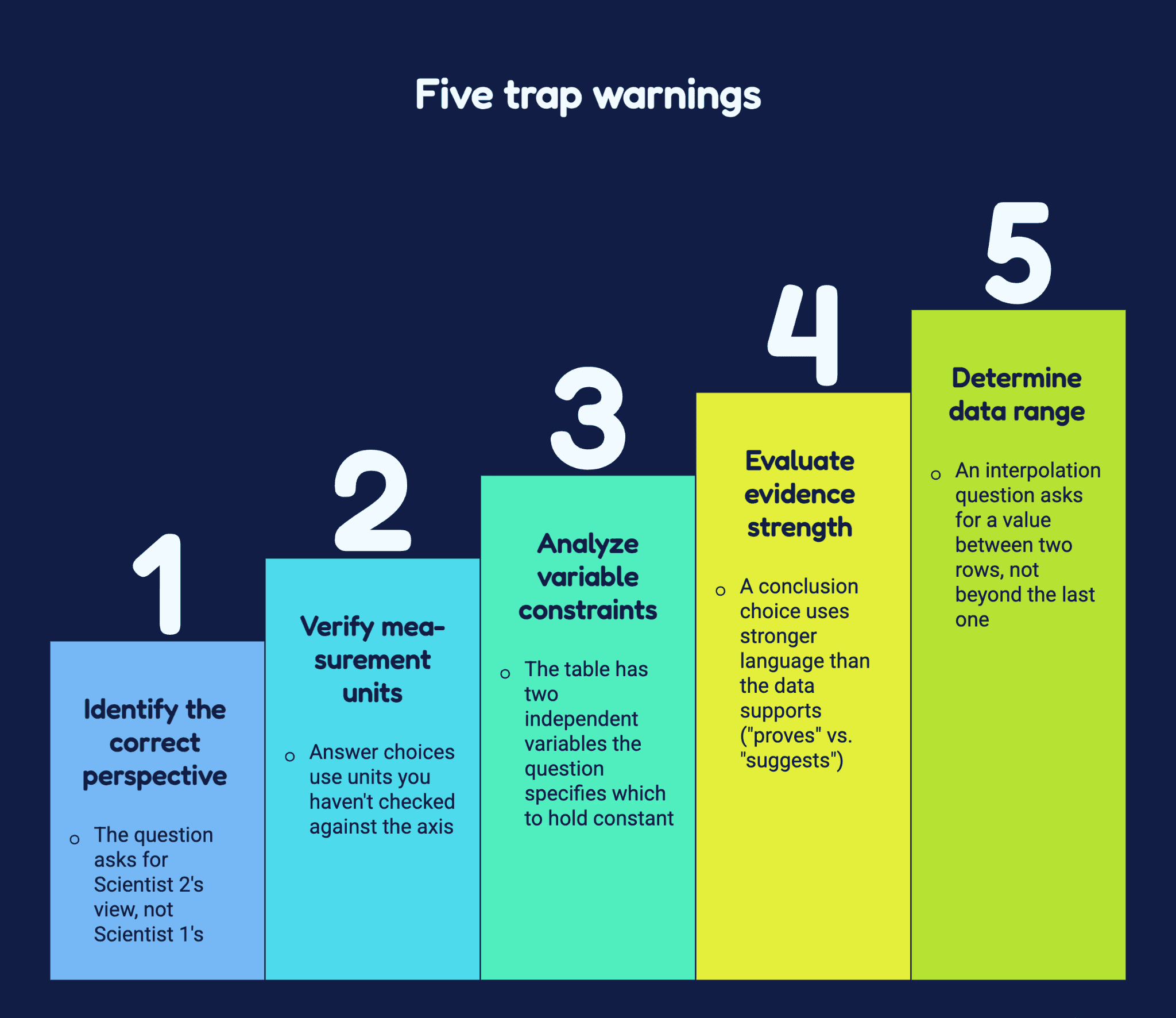
Five trap warnings
The question asks for Scientist 2's view, not Scientist 1's
Answer choices use units you haven't checked against the axis
The table has two independent variables the question specifies which to hold constant
A conclusion choice uses stronger language than the data supports ("proves" vs. "suggests")
An interpolation question asks for a value between two rows, not beyond the last one
Calculator reminder: Calculators are not permitted on ACT Science. All arithmetic in the section is simple enough to do by hand.
The four errors NAT tutors see most on ACT Science
Almost every missed ACT Science question fits into one of four categories. The passage gives you all the science content you need. Most lost points come from a process error, like misreading the data or drawing a conclusion the passage does not support.
Error type | What it looks like | The fix |
|---|---|---|
Axis/header misread | Reading the wrong column, wrong row, or tracking a trend in the wrong direction | Underline the exact cell or axis label before choosing; confirm units |
Overreading the data | Choosing a conclusion that sounds plausible but goes beyond what the passage actually states | Ask: "Is this specific claim supported by the numbers or words in this passage?" |
Variable confusion | Mixing up the manipulated variable, the measured outcome, and the controlled conditions | Write "independent = ___, dependent = ___" before answering Research Summaries questions |
Viewpoint mix-up | Attributing Scientist 1's evidence or conclusion to Scientist 2, or blending two views | Write one line per viewpoint before reading any Conflicting Viewpoints question |
Identifying your dominant error type is more useful than completing another untimed practice section without reviewing what went wrong.
Kurtis Lee scored a 36 on the ACT and a 1570 on the SAT. He's completing an M.S. in Mechanical Engineering at the University of Illinois Urbana-Champaign after earning 4s and 5s across 15 AP courses. He's been teaching one-on-one for five years. In the Conflicting Viewpoints passage, he identifies the most preventable time loss, and the fix, he says, is simpler than most students expect.
For a deeper look at how these error types show up in all three passage formats, NAT's ACT Science section guide explains the full framework and how to focus on the passage type that takes you the most time. The ACT tutoring overview shows how NAT tutors use this diagnostic method in one-on-one sessions.
How to use these free ACT Science practice questions
Practice only helps your score when you also figure out why you missed questions. Students who improve are the ones who know exactly what went wrong before they try more questions.
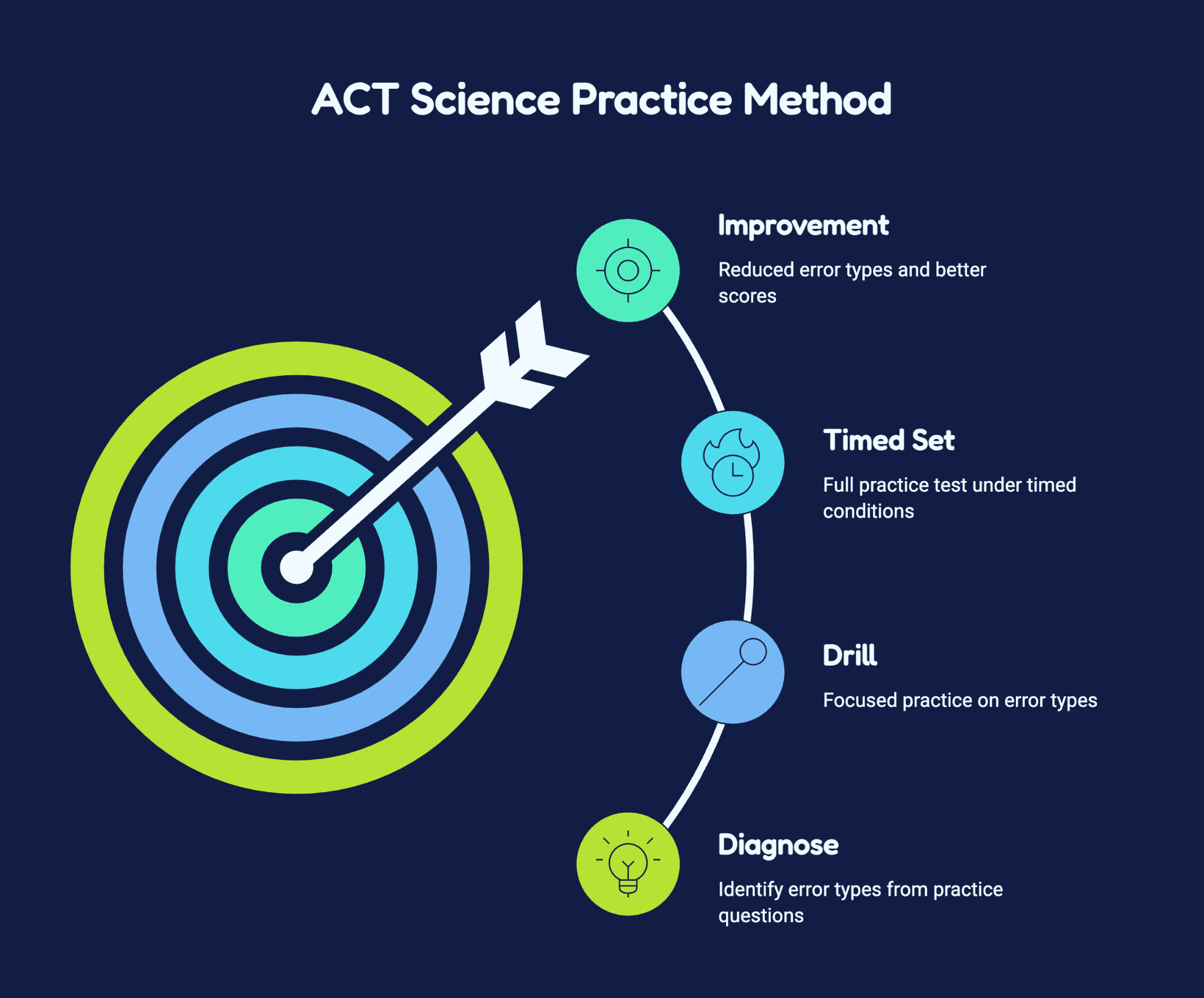
Here's the three-step method.
Step 1: Diagnose. Take 10 to 15 questions untimed and log every miss by error type: axis/header misread, overreading the data, variable confusion, or viewpoint mix-up. Use the error tags on the sample questions above as the model. After 15 questions, a clear pattern usually shows up, with one or two error types accounting for most misses.
Step 2: Drill. Once you know your dominant error type, your next session targets it specifically. If it's viewpoint mix-ups, run the mapping step on every Conflicting Viewpoints question for two weeks before timing yourself. If it's overreading, practice asking "is this claim actually in the passage?" before bubbling anything. If it's variable confusion, write out independent and dependent variables before answering every Research Summaries question for a week.
Step 3: Timed set. After two weeks of focused practice, take the full 40-question set under timed conditions: 40 minutes, one sitting, and no calculator. Score your test, note your mistakes by error type, and compare them to your first try. Most students see their main error type decrease while a new one appears. This means your practice worked, and it is time to start a new cycle.
Isaiah Fuji Brensihan studied Computer Science at Harvey Mudd College and has taught Physics, SAT, ACT, and AP Calculus in one-on-one sessions for more than nine years. Students come to him wanting a new reading strategy or a different approach to passages. His first move is always the same.
The case for diagnosed practice: Everleigh's story
Everleigh started with a 22 in ACT Science, part of a 23 composite. Her problem wasn't a content gap. Working with tutor Brian Min, she shifted her approach to data anchoring: every answer had to trace back to a specific row, column, or axis label in the passage before she could choose it. She replaced random reasoning and general science knowledge with deliberate passage anchoring on every question, every time.
Over four months, this method raised her Science score to 32 on the April test and her composite superscore to 31 by June. Her story shows why you should diagnose your error pattern before doing more practice. Read how one student raised her ACT Science score from 22 to 32.
Not sure which error type is costing you the most points, or whether you should take ACT Science at all? A free strategy session will map your error pattern in the first hour and give you an honest answer about whether the optional section is worth your time.
Book your free session.
What your ACT Science score means
ACT Science is scored on a 1-to-36 scale, reported separately from the composite. Here is where the most common score targets currently land.
Science score | Approximate national percentile | What it means |
|---|---|---|
32+ | ~90th percentile | Competitive for selective STEM programs |
28 | ~75th percentile | Strong; above most applicants |
24 | ~50th percentile | Near the national median |
Below 20 | Below median | Real room to gain points with targeted drilling |
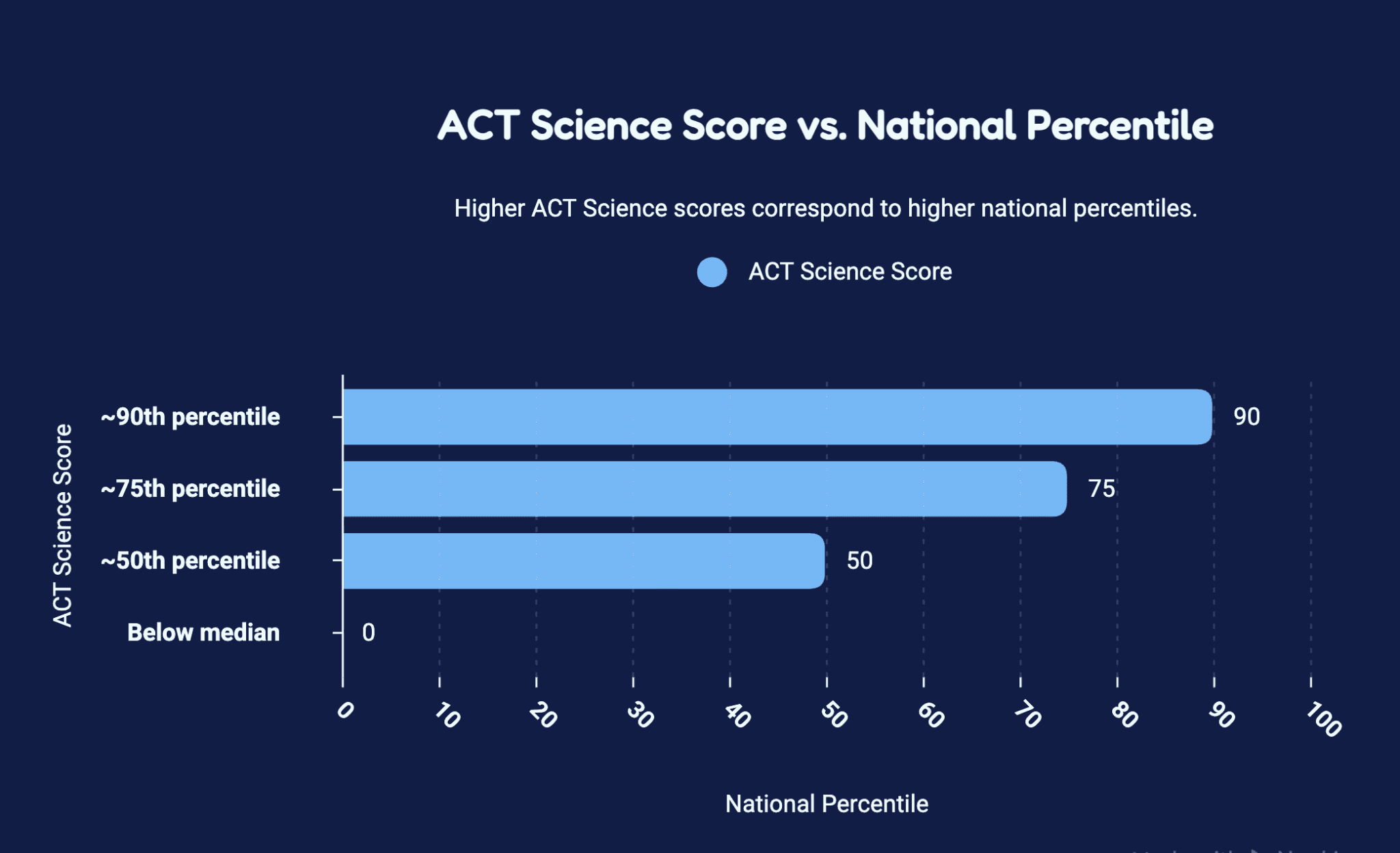
Percentile estimates based on NAT's ACT Science guide. Verify current figures against ACT's national ranks page before making application decisions.
Since Science no longer counts toward your composite, what makes a "good" score depends on your target schools. Engineering and STEM-focused universities look at the STEM score, which combines Math and Science on the 1-36 scale. If you are aiming for selective STEM programs, a Science score of 32 or higher is a strong result.
Use NAT's ACT score calculator to convert your raw Science score, and the ACT score range guide to benchmark against your target schools. For the most current official national percentile ranks, ACT's national score ranks page updates periodically as new graduating classes are added.
Putting it together
Practice questions only help your score when you also diagnose your errors. Download both PDFs, keep track of your mistakes by error type on your first untimed try, then do focused drills for two weeks before taking the timed 40-minute set. The cheat sheet gives you the strategy, the 40-question set gives you the practice, and the answer key with explanations helps you learn from each mistake.
ACT Science is optional, but if you are interested in STEM programs, scoring 32 or higher is worth spending 40 minutes on test day. Make sure you have the right information before deciding.
NAT's ACT tutors have scored 35 and 36, and NAT reports an average ACT composite gain of five or more points. A free strategy session takes one hour, maps your specific error pattern, gives you honest advice about whether to take the Science section, and does not require a long-term contract.
Book a free ACT strategy session with a NAT tutor today.
For more ACT preparation resources, check out NAT's ACT Science section guide, ACT tutor collection, and ACT tutoring resource hub.