What is the highest SAT score, and is a 1600 worth it?

Every year, parents and high-achieving students ask us the same question. Their child already scores 1450 or 1500, and they want to know if the final climb to 1600 is worth the effort. The pressure is real. A perfect SAT score feels like a trophy, and the internet makes it sound like a requirement for top colleges. It isn't.
The truth is more nuanced, and it starts with understanding what the highest SAT score actually means on today's digital test. Before you register for another sitting, it helps to know how rare a 1600 is, how the adaptive format changes the math behind achieving it, and where your prep time actually moves the needle. Our SAT resources cover the full landscape. This post focuses on the ceiling.
What is the highest SAT score?
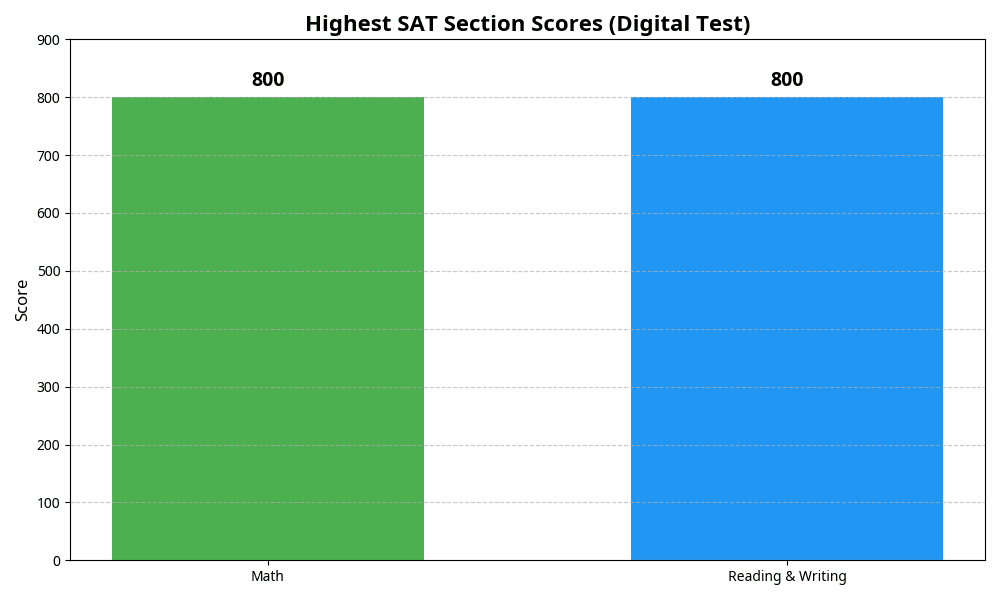
The highest SAT score is 1600, which equals a perfect 800 on the Evidence-Based Reading and Writing (ERW) section and a perfect 800 on the Math section. The College Board has used this 400-1600 scale since 2016. Before that, the SAT ran on a 600-2400 scale with three separate sections, including a standalone Writing section.
That 1600 is the absolute ceiling. There is no extra credit, no bonus questions, no path to a higher number. Every point comes from the two sections combined, and the scale is fixed regardless of which test date you sit.
This matters for parent readers in particular. If you took the SAT before 2016 and scored a 2100, your child's 1450 is not a lower result. The tests are different instruments measured on different scales.
What is a perfect SAT score on the digital test?
A perfect SAT score on the digital SAT is still 1600, but the adaptive module system makes it meaningfully harder to achieve than it was on the paper test. If you miss even one or two questions in Module 1 of either section, the algorithm may not route you to the highest-difficulty questions in Module 2. A 1600 on the digital SAT now requires both raw accuracy and adaptive performance. Getting every question right isn't enough if you don't get there through the right pathway.
The digital SAT runs on the College Board's Bluebook app and adapts in real time. Each section has two modules. Your Module 1 performance determines whether you receive the harder or easier version of Module 2. Perform well enough in Module 1, and you unlock the higher-difficulty questions that make a top score possible. Miss a few early, and the algorithm caps your ceiling before you reach the second half of the test.
On the paper SAT, the curve sometimes allowed one or two errors and still produced a scaled 800. On the digital SAT, the adaptive pathway itself is the gatekeeper. You can't outsmart it after the fact.
In SAT Reading and Writing sessions with students scoring between 650 and 700 on that section, our tutors consistently find that inference errors cluster in paired-passage questions. Students answer based on one passage alone and miss the synthesis the question is actually testing. On the digital SAT, missing two of those questions in Module 1 can route you into a lower-difficulty Module 2, costing you the 1600 before you've even seen half the test.
How rare is a 1600 on the SAT?
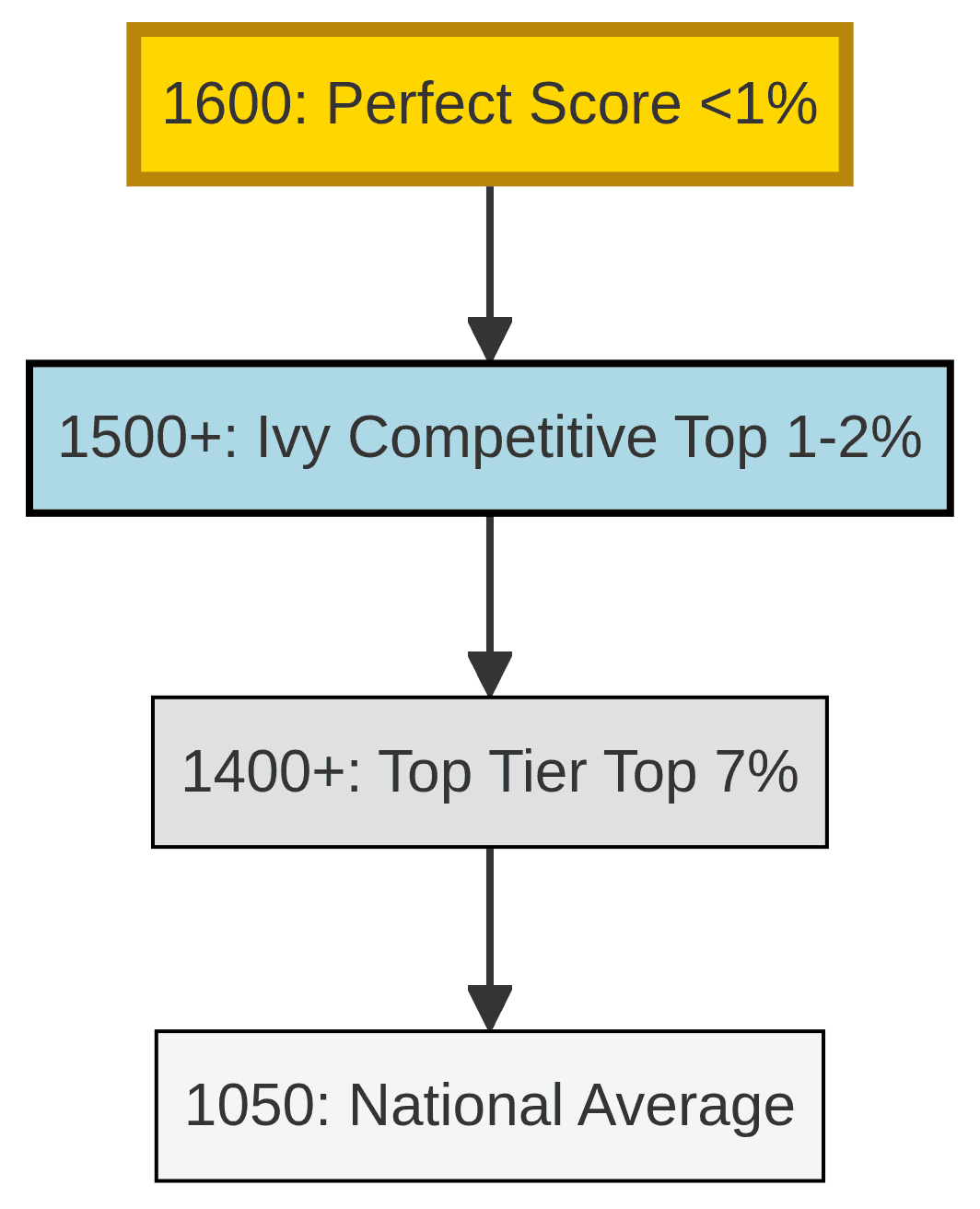
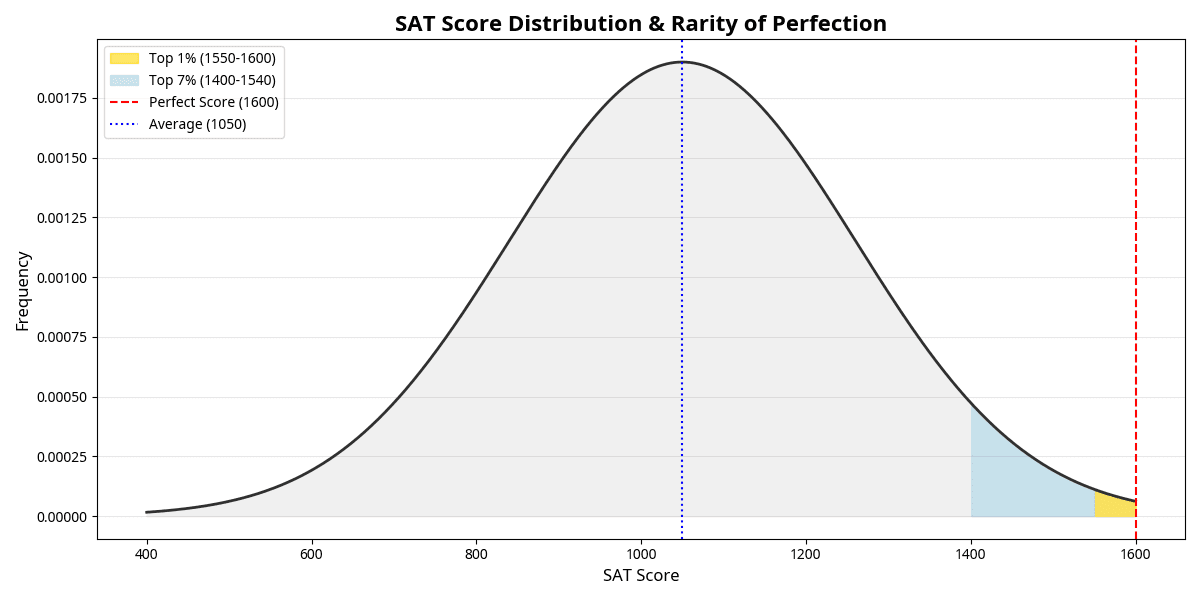
Only a few hundred students out of roughly 2 million annual test-takers earn a perfect 1600. College Board's 2025 Total Group Report shows 2,004,965 students took the SAT that year, with an average total score of 1029. The average ERW score was 521 and the average Math score was 508. Approximately 7% of test-takers, around 149,767 students, scored between 1400 and 1600. The 1600 tier is a fraction of that already small group. Estimates suggest fewer than 10,000 students score 1570 or above in any given year, and the true 1600 club is a subset of that.
SAT Score | Percentile | Rarity | Group |
|---|---|---|---|
1600 | 99.9+ | 1 in 1,000 | The Perfectionists |
1550 | 99 | 1 in 100 | Ivy League Competitive |
1500 | 98 | 1 in 50 | Top 20 National |
1400 | 93 | 1 in 14 | Selective Universities |
1050 | 50 | 1 in 2 | National Average |
Key Insight: Of the approximately 2 million students who take the SAT annually, fewer than 20,000 score in the 1550-1600 range. A perfect 1600 is achieved by fewer than 1% of test-takers.
A 1600 places you in the 99th percentile or above, meaning you scored higher than at least 99% of every student who sat for the exam. The score distribution follows a bell curve centered near 1029. The further you move from that center, the fewer students you find. A 1600 sits at the extreme right tail of that curve, which is precisely why it's extraordinary and precisely why it shouldn't be your benchmark unless you're already very close.
What are the highest scores for each SAT section?
The highest possible score for each SAT section is 800. An 800 on ERW combined with an 800 on Math produces the 1600 total. Each section is scored on its own 200-800 scale, and neither score is more important than the other in calculating your total. Where they differ is in what it takes to get there.
Highest Evidence-Based Reading and Writing score
An 800 on the ERW section means answering nearly every question correctly across both reading and writing modules. The section tests reading comprehension, grammar, and expression of ideas through short passages, most between 25 and 150 words. Most students find this section harder to perfect than Math, not because the content is more advanced, but because the inference questions are subtle and the time pressure is unforgiving. A misread passage or an overconfident answer on a "best evidence" question can cost points that feel unfair in hindsight.
Highest Math score
An 800 on the Math section requires mastery of algebra, advanced math, problem solving, and data analysis. The digital SAT allows a calculator on every Math question, and the built-in Desmos calculator is genuinely powerful if you know how to use it. But a calculator can't fix a misread question or a sign error. Students who score 790 on Math almost always know the content cold. They lose the final 10 points to execution under pressure, not to gaps in understanding.
In one-on-one Math sessions, our SAT tutors Rachel C, see the same execution errors repeat at the 790 level, She explains:
Is 1500 close enough to the highest SAT score?
Yes. A 1500 sits in the 98th percentile and is competitive for admission at nearly every university in the United States, including Ivy League schools. At most selective colleges, the difference in acceptance rates between a 1500 and a 1600 is statistically negligible. Admissions officers weigh your four-year academic record, essays, and extracurricular commitments far more heavily than the final 100 points on a standardized test.
Students on Reddit's r/ApplyingToCollege consistently reflect what admissions officers say on the record: colleges value sustained performance across four years far more than a single two-hour exam. Above 1550, in particular, the score stops opening new doors and starts being one more signal that already matches what the rest of the application says. A 1500 tells a top college you can handle the work. A 1600 tells them the same thing, with slightly more margin.
The marginal return drops sharply after 1500. This is not an argument against ambition. It's an argument for directing ambition toward the parts of your application that move the needle more.
Should you retake the SAT to get a 1600?
Whether your student should retake depends on their starting score, their error patterns, and the opportunity cost of more prep time. The answer is rarely the same for two students, even if they're sitting at the same score.
When retaking makes sense
Retaking makes sense when you left clear points on the table due to circumstances you can control. You ran out of time on the final Math module. You misread a question under pressure. You were sick on test day. In those cases, a retake is rational. You aren't chasing a number you haven't earned. You're reclaiming points that your preparation already supports.
It also makes sense if your current score falls below the middle 50% range of your target schools. Moving from a 1350 to a 1450, or from a 1420 to a 1500, through targeted one-on-one SAT tutoring has a documented, meaningful impact on admissions competitiveness. That investment pays off.
When your time is better spent elsewhere
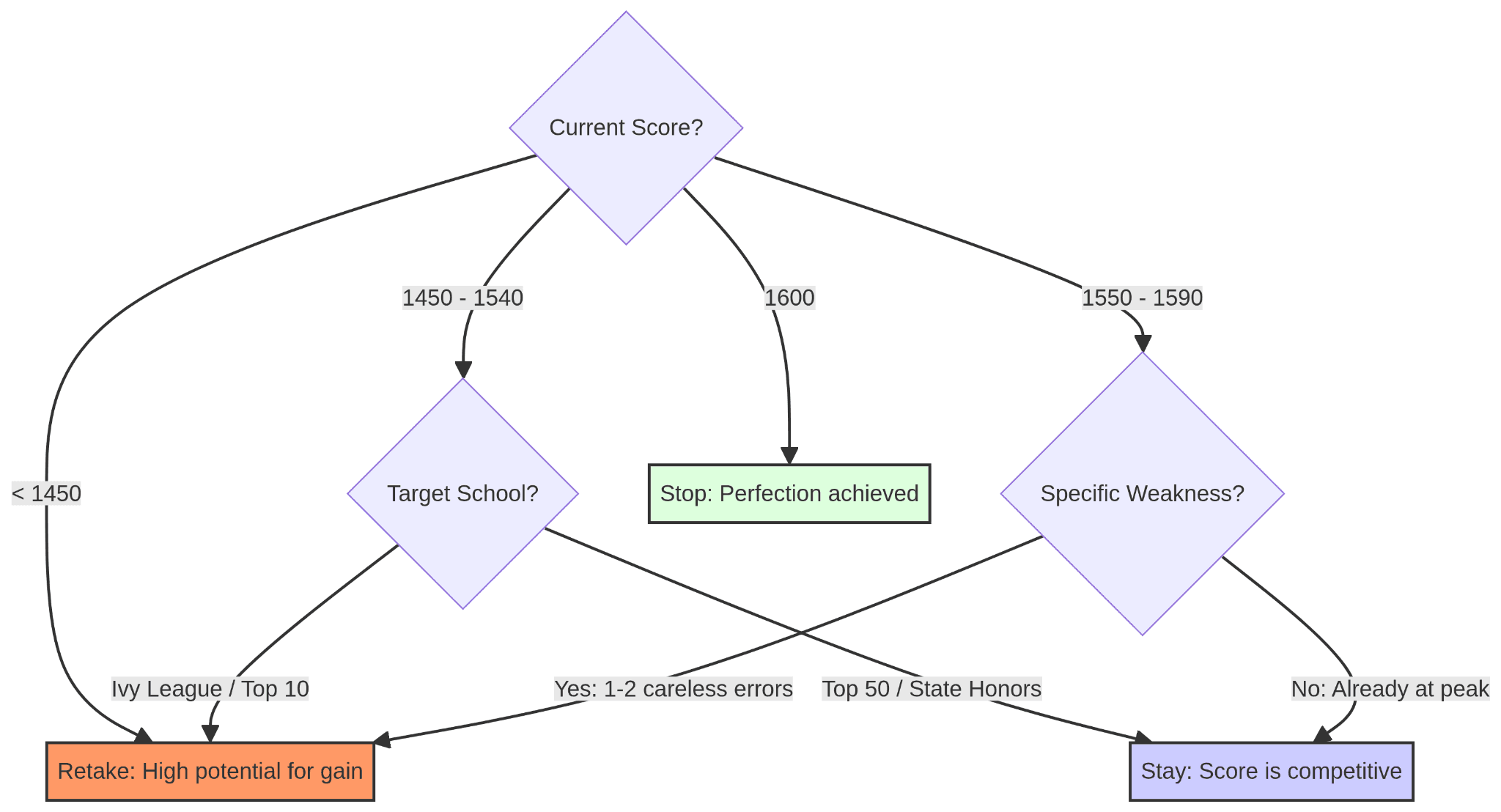
If your student is already at 1550 or above and their remaining errors are scattered and inconsistent, stop. One more point on the SAT will not change an admissions outcome at any school where a 1550 is already competitive. That same time invested in essays, a meaningful extracurricular, or a challenging course is a better return.
Our SAT tutor Gia K, who scored 1570 on the SAT at Cornell, puts it directly:
See the flow chart below to make a quick decision made by Ivy League North American tutors:
Do colleges care about a perfect SAT score?
Most selective colleges do not treat a 1600 differently from a 1550 or 1570 in admissions decisions. A perfect score can matter at schools with strict academic index cutoffs or for specific merit scholarships, but it is not a guaranteed admission advantage. Admissions officers at top universities consistently say that context, course rigor, essays, and recommendations carry more weight than the final 50 points on a standardized test.
One distinction is worth knowing. A 1600 earned in a single sitting reads differently from a 1600 superscore. Superscoring combines your best section scores across multiple test dates. It is a legitimate strategy that most colleges accept, and it is worth pursuing if your sections peak on different dates. But a single-sitting 1600 signals consistency under pressure that a superscore cannot. For schools that require all scores to be submitted, that distinction carries real weight.
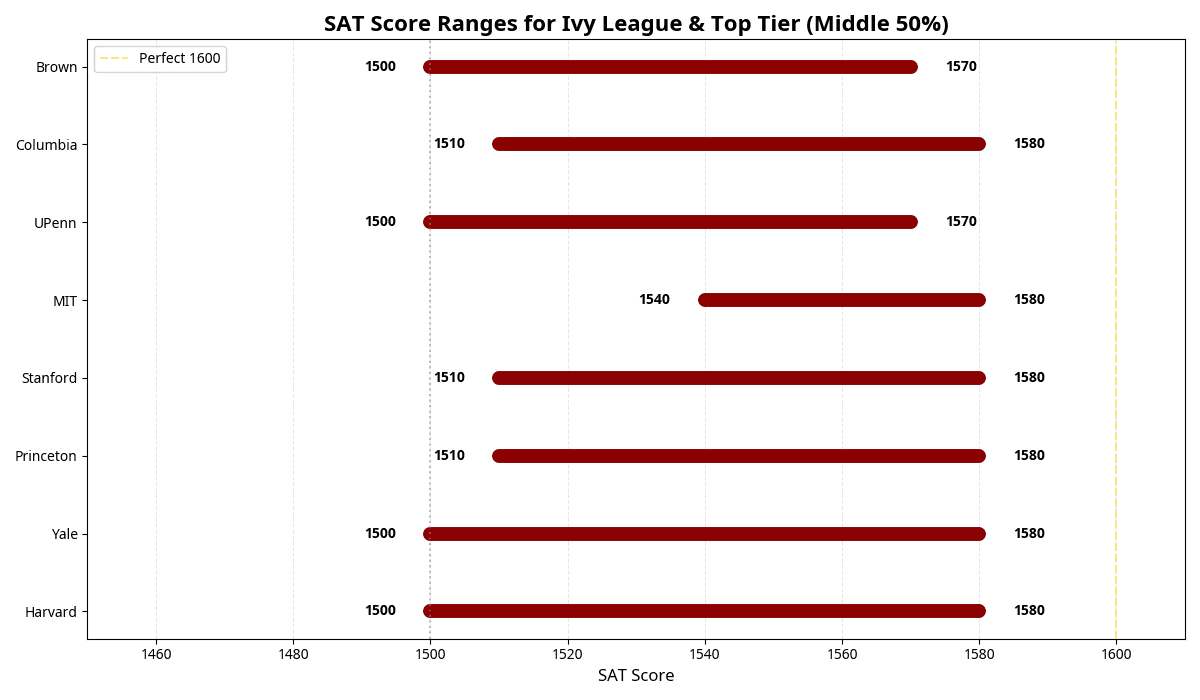
For students with a specific Ivy League target, understanding the middle 50% range at each school is a more useful exercise than chasing an abstract ceiling.
Conclusion
The highest SAT score is 1600. It's rare, it's impressive, and it's achievable. But it isn't a prerequisite for admission to any college in the country. A 1500 puts your student in the top 2% of test takers. A 1550 puts them in the top 1%. The difference between those scores and a 1600 is almost never a knowledge gap. It's usually one or two error patterns, specific to that student, that a trained eye can identify in a single session.
What separates students who break through to 1600 from students who plateau at 1570 isn't volume of practice. It's a precise diagnostic of which question types are still costing them points and a targeted plan to fix exactly those, not everything.
If your student is scoring 1450 or above and wants to close the gap, our team offers a free consultation to review score reports, identify error patterns, and build a plan that actually moves the needle. One-on-one SAT tutoring with North American Tutors means your grades are now our responsibility.