What is a good ACT score?

You open your ACT score report and see a 25. Your friend got a 29. Your cousin got a 21. All three of you are asking the same question: what is a good ACT score?
The internet doesn't help much here. Some sites say a 21 is fine for college. Others say anything below 30 is risky. Spend an hour reading forums, and you'll feel more confused than when you started. The truth is that "good" depends on three things: your college list, your intended major, and whether you took the test before or after the 2025 Enhanced ACT changes.
For the class of 2025, ACT Inc. reported a national average composite score of 19.4 among 1.38 million test-takers. That average has held flat since 2024 and is the lowest since 1990. So if you scored a 20, you're already above average nationally. But that number alone doesn't tell you much about your actual college chances.
By the end of this guide, you'll know exactly where your score stands, what score you actually need for your target schools and scholarships, and whether retaking is worth your time. If you want to cut straight to personalized help, you can also speak with an ACT tutor at NAT who scored a 36 and has worked through this exact question with hundreds of students.
What is a good ACT score?
A good ACT score is a composite score of 23 or higher, which places you in roughly the top 25% of test-takers nationally. More precisely, it is any score that falls within or above the middle 50% range of your target colleges. For the class of 2025, the national average composite was 19.4, so any score above 20 is technically above average.
The problem with that answer is that "above average" and "good enough to get in" are two different things. A student applying to a public flagship with a 22 middle 50% range and a student applying to Georgetown with a 33-35 range need very different scores. The only definition of "good" that actually matters is whether your score strengthens your specific application.
ACT score breakdown: good, competitive, and exceptional ranges
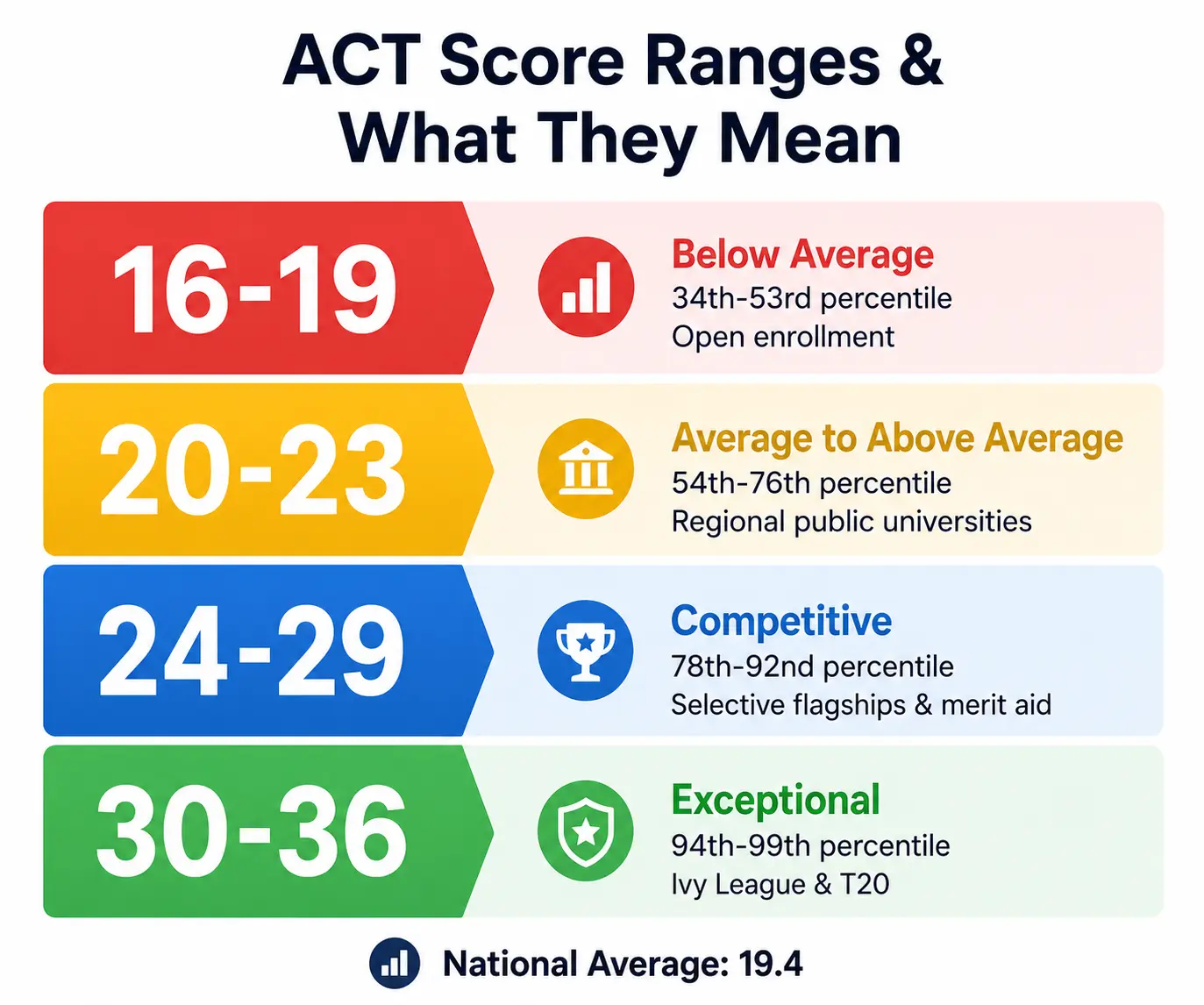
ACT scores fall into four practical bands based on national percentile data from ACT's official national ranks table. A score of 16-19 is below average and limits four-year college options. A score of 20-23 is average to above-average and is acceptable for many state universities. A score of 24-29 is competitive for selective schools and often qualifies for merit aid. A score of 30-36 is exceptional and competitive at Ivy League and T20 institutions.
The ACT also publishes College Readiness Benchmarks that represent the minimum scores associated with a 50% probability of earning a B or better in a corresponding college course. Those benchmarks are English 18, Math 22, Reading 22, and Science 23. Only 20% of the class of 2025 met all four benchmarks, according to ACT's national profile data.
Score range | Approx. percentile | Typical college fit |
16-19 | 34th-53rd | Open enrollment, community college transfer paths |
20-23 | 54th-76th | Regional public universities, less selective private colleges |
24-29 | 78th-92nd | Selective public flagships, mid-tier private universities |
30-36 | 94th-99th | Ivy League, T20, highly selective STEM programs |
Is a 21, 25, or 29 a good ACT score?
Whether a specific ACT score is good depends on your college list. A 21 is at the 68th percentile and is considered competitive for many public universities. A 25 is at the 83rd percentile and is competitive for state flagships. A 29 is at the 92nd percentile and is strong for selective private colleges. Always compare your score to each school's middle 50% range before deciding whether to retake.
Is a 20 a good ACT score?
A 20 sits at the 63rd percentile, just above the national average of 19.4. It is a reasonable score for less selective four-year colleges but typically falls below the middle 50% range for public flagship universities, which typically expect 22-27 or higher.
Is a 21 a good ACT score?
A 21 is at the 68th percentile and above the national average. It meets the minimum threshold for many public universities and some private colleges. At schools where the middle 50% starts at 21-22, a 21 keeps you in consideration. It falls below the typical range for selective institutions.
Is a 22 or 23 a good ACT score?
A 22 lands at the 72nd percentile and a 23 at the 76th. Both are solidly above average and competitive at regional public universities and at many less-selective private schools. For scholarships, the 22-23 range often falls just below the minimum cutoffs at larger merit-aid programs.
Is a 24 a good ACT score?
A 24 is at the 80th percentile and the start of what most college counselors consider a "strong" score. It is competitive for many state universities and some selective privates. Several merit scholarship programs also begin their threshold requirements at 24-25.
Is a 25 a good ACT score?
A 25 is at the 83rd percentile and a solid score for public flagships and mid-tier private colleges. At schools like the University of Georgia, Ohio State, or Wisconsin-Madison, a 25 falls within or near their middle 50% range. It may also unlock merit scholarships at some institutions.
Is a 26 a good ACT score?
A 26 is at the 86th percentile and above average for most selective universities. It is accepted at many strong public and private institutions and often qualifies for merit aid at schools with competitive scholarship programs.
Is a 28 a good ACT score?
A 28 is at the 91st percentile. It is a genuinely high score that strengthens applications at most selective schools outside the Ivy League. For students comparing ACT and SAT results, a 28 ACT converts to roughly a 1310-1330 SAT using the official concordance table.
Is a 29 a good ACT score?
A 29 is at the 92nd percentile and widely considered a high score. It is competitive at most selective universities, including many ranked in the top 50 nationally. A 29 also often qualifies for significant merit-based aid at institutions with strong scholarship programs.
Is a 30 a good ACT score?
A 30 is at the 94th percentile. It is an excellent score that aligns with the lower end of Ivy League middle 50% ranges. For context, Harvard's middle 50% is roughly 34-36, while schools like Georgetown and Emory typically report 30-34.
Quick reference: percentiles for ACT scores 20-31
ACT score | Approx. national percentile |
|---|---|
20 | 63rd |
21 | 68th |
22 | 72nd |
23 | 76th |
24 | 80th |
25 | 83rd |
26 | 86th |
27 | 88th |
28 | 91st |
29 | 92nd |
30 | 94th |
31 | 95th |
Percentile data sourced from ACT national ranks. Figures represent approximate standing among all test takers.
What is a good ACT score for top colleges and scholarships?
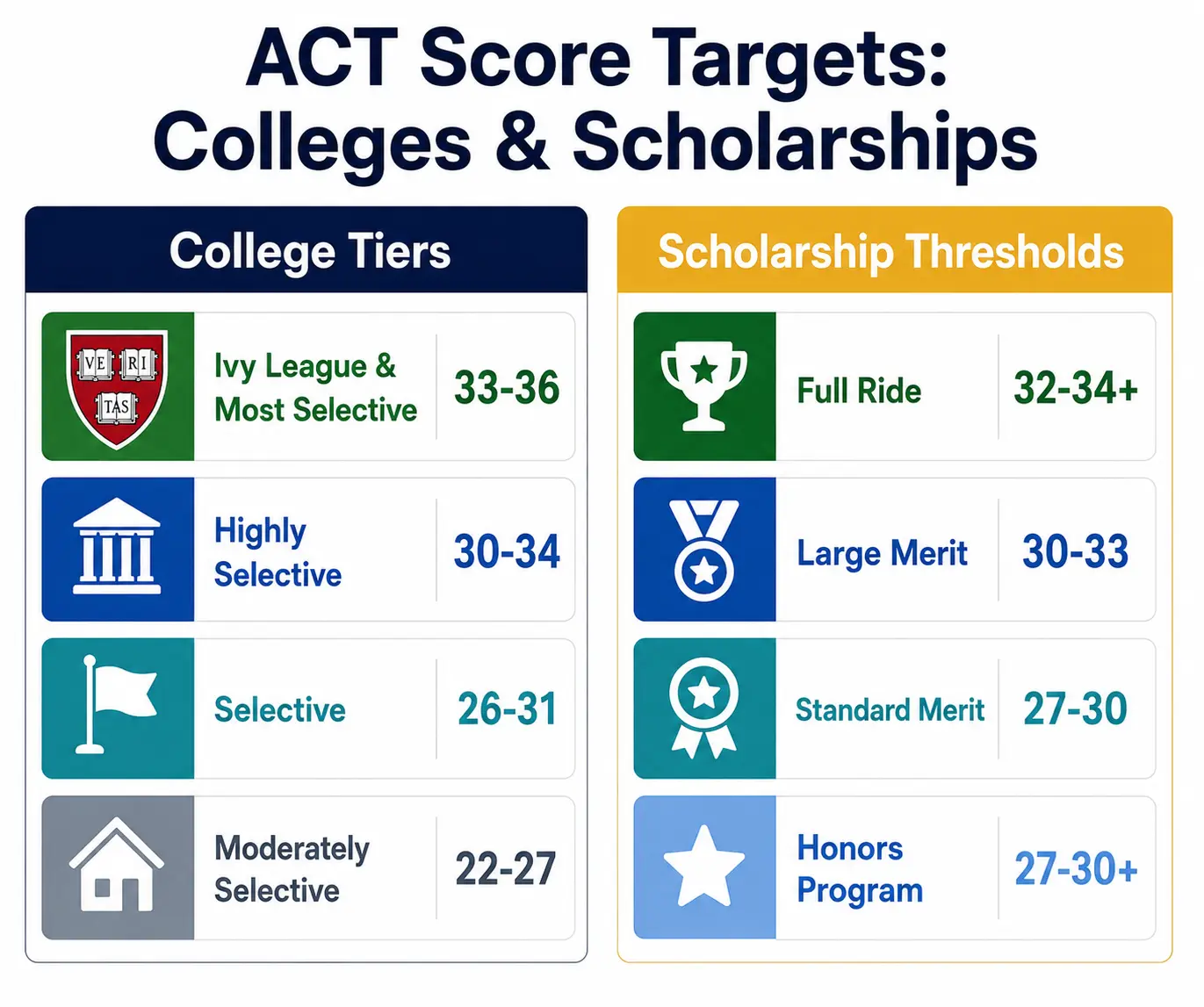
For Ivy League schools, a good ACT score is typically 33-36. For highly selective private universities, a competitive ACT score typically ranges from 30 to 34. For merit scholarships, thresholds often start at 27-30, with larger awards requiring 32-34. Always check each school's Common Data Set for the exact middle 50% range, as scholarship cutoffs vary by institution and can change year to year.
The Common Data Set is the most reliable source for this data. You can find it by searching "[School Name] Common Data Set" and looking at Section C9, which lists the ACT scores of enrolled students. The 25th and 75th percentile scores define the middle 50% range, and your goal is to meet or exceed the 75th percentile at your target schools.
College tier | Typical ACT range | Examples |
|---|---|---|
Ivy League and most selective | 33-36 | Harvard, Princeton, MIT, Stanford, Yale |
Highly selective | 30-34 | Georgetown, Emory, Vanderbilt, Notre Dame |
Selective | 26-31 | Boston University, UC Santa Barbara, Fordham |
Moderately selective | 22-27 | Many state universities, mid-tier private colleges |
Scholarship level | Typical ACT requirement | Approx. annual value |
Full-ride or presidential | 32-34 and above | Full tuition and room and board |
Large merit awards | 30-33 | $15,000-$25,000 and above |
Standard merit scholarships | 27-30 | $5,000-$15,000 |
Honors program eligibility | 27-30 and above | Priority registration and housing |
Uju K. scored 1590 on the SAT and 35 on the ACT at Northwestern. Over 6 years coaching 200+ students through scholarship decisions, she's seen students miss out on aid they qualified for because they aimed for the middle of the range rather than the top.
Pattern seen in: students targeting merit aid at public flagships and selective private colleges.
If you're deciding whether the SAT or ACT is a better fit for your score goals, comparing both tests head to head is a useful starting point. The same college list can look very different depending on which test is a better fit for you.
The 3-section composite shift: why good ACT scores mean something different in 2026
Most guides on ACT scores were written before the 2025 Enhanced ACT changed how composites are calculated. Those guides are now providing students with incomplete information.
What changed in the 2025 Enhanced ACT
Before April 2025, the ACT composite was the average of four sections: English, Math, Reading, and Science. Each section carried 25% of the composite weight. Starting with digital administrations in April 2025, and extending to paper tests in September 2025, the ACT shifted to a 3-section composite. Science became optional and is now reported as a separate score rather than factored into the main composite.
Progress Learning's format overview confirms the Enhanced ACT is also 75 minutes shorter overall, with 44 fewer questions and math answer choices reduced from 5 to 4. The score scale remains 1-36, and the new structure is covered in detail in NAT's guide on the ACT Science section becoming optional.
Section | Old ACT weight | Enhanced ACT weight | Status |
|---|---|---|---|
English | 25% | 33.3% | Required |
Math | 25% | 33.3% | Required |
Reading | 25% | 33.3% | Required |
Science | 25% | 0% in composite | Optional, reported separately |
Writing | Separate | Separate | Optional |
Why this changes the definition of "good"
Under the old 4-section system, a weak English score could be offset by a strong Science score. That trade-off is gone. With only three sections contributing to the composite, each one now carries 33.3% of your final number. A student who scored 32 in English, 30 in Math, 32 in Reading, and 24 in Science previously landed at a composite of 30. Under the Enhanced ACT, that same student scores a 31 composite. The Science section no longer masks weaknesses in core areas.
A "good" composite score now requires balanced performance across English, Math, and Reading. Students with a strong Science score but uneven results in the core sections need to rethink their prep strategy. The Enhanced ACT rewards consistency across the three required sections more than the old format did.
What STEM majors need to know
Competitive STEM programs, including engineering, pre-med, and computer science, still expect strong Science section scores even though Science no longer counts toward the composite. Admissions officers at these programs have always viewed the ACT Science section as a proxy for data reasoning ability, and that hasn't changed.
ACT's own research on high-performing STEM majors found that students entering these programs averaged 27 in biological sciences and 28 in quantitative fields on the ACT. Hitting those benchmarks requires active Science prep, not a decision to skip the section entirely.
We asked Alexander, one of NAT's top pre-med and STEM tutors. He scored a perfect 1600 on the SAT and is completing his medical degree at Brown. Over 5 years working with 131+ pre-med and STEM applicants, he's had to address this exact shift with most of his students.
Pattern seen in: STEM-focused students applying to T20 programs who deprioritize ACT Science prep after reading that it no longer affects the composite.
If you're a STEM applicant deciding between the ACT and SAT, NAT's comparison of the Digital SAT vs ACT for STEM students breaks down how the section change affects that decision.
How to set your target ACT score using the 75th percentile rule
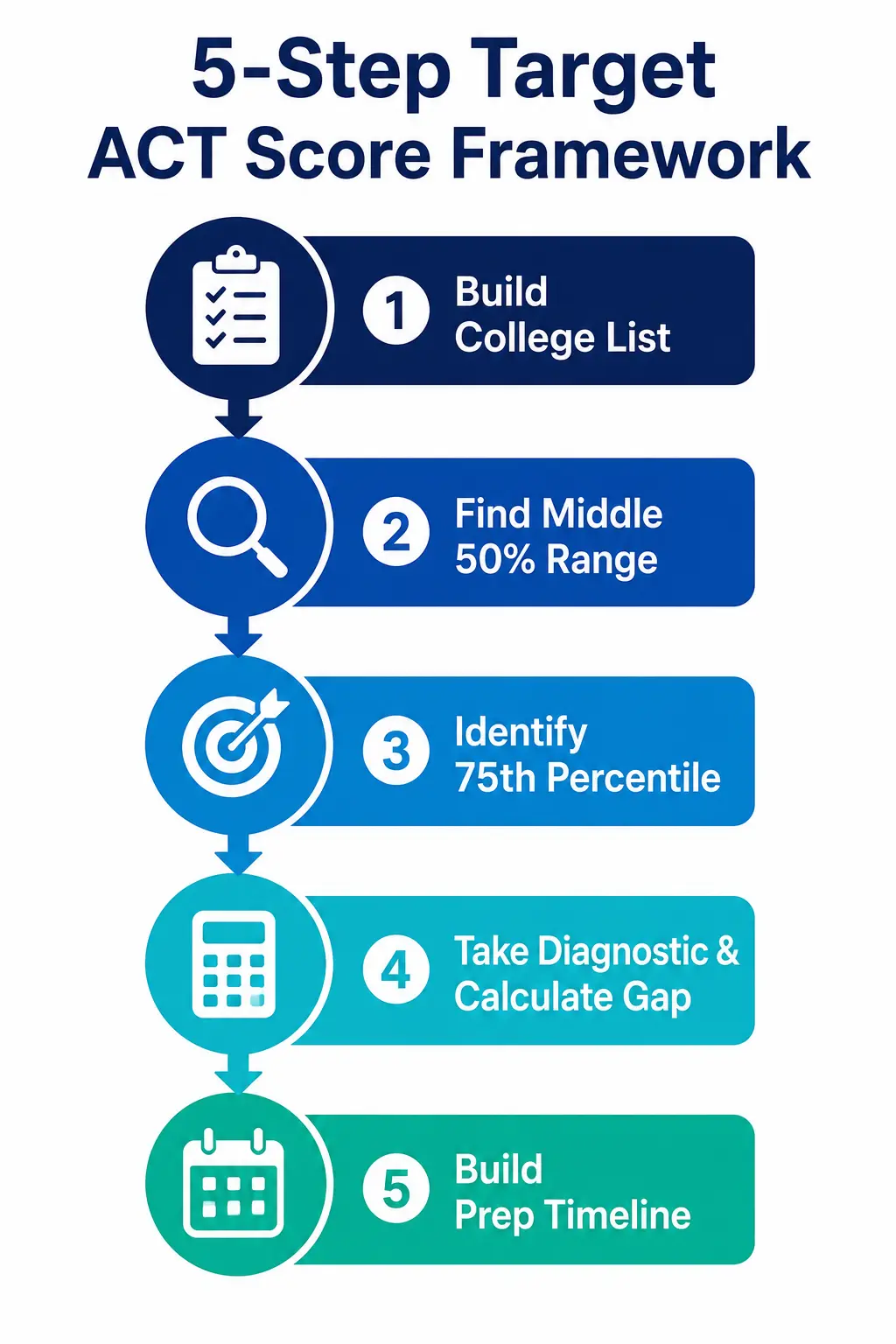
The most common mistake students make is picking an ACT target based on the national average or a score they saw in a ranking list. The right target comes from your college list, not from a general guide. Here's how NAT tutors build a score target in five steps.
Step 1: Build your college list
List 8-12 schools across three tiers: 2-3 reach schools (where your current academic profile is below their median), 5-6 match schools (where your profile aligns with their reported middle 50%), and 2-3 safety schools (where your profile is clearly above their range). This spread gives you a realistic target zone.
Step 2: Find each school's middle 50% ACT range
Use the Common Data Set for each school on your list. Search "[School Name] Common Data Set" and find Section C9. It lists the 25th and 75th percentile ACT scores for enrolled students. These are the actual ranges your score will be compared against, not the averages quoted in marketing materials.
Step 3: Identify the 75th percentile of your top match schools
Look at the 75th percentile score across your strongest match schools. That number is your target. Hitting the 75th percentile means your score is in the top quarter of admitted students at that school. It strengthens your application rather than just qualifying it. Scoring at or below the 25th percentile means your score is working against you.
Step 4: Take a diagnostic and calculate your gap
Take a full official ACT practice test under timed conditions before setting a prep plan. Your diagnostic composite gives you a realistic baseline. The gap between your diagnostic and your target tells you how much prep time you need and which sections to prioritize. Also, check your exact score using the ACT score calculator by entering your individual scores for each section.
Step 5: Build a prep timeline based on your gap
Prep timelines depend on how far your diagnostic sits from your target:
1-3 point gap: 4-8 weeks of targeted section prep
4-6 point gap: 10-16 weeks of structured prep with tutor support
7+ point gap: 20 or more weeks; also consider whether test-optional is a more efficient strategy
If the SAT is on the table as an alternative, check the ACT to SAT score conversion to see how your current composite translates. Some students find their baseline on the SAT is naturally stronger, which changes which test is worth investing in.
Should you retake the ACT?
Retake the ACT if your score is below the 25th percentile at your target schools, if you need a higher composite to meet scholarship cutoffs, or if one weak section is dragging down your overall score. ACT data shows that students who retest improve their superscore by an average of 2.4 composite points. If your score already sits above the 75th percentile for your match schools, focus on other parts of your application instead.
A retake without a clear plan is the most common waste of prep time we see. According to research on ACT retakes, 57% of students who retake the ACT improve their composite. The average gain is 1.14 composite points. After three attempts, gains typically fall below 0.5 points.
Quick retake decision checklist:
Score below target school's 25th percentile? Retake.
Score near a scholarship cutoff? Retake.
One section 3 or more points below the others? Retake with a section-specific focus.
Score above 75th percentile for all target schools? Skip the retake. Invest that time elsewhere.
ACT superscoring works in your favor here. Many colleges combine your highest section scores from multiple test dates into a new composite score. If you scored a 27 in English on one date and a 29 in Math on another, your superscore composite reflects both highs. It's worth understanding each target school's superscore policy before committing to a retake strategy.
If you want to understand how your current ACT score maps to your target schools' SAT ranges, the comparison can help clarify whether retaking the ACT or preparing for the SAT is the more efficient use of your time. NAT offers a free consultation in which our tutors review your current score, your college list, and your section breakdown to provide a clear recommendation.
Getting your score where it needs to be
Here's what the data and our tutors' experience both show. A good ACT score isn't a single number. It's the score that strengthens your specific application at your specific target schools.
If your composite is below the 25th percentile of your targets, a retake with a real prep plan is worth it. If your composite is within the middle 50%, focus on pushing to the 75th percentile rather than settling. If you're already above the 75th percentile at your match schools, your time is better spent on essays, activities, and building relationships with teachers.
92% of NAT students improve by 2 grade letters or 90+ SAT points. Your grades are now our responsibility. If you want help building a prep plan around your actual score, schedule your free consultation. We'll match your child with a tutor who scored a 36 on the ACT and knows exactly what it takes to reach your target.