Free ACT English Practice Questions & Cheat Sheet (PDF)
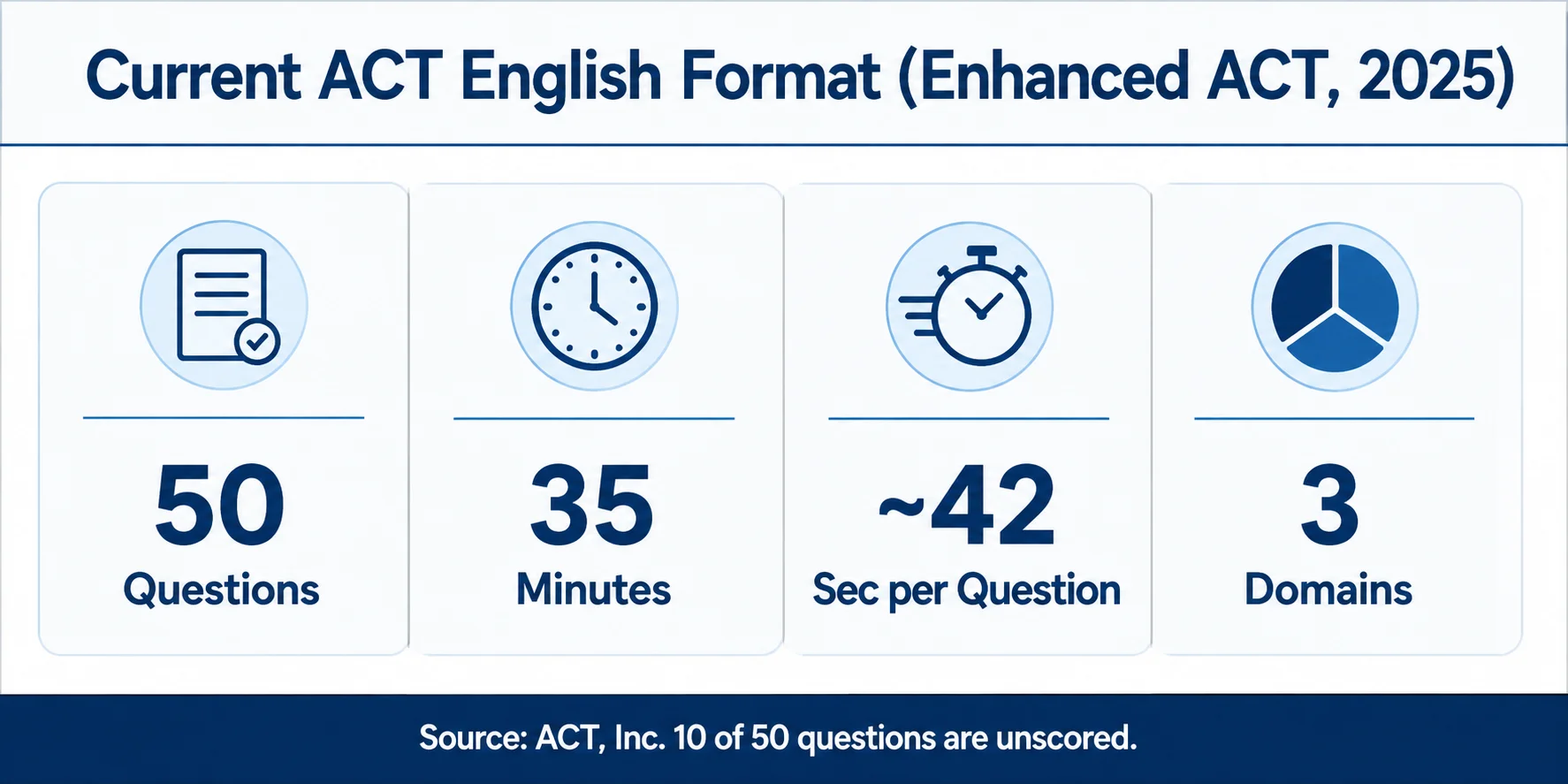
Most free ACT English practice materials online are built for the old test. The previous ACT English section had 75 questions in 45 minutes. The current Enhanced ACT English section, which rolled out in 2025 and now governs all official administrations, has 50 questions in 35 minutes. Ten of those questions are unscored field test items. If you are timing yourself against the old format, your pacing is wrong before you start.
Many practice resources focus on grammar drills, even though about half of the English section tests rhetorical skills. Production of Writing questions assess whether a sentence fits the passage, if a paragraph needs a transition, and whether the writer achieved the intended purpose. Correcting grammar in a sentence that should be deleted does not improve your score.
NAT tutors who have scored 34 or higher on the ACT, including those with perfect 36 English sections, work individually with students to develop section-level precision. This page provides a current-format cheat sheet, eight free practice questions focused on frequently tested rules, and the strategies these tutors use.
The ACT English section in 60 seconds
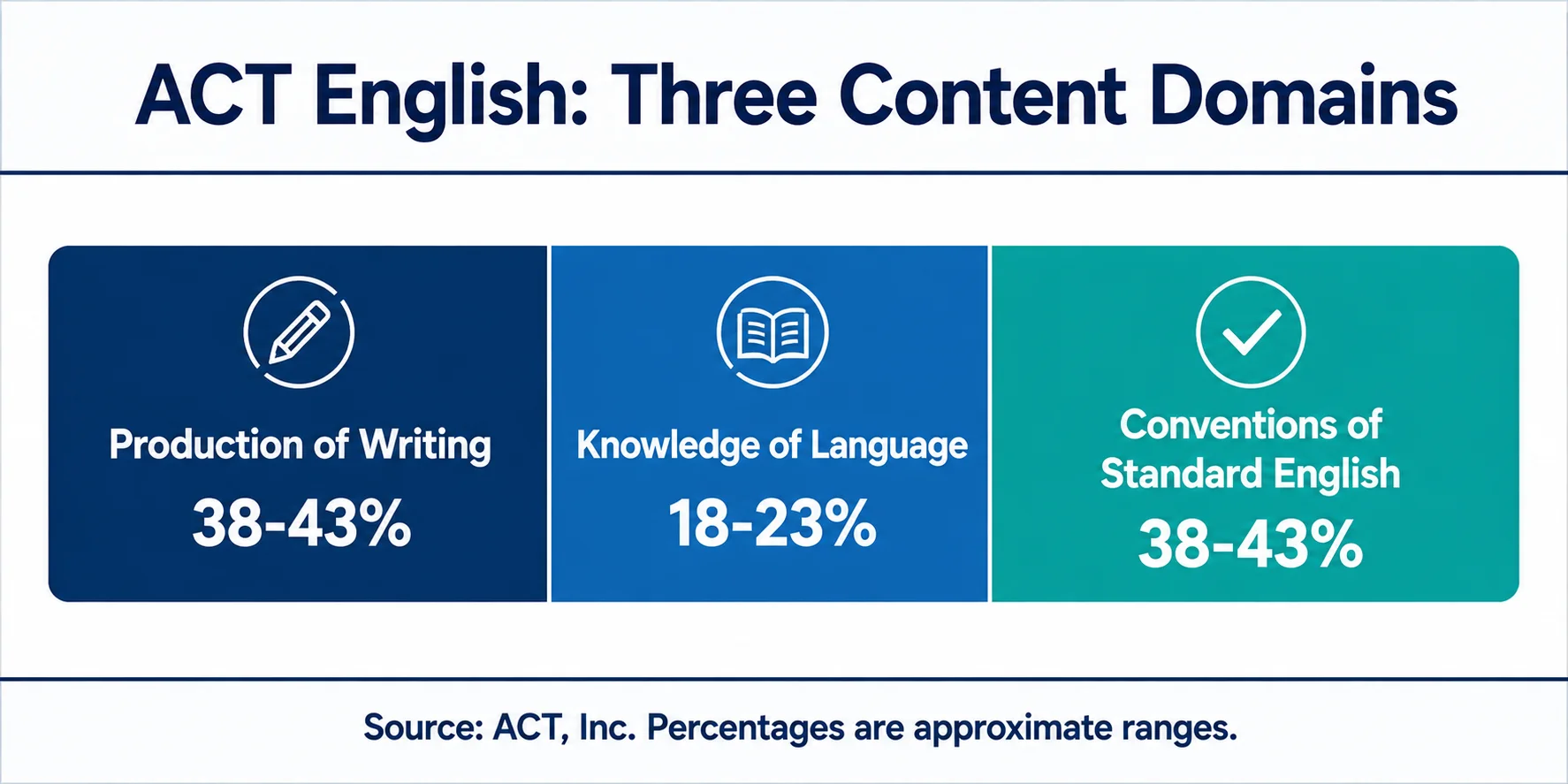
The ACT English section is the first section of the test. You edit five or six prose passages by answering questions about underlined portions. Some questions ask whether the underlined text is correct as written; others ask you to choose the best revision. Per ACT, Inc.'s current English section documentation, the section tests three content domains:
Domain | Share of questions | What it tests |
|---|---|---|
Production of Writing | 38-43% | Purpose, organization, development |
Knowledge of Language | 18-23% | Precision, conciseness, tone |
Conventions of Standard English | 38-43% | Punctuation, grammar, usage, sentence structure |
Format at a glance:
Fact | Current (Enhanced ACT, 2025) |
|---|---|
Total questions | 50 |
Scored questions | 40 |
Unscored field test items | 10 |
Time | 35 minutes |
Passages | 5 to 6 |
Time per question | ~42 seconds |
Guessing penalty | None |
Score scale | 1 to 36 |
No guessing penalty means you should never leave a bubble blank, even when you have no idea. The composite score is the average of your English, Math, and Reading scores under the current Enhanced ACT; Science is optional and does not affect the composite.
For a full breakdown of how the section fits into the overall exam, the ACT test sections and scoring guide walks through every part of the test in one place. And if you want to see how a perfect 36 in English translates to a composite result, you can model different section combinations using the NAT ACT English guide.
The complete free ACT English cheat sheet
The cheat sheet below summarizes the most frequently tested rules across all three domains. Download the free printable PDF for a clean reference copy. For a comprehensive grammar resource organized by rule category, refer to the full grammar and punctuation guide and its second part, which include examples for every tested pattern.
Conventions of Standard English: punctuation rules
Rule | Quick example |
|---|---|
Comma + FANBOYS: a comma before for, and, nor, but, or, yet, so joins two independent clauses | She studied all week, so she felt ready. |
Semicolon: joins two independent clauses with no conjunction | She studied all week; she felt ready. |
Comma splice: two independent clauses joined by only a comma is wrong | Wrong: She studied, she felt ready. |
Commas in a series: separate three or more items | apples, oranges, and bananas |
Introductory element: comma after an opening word or phrase | After the storm, the road was blocked. |
Nonessential clause: commas set off extra, non-defining information | My sister, who lives in Ohio, is visiting. |
Colon: introduces a list or explanation after a complete sentence | She brought three items: a book, a pen, and a map. |
Apostrophe: shows possession, not plurals; it's = it is; its = possessive | The dog wagged its tail. It's a good day. |
Conjunctive adverb (however, therefore, moreover): semicolon before, comma after | They finished on time; however, the results were wrong. |
Conventions of Standard English: grammar and usage rules
Rule | Quick example |
|---|---|
Subject-verb agreement: ignore distracting phrases between subject and verb | The box of cookies is empty. |
Pronoun agreement: match number, person, and gender | Every student brought their book. |
Pronoun case: subjects use I/she/they; objects use me/her/them | Between you and me, this is hard. |
Verb tense: stay consistent and logical within a passage | She walked in and sat down. |
Parallel structure: items in a list take the same grammatical form | running, biking, and swimming |
Modifier placement: a modifier must sit next to the word it describes | Running late, she grabbed her keys. |
Confused words: their/there/they're, its/it's, who/whom, affect/effect, less/fewer | Fewer students, less time. |
Production of Writing and Knowledge of Language: rhetorical skills rules
Skill | What it asks | How to answer |
|---|---|---|
Strategy | Does this sentence match the writer's stated purpose? | Re-read the question stem; match the stated goal, not your opinion |
Organization | Where should this sentence or paragraph go? | Track transition words and the logical flow |
Conciseness | Is the sentence wordier than it needs to be? | Delete any phrase that repeats information already stated |
Relevance | Does this detail belong in the passage? | Off-topic sentences are almost always wrong |
Tone | Does this word choice match the passage's register? | Formal passage needs a formal word; casual passage needs casual |
Transitions | Does this word show the right logical relationship? | Contrast gets "however," cause-and-effect gets "therefore" |
Cheat sheet tip: Roughly one in four ACT English answers is NO CHANGE. If you cannot find a concrete error, trust the passage as written. Overcorrecting is one of the most consistent score losses on this section.
Why students miss ACT English questions
The grammar rules above can be learned in a single study session. Many students still miss questions, not because they forget the rules, but because they focus on the wrong part of the sentence.
Frances O'Grady earned her B.A. in English and scored 1580 on the SAT, and she has taught ACT and SAT English at North American Tutors for over four years. She is the tutor behind Octavia's perfect 36 on the ACT English section. Over 5 years and with 500+ students, Frances sees the same reading error repeat across skill levels.
The solution is straightforward: before evaluating the underlined portion, read the entire sentence from the capital letter to the period. The subject in subject-verb agreement questions is rarely within the underline, and modifiers causing errors often appear just before the underlined section. Reading the full sentence takes only a few extra seconds and helps catch errors that guessing will miss.
Free ACT English practice questions
The following eight questions focus on rules most frequently tested in the Conventions and Knowledge of Language domains. Complete each question in approximately 42 seconds to match current ACT English pacing. Review each explanation only after checking your answer.
Passage: A morning at the farmers' market
Every Saturday morning, my grandmother loads her canvas bags into the back of her truck and drives to the farmers' market at the edge of town. She has been selling homemade preserves for more than thirty years, and her strawberry jam has earned a loyal following among local residents.
(1) The crowd at the market is thick, but she always arrives early enough to claim her usual spot beneath the old oak tree. She sets up her folding table, arranges the jars in neat rows, and hangs a hand-painted sign that reads "Grandma's Jam."
(2) Customers stop to chat, to sample her jams, and they tell her stories about their own gardens.
(3) She listens patiently while filling each jar and a smile spreads across her weathered face.
(4) By noon, most of the jars are sold, however, she always keeps one jar aside for my family.
(5) As we drive home, she says, "The market isn't about the money. Its about the people."
Question 1 — Punctuation and sentence structure
Which choice is best for the underlined sentence at (1)?
A. NO CHANGE
B. The crowd at the market is thick but she always arrives early enough to claim her usual spot
C. The crowd at the market is thick; but she always arrives early enough to claim her usual spot
D. The crowd at the market is thick, but, she always arrives early enough to claim her usual spot
Answer: A. Two independent clauses joined by a comma plus the conjunction "but" is the correct structure. B drops the comma before the conjunction, creating an error. C pairs a semicolon with a conjunction, which is wrong. D adds an unnecessary second comma after "but." NO CHANGE is the right answer here.
Question 2 — Parallel structure
Which choice best keeps the underlined list at (2) parallel?
F. NO CHANGE
G. Customers stop to chat, sample her jams, and they tell her stories about their own gardens.
H. Customers stop to chat, to sample her jams, and to tell her stories about their own gardens.
J. Customers stop to chat, to sample her jams, and telling her stories about their own gardens.
Answer: H. The structure "to chat, to sample, and to tell" keeps all three verbs in the infinitive form. F, G, and J each mix grammatical forms in the list.
Question 3 — Run-on and comma splice
Which choice best corrects the underlined portion at (3)?
A. NO CHANGE
B. She listens patiently while filling each jar, and a smile spreads across her weathered face.
C. While filling each jar, a smile spreads across her weathered face as she listens patiently.
D. Listening patiently while she fills each jar, a smile spreads across her weathered face.
Answer: B. The original joins two independent clauses with no comma, creating a run-on. B adds the comma before "and" to fix it. C and D create dangling modifiers: the opening phrase is attached to "a smile" rather than to the grandmother.
Question 4 — Conjunctive adverbs
Which choice is the best version of the underlined portion at (4)?
F. NO CHANGE
G. By noon, most of the jars are sold; however, she always keeps one jar aside for my family.
H. By noon, most of the jars are sold however she always keeps one jar aside for my family.
J. By noon, most of the jars are sold; however she always keeps one jar aside for my family.
Answer: G. "However" is a conjunctive adverb. The correct punctuation is a semicolon before it and a comma after it. F is a comma splice. H has no punctuation between the two clauses. J drops the required comma after "however."
Question 5 — Its vs. it's
Which choice best corrects the apostrophe error in the quotation at (5)?
A. NO CHANGE
B. "The market isn't about the money. It's about the people."
C. "The market is'nt about the money. Its about the people."
D. "The market isn't about the money. Its' about the people."
Answer: B. "It's" is the contraction of "it is," which is what the sentence needs. The original uses the possessive "its." C misspells "isn't" with a misplaced apostrophe. D invents a form that does not exist.
Question 6 — Conciseness
Which choice is the most concise version of the sentence without losing meaning?
(Original: "She makes extra jam for the reason that she likes giving gifts to her neighbors.")
F. NO CHANGE
G. She makes extra jam for the reason that she likes giving gifts to her neighbors.
H. She makes extra jam because she likes giving gifts to her neighbors.
J. The reason she makes extra jam is due to the fact that she likes giving gifts to her neighbors.
Answer: H. "Because" says the same thing as "for the reason that" and "due to the fact that" in far fewer words. F and G both use redundant phrasing. J is the most verbose option and the clearest wrong answer.
Question 7 — Subject-verb agreement
(Original: "A basket of fresh peaches [sit/sits] on the folding table.")
Which choice correctly completes the sentence?
A. sit
B. sits
C. have sat
D. were sitting
Answer: B. The subject is "basket," not "peaches." The prepositional phrase "of fresh peaches" sits between the subject and the verb. A singular subject takes a singular verb: "sits."
Question 8 — Organization and relevance
The writer wants to add the following sentence to the passage: "The market first opened in 1987, three years before my mother was born."
Where is this sentence MOST relevant?
F. At the start of paragraph one
G. At the end of paragraph one
H. At the end of paragraph two
J. The sentence does not belong in this passage
Answer: F. Paragraph one introduces the market and the grandmother's long history with it. A historical fact about when the market opened belongs at the start of that paragraph, where it gives context before the scene is described. The sentence would be out of place after the scene is already underway.
Answer key at a glance
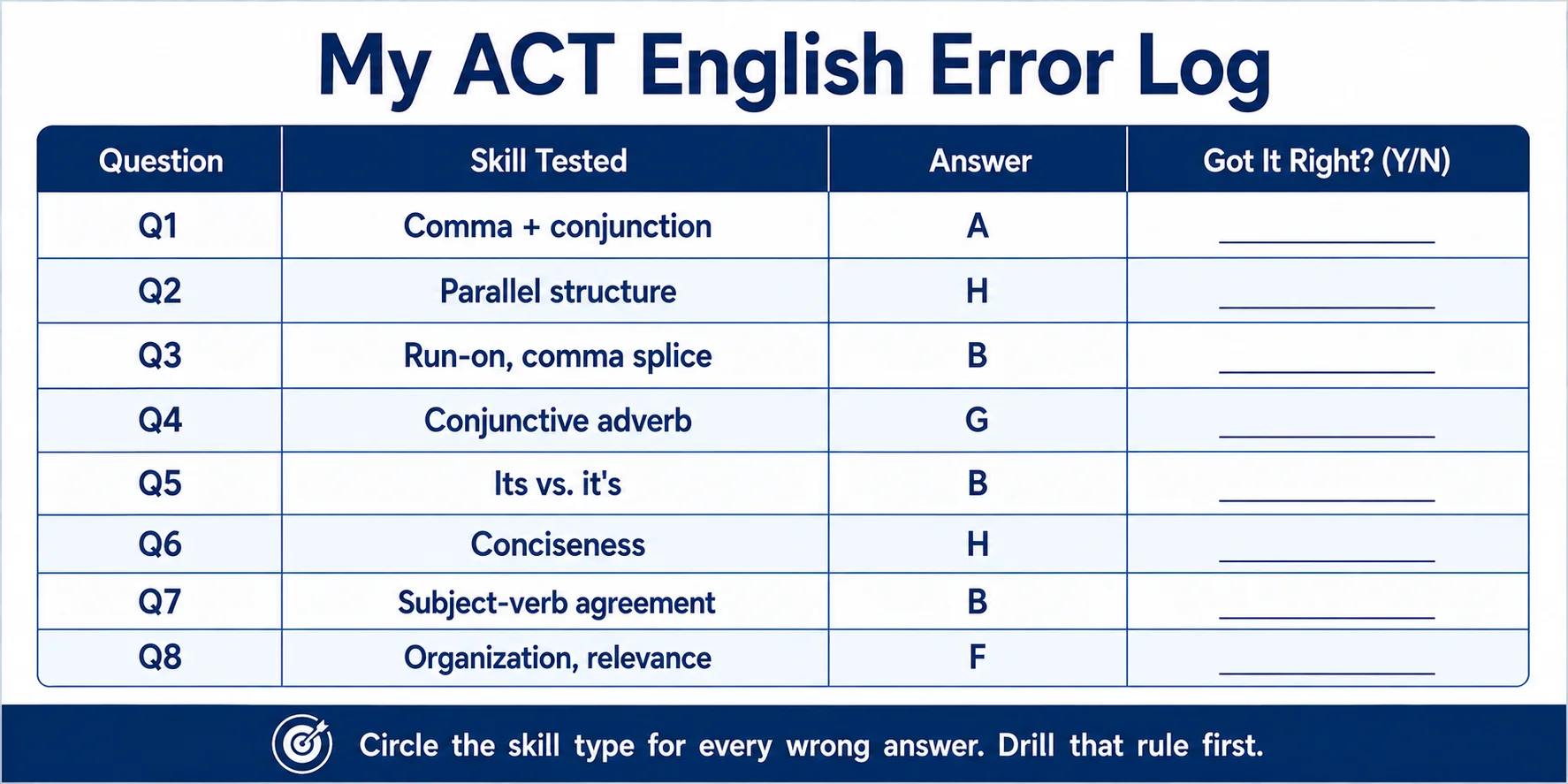
Question | Skill | Answer |
|---|---|---|
1 | Comma + conjunction | A |
2 | Parallel structure | H |
3 | Run-on / comma splice | B |
4 | Conjunctive adverb | G |
5 | Its vs. it's | B |
6 | Conciseness | H |
7 | Subject-verb agreement | B |
8 | Organization / relevance | F |
What a perfect 36 English score looks like in practice
Octavia started with a 32 ACT composite and wasn't certain which test was the better fit for her. Her tutor, Frances O'Grady, focused her work on grammar mechanics — linking clauses, modifier placement, tone, and word choice — while drilling full ACT English sections each week. Octavia finished with a 35 composite and a perfect 36 on the ACT English section.
The method Frances used wasn't about covering every possible rule. It was about identifying the specific errors Octavia kept making, naming the rules behind them, and drilling those patterns until they were automatic. Grammar mastery at that level comes from repetition with a diagnostic loop, not from reading the rules once and hoping they stick.
You can read Octavia's full ACT score improvement story on the NAT site. The score progression and the session approach are both described there.
If you want a similar diagnostic plan for your own ACT English prep, a free strategy session with NAT identifies the specific rule categories costing you points and maps a preparation path from your current English score to your target. Book a free ACT English strategy session and leave with a specific list of rules to drill, not a general study plan.
ACT grammar practice strategy that actually works
Most students practice by reading all the rules and then doing questions and checking answers. The problem is that checking answers after the fact doesn't tell you what went wrong in the reading process. You end up knowing you got question 14 wrong but not knowing why your eyes skipped past the subject before the verb.
Lia Hansen attends Dartmouth College and scored 1580 on the SAT, with a perfect 800 on reading. She earned 5s on both AP English Language and AP English Literature, and at NAT she works with students on the precision the English section rewards. She has noticed that timing failures in ACT English are almost never about speed.
Lia's observation points to a specific technique: look at the answer choices before you read the full sentence. The four answer choices tell you which rule the question is testing. If the only differences between A, B, C, and D are comma placement options, the question is testing punctuation. Read for that rule specifically. If two choices include "however" with different punctuation, the question is testing conjunctive adverb mechanics. Name the rule first, then read the sentence for that rule alone.
The five-step method for each question:
Look at the answer choices and identify what changes between them.
Name the rule being tested (punctuation, agreement, parallelism, conciseness, or relevance).
Read the full sentence from the capital letter to the period, looking for that rule.
Eliminate the two choices that most clearly violate the rule.
Compare the final two choices on meaning and tone, then commit.
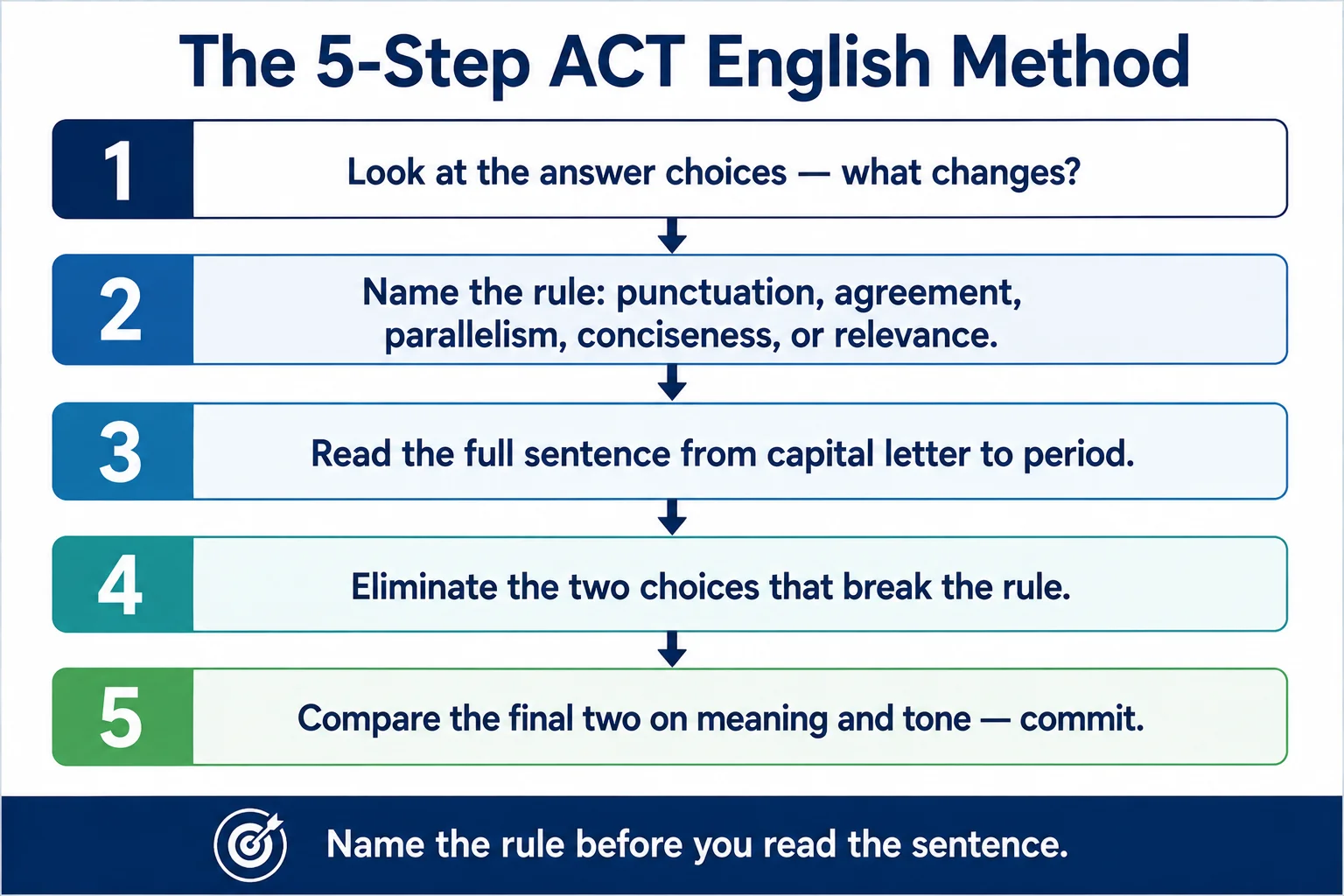
Use this method on every timed ACT English practice set you take. Log which rule type appears in each wrong answer. After five practice sets, the two or three rules showing up most often in your error log are your highest-value drill targets.
For a wider range of practice and scoring context, the average ACT composite and section scores page gives a benchmark for where your current English score sits nationally. You can also find additional ACT tips and tricks for every section of the exam.
Rhetorical skills: the half of the test most students underprepare for
The Conventions domain is the half that most students study. The production of writing domain is the half most students ignore. Together, those two domains make up the entire English section. A student who drills every punctuation rule but never practices rhetorical questions has prepared for less than half the test.
Jamie Cheung graduated summa cum laude from UCLA with a 3.99 GPA and has over five years of teaching experience, including standardized English prep. At NAT, she works with students on the judgment calls the English section rewards: not just grammar, but whether the passage needs a sentence at all.
Three rhetorical skills to practice specifically:
Conciseness: When two answer choices say the same thing, pick the shorter one. The ACT penalizes redundancy. Phrases like "the reason why... is because" and "due to the fact that" are always wrong when "because" is an available choice.
Relevance: When the question asks whether to add or keep a sentence, ask whether it directly supports the paragraph's main idea. If it introduces a new topic or repeats information already stated, it does not belong.
Transition words: The ACT tests whether students can identify the correct logical relationship between sentences. "However" signals contrast. "Therefore" signals cause and effect. "In addition" signals continuation. Read both sentences, identify the relationship, then pick the transition word that matches.
For more on the rhetorical structures the ACT tests most often across both ACT and SAT, the advanced grammar and punctuation guide covers style and organization patterns in depth.
The ACT English section primarily rewards two skills: identifying which rule a question tests before reading the sentence, and trusting the passage when no error is present. Most students who plateau do so by misreading sentence structure or overcorrecting answers that were already correct.
The cheat sheet summarizes the rules, and the practice questions provide timed experience with common question types. Next, track your errors across multiple practice sets to identify the two or three rule categories that recur in your incorrect answers. Focus your preparation on these areas until test day.
NAT tutors who scored 34 or higher on the ACT work one-on-one with students to build that kind of specific preparation plan. A free strategy session includes a section-level diagnostic and a prioritized list of rule categories to address before your next attempt. Book a free ACT English strategy session, and connect with tutors through NAT's ACT tutoring team or browse free ACT resources to continue your prep.