Free ACT Math Practice Questions & Cheat Sheet (PDF)
No signup needed. Just click to download
Click to download the free 45-question ACT math practice set and the one-page strategy cheat sheet at the top of this page. No email. No signup. Just download and start.
Most students who come to us after a frustrating practice test say some version of the same thing: "I know the math, but my score won't move." That is rarely a content problem. After working with thousands of students on ACT math, NAT tutors have found that score plateaus almost always trace back to one of four diagnosable errors, and doing more random practice without fixing the error keeps the score exactly where it is.
Everything in this guide follows the current Enhanced ACT format: 45 questions, 50 minutes, four answer choices per question, no formula sheet. If your prep materials say "60 questions, 60 minutes," that format is retired. Everything here reflects the current test.
NAT tutors scored 36 and 35 on the ACT, and NAT states an average ACT composite gain of 5 or more points. Below, you will find the current math format, seven worked practice questions tagged by error type, a strategy cheat sheet, the four-error framework that explains most missed points, a three-step method for using the practice set, what your score actually means, and answers to the questions students ask most.
What's inside this free ACT math practice pack
You get three resources in the download.
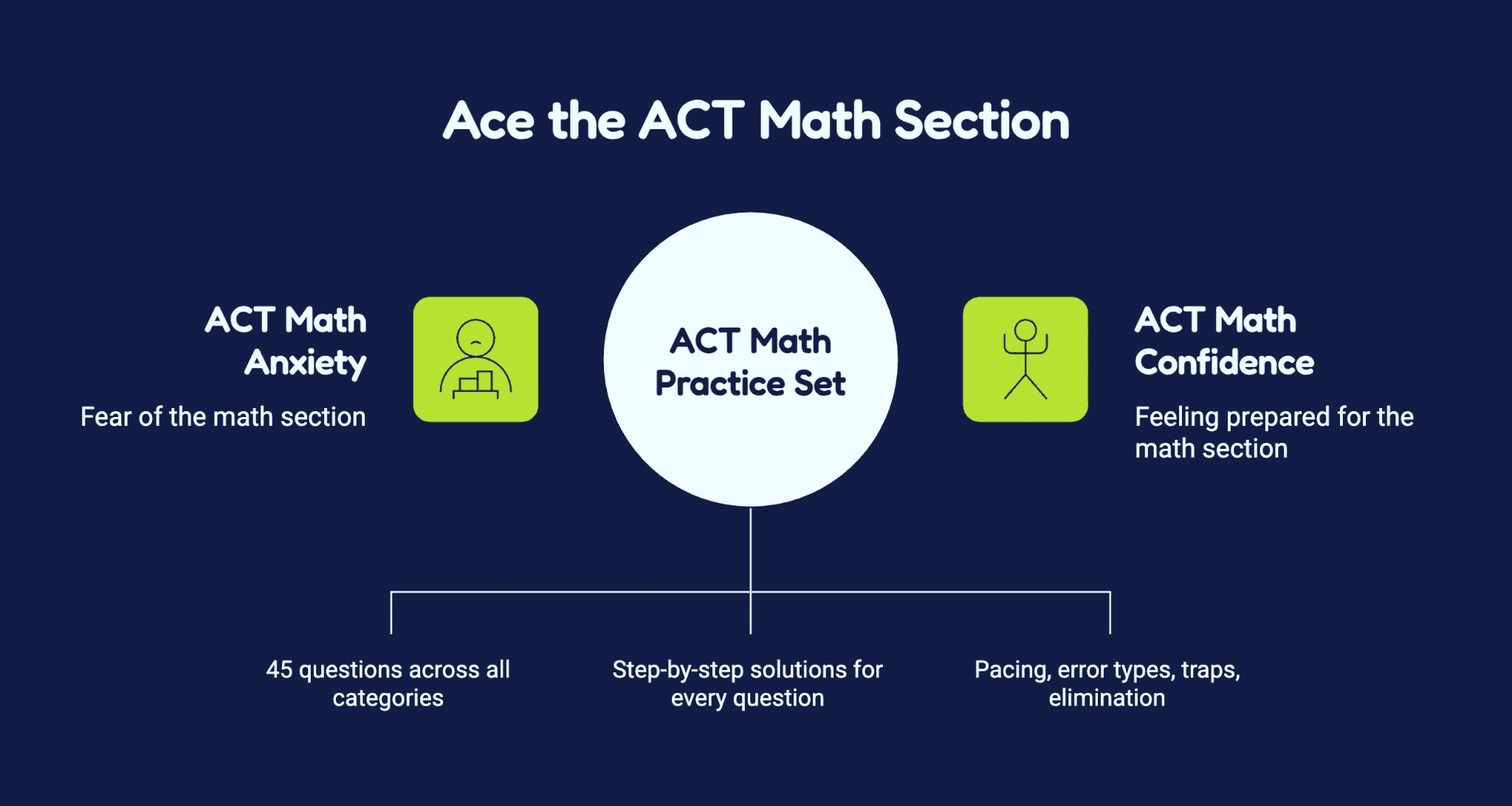
45-question ACT math practice set (PDF). Questions are distributed across all tested content categories in roughly the same proportion as the real Enhanced ACT, weighted toward Algebra and Functions, with Geometry, Statistics and Probability, and Trigonometry spread through the rest. A 50-minute timing guide is included so you can run it like a real section.
Answer key with worked solutions (PDF). Every question includes a full step-by-step solution, not just the final answer. Wrong answers get explained too, because knowing why B is wrong is often more useful than knowing why C is right.
One-page strategy cheat sheet (PDF). This is a strategy and process sheet, not a formula dump. It covers pacing checkpoints, the four error types, common traps, answer-elimination rules, and a formula-recall checklist that points to the full formula list for deeper review.
Each resource matches the Enhanced ACT format and is ready to print or use on-screen. For a full formula list, use NAT's one-page ACT math formula sheet alongside this guide.
The ACT math section: 45 questions, 50 minutes, no formula sheet
Here is the current Enhanced ACT math section at a glance.
Feature | Current Enhanced ACT |
|---|---|
Total questions | 45 |
Scored questions | 41 (4 are unscored field-test items) |
Time | 50 minutes |
Answer choices | 4 per question |
Average time per question | ~67 seconds |
Calculator | Permitted for the entire section |
Formula sheet | Not provided |
Score range | 1 to 36 |
If your prep books or old practice tests say "60 questions in 60 minutes," they are using the retired format. The math section is shorter now, with the same 1-to-36 scale but tighter pacing pressure on every question.
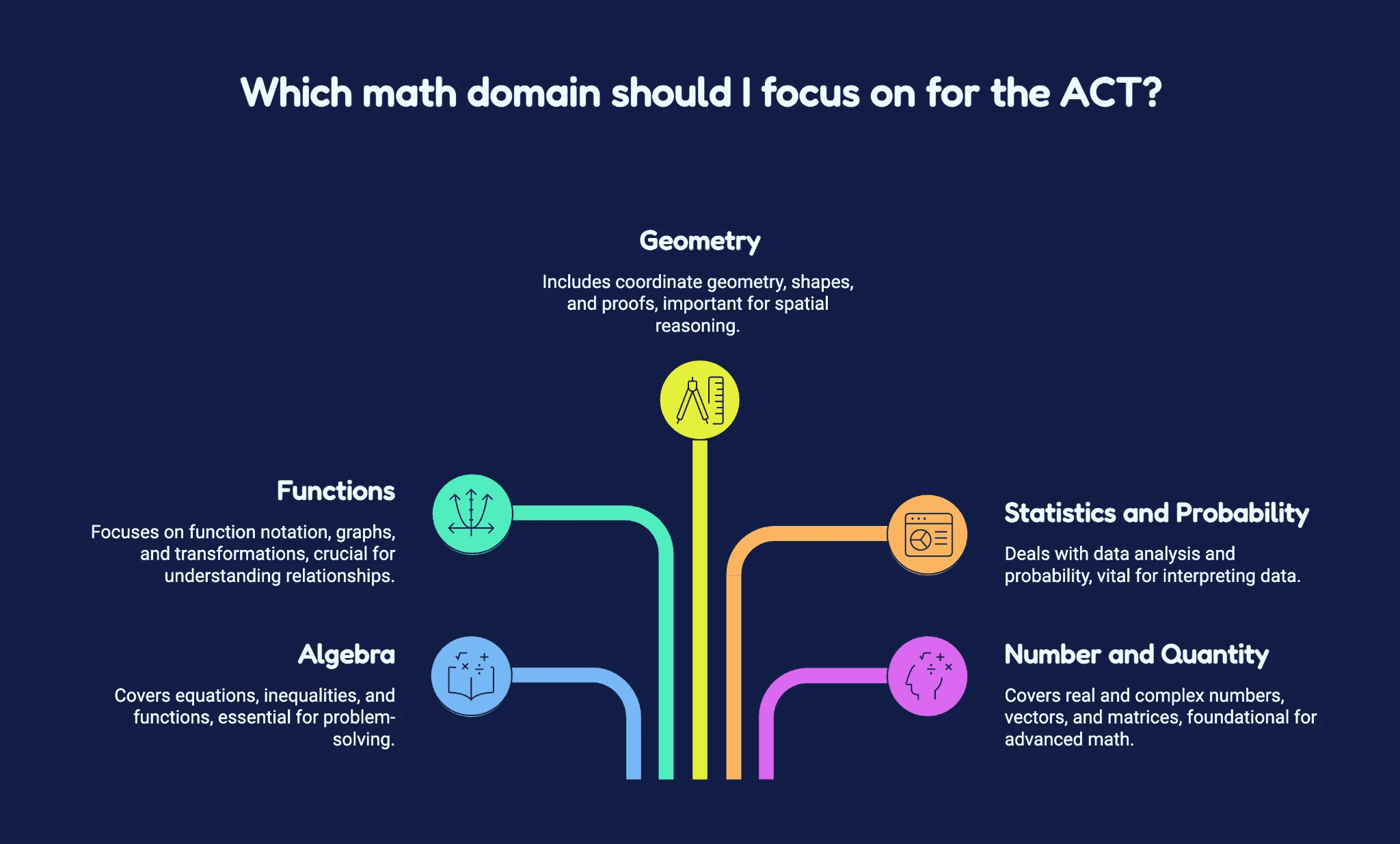
What the section actually tests: ACT, Inc. states that about 80% of the math section falls under Preparing for Higher Math, which spans five domains.
Algebra: equations, inequalities, functions defined by equations, linear and polynomial expressions
Functions: function notation, graphs, transformations, piecewise functions
Geometry: coordinate geometry, shapes, measurement, proofs and properties
Statistics and Probability: data collection, distributions, center and spread, probability
Number and Quantity: real and complex numbers, vectors, matrices, integer and rational exponents
The remaining 20% is Integrating Essential Skills, which applies math to multi-step real-world problems: ratios, proportions, rates, percentages, area, volume, and averages. Modeling questions run through both categories, showing up as word problems and data-interpretation scenarios where you have to set up a mathematical model before you can solve anything.
Calculator policy. You can use a calculator for the entire section. Graphing and scientific calculators are permitted; calculators with a computer algebra system, or CAS, are not. On the digital ACT, a built-in Desmos graphing calculator is available during math. <cite index="13-1"> Calculators are allowed only on the mathematics test, and every problem on that test can be solved without one </cite>, so treat your calculator as a speed tool, not a crutch. Confirm your specific model against ACT's calculator policy before test day.
For a deeper breakdown of the math section, including study plans and topic priorities, NAT's ACT math section guide covers the full picture.
Try these free ACT math practice questions
The seven questions below are pulled from the full 45-question set in the downloadable PDF. Each is tagged with the error type it most commonly exposes. Those tags matter once you reach the four-error framework further down.
Work each question before reading the solution. If you miss one, check the error tag and ask yourself which mistake actually happened, not just which answer was right.
Q1 — Algebra
If 3x + 7 = 4x - 2, what is the value of x?
A) 5
B) 7
C) 9
D) 11
Answer: C. Subtract 3x from both sides: 7 = x - 2. Add 2 to both sides: x = 9. The most common wrong answer is A (x = 5), which comes from a sign slip while moving terms across the equal sign. Error tag: careless arithmetic.
Q2 — Algebra / word problem
A store sells pens for $2 each and notebooks for $5 each. A student buys 6 items total and spends $21. How many notebooks did the student buy?
A) 2
B) 3
C) 4
D) 5
Answer: B. Set up two equations: p + n = 6 and 2p + 5n = 21. Substitute p = 6 - n into the second equation: 2(6 - n) + 5n = 21, which gives 12 + 3n = 21, so n = 3. Students who pick A usually build the cost equation from the wrong quantities. Error tag: setup error.
Q3 — Functions
If f(x) = x² - 2x + 1, what is f(4)?
A) 7
B) 9
C) 11
D) 15
Answer: B. Substitute 4 for x: f(4) = 16 - 8 + 1 = 9. The common mistake is computing something like f(x - 2) instead of plugging 4 in cleanly. Error tag: function-notation error, a subtype of setup error.
Q4 — Geometry
A right triangle has legs of length 5 and 12. What is the length of the hypotenuse?
A) 10
B) 13
C) 15
D) 17
Answer: B. Apply the Pythagorean theorem: 5² + 12² = 25 + 144 = 169, so c = 13. Students who pick A often try to add or average the legs instead of using a² + b² = c². Error tag: formula recall.
Q5 — Statistics and Probability
A bag contains 3 red, 5 blue, and 2 green marbles. If one marble is drawn at random, what is the probability that it is blue?
A) 1/10
B) 1/5
C) 1/2
D) 3/5
Answer: C. Five blue marbles out of ten total: 5 ÷ 10 = 1/2. The most common wrong answer is D (3/5), which comes from using the wrong total, the sum of two colors instead of all three. Error tag: setup error.
Q6 — Trigonometry
In a right triangle, one angle measures 30 degrees and the hypotenuse is 10. What is the length of the side opposite the 30-degree angle?
A) 5
B) 5√3
C) 10
D) 10/√3
Answer: A. In a 30-60-90 triangle, the side opposite the 30-degree angle is half the hypotenuse: 10 ÷ 2 = 5. Students who pick B are confusing the side opposite 30 degrees with the side opposite 60 degrees. Error tag: formula recall, specifically 30-60-90 ratio confusion.
Q7 — Integrating Essential Skills / percent
A jacket costs $60. During a sale, the price is reduced by 25%. What is the sale price?
A) $40
B) $45
C) $48
D) $50
Answer: B. 25% of $60 is $15, so the sale price is $60 - $15 = $45. The most common wrong answer is A, which usually comes from misremembering the discount as roughly a third off instead of a quarter off. Error tag: answering the wrong question, since the discount amount and the sale price are two different numbers.
The full PDF set mirrors the Enhanced ACT's category weighting, with more questions per topic and the same answer key and worked solutions.
Free ACT math cheat sheet: what to review the week before your test
The one-page cheat sheet in this guide is a strategy document. It will not replace formula memorization; you still need your formulas cold before test day, and NAT's free one-page ACT math formula sheet handles that job. The cheat sheet here covers what to do with your knowledge once you are actually in the testing room.
Here is what it includes.
Three pacing checkpoints
By question 15: roughly 33 minutes should remain
By question 30: roughly 16 minutes should remain
With 10 minutes left: bubble an answer for every unanswered question, since there is no guessing penalty
The four error types, in summary Setup error, formula recall, wrong question, careless arithmetic. The full breakdown is in the next section.
Six trap warnings
The problem asks for x + 5, not x
The shaded region, not the whole shape
The diameter, not the radius
Percent of the new value, not the original
The median, not the mean
The probability of NOT event A, when you calculated P(A)
Answer-elimination rules
Eliminate obviously extreme values first
On geometry, an answer larger than the whole figure is wrong
On probability, no answer can fall below 0 or above 1
Calculator do and don't list
Do use it for messy arithmetic and to double-check your setup
Do use Desmos on the digital ACT for graphing questions
Don't use it as a substitute for knowing your formulas
Don't punch numbers into the calculator before you have set the problem up on paper
Formula-recall checklist A short list of categories to confirm you have memorized: area, perimeter, volume, the Pythagorean theorem, special triangles, slope, SOHCAHTOA, and the quadratic formula. The full list lives on the ACT math formula sheet.
When a parent tells us their child "knows the math" but the practice score will not move, Kurtis Lee is the tutor we route the conversation to first. Kurtis scored a 36 on the ACT and a 1570 on the SAT, and he is finishing an M.S. in Mechanical Engineering at UIUC after earning 4s and 5s in 15 AP courses. In his 5 years of one-on-one teaching and 300 students, he has watched the same formula-recall pattern erase points across every score range.
The cheat sheet's formula-recall checklist is built for exactly that daily writing drill. Check off a formula only once you can reproduce it from memory, not once you can recognize it on a page.
The four errors NAT tutors see most on ACT math
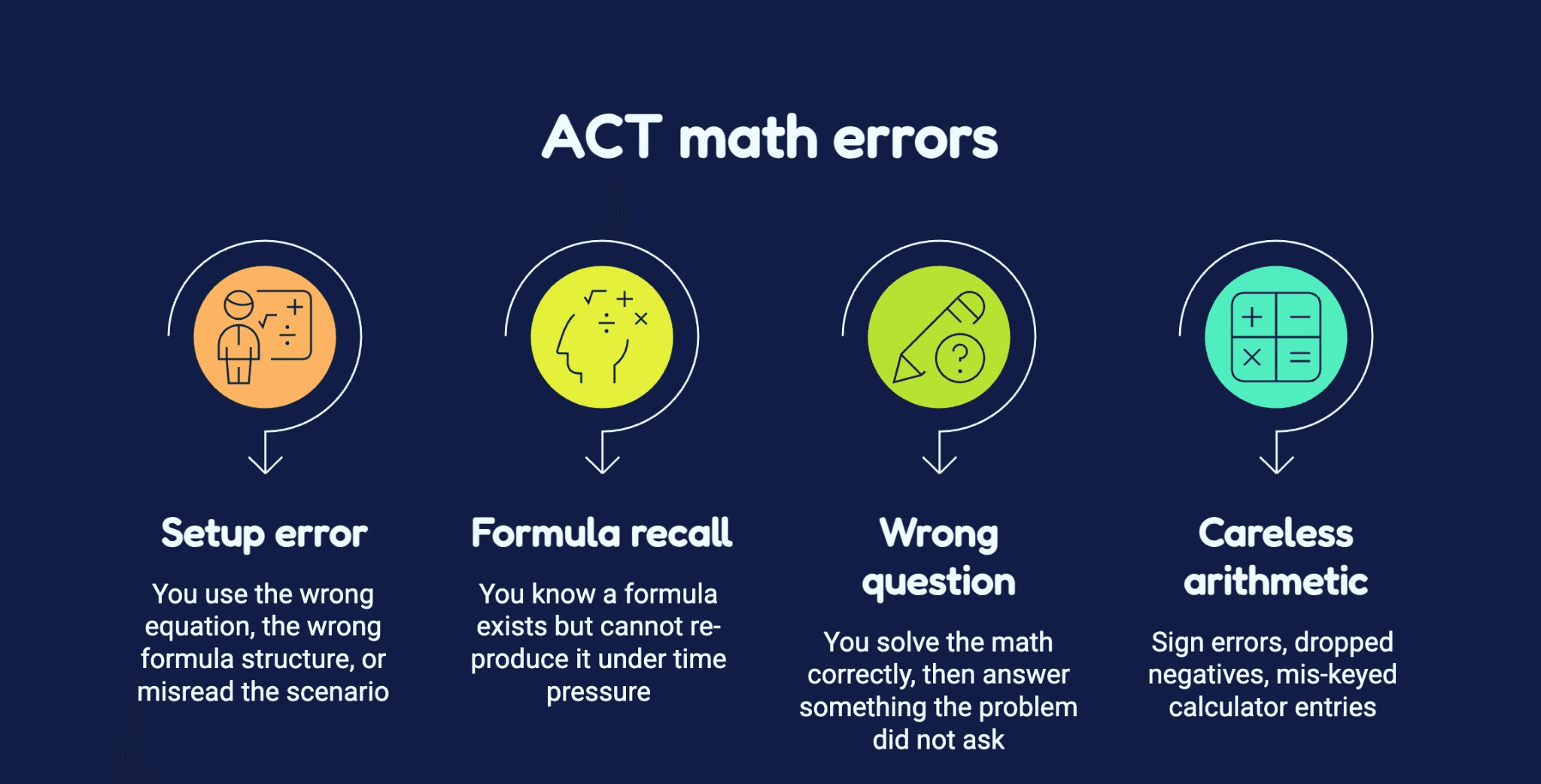
Nearly every missed ACT math question falls into one of four categories. The content is learnable. What holds students back is usually a process error, not a lack of knowledge.
Identifying your error type is more valuable than running another practice section without understanding your mistakes.
Error type | What it looks like | The fix |
|---|---|---|
Setup error | You use the wrong equation, the wrong formula structure, or misread the scenario | Read the problem twice; write down what you are solving for before touching the math |
Formula recall | You know a formula exists but cannot reproduce it under time pressure | Write formulas from memory daily; use the checklist on the cheat sheet |
Wrong question | You solve the math correctly, then answer something the problem did not ask | Read the final sentence of the question before bubbling anything |
Careless arithmetic | Sign errors, dropped negatives, mis-keyed calculator entries | Write out each step; do not skip work to save time |
Every error type has a specific fix. Doing 50 more practice questions without targeting your error type keeps your score exactly where it is.
Kurtis's formula-recall insight sits in the cheat sheet section above. For setup errors and wrong-question errors, Prisha Bali sees both constantly.
Strong math students often assume their ACT math misses are random. Prisha Bali sees it differently. She scored a 35 on the ACT and studies bioengineering at UCLA, where she also builds STEM curricula and carries top AP scores in Calculus BC and Chemistry. Across 6 years of tutoring, the mistake she corrects most often is not a content gap at all.
Reading the final sentence before bubbling your answer catches wrong-question errors before they cost you points. It takes two seconds per question and is worth practicing on every question in the set.
For a deeper look at how the four error types distribute across content categories, both NAT's ACT math section guide and the ACT tutoring overview walk through the full framework.
As you work through the 45-question set and log your misses by error type, you will usually see one or two types dominate. That pattern tells you what to fix next.
If you are not sure which error type is costing you the most points, a free ACT strategy session with a NAT tutor will map your error pattern in the first hour and leave you with a prioritized plan for your score range. Book your free session.
How to use these free ACT math practice questions
Practice only helps when it targets your real errors. The students who raise their ACT math scores are the ones who diagnose first and drill second—not those who just do the most questions.
Here is the three-step method.
Diagnose. Take a short, untimed set of 10 to 15 questions and log every miss by error type: setup, formula recall, wrong question, or careless arithmetic. Use the error tags on the sample questions above as your model. After 15 questions, a clear pattern usually shows up, with one or two error types accounting for most of your misses.
Drill. Once you know your dominant error type, spend your next practice session fixing it specifically. If it is formula recall, run Kurtis's daily memory drill. If it is wrong-question errors, practice Prisha's "read the last line first" habit on every question for a week before you time yourself. If it is setup errors, slow down and write out your model before calculating anything.
Timed set. After two weeks of targeted drilling, take the full 45-question set under timed conditions: 50 minutes, one sitting, approved calculator only. Score it, log your misses by error type, and compare to your earlier results. Most students see their dominant error type shrink and a new one appear. That shift tells you it is time to start the next drill cycle.
A score plateau between 24 and 27 on ACT math usually is not a knowledge problem. Kendra Kim sees the cause in how students spend the 50 minutes, not in what they know. Kendra is a junior majoring in statistics at the University of Chicago, she has qualified for AIME, and she took 18 AP courses in high school, which gives her a numbers-first read on test strategy. In 4 years of tutoring and 200 students, her pacing advice is what students report back on first.
The three-checkpoint pacing plan from Kendra, question 15, question 30, ten minutes remaining, is built into the strategy cheat sheet. During your timed practice run, mark each checkpoint on your scratch paper and stay off the clock in between.
The case for targeted practice: Everleigh's story
Everleigh started with a 23 composite and a 26 in math. Her problem was not content knowledge. She was losing time on harder questions after question 30, and she was reading advanced prompts imprecisely, which led to wrong-question errors on material she actually understood well.
Over four months of timed execution drills, calculator strategy work, and a deliberate shift from mental math to written calculation, her math score rose to 32 and her composite superscore reached 31. Her story makes the case for diagnosing your error pattern before adding more practice volume.
For more free resources alongside this practice set, ACT.org's own free official ACT practice tests and prep tools include official sample questions and a full prep guide. Using official material for full-length timed runs, and NAT's set for error-diagnosis practice, gives you both scoring validity and diagnostic detail.
When you are ready to work through your error patterns with a tutor, NAT's ACT tutor collection and ACT tutoring resource hub are good next stops.
What your ACT math score means
ACT math is scored on a 1-to-36 scale. Here is where the most common score targets currently land nationally.
Math score | Current national percentile | What it means |
|---|---|---|
36 | 100th | Perfect section score |
30-35 | 96th-99th | Competitive for selective STEM programs |
24-29 | 81st-94th | Above average; competitive at most four-year schools |
20-23 | 68th-77th | At or slightly above the national average |
Below 20 | Below 68th | Below the national average; real room to gain points |
The current national average ACT math score is 19.0, based on recent high school graduates. A math score of 24 places you at the 81st percentile nationally. Selective STEM programs typically look for 30 or higher in math specifically.
Your real target depends on the schools you are applying to, not the national average. Use NAT's ACT score calculator to work out your current composite, and check the ACT score percentiles guide and what is a good ACT score articles to benchmark against your target list.
For the official, current national percentile ranks, ACT's national score ranks page is the primary source, and it updates periodically as new graduating classes are added.
Putting it together
Practice questions only raise your score when they are paired with error diagnosis. Download both PDFs, log your misses by error type on your first untimed pass, then run targeted drills for two weeks before you take a timed set. The cheat sheet gives you the framework, the 45-question set gives you the material, and the answer key with worked solutions closes the loop.
If you work through the set and want help identifying which error type is holding your score back, NAT tutors scored 36 on the ACT, and NAT states an average composite gain of 5 or more points. A free strategy session takes one hour and leaves you with a specific plan for your score range, with no long-term contract required.
Book a free ACT math strategy session with a NAT tutor.
For more ACT preparation resources, NAT's ACT math section guide, ACT tutor collection, and ACT prep blog are good next stops.