How to ace the SAT: a complete guide to digital SAT prep
Date:
Date:
TL;DR
Acing the SAT means mastering the digital format, not just the content. Focus on three things: smart Desmos use, adaptive module strategy, and targeted error review. Most students improve 90-120 points with structured prep. Start with a diagnostic, build a 6-12 week plan, and finish with the Last 48 Hours protocol below. Your grades are now our responsibility.
TL;DR
Acing the SAT means mastering the digital format, not just the content. Focus on three things: smart Desmos use, adaptive module strategy, and targeted error review. Most students improve 90-120 points with structured prep. Start with a diagnostic, build a 6-12 week plan, and finish with the Last 48 Hours protocol below. Your grades are now our responsibility.
If you're "stuck at 1300" and feel like you're "grinding" with nothing to show for it, you're not alone. Learning how to ace the SAT is harder than most guides admit, because the digital SAT format works differently from the old paper test. It's adaptive, it uses a built-in Desmos calculator, and it rewards test strategy just as much as content knowledge.
According to the College Board's 2025 SAT Suite Annual Report, the national average SAT score is 1029 across more than 2 million test takers, and only 7% of students score 1400 or above. That gap is real, but it's closeable with the right prep. Research from the Brookings Institution shows that structured, targeted prep produces measurable SAT gains, and federal test prep research from NCEE confirms that students who follow organized programs see significant score improvements, with larger effects for students who start from lower baselines.
This guide covers SAT prep tips, Desmos strategies, reading and writing tactics, and last-minute advice from NAT tutors who scored 1500 or above on the actual test.
How long does SAT prep take to see real results?
Most students see meaningful SAT score improvement in 6-12 weeks of consistent, structured prep. Students working one-on-one with a tutor typically improve 90-120 points, while self-study results vary widely. The biggest factor is not time: it's whether you're targeting your actual weak areas, not just doing generic practice.
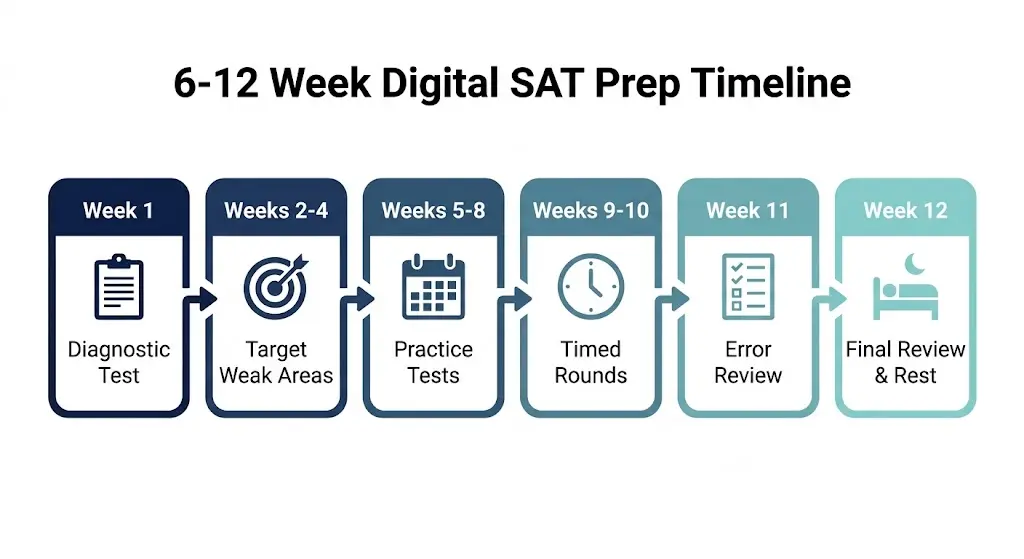
Students who start prep three or more months before test day build a foundation that compounds over time. They complete more diagnostic rounds, fix error patterns earlier, and arrive on test day with real confidence rather than last-minute panic. College Board reports show that students who retake the SAT improve by an average of 40 points, which means most students leave significant score on the table on their first attempt by not doing enough targeted prep. An AERA Journal meta-analysis found that one-on-one tutoring produces larger standardized test gains than group prep, which is consistent with what NAT tutors observe across sessions.
If you already have a PSAT score, use our PSAT to SAT score conversion guide to set a realistic target before you build your timeline. For a full breakdown of how to schedule practice rounds, read our guide on how many practice tests you need before test day.
Alexander J., our SAT tutor from Brown Medical School, describes the pattern after having more than 750 sessions with SAT students like this:
"Students who start three months out almost always reach their target score. The ones who come to me two weeks before test day aren't really preparing, they're hoping. In my first session with any new student, I build a personal error log before we touch any new content. I don't care how many practice tests they've done. I care which three question types they miss every single time, and we fix those before anything else."
What are the best digital SAT tips and tricks for math?
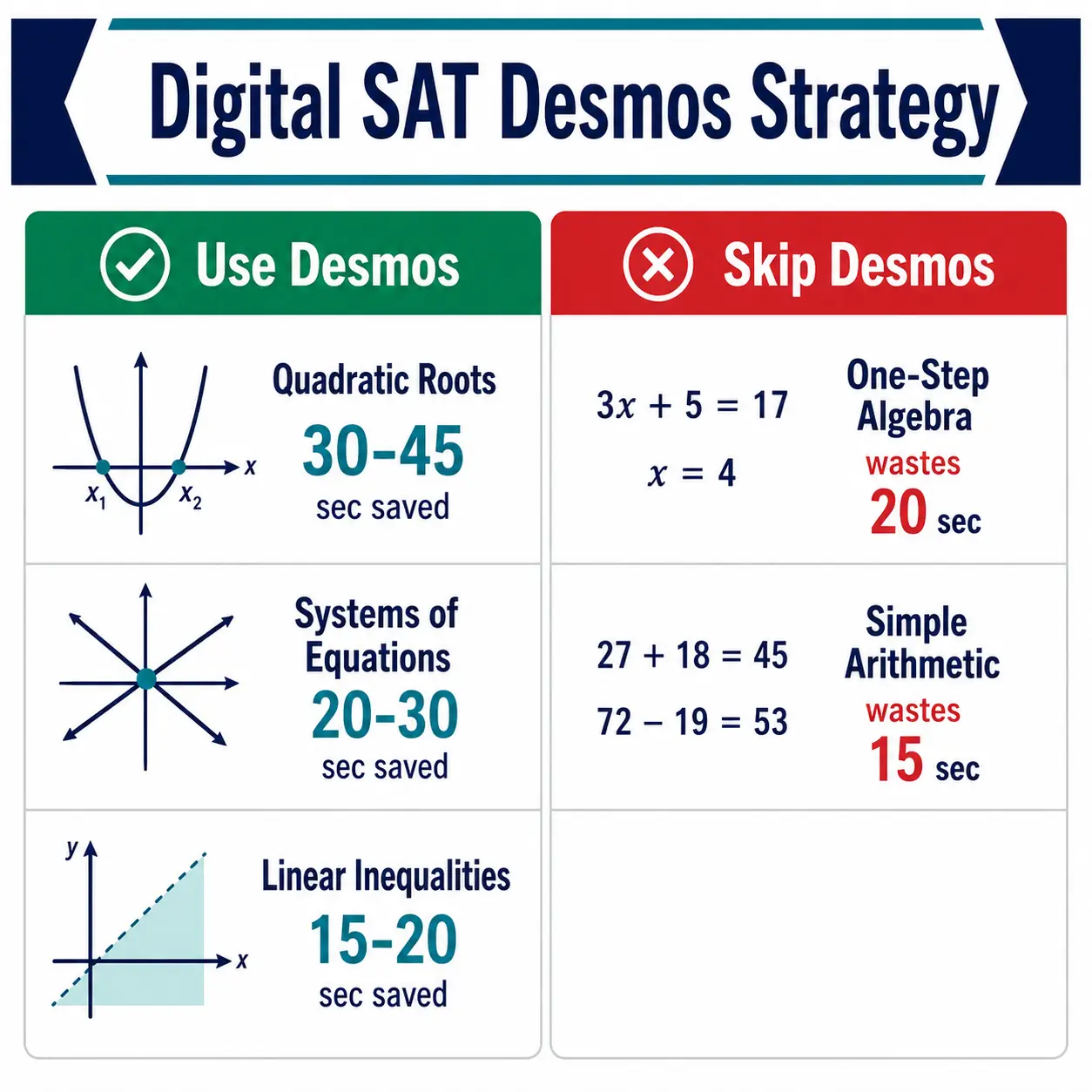
The digital SAT math section rewards strategic Desmos use, not just calculator speed. Master the "big five" Desmos functions: graphing, tables, intersections, regression, and inequalities. For quadratics and systems of equations, graph first and confirm with algebra. Never use Desmos for one-step mental math. Practice under timed conditions so you instinctively know when Desmos saves time and when it wastes it. Download our free SAT Desmos Cheat Sheet and our free SAT math formula sheet to use alongside timed practice sessions.
Question Type | Use Desmos? | Time Saved |
|---|---|---|
Quadratic roots or vertex | Yes | 30-45 seconds |
System of equations | Yes | 20-30 seconds |
Linear inequality | Yes | 15-20 seconds |
One-step algebra | No | Wastes 20 seconds |
Simple arithmetic | No | Wastes 15 seconds |
Jay.S scored a perfect 800 in Math on the August 2025 SAT after drilling his Desmos decision process in NAT sessions. Diya.D reached a 760 Math score and a total 1510 after working through the same strategy with her NAT tutor.
How do I improve my SAT reading and writing score?
The Digital SAT Reading and Writing uses short 25-150 word passages, usually with one question per passage. The key is active reading: pre-highlight line references, jot quick "caveman notes" for the main idea, and eliminate wrong answers before picking the correct one. For grammar, master the 12 most-tested rules: subject-verb agreement, comma splices, semicolons, pronoun clarity, and modifier placement. Grammar is the fastest part of the test to improve with focused, daily drills.
College Essay Guy's active reading guide describes the pre-highlighting and process-of-elimination habits that strong readers use consistently on short-passage questions. The annotation tools in the College Board's Bluebook app, including the built-in line reader, answer eliminator, and flagging feature, let you practice these habits in the exact interface you'll use on test day. Use Bluebook for every practice session, not third-party apps.
Gia K., our SAT tutor from Cornell, describes the pattern after having more than 750 sessions with SAT students like this:
"About 80% of students I work with who are plateaued below 700 in Reading and Writing are stuck in what I call the Sounds-Right Trap. They pick the answer that feels natural in conversation, not the one that follows the formal grammar rule. In every session, I start by giving students exactly ten grammar-rule flashcards — just ten — and we don't move on until all ten are automatic. Once they stop choosing by feel, their R&W score typically jumps 40-60 points within two weeks."
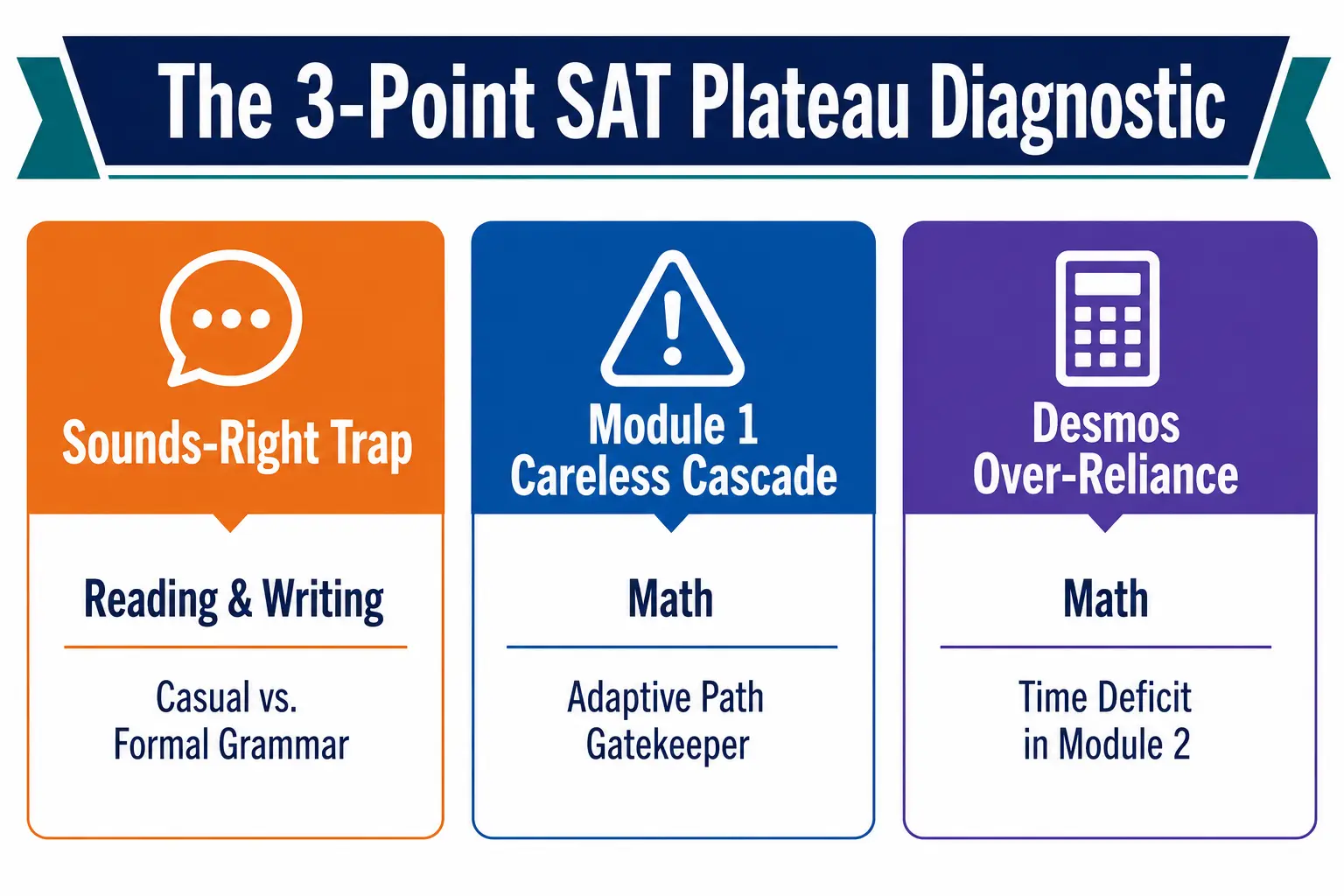
The 3-Point Plateau Diagnostic

Most students who plateau below 1350 are not struggling with content. They are stuck in one of three error clusters that NAT tutors see in 80% of plateaued students across more than 500 tutoring hours.
Cluster 1: The Sounds-Right Trap (Reading and Writing) Students pick answers that sound correct in casual conversation but violate formal grammar. "Between you and I" sounds elevated but is grammatically wrong (the correct form is "me"). NAT tutors drill the 12 formal grammar rules the SAT actually tests, not conversational English. Once students stop choosing by feel, Reading and Writing scores typically climb 40-60 points within two weeks.
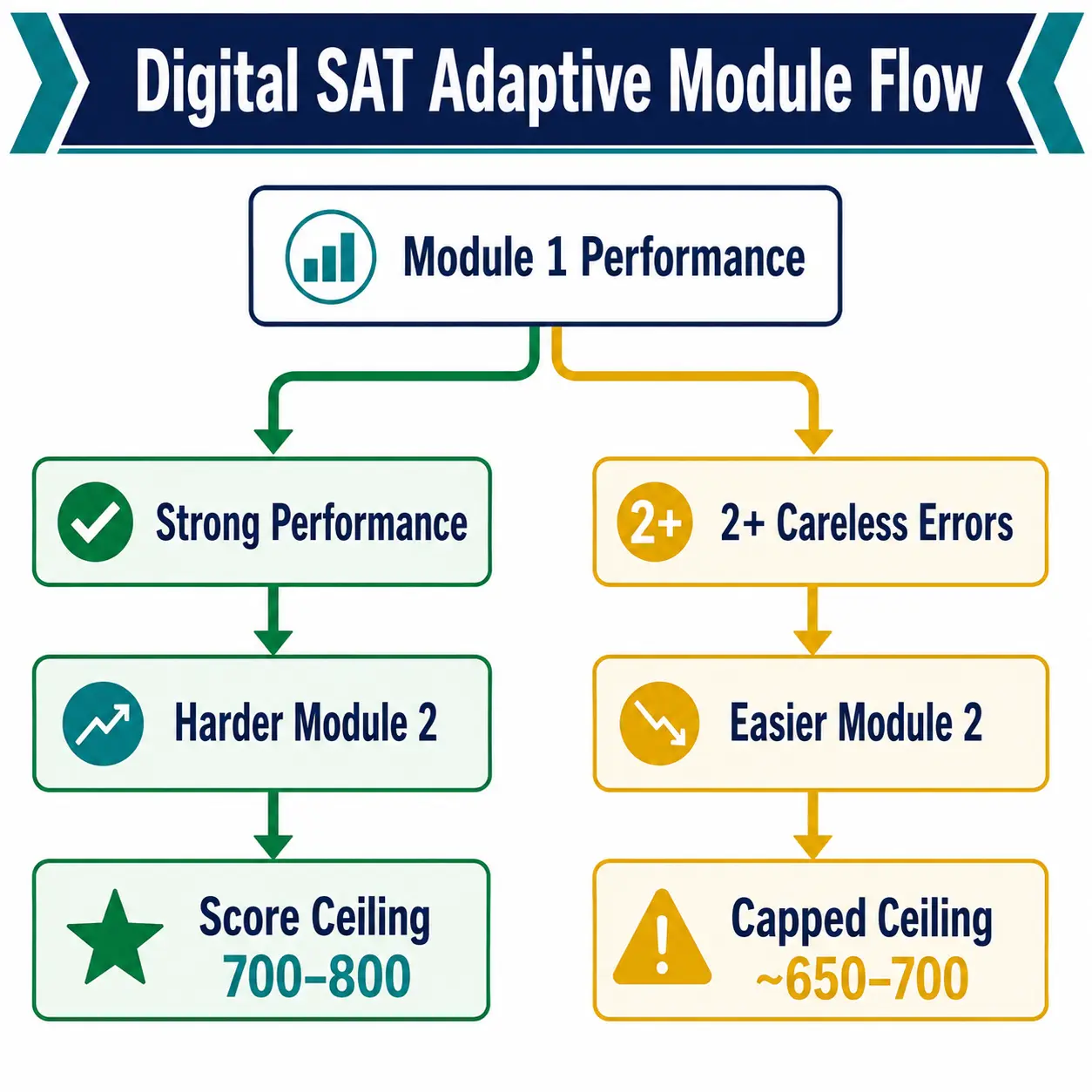
Cluster 2: The Module 1 Careless Cascade (Math) On the adaptive digital SAT, your Module 1 performance determines whether Module 2 is harder or easier. Two careless errors in Module 1 can drop you into the easier Module 2 path, capping your score ceiling at roughly 650-700 for that section. NAT tutors train students to treat Module 1 as a gatekeeper: slow down on the first ten questions, double-check your arithmetic, and protect your path to the harder module.
Cluster 3: The Desmos Over-Reliance (Math) Students open Desmos for problems they could solve mentally in ten seconds. This burns 30-45 seconds per question and creates a time deficit heading into Module 2. NAT tutors use the "10-second rule": if you can see the path in ten seconds, solve by hand. If not, graph it.
If you recognize any of these patterns in your own practice test results, that's exactly where your prep should start. Book a free consultation with an NAT tutor to identify which cluster is capping your score.

How many practice tests should I take before the SAT?
Most students do best with 4-6 full-length digital SAT practice tests using the Bluebook app. Take one diagnostic test to set your baseline, then one test every 3-4 weeks during your prep window. In the final month, take 2-3 tests to build stamina and timing consistency. Quality review beats quantity: spend as much time analyzing your mistakes as you spent taking the test.
The College Board's Bluebook app includes annotation tools, a built-in line reader, an answer eliminator, and a flagging feature that mirrors the real test interface exactly. Using third-party apps or paper tests for full-length practice rounds gives you an inaccurate picture of your timing and score. Read our full guide on how many practice tests you need for a week-by-week schedule.
Is the SAT or ACT easier for me?
The digital SAT and ACT test different skills. The SAT is adaptive, shorter, and math-heavy, with no dedicated science section. The ACT is faster-paced and includes a science reasoning section that requires a different set of reading strategies. The best way to decide is to take one practice test of each under timed conditions and compare your baseline scores. Check our digital SAT format breakdown for a detailed side-by-side comparison of both tests.
Reach Your Target SAT Score Faster
A personalized SAT strategy can uncover the exact mistakes holding your score back and help you improve faster with a clear study plan.
Book a FREE consultation
Reach Your Target SAT Score Faster
A personalized SAT strategy can uncover the exact mistakes holding your score back and help you improve faster with a clear study plan.
Book a FREE consultation
What is a good SAT score for top colleges?
A "good" SAT score lands in the middle 50% range of admitted students at your target schools. For Ivy League schools, that typically means 1500-1600. For selective public universities, 1400-1500 is competitive. Use your specific college list, not the national average of 1029, to set your target. Our SAT tutoring resources hub includes score breakdowns by school and prep guides for every score range.
Conclusion
Acing the SAT comes down to three things: understanding the digital format, using Desmos strategically, and fixing your specific error patterns before test day.
Acing the SAT is about strategy, not just studying harder
The digital adaptive format rewards smart Desmos use and Module 1 awareness
Targeted error review beats endless practice tests every time
NAT tutors have helped students across every score range reach their targets, from students "stuck at 1300" to those aiming for 1580+. Our SAT tutoring programs include one-on-one sessions with tutors who scored 1570 or above on the real test. View our transparent pricing and schedule your free consultation to get started.

Your grades are now our responsibility.
TL;DR
Acing the SAT means mastering the digital format, not just the content. Focus on three things: smart Desmos use, adaptive module strategy, and targeted error review. Most students improve 90-120 points with structured prep. Start with a diagnostic, build a 6-12 week plan, and finish with the Last 48 Hours protocol below. Your grades are now our responsibility.
If you're "stuck at 1300" and feel like you're "grinding" with nothing to show for it, you're not alone. Learning how to ace the SAT is harder than most guides admit, because the digital SAT format works differently from the old paper test. It's adaptive, it uses a built-in Desmos calculator, and it rewards test strategy just as much as content knowledge.
According to the College Board's 2025 SAT Suite Annual Report, the national average SAT score is 1029 across more than 2 million test takers, and only 7% of students score 1400 or above. That gap is real, but it's closeable with the right prep. Research from the Brookings Institution shows that structured, targeted prep produces measurable SAT gains, and federal test prep research from NCEE confirms that students who follow organized programs see significant score improvements, with larger effects for students who start from lower baselines.
This guide covers SAT prep tips, Desmos strategies, reading and writing tactics, and last-minute advice from NAT tutors who scored 1500 or above on the actual test.
How long does SAT prep take to see real results?
Most students see meaningful SAT score improvement in 6-12 weeks of consistent, structured prep. Students working one-on-one with a tutor typically improve 90-120 points, while self-study results vary widely. The biggest factor is not time: it's whether you're targeting your actual weak areas, not just doing generic practice.

Students who start prep three or more months before test day build a foundation that compounds over time. They complete more diagnostic rounds, fix error patterns earlier, and arrive on test day with real confidence rather than last-minute panic. College Board reports show that students who retake the SAT improve by an average of 40 points, which means most students leave significant score on the table on their first attempt by not doing enough targeted prep. An AERA Journal meta-analysis found that one-on-one tutoring produces larger standardized test gains than group prep, which is consistent with what NAT tutors observe across sessions.
If you already have a PSAT score, use our PSAT to SAT score conversion guide to set a realistic target before you build your timeline. For a full breakdown of how to schedule practice rounds, read our guide on how many practice tests you need before test day.
Alexander J., our SAT tutor from Brown Medical School, describes the pattern after having more than 750 sessions with SAT students like this:
"Students who start three months out almost always reach their target score. The ones who come to me two weeks before test day aren't really preparing, they're hoping. In my first session with any new student, I build a personal error log before we touch any new content. I don't care how many practice tests they've done. I care which three question types they miss every single time, and we fix those before anything else."
What are the best digital SAT tips and tricks for math?
The digital SAT math section rewards strategic Desmos use, not just calculator speed. Master the "big five" Desmos functions: graphing, tables, intersections, regression, and inequalities. For quadratics and systems of equations, graph first and confirm with algebra. Never use Desmos for one-step mental math. Practice under timed conditions so you instinctively know when Desmos saves time and when it wastes it. Download our free SAT Desmos Cheat Sheet and our free SAT math formula sheet to use alongside timed practice sessions.
Question Type | Use Desmos? | Time Saved |
|---|---|---|
Quadratic roots or vertex | Yes | 30-45 seconds |
System of equations | Yes | 20-30 seconds |
Linear inequality | Yes | 15-20 seconds |
One-step algebra | No | Wastes 20 seconds |
Simple arithmetic | No | Wastes 15 seconds |

Jay.S scored a perfect 800 in Math on the August 2025 SAT after drilling his Desmos decision process in NAT sessions. Diya.D reached a 760 Math score and a total 1510 after working through the same strategy with her NAT tutor.
How do I improve my SAT reading and writing score?
The Digital SAT Reading and Writing uses short 25-150 word passages, usually with one question per passage. The key is active reading: pre-highlight line references, jot quick "caveman notes" for the main idea, and eliminate wrong answers before picking the correct one. For grammar, master the 12 most-tested rules: subject-verb agreement, comma splices, semicolons, pronoun clarity, and modifier placement. Grammar is the fastest part of the test to improve with focused, daily drills.
College Essay Guy's active reading guide describes the pre-highlighting and process-of-elimination habits that strong readers use consistently on short-passage questions. The annotation tools in the College Board's Bluebook app, including the built-in line reader, answer eliminator, and flagging feature, let you practice these habits in the exact interface you'll use on test day. Use Bluebook for every practice session, not third-party apps.
Gia K., our SAT tutor from Cornell, describes the pattern after having more than 750 sessions with SAT students like this:
"About 80% of students I work with who are plateaued below 700 in Reading and Writing are stuck in what I call the Sounds-Right Trap. They pick the answer that feels natural in conversation, not the one that follows the formal grammar rule. In every session, I start by giving students exactly ten grammar-rule flashcards — just ten — and we don't move on until all ten are automatic. Once they stop choosing by feel, their R&W score typically jumps 40-60 points within two weeks."
The 3-Point Plateau Diagnostic

Most students who plateau below 1350 are not struggling with content. They are stuck in one of three error clusters that NAT tutors see in 80% of plateaued students across more than 500 tutoring hours.
Cluster 1: The Sounds-Right Trap (Reading and Writing) Students pick answers that sound correct in casual conversation but violate formal grammar. "Between you and I" sounds elevated but is grammatically wrong (the correct form is "me"). NAT tutors drill the 12 formal grammar rules the SAT actually tests, not conversational English. Once students stop choosing by feel, Reading and Writing scores typically climb 40-60 points within two weeks.
Cluster 2: The Module 1 Careless Cascade (Math) On the adaptive digital SAT, your Module 1 performance determines whether Module 2 is harder or easier. Two careless errors in Module 1 can drop you into the easier Module 2 path, capping your score ceiling at roughly 650-700 for that section. NAT tutors train students to treat Module 1 as a gatekeeper: slow down on the first ten questions, double-check your arithmetic, and protect your path to the harder module.
Cluster 3: The Desmos Over-Reliance (Math) Students open Desmos for problems they could solve mentally in ten seconds. This burns 30-45 seconds per question and creates a time deficit heading into Module 2. NAT tutors use the "10-second rule": if you can see the path in ten seconds, solve by hand. If not, graph it.
If you recognize any of these patterns in your own practice test results, that's exactly where your prep should start. Book a free consultation with an NAT tutor to identify which cluster is capping your score.

How many practice tests should I take before the SAT?
Most students do best with 4-6 full-length digital SAT practice tests using the Bluebook app. Take one diagnostic test to set your baseline, then one test every 3-4 weeks during your prep window. In the final month, take 2-3 tests to build stamina and timing consistency. Quality review beats quantity: spend as much time analyzing your mistakes as you spent taking the test.
The College Board's Bluebook app includes annotation tools, a built-in line reader, an answer eliminator, and a flagging feature that mirrors the real test interface exactly. Using third-party apps or paper tests for full-length practice rounds gives you an inaccurate picture of your timing and score. Read our full guide on how many practice tests you need for a week-by-week schedule.
Is the SAT or ACT easier for me?
The digital SAT and ACT test different skills. The SAT is adaptive, shorter, and math-heavy, with no dedicated science section. The ACT is faster-paced and includes a science reasoning section that requires a different set of reading strategies. The best way to decide is to take one practice test of each under timed conditions and compare your baseline scores. Check our digital SAT format breakdown for a detailed side-by-side comparison of both tests.
Reach Your Target SAT Score Faster
A personalized SAT strategy can uncover the exact mistakes holding your score back and help you improve faster with a clear study plan.
Book a FREE consultation
What is a good SAT score for top colleges?
A "good" SAT score lands in the middle 50% range of admitted students at your target schools. For Ivy League schools, that typically means 1500-1600. For selective public universities, 1400-1500 is competitive. Use your specific college list, not the national average of 1029, to set your target. Our SAT tutoring resources hub includes score breakdowns by school and prep guides for every score range.
Conclusion
Acing the SAT comes down to three things: understanding the digital format, using Desmos strategically, and fixing your specific error patterns before test day.
Acing the SAT is about strategy, not just studying harder
The digital adaptive format rewards smart Desmos use and Module 1 awareness
Targeted error review beats endless practice tests every time
NAT tutors have helped students across every score range reach their targets, from students "stuck at 1300" to those aiming for 1580+. Our SAT tutoring programs include one-on-one sessions with tutors who scored 1570 or above on the real test. View our transparent pricing and schedule your free consultation to get started.

Your grades are now our responsibility.
Ready to boost your score?
Schedule a free consultation with our Ivy League experts and get a personalized study plan.
Book a free consultation
Join 5,000+ Students
Get weekly academic tips and test prep resources delivered to your inbox.
Trending Topics
Trending Topics
Trending Topics
SAT
SAT
How to ace the SAT: a complete guide to digital SAT prep
SAT
SAT
SAT vs ACT: How to decide which test to take in 2026
College Admissions
College Admissions
How to send SAT scores to colleges: a step-by-step guide for 2026
SAT
SAT
What is the average SAT score?
Frequently Asked Questions
How long does it take to prepare for the SAT?
Most students need 40 to 120 hours of total study time spread over 2 to 3 months to see a significant score improvement. The exact duration depends on your target score and starting baseline
How long does it take to prepare for the SAT?
Most students need 40 to 120 hours of total study time spread over 2 to 3 months to see a significant score improvement. The exact duration depends on your target score and starting baseline
Can I use Desmos on every SAT math question?
Yes, Desmos is built into every math question on the digital SAT through the College Board's Bluebook app. However, using it for simple problems wastes time and creates a pacing deficit in Module 2. Use Desmos strategically for quadratics, systems of equations, and regression problems. For one-step algebra or arithmetic, solve by hand.
Can I use Desmos on every SAT math question?
Yes, Desmos is built into every math question on the digital SAT through the College Board's Bluebook app. However, using it for simple problems wastes time and creates a pacing deficit in Module 2. Use Desmos strategically for quadratics, systems of equations, and regression problems. For one-step algebra or arithmetic, solve by hand.
What should I do the night before the SAT?
The night before the SAT, your main goals are to rest your mind and eliminate morning stress. Do not cram new material. Instead, review your past mistakes, pack your testing bag, verify your test center location and start time, and go to sleep early
What should I do the night before the SAT?
The night before the SAT, your main goals are to rest your mind and eliminate morning stress. Do not cram new material. Instead, review your past mistakes, pack your testing bag, verify your test center location and start time, and go to sleep early
Is 3 months enough time to improve my SAT score by 100 points?
Yes, three months is plenty of time to boost your SAT score by 100 points. In fact, test prep experts typically recommend a 2 to 3-month timeline. Achieving this jump requires roughly 40 hours of dedicated practice—broken down into consistent, manageable sessions rather than last-minute cramming.
Is 3 months enough time to improve my SAT score by 100 points?
Yes, three months is plenty of time to boost your SAT score by 100 points. In fact, test prep experts typically recommend a 2 to 3-month timeline. Achieving this jump requires roughly 40 hours of dedicated practice—broken down into consistent, manageable sessions rather than last-minute cramming.
Should I take the SAT more than once?
Yes, you should absolutely plan to take the SAT at least twice. Most students see score improvements on their second or third attempts because they are familiar with the test format, and many colleges use "superscoring," which combines your highest section scores across all your test dates.
Should I take the SAT more than once?
Yes, you should absolutely plan to take the SAT at least twice. Most students see score improvements on their second or third attempts because they are familiar with the test format, and many colleges use "superscoring," which combines your highest section scores across all your test dates.
Get the Ivy League Advantage
Work with elite tutors who have walked the path you are on. Personalised strategy for extraordinary results.
Book a free consultation
Related Articles

SAT
How to ace the SAT: a complete guide to digital SAT prep
Read article

SAT
SAT vs ACT: How to decide which test to take in 2026
Read article

College Admissions
How to send SAT scores to colleges: a step-by-step guide for 2026
Read article