What is the average SAT score?

What is the average SAT score?

Date:

Date:

Written by:

Written by:

Written by:

GCSE | NAT Tutor Reviewed by the NAT Editorial Team

GCSE | NAT Tutor Reviewed by the NAT Editorial Team

GCSE | NAT Tutor Reviewed by the NAT Editorial Team

TL;DR

The national average SAT score for the Class of 2025 was 1029 out of 1600. That breaks into 521 for Reading and Writing and 508 for Math. But the national average is a reference point, not a college admissions target. Whether your child scored above, below, or right at 1029, what matters is how their score compares to the actual admitted students at their target schools.

TL;DR

The national average SAT score for the Class of 2025 was 1029 out of 1600. That breaks into 521 for Reading and Writing and 508 for Math. But the national average is a reference point, not a college admissions target. Whether your child scored above, below, or right at 1029, what matters is how their score compares to the actual admitted students at their target schools.

You get the score report back. It says 1029. You Google "average SAT score" and land on that same number. So is this good? Is your child in trouble? Can they still get into a real college?

Here's the honest answer: the average SAT score tells you where 2 million test-takers landed. It tells you almost nothing about your child's specific college chances. A 980 might be competitive for their list. A 1200 might not be enough for their dream school. Context is what turns numbers into something useful.

At North American Tutors, we've worked with students across every score level since the shift to digital adaptive testing. This guide covers the 2026 average SAT score landscape with data from the College Board, real student outcomes, and a step-by-step framework for figuring out exactly where your child needs to be.
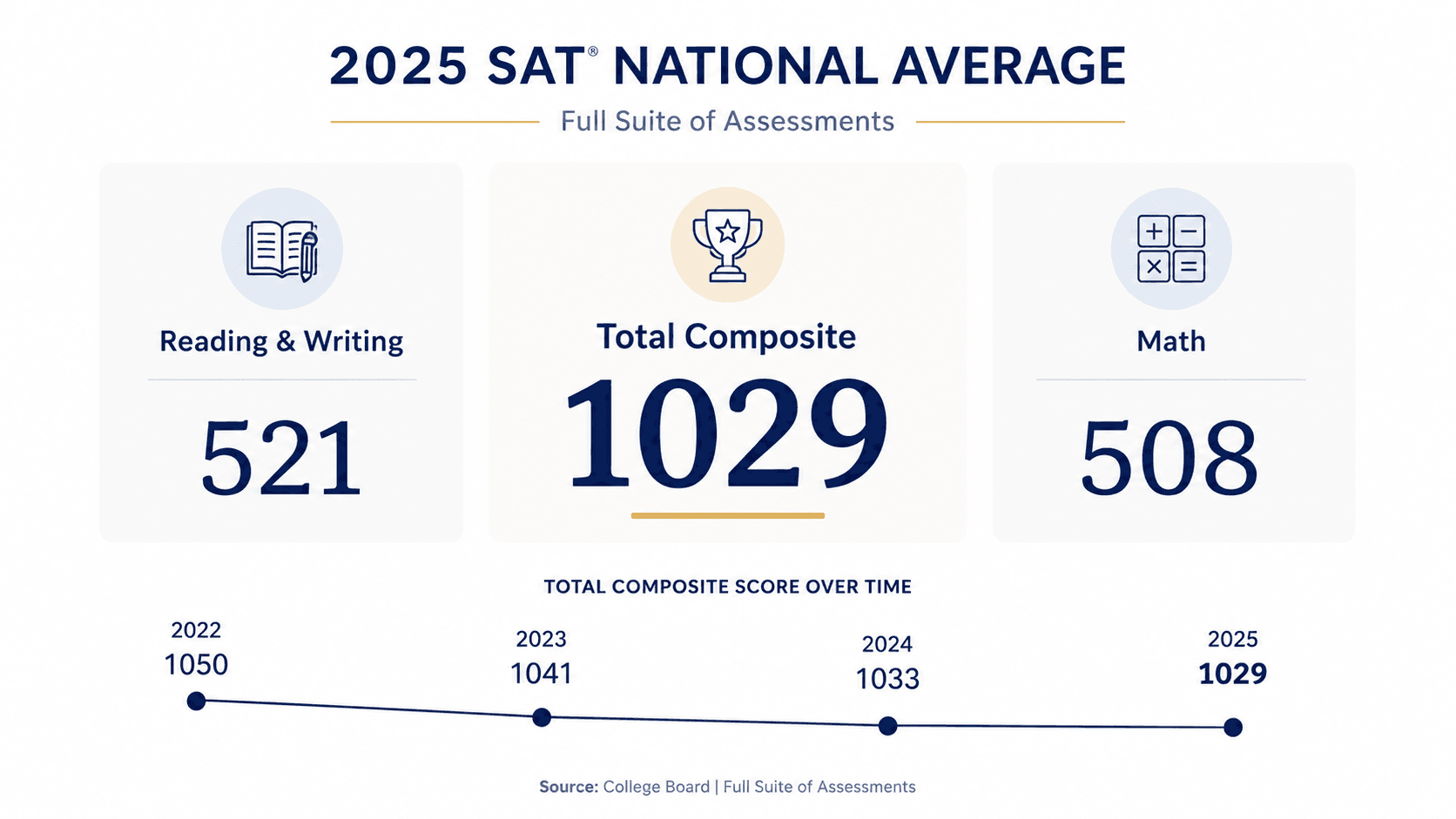

Average SAT score breakdown showing national average 1029 with Reading and Writing 521 and Math 508 section scores

What is the average SAT score in 2026?

The most recent College Board data from the 2025 graduating cohort shows these national averages:

Section

Average Score

Total (Composite)

1029

Reading and Writing

521

Math

508

These figures represent all students who tested in that cycle. More than 2 million students took the SAT in 2025, the highest participation since 2020. A score of 1029 sits exactly at the 50th percentile nationally.

Here's how the average has shifted over the past four years:

Year

Total

Reading and Writing

Math

2022

1050

529

521

2023

1028

520

508

2024

1024

519

505

2025

1029

521

508

The 2025 uptick to 1029 suggests scores are stabilizing after the full transition to the digital adaptive SAT format in 2024.

Alexander J., a 1600 SAT tutor and medical student at Brown University, explains what he sees in first sessions with students targeting 1400 and above:

"Students who score near the national average in Reading almost always share one pattern: they pick answers that sound right instead of answers the passage directly supports. I call it the 'sounds-right trap'. Once a student can articulate exactly why a tempting wrong answer sounds plausible but isn't in the text, their accuracy on inference questions typically jumps 30 to 50 points within two sessions. It's one of the fastest single-skill gains I see." 

- Alexander Joseph

"Students who score near the national average in Reading almost always share one pattern: they pick answers that sound right instead of answers the passage directly supports. I call it the 'sounds-right trap'. Once a student can articulate exactly why a tempting wrong answer sounds plausible but isn't in the text, their accuracy on inference questions typically jumps 30 to 50 points within two sessions. It's one of the fastest single-skill gains I see." 

- Alexander Joseph

For students starting near the national average, 92% of NAT students improved by at least 90 SAT points. Moving from 1029 to the 1150 to 1300 range is a realistic outcome with targeted one-on-one prep.

Why the digital adaptive SAT changed what "average" means

Since March 2024, the SAT has been fully digital and section-adaptive. This isn't just a format change. It fundamentally affects how score distributions work and why some students feel stuck despite studying hard.

Here's how it works: each section has two modules. Your child's performance on Module 1 determines whether they get the harder or easier Module 2. Students routed to the lower second module have their maximum possible section score capped at approximately 620 to 630, even if they answer every remaining question correctly.

What this means in practice: a student scoring 600 to 650 on a section may have been routed to the lower module based on early pacing or a cluster of errors in Module 1. This isn't an ability problem. It's a strategy problem, and it's fixable.

Mastering the built-in Desmos calculator helps students move through Module 1 Math questions faster and with fewer errors, which directly affects module routing. Our free SAT Desmos cheat sheet covers the essential shortcuts.

For a deeper dive, our guide on SAT Desmos calculator tips walks through the five functions every student needs to know before test day.

Average SAT score by state: the participation rate paradox

State averages vary from 875 in New Mexico to 1249 in Nebraska. But these numbers are almost meaningless without understanding participation rates, according to Scholarships360's 2025 state breakdown.

State

Participation Rate

Average Score

Nebraska

1%

1249

Wisconsin

2%

1240

Indiana

100%

950

New Mexico

100%

875

National Average

n/a

1029

States with 1 to 3% participation typically have only self-selected, highly motivated students who are testing. States with 100% participation test every junior during school hours, capturing the full academic spectrum. The result is an apples-to-oranges comparison that misleads more families than it helps.

If your child lives in a high-participation state like Indiana, Illinois, or Michigan, their score may fall below the state average and still be well-positioned for their specific college list. The state average tells you almost nothing useful about individual college readiness.

What is a good SAT score for college admissions?

A good SAT score meets or exceeds the 25th percentile of admitted students at your child's target schools. According to College Board guidance on score meaning, students should aim for the upper end of the middle 50% range at schools where they want to be competitive.

Here's a fast percentile reference:

Score Range

Percentile

What It Means

1350 and above

90th

Top 10%, competitive for selective schools

1200 to 1340

75th to 89th

Above average, strong for most public universities

1029

50th

National average

900 to 1010

25th to 49th

Below average, viable at many test-optional schools

Below 900

Bottom 25%

Test-optional route worth considering

And by college tier:

College Type

Typical Mid-50% SAT Range

Community colleges and open-enrollment

800 to 1050

Most regional public universities

1050 to 1250

Competitive state flagships

1200 to 1380

Selective private universities

1350 to 1500

Ivy League and top-tier schools

1500 to 1580

For families targeting the Ivy League specifically, our detailed guide on Ivy League SAT requirements breaks down the middle-50% ranges for each school and what submission actually signals at those institutions.
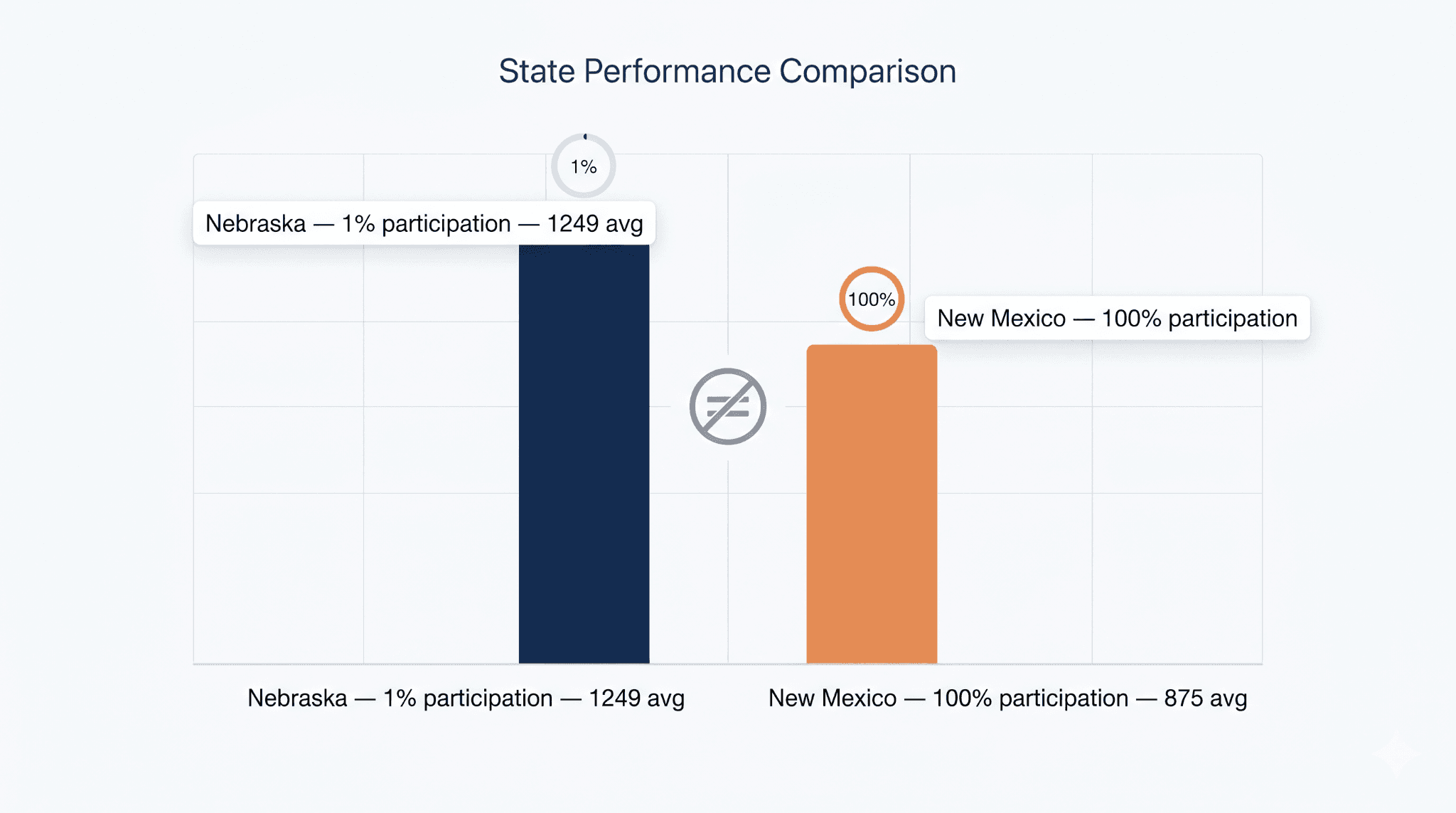

SAT score average by state comparison chart showing why high participation states have lower averages than low participation states

The Score Gap Framework: how NAT tutors set the real target

The national average SAT score of 1029 shows where 2 million test-takers landed. It doesn't show where your child needs to land. NAT tutors use a different starting point: the Score Gap, which is the distance between a student's current diagnostic score and their target school's 25th percentile admitted score. That gap, not the national average, drives every prep decision we make.

The Score Gap formula:

Score Gap = Target School's 25th Percentile Admitted Score minus Your Child's Current Diagnostic Score

Here's what that looks like across three real score bands:

Band 1: 980 diagnostic, targeting a state flagship (25th percentile: 1150) The Score Gap is 170 points. Prep at this level focuses on foundational section skills: closing the "sounds-right trap" in Reading, tightening algebra and data analysis in Math, and building consistent timing across both modules. A structured plan closes this gap in 3 to 4 months of focused one-on-one sessions.

Band 2: 1150 diagnostic, targeting a competitive private school (25th percentile: 1300) The Score Gap is 150 points. Foundational skills are mostly in place. Prep shifts to precision work: stronger inference reading, advanced algebra setups, and careless error reduction. This is a 2 to 3 month plan with heavy emphasis on full-length adaptive practice under real conditions.

Band 3: 1280 diagnostic, targeting a selective university (25th percentile: 1450) The Score Gap is 170 points. This range requires mastering the top 10 to 15% of question difficulty in both sections. Reading precision on evidence-support questions, Math fluency on advanced function and geometry problems, and module routing strategy all become critical. Two to three months with session-level diagnosis of specific question types, not general practice.
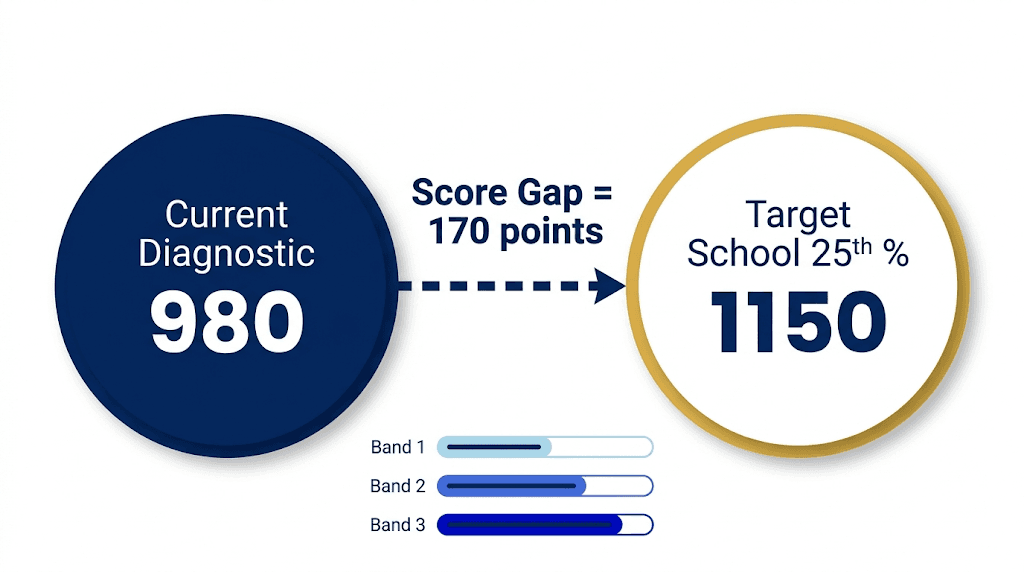

SAT score gap calculator showing current diagnostic score versus target school 25th percentile admitted average SAT score

Wanning L., a 1570 SAT scorer tutoring students across all score levels, explains what changes when students see their real number:

"Students almost never come in with the right target score. They're aiming at the national average or a vague number that 'sounds good.' When I map their diagnostic against their actual school list and show them the Score Gap, the whole session shifts. A student with a 1280 targeting a 1450 school doesn't need more practice. They need a completely different kind of practice. The gap tells us what that is, and that specificity is where scores actually move." 

- Wanning Lu

"Students almost never come in with the right target score. They're aiming at the national average or a vague number that 'sounds good.' When I map their diagnostic against their actual school list and show them the Score Gap, the whole session shifts. A student with a 1280 targeting a 1450 school doesn't need more practice. They need a completely different kind of practice. The gap tells us what that is, and that specificity is where scores actually move." 

- Wanning Lu

My child scored exactly average. What should we do now?

A score of 1020 to 1040 places your child at the 50th percentile nationally. It's not a bad result. But it's not a finish line either. What you do next depends entirely on their college list and financial goals.

Scenario

Recommendation

Targeting test-optional schools

Only submit the SAT if it's at or above the school's middle 50%. Invest prep time in GPA and essays. Consider how extracurriculars factor into admissions for test-optional review.

Targeting test-required public universities

A score of 1020 to 1050 is competitive at many broad-access public colleges. Check the specific school's middle 50% before deciding to retake.

Aiming for merit scholarships

Retake if possible. A 100-point improvement to 1120 to 1140 can unlock thousands in automatic aid at many state universities.

Scoring below 1000 with a strong GPA

Consider the test-optional route at applicable schools. If scores are required, 6 to 8 weeks of targeted prep can typically yield 150 to 200 points of improvement.

Real student outcome: Eli A. came to NAT with a 1360 and a target school requiring closer to 1500. Working with NAT tutors on structured session planning and error-level diagnosis, he scored a 1510 on his official SAT in 3 months, a 150-point gain that met his Score Gap nearly exactly.

Planning a retake? Our guide on how many SAT practice tests you really need breaks down the optimal testing timeline by score band and target. Most students need 4 to 6 full-length adaptive tests built into a structured plan, not just stacked at the end.

Average SAT scores by gender and ethnicity (2025 data)

Understanding how scores vary by group can help contextualize where your child's score fits:

By Gender

Gender

Total

Reading and Writing

Math

Male

1035

520

515

Female

1021

522

500

By Race and Ethnicity

Group

Total

Reading and Writing

Math

Asian

1229

599

630

White

1077

550

527

Two or More Races

1073

550

524

Hispanic or Latino

928

474

454

Black or African American

904

464

440

These demographic averages reflect documented educational inequities, not individual potential. According to the NACAC State of College Admission report, colleges using holistic review specifically account for these disparities when evaluating applications. A student scoring below their demographic average who shows a strong GPA trajectory and meaningful extracurricular commitment can still be highly competitive.

How to improve your child's SAT score from average to competitive

Improvement starts with a full-length diagnostic, not a short quiz or a practice section. A complete adaptive test taken through College Board's Bluebook app gives you actual section scores, module routing data, and a question-level breakdown that shows exactly where points are being lost. Prepping without a diagnostic is guesswork.

Once you have a diagnosis, the path forward depends on the Score Gap:

Gap of 150 points or more: Section-level work comes first. Identify which section is dragging the composite down and target it specifically. Most students at this gap have 2 to 3 question types in their weaker section that account for the majority of errors.

Gap of 80 to 150 points: Foundational skills are mostly in place. Focus on full-length tests with post-session error analysis, reviewing why each wrong answer was chosen rather than just confirming the right one. This approach reveals process errors that generic practice misses entirely.

Gap under 80 points: Precision work. The gains at this level come from the hardest 10 to 15% of questions. Generic practice won't make a difference. Documented weak question types will be drilled under timed conditions.

For students unsure whether the SAT or ACT is the right test for them, our SAT vs ACT guide walks through the differences section by section, and our ACT to SAT conversion chart helps families compare where a student stands on both scales.

Our SAT tutoring resource hub also has free formula sheets, Desmos shortcuts, and success stories from students who closed their Score Gap.
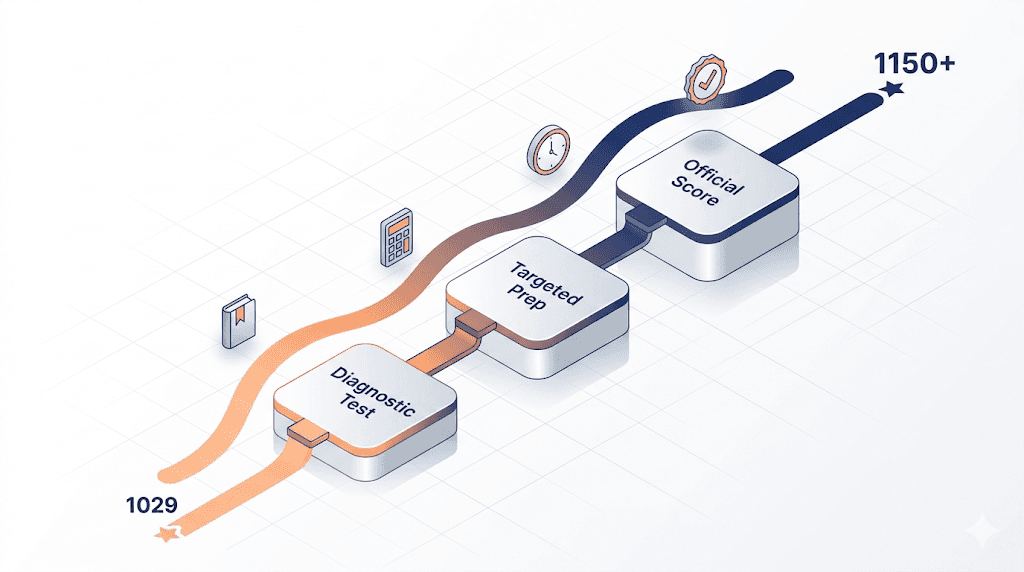

How to improve your average SAT score from 1029 to competitive range with targeted one-on-one prep pathway

The average SAT score is a starting point, not a verdict

The national average of 1029 tells you where the country lands. It doesn't tell you whether your child is on track for their specific schools, whether they should retake, or how much prep will actually move their score. Those answers come from the Score Gap, not the national number.

If your child is below average, they have more options than it feels like right now. If they're above average, that's a solid starting point, but it may not be enough depending on their college list. The students who improve fastest are the ones who stop comparing themselves to the national benchmark and start working toward their actual target.

Our SAT tutoring program specializes in digital SAT strategy for every score level, from students rebuilding a 950 to students pushing a 1450 toward 1550. 92% of our students improve by at least 90 SAT points. Your grades are now our responsibility.

Book a free consultation, and we'll map your child's Score Gap and build a session plan around their actual college list.

TL;DR

The national average SAT score for the Class of 2025 was 1029 out of 1600. That breaks into 521 for Reading and Writing and 508 for Math. But the national average is a reference point, not a college admissions target. Whether your child scored above, below, or right at 1029, what matters is how their score compares to the actual admitted students at their target schools.

You get the score report back. It says 1029. You Google "average SAT score" and land on that same number. So is this good? Is your child in trouble? Can they still get into a real college?

Here's the honest answer: the average SAT score tells you where 2 million test-takers landed. It tells you almost nothing about your child's specific college chances. A 980 might be competitive for their list. A 1200 might not be enough for their dream school. Context is what turns numbers into something useful.

At North American Tutors, we've worked with students across every score level since the shift to digital adaptive testing. This guide covers the 2026 average SAT score landscape with data from the College Board, real student outcomes, and a step-by-step framework for figuring out exactly where your child needs to be.


Average SAT score breakdown showing national average 1029 with Reading and Writing 521 and Math 508 section scores

What is the average SAT score in 2026?

The most recent College Board data from the 2025 graduating cohort shows these national averages:

Section

Average Score

Total (Composite)

1029

Reading and Writing

521

Math

508

These figures represent all students who tested in that cycle. More than 2 million students took the SAT in 2025, the highest participation since 2020. A score of 1029 sits exactly at the 50th percentile nationally.

Here's how the average has shifted over the past four years:

Year

Total

Reading and Writing

Math

2022

1050

529

521

2023

1028

520

508

2024

1024

519

505

2025

1029

521

508

The 2025 uptick to 1029 suggests scores are stabilizing after the full transition to the digital adaptive SAT format in 2024.

Alexander J., a 1600 SAT tutor and medical student at Brown University, explains what he sees in first sessions with students targeting 1400 and above:

"Students who score near the national average in Reading almost always share one pattern: they pick answers that sound right instead of answers the passage directly supports. I call it the 'sounds-right trap'. Once a student can articulate exactly why a tempting wrong answer sounds plausible but isn't in the text, their accuracy on inference questions typically jumps 30 to 50 points within two sessions. It's one of the fastest single-skill gains I see." 

- Alexander Joseph

For students starting near the national average, 92% of NAT students improved by at least 90 SAT points. Moving from 1029 to the 1150 to 1300 range is a realistic outcome with targeted one-on-one prep.

Why the digital adaptive SAT changed what "average" means

Since March 2024, the SAT has been fully digital and section-adaptive. This isn't just a format change. It fundamentally affects how score distributions work and why some students feel stuck despite studying hard.

Here's how it works: each section has two modules. Your child's performance on Module 1 determines whether they get the harder or easier Module 2. Students routed to the lower second module have their maximum possible section score capped at approximately 620 to 630, even if they answer every remaining question correctly.

What this means in practice: a student scoring 600 to 650 on a section may have been routed to the lower module based on early pacing or a cluster of errors in Module 1. This isn't an ability problem. It's a strategy problem, and it's fixable.

Mastering the built-in Desmos calculator helps students move through Module 1 Math questions faster and with fewer errors, which directly affects module routing. Our free SAT Desmos cheat sheet covers the essential shortcuts.

For a deeper dive, our guide on SAT Desmos calculator tips walks through the five functions every student needs to know before test day.

Average SAT score by state: the participation rate paradox

State averages vary from 875 in New Mexico to 1249 in Nebraska. But these numbers are almost meaningless without understanding participation rates, according to Scholarships360's 2025 state breakdown.

State

Participation Rate

Average Score

Nebraska

1%

1249

Wisconsin

2%

1240

Indiana

100%

950

New Mexico

100%

875

National Average

n/a

1029

States with 1 to 3% participation typically have only self-selected, highly motivated students who are testing. States with 100% participation test every junior during school hours, capturing the full academic spectrum. The result is an apples-to-oranges comparison that misleads more families than it helps.

If your child lives in a high-participation state like Indiana, Illinois, or Michigan, their score may fall below the state average and still be well-positioned for their specific college list. The state average tells you almost nothing useful about individual college readiness.

What is a good SAT score for college admissions?

A good SAT score meets or exceeds the 25th percentile of admitted students at your child's target schools. According to College Board guidance on score meaning, students should aim for the upper end of the middle 50% range at schools where they want to be competitive.

Here's a fast percentile reference:

Score Range

Percentile

What It Means

1350 and above

90th

Top 10%, competitive for selective schools

1200 to 1340

75th to 89th

Above average, strong for most public universities

1029

50th

National average

900 to 1010

25th to 49th

Below average, viable at many test-optional schools

Below 900

Bottom 25%

Test-optional route worth considering

And by college tier:

College Type

Typical Mid-50% SAT Range

Community colleges and open-enrollment

800 to 1050

Most regional public universities

1050 to 1250

Competitive state flagships

1200 to 1380

Selective private universities

1350 to 1500

Ivy League and top-tier schools

1500 to 1580

For families targeting the Ivy League specifically, our detailed guide on Ivy League SAT requirements breaks down the middle-50% ranges for each school and what submission actually signals at those institutions.


SAT score average by state comparison chart showing why high participation states have lower averages than low participation states

The Score Gap Framework: how NAT tutors set the real target

The national average SAT score of 1029 shows where 2 million test-takers landed. It doesn't show where your child needs to land. NAT tutors use a different starting point: the Score Gap, which is the distance between a student's current diagnostic score and their target school's 25th percentile admitted score. That gap, not the national average, drives every prep decision we make.

The Score Gap formula:

Score Gap = Target School's 25th Percentile Admitted Score minus Your Child's Current Diagnostic Score

Here's what that looks like across three real score bands:

Band 1: 980 diagnostic, targeting a state flagship (25th percentile: 1150) The Score Gap is 170 points. Prep at this level focuses on foundational section skills: closing the "sounds-right trap" in Reading, tightening algebra and data analysis in Math, and building consistent timing across both modules. A structured plan closes this gap in 3 to 4 months of focused one-on-one sessions.

Band 2: 1150 diagnostic, targeting a competitive private school (25th percentile: 1300) The Score Gap is 150 points. Foundational skills are mostly in place. Prep shifts to precision work: stronger inference reading, advanced algebra setups, and careless error reduction. This is a 2 to 3 month plan with heavy emphasis on full-length adaptive practice under real conditions.

Band 3: 1280 diagnostic, targeting a selective university (25th percentile: 1450) The Score Gap is 170 points. This range requires mastering the top 10 to 15% of question difficulty in both sections. Reading precision on evidence-support questions, Math fluency on advanced function and geometry problems, and module routing strategy all become critical. Two to three months with session-level diagnosis of specific question types, not general practice.


SAT score gap calculator showing current diagnostic score versus target school 25th percentile admitted average SAT score

Wanning L., a 1570 SAT scorer tutoring students across all score levels, explains what changes when students see their real number:

"Students almost never come in with the right target score. They're aiming at the national average or a vague number that 'sounds good.' When I map their diagnostic against their actual school list and show them the Score Gap, the whole session shifts. A student with a 1280 targeting a 1450 school doesn't need more practice. They need a completely different kind of practice. The gap tells us what that is, and that specificity is where scores actually move." 

- Wanning Lu

My child scored exactly average. What should we do now?

A score of 1020 to 1040 places your child at the 50th percentile nationally. It's not a bad result. But it's not a finish line either. What you do next depends entirely on their college list and financial goals.

Scenario

Recommendation

Targeting test-optional schools

Only submit the SAT if it's at or above the school's middle 50%. Invest prep time in GPA and essays. Consider how extracurriculars factor into admissions for test-optional review.

Targeting test-required public universities

A score of 1020 to 1050 is competitive at many broad-access public colleges. Check the specific school's middle 50% before deciding to retake.

Aiming for merit scholarships

Retake if possible. A 100-point improvement to 1120 to 1140 can unlock thousands in automatic aid at many state universities.

Scoring below 1000 with a strong GPA

Consider the test-optional route at applicable schools. If scores are required, 6 to 8 weeks of targeted prep can typically yield 150 to 200 points of improvement.

Real student outcome: Eli A. came to NAT with a 1360 and a target school requiring closer to 1500. Working with NAT tutors on structured session planning and error-level diagnosis, he scored a 1510 on his official SAT in 3 months, a 150-point gain that met his Score Gap nearly exactly.

Planning a retake? Our guide on how many SAT practice tests you really need breaks down the optimal testing timeline by score band and target. Most students need 4 to 6 full-length adaptive tests built into a structured plan, not just stacked at the end.

Average SAT scores by gender and ethnicity (2025 data)

Understanding how scores vary by group can help contextualize where your child's score fits:

By Gender

Gender

Total

Reading and Writing

Math

Male

1035

520

515

Female

1021

522

500

By Race and Ethnicity

Group

Total

Reading and Writing

Math

Asian

1229

599

630

White

1077

550

527

Two or More Races

1073

550

524

Hispanic or Latino

928

474

454

Black or African American

904

464

440

These demographic averages reflect documented educational inequities, not individual potential. According to the NACAC State of College Admission report, colleges using holistic review specifically account for these disparities when evaluating applications. A student scoring below their demographic average who shows a strong GPA trajectory and meaningful extracurricular commitment can still be highly competitive.

How to improve your child's SAT score from average to competitive

Improvement starts with a full-length diagnostic, not a short quiz or a practice section. A complete adaptive test taken through College Board's Bluebook app gives you actual section scores, module routing data, and a question-level breakdown that shows exactly where points are being lost. Prepping without a diagnostic is guesswork.

Once you have a diagnosis, the path forward depends on the Score Gap:

Gap of 150 points or more: Section-level work comes first. Identify which section is dragging the composite down and target it specifically. Most students at this gap have 2 to 3 question types in their weaker section that account for the majority of errors.

Gap of 80 to 150 points: Foundational skills are mostly in place. Focus on full-length tests with post-session error analysis, reviewing why each wrong answer was chosen rather than just confirming the right one. This approach reveals process errors that generic practice misses entirely.

Gap under 80 points: Precision work. The gains at this level come from the hardest 10 to 15% of questions. Generic practice won't make a difference. Documented weak question types will be drilled under timed conditions.

For students unsure whether the SAT or ACT is the right test for them, our SAT vs ACT guide walks through the differences section by section, and our ACT to SAT conversion chart helps families compare where a student stands on both scales.

Our SAT tutoring resource hub also has free formula sheets, Desmos shortcuts, and success stories from students who closed their Score Gap.


How to improve your average SAT score from 1029 to competitive range with targeted one-on-one prep pathway

The average SAT score is a starting point, not a verdict

The national average of 1029 tells you where the country lands. It doesn't tell you whether your child is on track for their specific schools, whether they should retake, or how much prep will actually move their score. Those answers come from the Score Gap, not the national number.

If your child is below average, they have more options than it feels like right now. If they're above average, that's a solid starting point, but it may not be enough depending on their college list. The students who improve fastest are the ones who stop comparing themselves to the national benchmark and start working toward their actual target.

Our SAT tutoring program specializes in digital SAT strategy for every score level, from students rebuilding a 950 to students pushing a 1450 toward 1550. 92% of our students improve by at least 90 SAT points. Your grades are now our responsibility.

Book a free consultation, and we'll map your child's Score Gap and build a session plan around their actual college list.

Ready to boost your score?

Ready to boost your score?

Ready to boost your score?

Schedule a free consultation with our Ivy League experts and get a personalized study plan.

Schedule a free consultation with our Ivy League experts and get a personalized study plan.

Schedule a free consultation with our Ivy League experts and get a personalized study plan.

Book a free consultation

Book a free consultation

Book a free consultation

Join 5,000+ Students

Join 5,000+ Students

Join 5,000+ Students

Get weekly academic tips and test prep resources delivered to your inbox.

Get weekly academic tips and test prep resources delivered to your inbox.

Get weekly academic tips and test prep resources delivered to your inbox.

Frequently Asked Questions

What is the average SAT score for 2026?

Based on early 2026 data, the national average SAT score is approximately 1050 out of 1600. This composite score generally consists of a Math section average around 520–530 and an Evidence-Based Reading and Writing (EBRW) average around 520–530. A score of 1350 or higher is considered top 10%.

What is the average SAT score for 2026?

Based on early 2026 data, the national average SAT score is approximately 1050 out of 1600. This composite score generally consists of a Math section average around 520–530 and an Evidence-Based Reading and Writing (EBRW) average around 520–530. A score of 1350 or higher is considered top 10%.

Is a 1000 SAT score good enough for college?

A 1000 SAT score is roughly average (around the 39th–40th percentile), making it good enough for admission to many 4-year, less-selective state schools, regional universities, and community colleges. It is generally not competitive for top-tier or highly selective institutions, but it is sufficient for a wide range of colleges that focus on holistic admissions

Is a 1000 SAT score good enough for college?

A 1000 SAT score is roughly average (around the 39th–40th percentile), making it good enough for admission to many 4-year, less-selective state schools, regional universities, and community colleges. It is generally not competitive for top-tier or highly selective institutions, but it is sufficient for a wide range of colleges that focus on holistic admissions

Is a 1200 SAT score good?

Yes. A 1200 SAT score is considered good, placing you in approximately the top 25% of all test-takers (around the 74th–76th percentile). It is well above the national average of ~1050, demonstrating solid academic readiness for many colleges. While competitive for many state universities and private colleges, it is average for top-tier institutions.

Is a 1200 SAT score good?

Yes. A 1200 SAT score is considered good, placing you in approximately the top 25% of all test-takers (around the 74th–76th percentile). It is well above the national average of ~1050, demonstrating solid academic readiness for many colleges. While competitive for many state universities and private colleges, it is average for top-tier institutions.

Is a 1400 SAT score good?

Absolutely. A 1400 is in the 94th percentile and competitive for most selective schools outside the Ivy League tier. For Ivy League programs, where middle-50% ranges typically start at 1500, a 1400 falls below the 25th percentile of admitted students who submitted scores.

Is a 1400 SAT score good?

Absolutely. A 1400 is in the 94th percentile and competitive for most selective schools outside the Ivy League tier. For Ivy League programs, where middle-50% ranges typically start at 1500, a 1400 falls below the 25th percentile of admitted students who submitted scores.

Should my child submit an average SAT score to test-optional schools?

Generally, yes—if your child’s SAT score is at or above the 50th percentile (the median/average) of the university’s middle 50% range, it is beneficial to submit it. If the score is below the average, especially below the 25th percentile, it is typically better not to submit, unless the score validates an otherwise lower GPA.

Should my child submit an average SAT score to test-optional schools?

Generally, yes—if your child’s SAT score is at or above the 50th percentile (the median/average) of the university’s middle 50% range, it is beneficial to submit it. If the score is below the average, especially below the 25th percentile, it is typically better not to submit, unless the score validates an otherwise lower GPA.

Get the Ivy League Advantage

Get the Ivy League Advantage

Work with elite tutors who have walked the path you are on. Personalised strategy for extraordinary results.

Work with elite tutors who have walked the path you are on. Personalised strategy for extraordinary results.

Book a free consultation

Book a free consultation

Related Articles

Average SAT score 2025 national result of 1029 displayed on a laptop study desk with calculator and prep notebook

SAT

What is the average SAT score?

What is the average SAT score?

Read article

What is the lowest SAT score, and what does it mean?

SAT

What is the lowest SAT score, and what does it mean?

What is the lowest SAT score, and what does it mean?

Read article

High school textbooks and microscope representing world university rankings by subject

College Admissions

THE World University Rankings by Subject 2026 Explained

THE World University Rankings by Subject 2026 Explained

Read article

Average SAT score 2025 national result of 1029 displayed on a laptop study desk with calculator and prep notebook

SAT

What is the average SAT score?

Read article

What is the lowest SAT score, and what does it mean?

SAT

What is the lowest SAT score, and what does it mean?

Read article

High school textbooks and microscope representing world university rankings by subject

College Admissions

THE World University Rankings by Subject 2026 Explained

Read article

Google Gemini AI logo beside SAT practice test sheet

SAT

Google Gemini SAT Practice Tool Review | Is It Reliable?

Read article

Get Notifications For Each Fresh Post

Get Notifications For Each Fresh Post