Free SAT Math Practice Questions for all 4 Domains
Most students who struggle with SAT Math aren't struggling with math. They're struggling with which math to focus on.
If you've ever finished a round of practice and still can't figure out why your score isn't moving, you're not alone. The digital SAT tests four content domains, and each one responds to a different kind of prep. Studying randomly across all four produces slow progress. Identifying your weakest domain first and fixing it systematically is what leads to real score gains.
This guide covers all four domains with worked SAT math practice questions, the most common mistakes students make in each, and a clear prep path based on where your score is right now.
What does the SAT Math section look like?
The digital SAT Math section has 44 questions, split into two modules of 22 each. Each module is 35 minutes. You get a calculator on every question. The built-in tool is Desmos, a graphing calculator that is available through the test interface.
The section is adaptive. Your performance in Module 1 determines whether you get an easier or harder Module 2. If you make two or three careless errors in Module 1, the test routes you to the lower-difficulty path and caps your score ceiling around 650 to 700. NAT tutors train students to treat Module 1 as a gatekeeper: slow down, double-check arithmetic, and protect your path to the harder module.
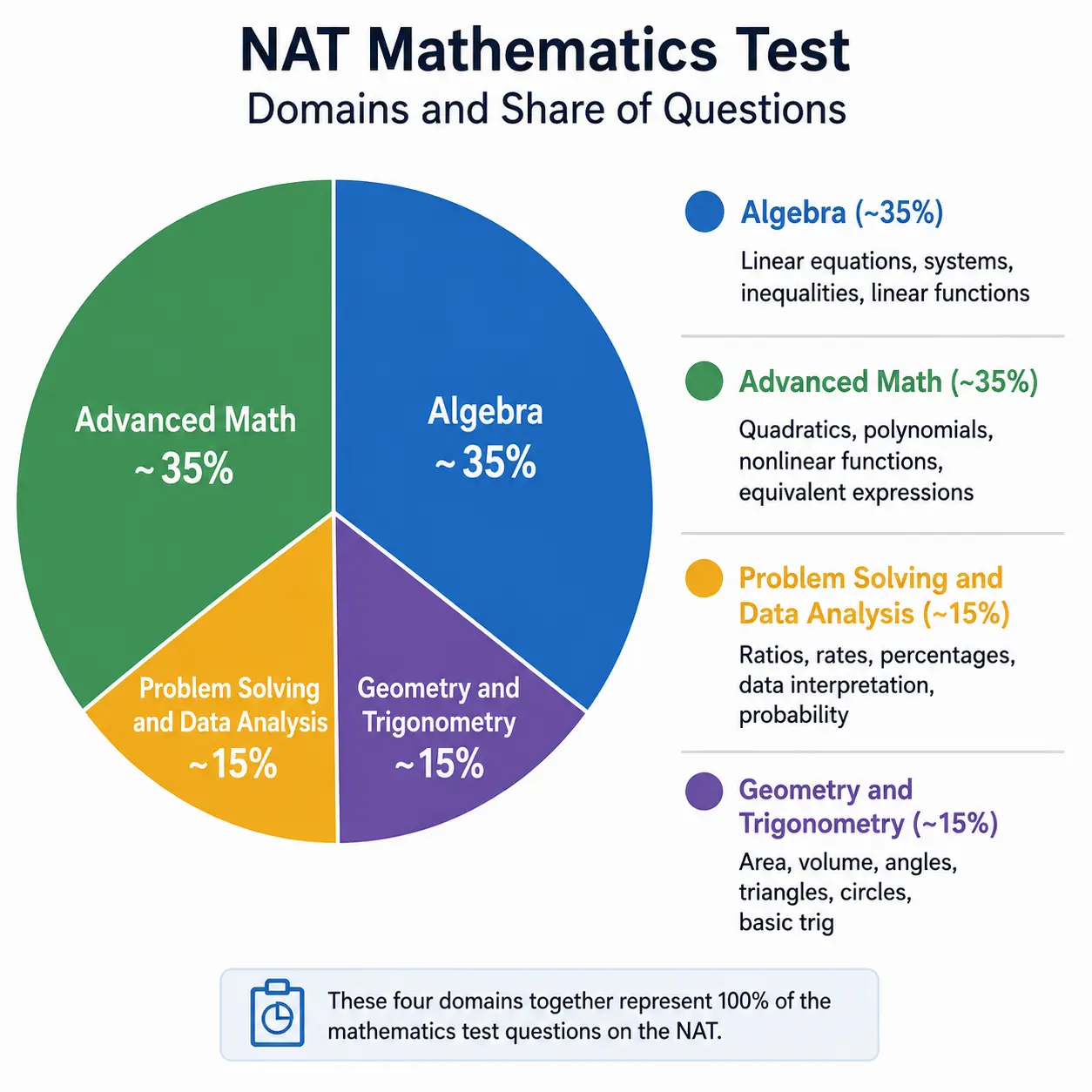
The four domains and their share of questions:
Domain | Share of Questions | Topics |
|---|---|---|
Algebra | ~35% | Linear equations, systems, inequalities, linear functions |
Advanced Math | ~35% | Quadratics, polynomials, nonlinear functions, equivalent expressions |
Problem Solving and Data Analysis | ~15% | Ratios, rates, percentages, data interpretation, probability |
Geometry and Trigonometry | ~15% | Area, volume, angles, triangles, circles, basic trig |
Domain 1: Algebra
What does Algebra test on the SAT?
Algebra is the largest domain on the digital SAT, accounting for roughly 35% of all math questions. It covers linear equations in one and two variables, systems of linear equations, linear inequalities, and the relationship between an equation and its graph. Most of these questions are straightforward if you know what you're solving for. The SAT makes them harder by wrapping them in word problems or by using variables in ways that feel unfamiliar.
Why do students miss Algebra questions?
This question was answered by our SAT tutor, Wanning.
“Students in the 550 to 650 score range lose more points in Algebra than in any other domain, including Advanced Math. The reason isn't that Algebra is hard. It's that students over-prepare for quadratics and functions because those feel harder, while careless multi-step errors on linear equations and systems quietly cap their score. Fixing Algebra first consistently produces faster gains than jumping straight to Advanced Math.”
The most common Algebra mistakes:
Distributing a negative sign incorrectly in multi-step equations
Setting up the wrong equation from a word problem (confusing "more than" with "less than")
Forgetting that in a system of equations, you're solving for a specific variable, not the full expression
Algebra practice questions
Q1. A store sells two types of notebooks. A single-subject notebook costs $3, and a multi-subject notebook costs $7. A student buys a total of 8 notebooks and spends $36. How many multi-subject notebooks did the student buy?
A) 2
B) 3
C) 4
D) 5
Answer: B. Set up a system: let s = single-subject, m = multi-subject. s + m = 8 3s + 7m = 36
From the first equation: s = 8 - m. Substitute: 3(8 - m) + 7m = 36. Simplify: 24 - 3m + 7m = 36. So 4m = 12, and m = 3.
Q2. Which value of x satisfies 3(2x - 4) = 2(x + 6)?
A) x = 5
B) x = 6
C) x = 7
D) x = 8
Answer: B. Expand both sides: 6x - 12 = 2x + 12. Subtract 2x from both sides: 4x - 12 = 12. Add 12: 4x = 24. Divide: x = 6.
Domain 2: Advanced Math
What does Advanced Math test on the SAT?
Advanced Math also accounts for roughly 35% of SAT math questions. It covers quadratic equations, polynomial expressions, nonlinear functions, exponential growth and decay, and equivalent algebraic expressions. These are the questions most students think of when they say "SAT Math is hard." They require you to factor, use the quadratic formula, interpret function notation like f(x), and work with expressions that don't simplify in one step.
Why do students miss Advanced Math questions?
The most common Advanced Math mistakes:
Solving for x in a quadratic instead of the form the question asks for (the SAT often asks for x + 1 or 2x, not x itself)
Misreading function notation: f(x + 2) does not mean f(x) + 2
Factoring incorrectly when the leading coefficient is not 1
Students who clear Module 1 and reach the high-difficulty Module 2 need to be solid on Advanced Math to push past 700. These are the questions that separate the 680 students from the 750 students.
Advanced Math practice questions
Q1. If f(x) = 2x^2 - 3x + 1, what is the value of f(4)?
A) 17
B) 21
C) 23
D) 25
Answer: B. Substitute x = 4: f(4) = 2(4)^2 - 3(4) + 1 = 2(16) - 12 + 1 = 32 - 12 + 1 = 21.
Q2. Which of the following is equivalent to x^2 - 5x + 6?
A) (x - 2)(x - 4)
B) (x - 2)(x - 3)
C) (x + 2)(x + 3)
D) (x - 1)(x - 6)
Answer: B. Factor by finding two numbers that multiply to 6 and add to -5. Those numbers are -2 and -3. So x^2 - 5x + 6 = (x - 2)(x - 3). Check: (x - 2)(x - 3) = x^2 - 3x - 2x + 6 = x^2 - 5x + 6. Correct.
Domain 3: Problem Solving and Data Analysis
What does the Problem Solving and Data Analysis test on the SAT?
Problem-solving and data analysis make up about 15% of SAT math questions. It covers ratios, rates, unit conversions, percentages, scatterplots, two-way tables, probability, and basic statistics (mean, median, mode, range). The math in this domain is rarely complicated. What confuses students is translating a dense word problem into the correct calculation.
Why do students miss Problem Solving and Data Analysis questions?
Hamza Kalim, our SAT Math specialist tutor answer this.
The most common Problem Solving and Data Analysis mistakes:
Calculating the right number but answering the wrong question (e.g., finding the percentage decrease when the question asks for the new value)
Misreading a scatterplot: identifying the trend correctly but estimating a specific value incorrectly
Confusing the probability of a single event with the conditional probability
Problem Solving and Data Analysis Practice Questions
Q1. A shirt originally costs $80. It goes on sale for 25% off. What is the sale price?
A) $20
B) $55
C) $60
D) $65
Answer: C. 25% of $80 = 0.25 x 80 = $20. Sale price = 80 - 20 = $60. Students who choose A are calculating the discount amount, not the sale price. Read what the question asks.
Q2. A researcher surveys 200 students. Of those, 120 prefer science and 80 prefer humanities. Among the 120 students who prefer science, 45 also participate in a science club. What is the probability that a randomly selected student from the entire group of 200 participates in the science club?
A) 0.225
B) 0.375
C) 0.45
D) 0.60
Answer: A. 45 out of 200 total students participate in the science club. 45 / 200 = 0.225. Students who choose B are calculating 45 out of 120 (science-only students), not the full group. The question specifies "from the full group of 200."
Domain 4: Geometry and Trigonometry
What does Geometry and Trigonometry test on the SAT?
Geometry and Trigonometry make up about 15% of SAT math questions. It covers area and perimeter of shapes, volume, properties of angles and triangles, the Pythagorean theorem, properties of circles (including arc length and sector area), coordinate geometry, and basic trigonometry (sine, cosine, tangent, and their relationships in right triangles).
The SAT provides a reference sheet with a handful of basic geometry formulas at the start of the math section. It does not include everything. Formulas for arc length, sector area, and many circle relationships are not on the sheet and must be memorized.
Why do students miss Geometry and Trigonometry questions?
The most common Geometry and Trigonometry mistakes:
Assuming the reference sheet covers all needed formulas (it does not)
Misapplying SOH-CAH-TOA: using sine when cosine is needed because the diagram is oriented differently than expected
Confusing the radius and diameter in circle problems
The good news: Geometry and Trigonometry questions are the most recoverable on the SAT. Most of the lost points come from formula gaps, which you can fix with one focused study session. For every formula the SAT does not provide, check NAT's SAT Math formula sheet, which covers every formula you need to memorize.
Geometry and Trigonometry practice questions
Q1. A right triangle has legs of length 6 and 8. What is the length of the hypotenuse?
A) 9
B) 10
C) 11
D) 14
Answer: B. Use the Pythagorean theorem: a^2 + b^2 = c^2. So 6^2 + 8^2 = 36 + 64 = 100. The square root of 100 is 10.
Q2. In a right triangle, the angle opposite the shorter leg measures 30 degrees. The hypotenuse is 12. What is the length of the shorter leg?
A) 4
B) 6
C) 8
D) 10
Answer: B. In a 30-60-90 triangle, the side opposite the 30-degree angle equals half the hypotenuse. Half of 12 is 6. You can also use sin(30) = opposite / hypotenuse. sin(30) = 0.5. So the shorter leg = 0.5 x 12 = 6.
When should you use Desmos on the SAT?
Desmos is the built-in graphing calculator available on every digital SAT math question. It is a powerful tool when used correctly. It slows you down when you reach for it on problems you could solve mentally.
NAT tutors use the 10-second rule: if you can see the path to the answer in ten seconds without Desmos, solve it by hand. If you cannot, open Desmos. This rule prevents the most common time drain students create for themselves in Module 2: graphing simple linear equations that could be solved with two steps of algebra.
Use Desmos for: nonlinear systems of equations, graphing to find intersections, checking a quadratic's roots, or verifying an answer you are unsure about. Do not use Desmos for: basic arithmetic, single-variable linear equations, or any calculation you can complete in under 30 seconds by hand.
For a full breakdown of how to use Desmos strategically across the full SAT, read NAT's complete SAT prep guide.
What is the best way to prepare for SAT Math?
The best way to prepare for SAT Math is to start with a domain-level diagnostic, identify your weakest domain, and fix it before moving on to the next.
Here’s how to approach prep based on your score range:
If your current Math score is below 600: Focus entirely on Algebra. Linear equations, systems, and inequalities account for the largest share of questions and are the most teachable. One focused week on Algebra will move your score more than a week spread across all four domains. Use College Board's Bluebook app to take a full-length practice test first so you know your baseline.
If your current Math score is 600 to 680: Your Algebra foundation is mostly solid. The points you're losing are likely in Problem Solving and Data Analysis word problems and in careless errors in Advanced Math. Slow down on word problems and practice underlining the specific question before you calculate.
If your current Math score is 680 to 750: You're reaching Module 2 but losing points on hard Advanced Math and nonlinear function questions. These are the gatekeeping questions between 700 and 760. Target quadratics, polynomial manipulation, and function notation specifically.
If your current Math score is above 750: You need near-perfect execution on Module 2 hard questions. At this level, errors are almost always careless rather than conceptual. Timed drills under real testing conditions, not untimed review, will close the remaining gap.
Khan Academy is a useful free resource and an official College Board partner for SAT prep. Use it for additional practice within your target domain. Do not use it as your primary curriculum without first doing a diagnostic. Khan Academy randomizes questions across topics, which means you can spend hours practicing and still not address your actual weak domain.
Put the practice to work
Every SAT math question comes from one of these four domains. The students who improve fastest are the ones who stop doing random practice and start drilling the domain that is costing them the most points.
If you're not sure which domain that is, a diagnostic session with one of our SAT tutors will tell you within the first hour. Wanning, who scored 800 on the SAT Math section, and Uju, who scored 1590 overall, work with students on exactly this kind of targeted, domain-specific prep. 92% of NAT students improved by 90 or more points on the SAT. Book your free intro consultation and find out which domain is holding your score back.
Your grades are now our responsibility.