How long is the SAT? Test Duration & Section Times
If you're wondering whether you'll be home by lunch or stuck at a test center until dinner, you're asking exactly the right question.
Test day logistics create real anxiety. Parents coordinate ride schedules. Students worry whether their brains will hold up for the entire exam. So many students say things like "I burned out by the math section" or "I ran out of time and panicked," which means that timing isn't just about logistics; it's also a performance factor.
Here's the good news: according to the College Board, the digital SAT is 46 minutes shorter than the old paper version. But shorter doesn't mean easier to manage. The adaptive module structure changes how time pressure feels, and how you pace yourself in Module 1 directly affects how many challenging questions you see in Module 2.
This guide breaks down exactly how long the SAT takes, section by section, with real strategies our tutors use to turn time pressure into a score advantage.
How long is the SAT test exactly?
The digital SAT takes 2 hours and 14 minutes of pure testing time. Add the 10-minute break between sections, and your total seated time is 2 hours and 24 minutes. Plan to arrive at the test center by 7:45 AM, and expect to leave between 11:00 AM and 11:30 AM, putting the full test-center experience at roughly 3.5 to 4 hours.
That total-center-time number surprises a lot of students. The test itself is 2 hours and 24 minutes with the break included, but check-in, ID verification, proctor instructions, and section transitions add another 45 to 75 minutes before you're even sitting down to the first question.
How long does each SAT section take?
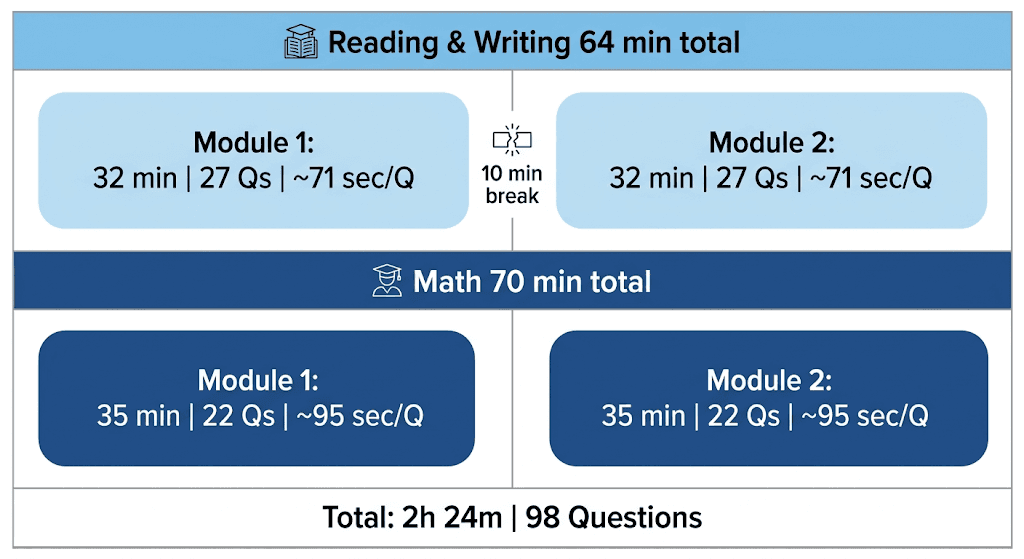
The SAT has two sections, each split into two timed modules. Reading and Writing takes 64 minutes total across two 32-minute modules of 27 questions each. Math takes 70 minutes total across two 35-minute modules of 22 questions each. That works out to about 71 seconds per Reading and Writing question and roughly 95 seconds per Math question.
Section | Module | Time | Questions | Time Per Question |
|---|---|---|---|---|
Reading and Writing | Module 1 | 32 min | 27 | ~71 sec |
Reading and Writing | Module 2 | 32 min | 27 | ~71 sec |
Break | 10 min | |||
Math | Module 1 | 35 min | 22 | ~95 sec |
Math | Module 2 | 35 min | 22 | ~95 sec |
Total | 4 modules | 2h 24m | 98 |
The difference in time-per-question matters. Math gives you more time per question, but those questions are often multi-step. Reading and Writing moves faster, which means students who read slowly or second-guess word-choice questions can fall behind quickly in Module 1.
Regarding the timing of the SAT exam, our SAT tutor from Harvard, Cathleen Kong, who tutors students targeting 1500+, explains this after having conducted 139+ sessions with different SAT students:
What time does the SAT start and end?
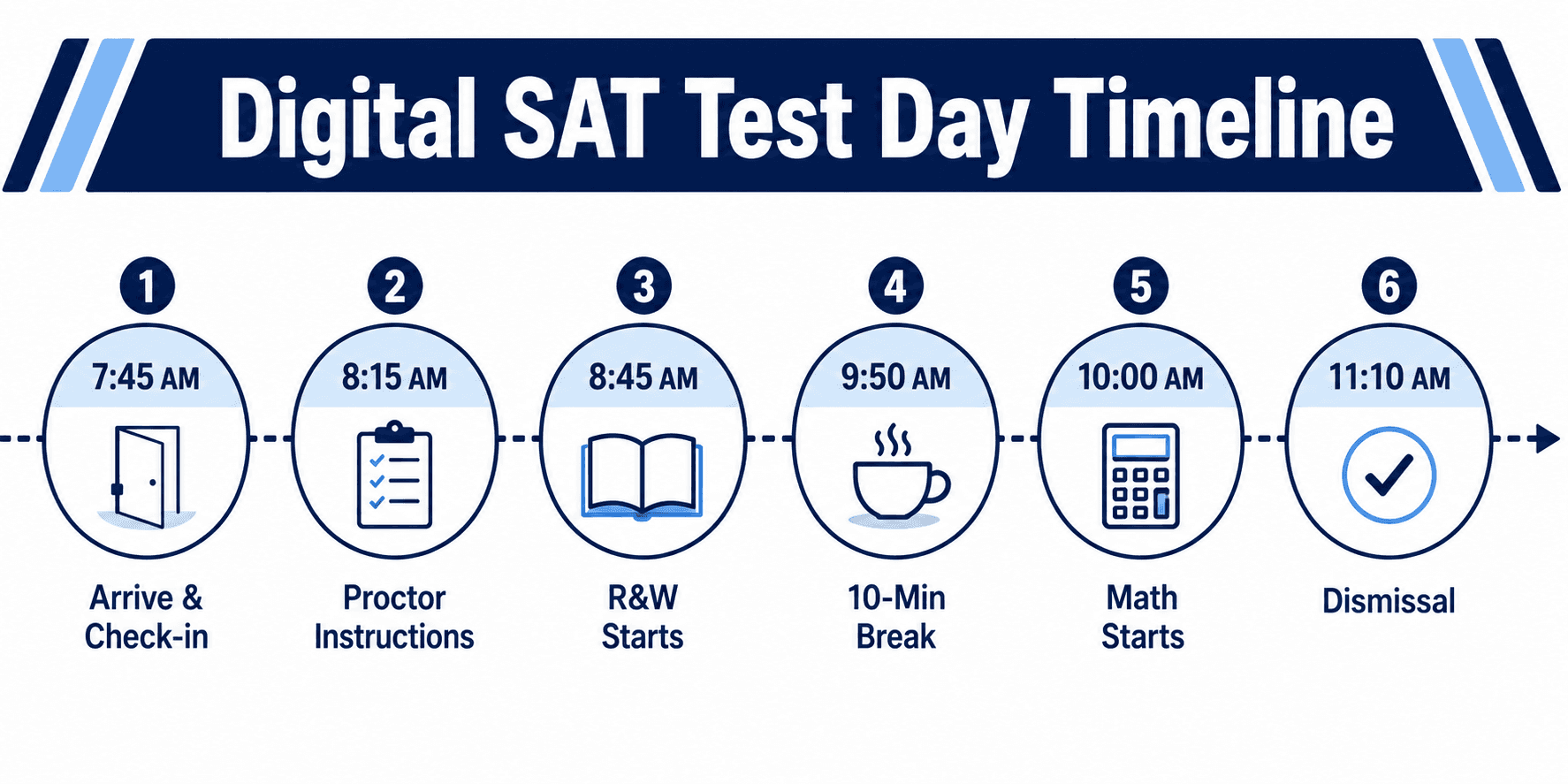
College Board policy specifies that test center doors open at 7:45 AM and close at 8:00 AM. Students who arrive after 8:00 AM are not admitted. After check-in and proctor instructions, testing typically begins between 8:15 AM and 8:45 AM. Standard-time students finish between 10:45 AM and 11:15 AM.
Time | What Happens |
|---|---|
7:45 AM | Doors open; check-in begins |
8:00 AM | Doors close; late arrivals turned away |
8:15 to 8:45 AM | Proctor instructions; testing begins |
8:45 to 9:50 AM | Reading and Writing section (64 minutes) |
9:50 to 10:00 AM | 10-minute break |
10:00 to 11:10 AM | Math section (70 minutes) |
~11:00 to 11:30 AM | Standard-time students dismissed |
One important note: students cannot leave after finishing a module early. The Bluebook app, which is the College Board's official digital testing platform, holds the timer per module. You can review flagged questions within a module, but you cannot carry unused time forward to the next module.
How long is the SAT with extended time?
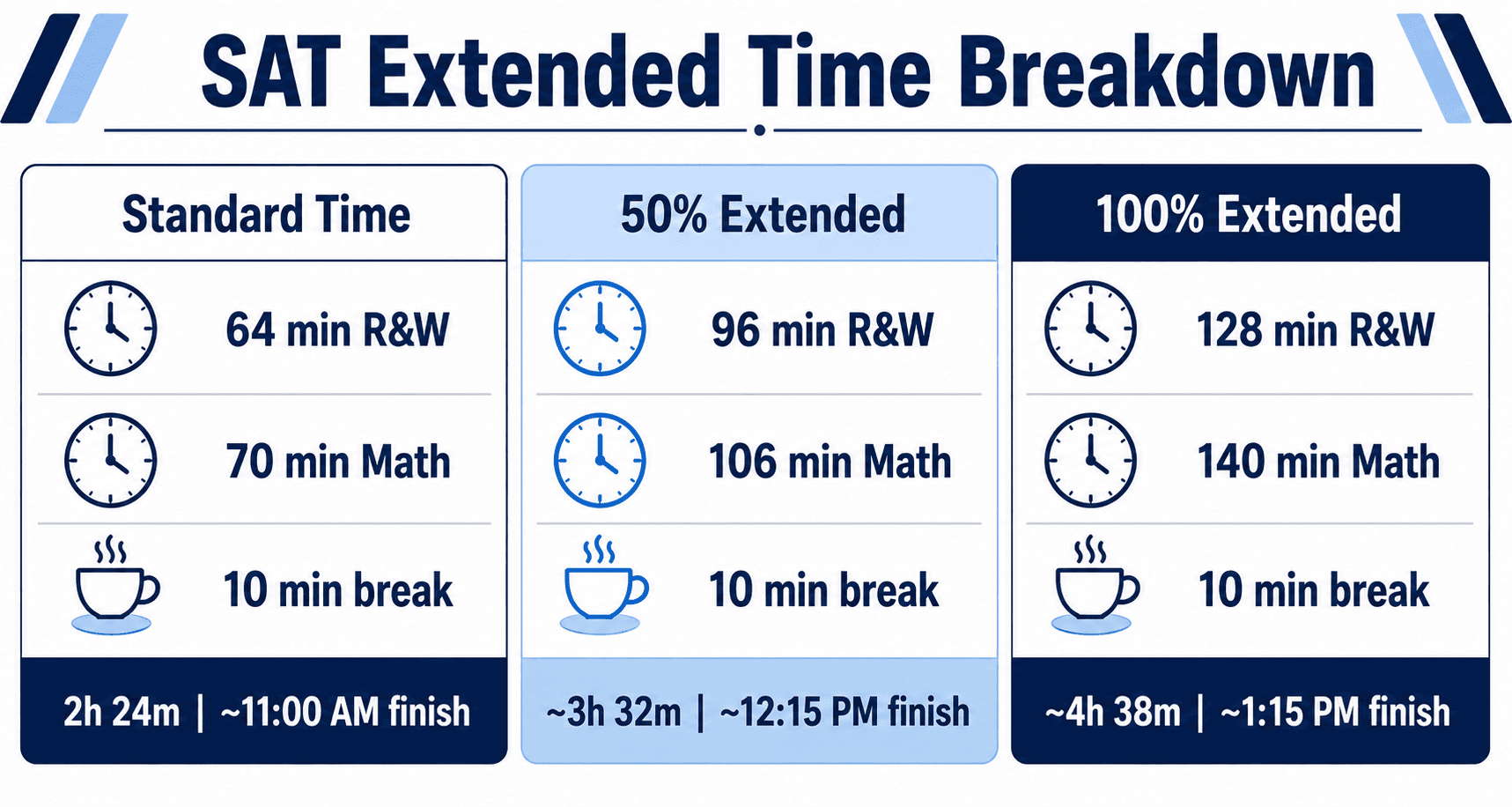
Students with approved accommodations through the College Board's Services for Students with Disabilities (SSD)program receive either 50% extended time (time-and-a-half) or 100% extended time (double time). With time-and-a-half, the SAT takes approximately 3 hours and 32 minutes of testing time. With double time, testing takes approximately 4 hours and 38 minutes.
Students with extended time must stay for the full allotted duration. Leaving early is not permitted, even if you finish all questions before the time expires.
Accommodation | R&W Time | Math Time | Break | Total Test Time | Approx. Finish |
|---|---|---|---|---|---|
Standard | 64 min | 70 min | 10 min | 2h 24m | ~11:00 AM |
50% Extended | 96 min | 106 min | 10 min | ~3h 32m | ~12:15 PM |
100% Extended | 128 min | 140 min | 10 min | ~4h 38m | ~1:15 PM |
Accommodations must be requested through SSD well in advance of test day. The College Board recommends applying at least 7 weeks before the test date. Extended time does not change the content or structure of the SAT; only the amount of time per module increases.
How does SAT timing compare to the ACT?
The digital SAT gives students significantly more time per question than the ACT. According to College Board, SAT test-takers have about 67% more time per question on average compared to ACT test-takers. The ACT runs 2 hours and 55 minutes for the core test across four sections, with a more aggressive per-question pace that benefits students who process quickly under pressure.
For a deeper breakdown of which test format fits your student's strengths, see our SAT vs ACT comparison.
Jiayue L., 1560 SAT, Cornell University, who tutors students targeting 1400+ SAT and 30+ ACT, has the same pov reagarding the SAT vs ACT timing comparison Pattern seen in: Students deciding between SAT and ACT who score similarly on practice tests for both
The PSAT exam follows the same digital structure as the SAT, also taking 2 hours and 14 minutes of testing time. The questions are slightly easier and the maximum score is 1520 instead of 1600. If your student is using the PSAT to benchmark before the SAT, our PSAT to SAT score conversion guide shows exactly how scores translate.
The Module 1 Time Bank Strategy: why speeding up early helps you slow down later
Here is a pacing insight that no standard SAT prep guide covers, because it comes directly from observing real student behavior across hundreds of NAT tutoring sessions.
The digital SAT is adaptive. Module 1 of each section contains a mix of easy, medium, and hard questions. Based on how you perform in Module 1, the Bluebook algorithm assigns you either a harder or easier Module 2. This means Module 1 is not just about getting answers right; it's about doing so with enough time left to think clearly on the harder questions at the end.
NAT tutors teach students a counter-intuitive strategy called the Module 1 Time Bank. The approach works like this: for the first 5 questions of each module, where questions are typically easier, target 60 to 65 seconds per question instead of the 71-second average. This builds a 30 to 45 second time cushion before the difficulty ramp begins. Students who carry this cushion into questions 6 through 27 have more mental bandwidth when adaptive difficulty kicks in.
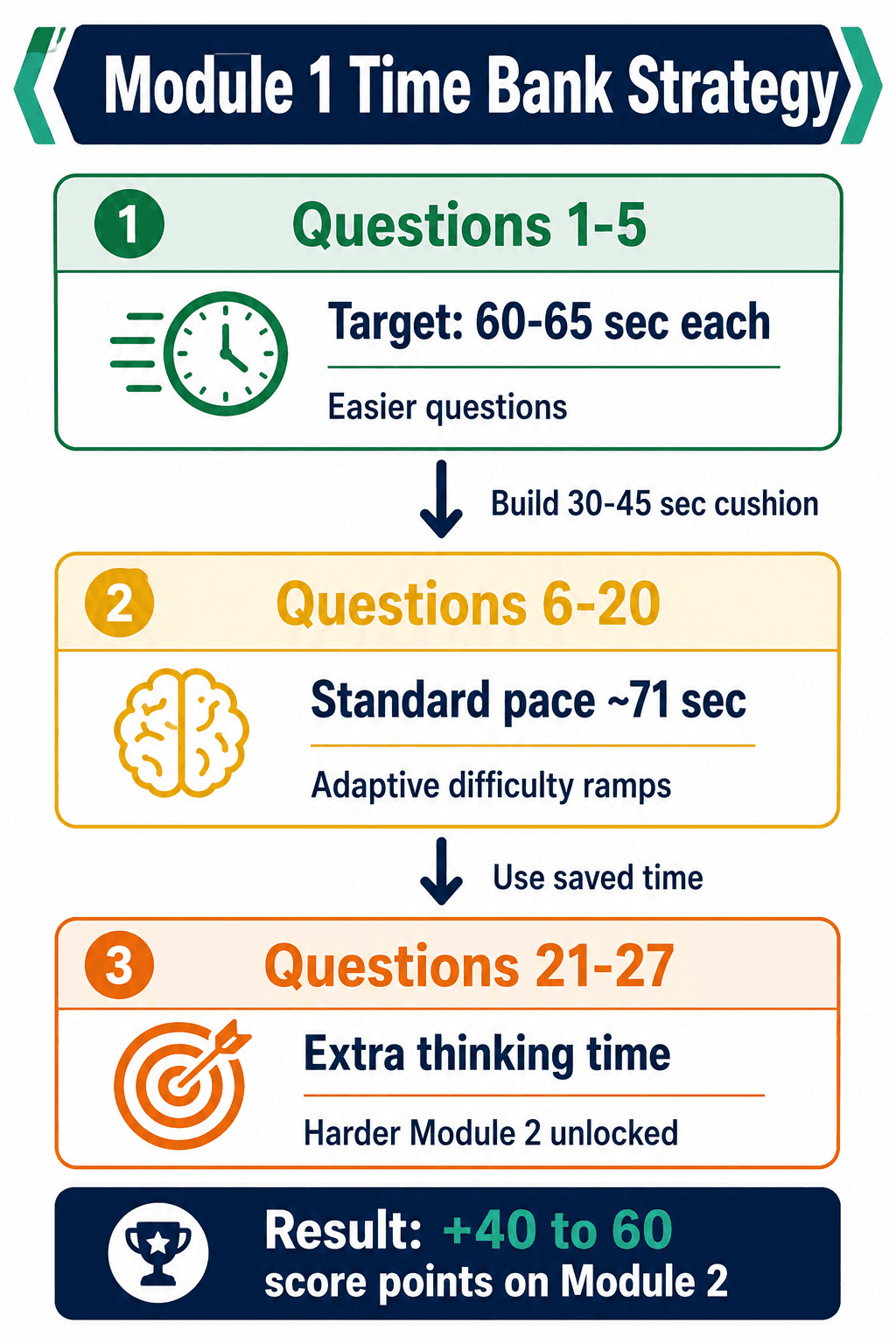
In NAT sessions, students who learn and apply this strategy before test day consistently improve their Module 2 performance by 40 to 60 score points compared to students who pace evenly throughout. The key is practicing it under timed conditions during SAT practice tests so it becomes automatic before the real exam.
What should you do during the 10-minute break?
Use all 10 minutes. Stand up, stretch, step outside the room if permitted, eat a small snack with protein and complex carbs (think a handful of nuts or a granola bar, not candy), drink water, and use the restroom. Your brain needs blood flow and hydration to sustain performance through the Math section.
What to avoid: checking your phone, talking about the test with other students, reviewing notes, or doing anything that requires mental effort. The break is designed to reset your nervous system, not your knowledge.
Students who skip the break or sit quietly at their desk during it consistently report more fatigue and lower Math scores compared to students who move around. You have 70 minutes of Math ahead. Treat the break like a reset button, not dead time.
Do:
Stand and stretch
Eat a light protein-based snack
Drink water
Use the restroom
Take slow, deep breaths if you're anxious
Don't:
Check your phone (it may be prohibited by your proctor)
Discuss Reading and Writing questions
Cram notes
Sit motionless at your desk
You know the clock. Now make it work for you.
The digital SAT is 2 hours and 14 minutes of testing, with one 10-minute break. Plan for 3.5 to 4 hours at the test center. Arrive by 7:45 AM. Use the Module 1 Time Bank Strategy to build a pacing cushion before adaptive difficulty kicks in. Use the break to reset, not to sit quietly and stress.
Knowing the timing is the first step. Practicing under exact timed conditions is what turns that knowledge into a higher score.
NAT tutors have helped students improve 90 to 120 points by working on pacing, strategy, and content together, not just one at a time. If your student is targeting 1400, 1500, or beyond, our tutors know exactly how to pace the digital SAT because they've scored 1570 to 1600 themselves.
Schedule a free consultation and find out what a targeted SAT tutoring plan looks like for your student. Your grades are now our responsibility.