Why a 1480 SAT No Longer Gets You Into Harvard

A 1480 used to be safe. It is not anymore
"Is a 1480 good enough for Harvard?" Three years ago, a tutor could honestly say, maybe if the rest of the application carried the weight. In 2026, the honest answer is no, not even close. If that stings, it is because nobody sent out a memo when the rules changed.
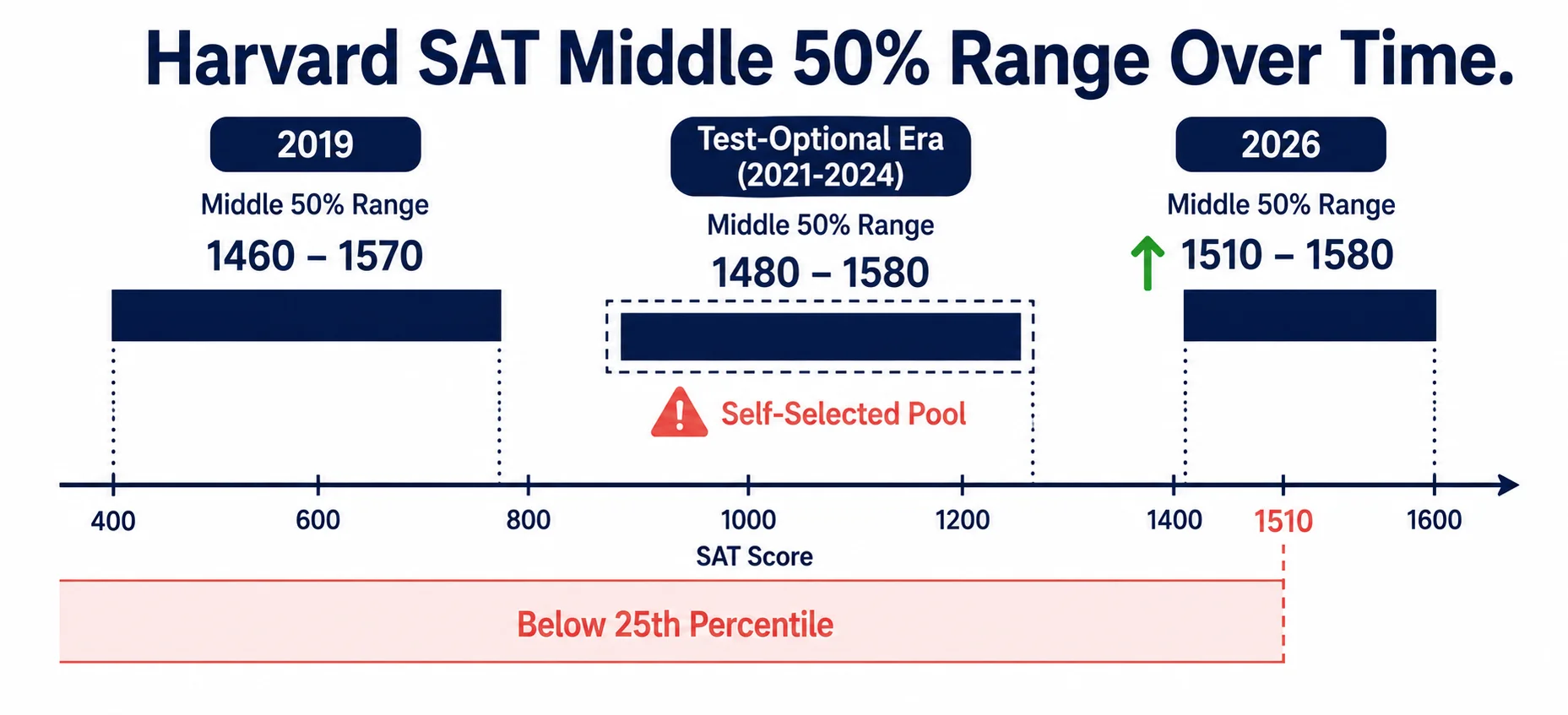
Harvard required standardized test scores again, starting with applicants for the Class of 2029. Yale, Dartmouth, Brown, Cornell, and Penn followed with their own testing requirements. Only Columbia and Princeton remain test-optional through the 2026-2027 cycle, and even Princeton has already announced it will require scores again starting with applicants in 2027-2028. Harvard's current middle 50% SAT range sits at 1510-1580. A 1480 lands below the 25th percentile, in a spot that felt perfectly normal to a Harvard applicant back in 2019.
We wrote this post to walk through exactly why that bar moved, what the real numbers look like at every Ivy right now, and what a family should actually do if the score they were counting on suddenly feels short. If you have been searching Reddit threads at midnight, wondering whether "1450-1500 is the new 1300," you are not imagining things, and you are not alone.
What is Harvard's SAT requirement for 2026?
Harvard requires the SAT or ACT for all first-year applicants, starting with the Class of 2029, according to its application requirements page. In rare cases where a student cannot access either test, AP, IB, or certain national exam results can substitute for it. The Admissions Committee has stated that it does not apply hard testing cutoffs, but current data show that most enrolled students score above 1500.
For the enrolling Class of 2029, the middle 50% SAT range runs 1510-1580, with Reading and Writing scores clustering between 740 and 780 and Math scores between 770 and 800. The ACT composite middle 50% ranges from 34 to 36. Harvard's own FAQ page also notes that in the last cycle before test-optional admissions began, the 10th-90th percentile SAT range for enrolling students was 670-790 on Reading and Writing and 680-800 on Math, with ACT composites between 31 and 36. That earlier band provides a useful baseline for how much room there was at the lower end before test-optional years reshaped what gets reported.
We know a good SAT score target looks different depending on which tier of school a student is aiming for. At Harvard specifically, the target has simply moved up.
Why did the SAT bar rise if students didn't get smarter?
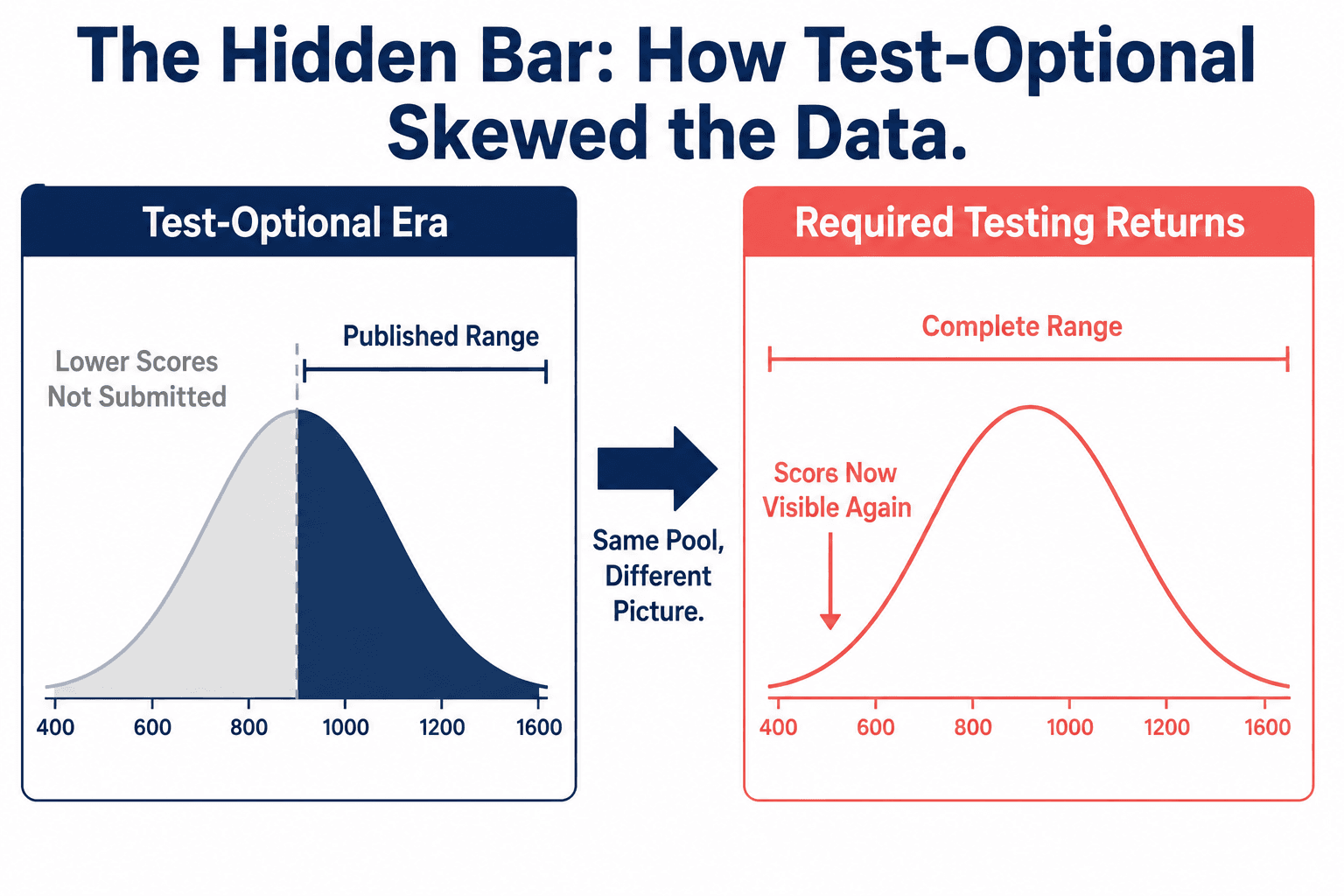
The bar climbed because of self-selection, not because a generation of students suddenly got sharper. During the test-optional years, students with lower scores mostly chose not to submit them. That meant the published SAT ranges only reflected the students who were confident enough to send in their numbers, which quietly inflated what "average" looked like at Harvard and every other Ivy.
Harvard's own announcement leaned on research from Opportunity Insights, the Harvard-based research group led by economist Raj Chetty. Their study of Ivy-Plus admissions data found that SAT and ACT scores predict first-year college GPA even after controlling for high school grades, and that the result held regardless of a student's family income. Faculty of Arts and Sciences dean Hopi Hoekstra wrote in Harvard's official announcement about the return to required testing that talent is universal, but opportunity is not, and that testing helps the admissions committee find promising students who might otherwise be overlooked.
Here is the part most families miss. A test-optional policy does not lower the bar. It hides the bar. Once a school goes back to requiring scores, the reported range snaps back toward what it actually was all along, and it looks like a jump even though the underlying pool of admitted students has not changed nearly as much as the numbers suggest.
On this topic, our college admissions strategist, Cathleen, who holds a Harvard M.Ed., who has a Princeton computer science degree and has guided more than 200 students through Ivy League applications over the past six years, told the NAT team:
Overrated application advice tends to lag behind these policy shifts by a full cycle, which is part of why so many families get caught off guard.
The Score Reality Check: Should you retake or reallocate?
We built this framework after watching too many strong students waste their senior fall retaking a test that was never going to make a difference, while equally strong students with a 1480 got into their target schools because they redirected that same time into essays. Three questions, thirty seconds, and a clear answer.
Is your score within 20 points of your target school's 25th percentile? If yes, a retake has real upside. If you are 60 or more points below, a single retake rarely closes that gap on its own.
Do you have eight or more weeks before your next application deadline? Score gains take structured practice time. Less than eight weeks usually means diminishing returns from an SAT retake.
Is your spike or essay narrative already strong? If a student's activities and essays remain generic, they should often spend that time improving them rather than taking a fourth SAT.
Two "YES" answers point toward a retake. One or zero points toward reallocating that time into the parts of the application that are still soft.
We saw this play out with Elizabeth G., a NAT student who moved from a 1370 to a 1480 across three sessions after her tutor targeted a specific pattern in her Reading and Writing errors around subject-modifier placement and semicolon rules. Once she hit 1480, she ran the Score Reality Check and landed on two "NO" answers. She had six weeks left, not eight, and her essays were already close to final. She chose to pivot her remaining time toward essay revision rather than a fourth sitting. She was admitted to her target school that cycle.
Zachary W., whose consulting practice has tracked outcomes for students scoring between 1460 and 1520 across the 2024-2025 and 2025-2026 application cycles, added this:
What SAT score do you actually need for each Ivy in 2026?
For Harvard, plan on 1530 or higher to be genuinely competitive and 1570 or higher to sit above the median admitted student. For Brown, Dartmouth, Penn, and Cornell, a 1500 or higher is competitive, with 1520 or higher preferred. Columbia remains test-optional for the 2026-2027 cycle, so a strong applicant with a score in the high 1400s can still choose not to submit and lean on the rest of the application.
Ivy League school | Current testing policy (2026-2027) | Reported middle 50% SAT range |
|---|---|---|
Harvard | Required | 1510-1580 |
Yale | Required (test-flexible: SAT, ACT, AP, or IB) | Approximately 1500-1580 |
Brown | Required | Approximately 1500-1570 |
Dartmouth | Required | Approximately 1500-1570 |
Penn | Required | Approximately 1500-1570 |
Cornell | Required | Approximately 1470-1560 |
Princeton | Test-optional (required again starting fall 2027 entry) | Approximately 1500-1580 among submitters |
Columbia | Test-optional (permanent, though a future review is possible) | Not consistently published |
Ranges for schools other than Harvard are approximate composites drawn from recent Common Data Set reporting and third-party admissions analysis, since not every Ivy publishes its exact current band in the same format each year. Cornell's lower 25th percentile reflects its multi-college admissions structure, where some undergraduate colleges weigh testing differently than others.
The highest possible SAT score matters less here than most families assume. Once a student clears roughly 1560 at any Ivy, additional points buy very little in extra odds.
Is a 1500 SAT enough for Harvard in 2026?
A 1500 sits at the very bottom edge of Harvard's competitive range. It is not disqualifying on its own, but it is not comfortable either. A student with a 1500 needs essays, recommendations, and a clear spike that all do real work, because the score alone will not carry the application.
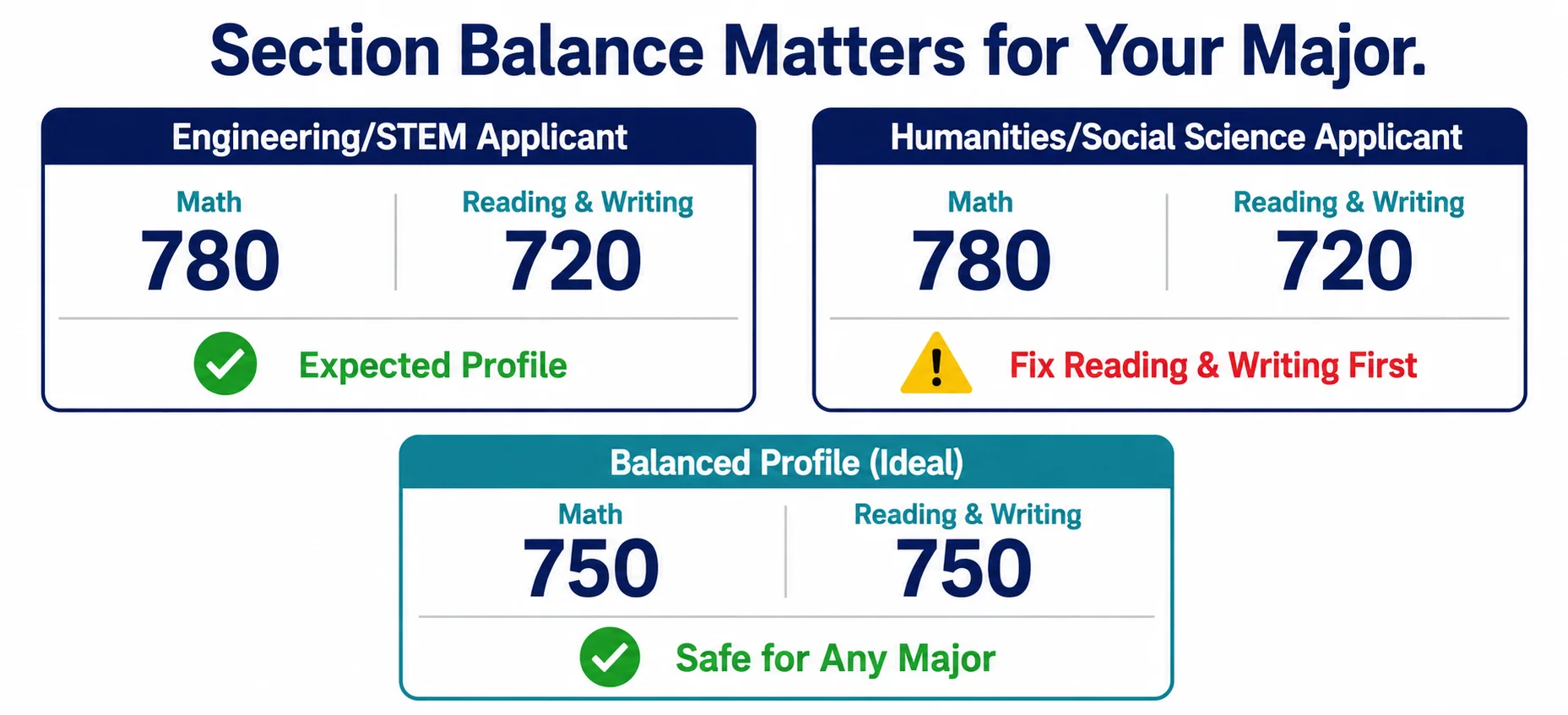
Moving from 1500 to 1530 or 1540 significantly increases the chances that a reader takes the academic profile seriously. Above roughly 1560, returns start to flatten out, which is a pattern we discuss in more detail in our post on why perfect stats still get rejected. A 1500 with an uneven split between sections also reads differently from a balanced one.
Uju, an SAT and ACT tutor who scored a 1590 SAT and a 35 ACT, is a Northwestern graduate, and has worked with more than 60 students applying to Ivy-Plus schools over the past four years, shared this with the NAT team:
Should I submit a 1480 to Harvard if I have strong essays?
Strong essays help, but they rarely offset a score that sits below the 25th percentile at a school as selective as Harvard on their own. If the rest of the application, including GPA, course rigor, and recommendations, is genuinely exceptional, a 1480 can still be part of a competitive file. Our Common App essay guide explains how to make that essay as strong as possible.
Which Ivies are still test-optional in 2026?
Columbia and Princeton are the two Ivy League schools that are still test-optional for the 2026-2027 admissions cycle. Princeton has already confirmed it will require testing again, starting with students applying for fall 2027 entry, and Columbia's internal reviews suggest its policy could shift for a future cycle as well. Families targeting either school for this cycle should still consider submitting a strong score, since most admitted students at both schools do so anyway.
The bar moved, but that is not the whole story
Three things are true at once here. The bar moved, and it is real. A 1480 is not a death sentence, especially outside the very top of the Ivy League tier. And the students who come out ahead in 2026 are the ones making a specific, data-backed decision about where to spend their remaining time, not the ones panicking into a fourth SAT sitting they cannot support with enough prep weeks.
Run your child's numbers through the Score Reality Check above before making any decisions. If the honest answer points toward a retake, one-on-one SAT tutoring built around their specific error patterns will move the needle faster than another round of full-length practice tests alone. If it points toward essays and activities, that is just as valid a path forward. Schedule your free consultation, and we will help you figure out which one your family is actually facing.