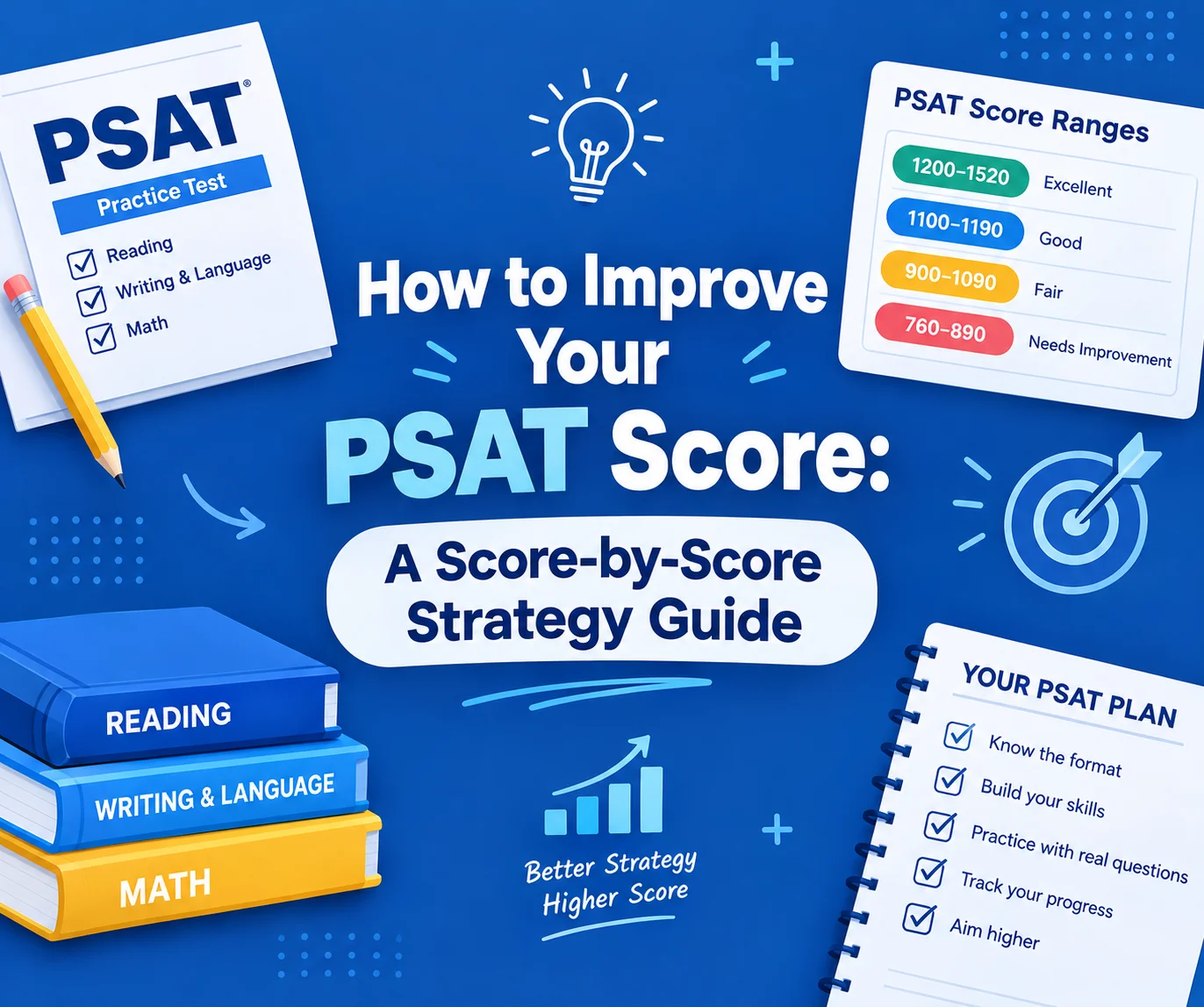
How to Improve Your PSAT Score: A Score-by-Score Strategy Guide
A PSAT/NMSQT score runs from 320 to 1520, and the test students take today looks almost nothing like the paper version their older siblings or parents remember. It is fully digital, delivered through College Board's Bluebook app, and adaptive within each section. That shift trips up a lot of families, because a student can walk out of a practice test unsure whether they did well, since the questions got harder or easier depending on how the first half went.
For a tenth or eleventh grader, the PSAT usually shows up quietly on the school calendar, sandwiched between an early fall sports schedule and college-planning nights nobody has scheduled yet. Parents often treat it as low-stakes practice, and for most students, it is. For a junior with a shot at National Merit recognition, though, it is the only test that counts toward that specific scholarship track, and the scoring rules reward a very particular kind of preparation.
This guide walks through what a strong PSAT score looks like right now, how the digital, adaptive format actually scores a student, why the National Merit Selection Index weights one section more than the other, and a practical way to close a score gap before test day.
What counts as a good PSAT score right now
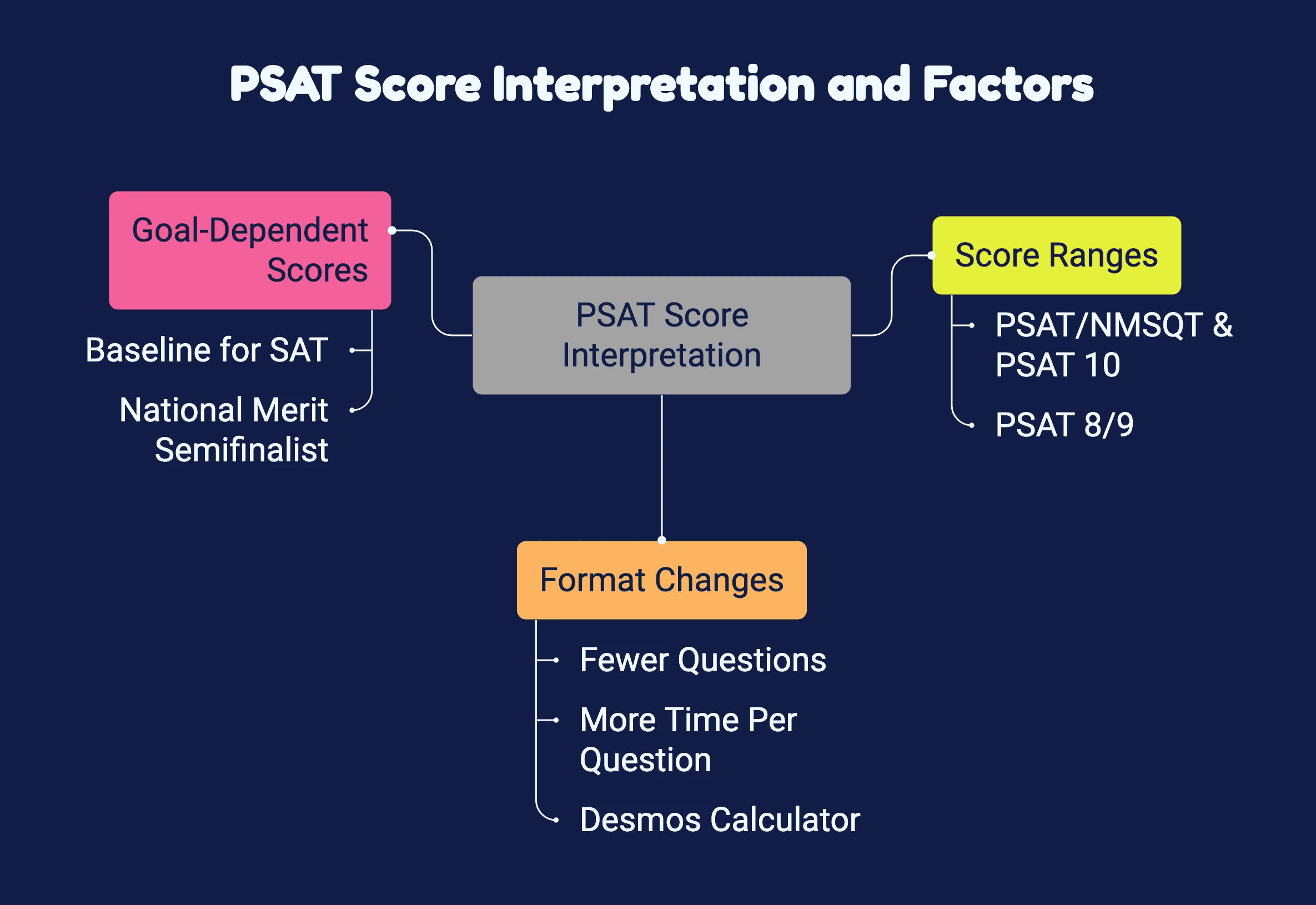
A PSAT/NMSQT or PSAT 10 total score sits somewhere between 320 and 1520, made up of two section scores, Reading and Writing and Math, each running from 160 to 760. There is also a separate PSAT 8/9 for eighth and ninth graders, scored from 240 to 1440, which uses an easier question set and should not be compared directly to the 10th and 11th grade version.
None of those ranges changed when the test went digital. What changed is the format: fewer questions, more time per question, and a built-in Desmos calculator for the entire Math section. College Board's own PSAT/NMSQT page confirms the exam is now fully digital, shorter than the retired paper version, and built around more time per question.
For most students, a good score depends entirely on the goal. A 10th grader using the PSAT as a baseline for the SAT two years out does not need the same score as an 11th grader trying to clear a state Semifinalist cutoff for National Merit. The number on the report matters less than what a student plans to do with it.
How the digital, adaptive PSAT actually scores a student
The current PSAT/NMSQT has 98 questions across two sections, delivered in 134 minutes: 54 Reading and Writing questions in 64 minutes, then 44 Math questions in 70 minutes. Both sections run on the same adaptive structure the digital SAT uses. Each section is split into two modules, and a student's performance on the first module determines whether the second module serves easier or harder questions.
That adaptive routing is exactly why two students can each get roughly the same number of questions right and still land on different scores. A student who reaches the harder second module and answers most of it correctly scores higher than one who gets routed to the easier module and answers nearly everything right, because the harder module is worth more.
A calculator, either the built-in Desmos tool inside Bluebook or an approved handheld model, is allowed for the entire Math section. There is no separate no-calculator portion on the digital test, which is one of the clearest differences from the retired paper PSAT.
The National Merit Selection Index: why Reading and Writing counts double
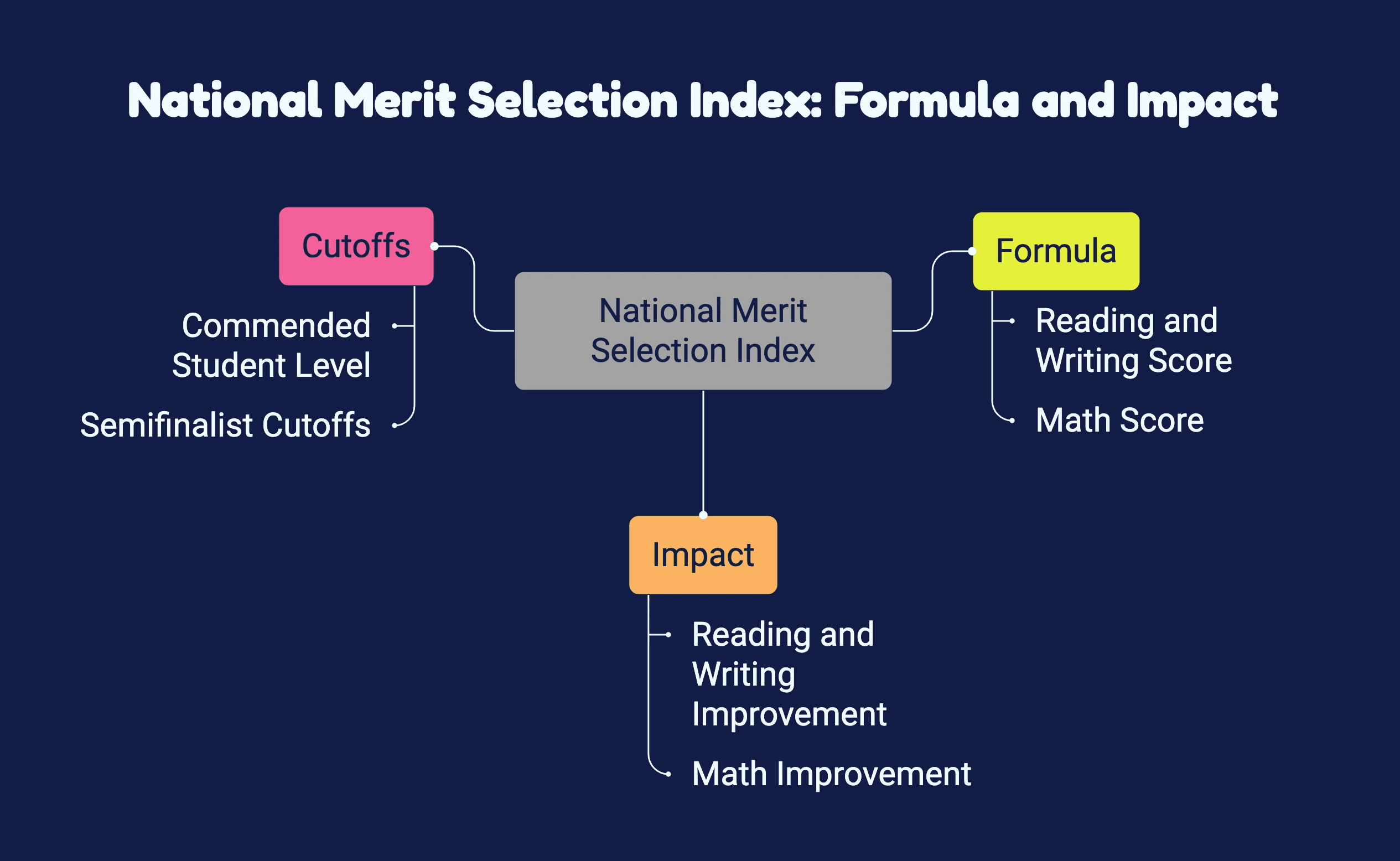
National Merit Scholarship Corporation, which runs the program, does not use a student's total PSAT/NMSQT score. It calculates a separate Selection Index, on a scale of 48 to 228, by doubling the Reading and Writing section score and adding the Math section score, then dividing by 10.
That weighting is not a minor detail. A 20-point improvement in Reading and Writing raises the Selection Index by 4 points, while the same 20-point improvement in Math raises it by only 2. A student who is a few points away from a state's Semifinalist cutoff gets more out of one strong week of Reading and Writing work than the same week spent on Math, purely because of how the formula is built.
The Commended Student level, the single national cutoff that applies to every state, has stayed within a narrow range for years, generally in the high 200s out of a possible 228. Semifinalist cutoffs are set separately by state and typically run a bit higher, since each state names Semifinalists based on its own distribution of scores. Neither cutoff is published until the fall after students take the test, so treat any specific number circulating online as a historical estimate, not a guarantee for this year's juniors. The full National Merit timeline, from testing in the fall of junior year to scholarship announcements the following spring, appears on NAT's PSAT overview.
Where PSAT points actually get lost
Two mistakes show up constantly among students who plateau on PSAT prep. The first is treating the PSAT as low-stakes practice and skipping real preparation entirely, which is a reasonable call for a 10th grader but a costly one for a junior with a shot at National Merit. The second, more common among motivated students, is spending nearly all of their prep time on Math because it feels more fixable than Reading and Writing.
Rachel Choi is a National Merit Finalist who scored 1580 on the SAT and studies political science and economics at UCLA. She has spent 5 years working with 120 students on SAT and PSAT preparation, and the math-first habit is the pattern she corrects most often with juniors chasing National Merit recognition.
A third, quieter mistake is skipping error review. A student who finishes a practice section and moves straight to the next one without checking why specific questions went wrong repeats the same mistake on test day that they made in practice.
A practical way to raise a PSAT score before test day
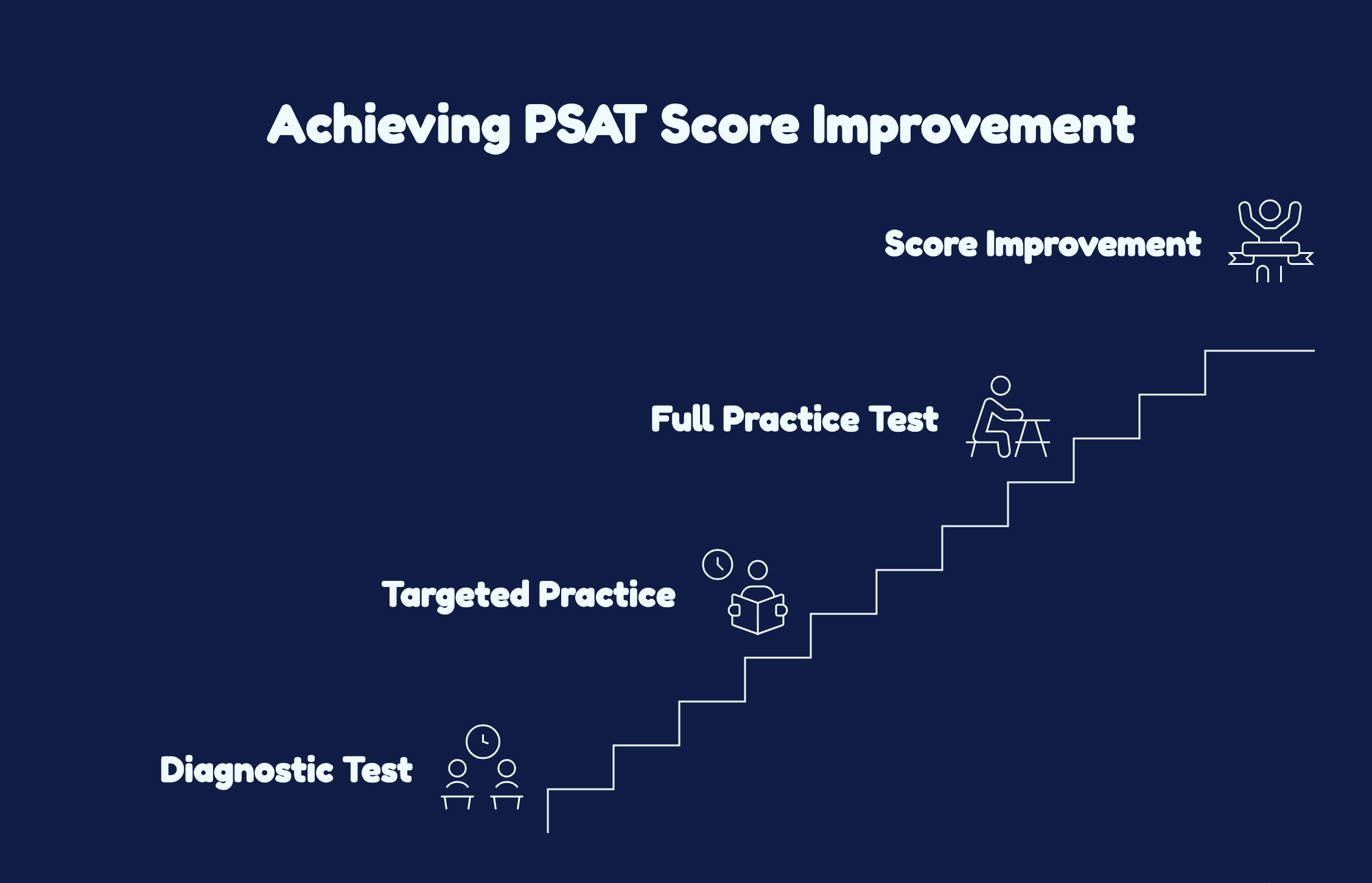
Score gains on the PSAT come from targeted correction, not volume. A useful sequence looks like this.
Take one untimed section and log every miss by cause: a content gap, a timing problem, or a careless read of the question.
Spend the next one to two weeks drilling whichever cause shows up most, using official Bluebook practice material rather than a third-party question bank that may not match the live adaptive format.
Run a full, timed practice test under real conditions, then compare the new miss pattern to the first one.
Kendra Kim studies statistics at the University of Chicago, has qualified for AIME, and took 18 AP courses in high school. She has worked with 4 years and 100+ students on SAT, ACT, and PSAT math preparation, and pacing under the adaptive format is the issue she flags first with new students.
Consider a student whose first diagnostic report shows a Reading and Writing score of 680 and a Math score of 650. Using the official formula, that student's Selection Index is 201: double 680, add 650, divide by 10. If that student closes a 20-point gap in Reading and Writing over the next month, the Index rises by 4 points to 205. The same 20-point gain in Math would raise it by only 2 points, to 203. Neither gain is guaranteed, but the arithmetic shows exactly where a limited number of study hours does the most work for a National Merit goal specifically.
Deciding how to prep: self-study, a course, or one-on-one tutoring
Not every student needs a private tutor to move a PSAT score. The right format depends on how large the gap is, how close the target is to a National Merit cutoff, and how independently a student studies.
Option | Typical structure | Best fit |
|---|---|---|
Self-study with official Bluebook practice | Free, student-directed | A small score gap and a student who works independently |
School or peer tutoring | Low cost, general review | A light refresher before the test, not a specific score target |
Group test-prep course | Fixed curriculum, shared pace | Students who benefit from structure and a set schedule |
One-on-one tutoring | Personalized to the student's score report | A larger gap, a National Merit target, or a defined test date |
Lia Hansen has tutored since middle school, scored 1580 on the SAT, and earned National Merit recognition herself before enrolling at Dartmouth to study biology and environmental studies. She has worked with 5 years and 100+ students, and she is usually the person a family talks to when deciding between self-study and a tutor.
A student who scored a 1300 on a diagnostic and needs a 1350 for a school benchmark can often close that gap with focused self-study and one or two official practice tests. A student trying to move from a Selection Index of 195 to a state Semifinalist cutoff in the low 200s, on a fixed fall testing date, is working with less room for trial and error.
Sharing a recent PSAT or practice score with an NAT tutor turns this decision into a specific plan instead of a guess. Book a free PSAT strategy session to find out which section is holding back your Selection Index and whether a tutor, a course, or focused self-study fits your timeline.
Putting it together
A PSAT score is easiest to move when a student knows exactly where it is leaking. That means separating a genuine content gap from a pacing problem, understanding that Reading and Writing carries more weight toward National Merit than Math does, and choosing a prep format that matches the size of the gap and the time available before test day.
None of that requires guessing. A single diagnostic section, scored and reviewed honestly, tells a student more about their next move than another week of unfocused practice.
If a PSAT score report is more confusing than helpful, an NAT tutor can walk through it in a free consultation and build a plan around the sections and the timeline that actually matter for this student. Sessions are one-on-one and online, and the plan can change if the first approach is not the right fit. Book a free PSAT consultation to get started.