When Do You Take the ACT? Grade-by-Grade Timeline for 2026-2027
Most students take the ACT for the first time in the spring of junior year and retake it in the fall of senior year. That's the short answer, and it's the right answer for most families asking "when do you take the ACT?" in this planning stage. But the timing question has more moving parts than it used to.
The ACT changed in 2025. Science and Writing are now optional add-ons that do not count toward your composite score. The core test is shorter, and that changes which dates actually make strategic sense. Most advice circulating online, including from parents and counselors who tested before 2025, was written for a different exam. If you're planning around old timing guidance, you may be adding unnecessary pressure on the wrong part of the calendar.
NAT's ACT tutors scored 34 to 36 on the exam. They tutor students one-on-one and know what's on it right now. This guide walks through the grade-by-grade timeline, the readiness checkpoint you need to pass before registering, all seven 2026-2027 test dates, and the decision rules for first attempts, retakes, and registration. To understand what's on the ACT, that overview covers the sections and scoring in full.
What grade do you take the ACT?
Most students take the ACT for the first time in the spring or fall of junior year (grade 11). ACT, Inc.'s own grade-by-grade timing guidance describes a typical three-test path: a first attempt in the fall of junior year to establish a baseline, a retake in the spring of junior year after focused preparation, and a final attempt in the fall of senior year before application deadlines close.
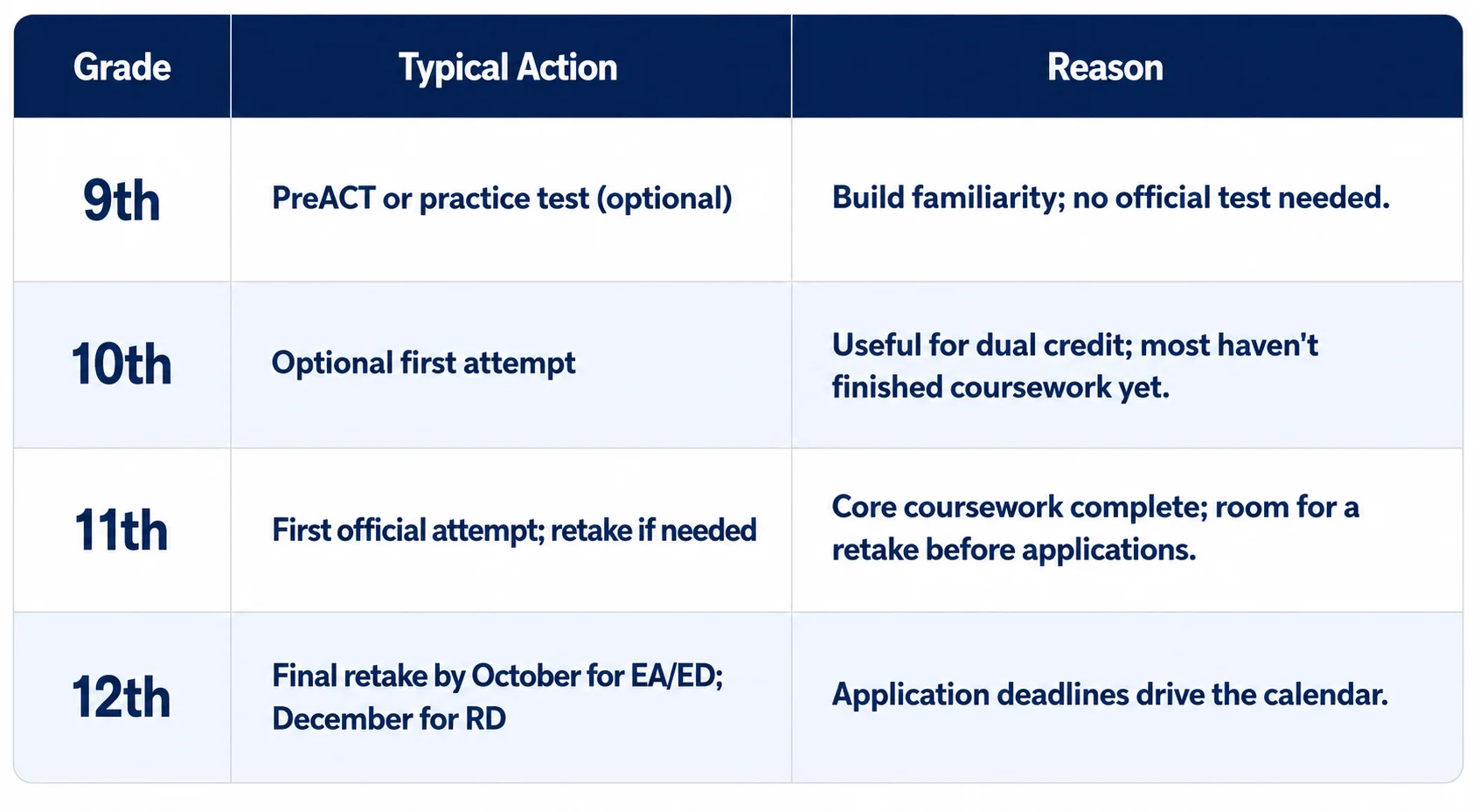
The table below shows what most students do at each grade level and why.
Grade | Typical action | Reason |
|---|---|---|
9th grade | PreACT or practice test (optional) | Build familiarity; no official test needed |
10th grade | PreACT or optional first attempt | Useful for dual credit or accelerated paths; most students are not yet ready |
11th grade | First official attempt (fall or spring); retake if needed | Core coursework is complete; room for a retake before applications open |
12th grade | Final retake by October for EA/ED; December for regular decision | Application deadlines drive the calendar; leave score-release buffer |
Junior year is the sweet spot for three reasons. First, by the end of sophomore year most students have covered enough algebra and reading to make a real score meaningful. Second, taking the test in junior year leaves a full test cycle for a retake before application deadlines. Third, finishing testing by the fall of senior year keeps senior year focused on applications and coursework rather than test prep.
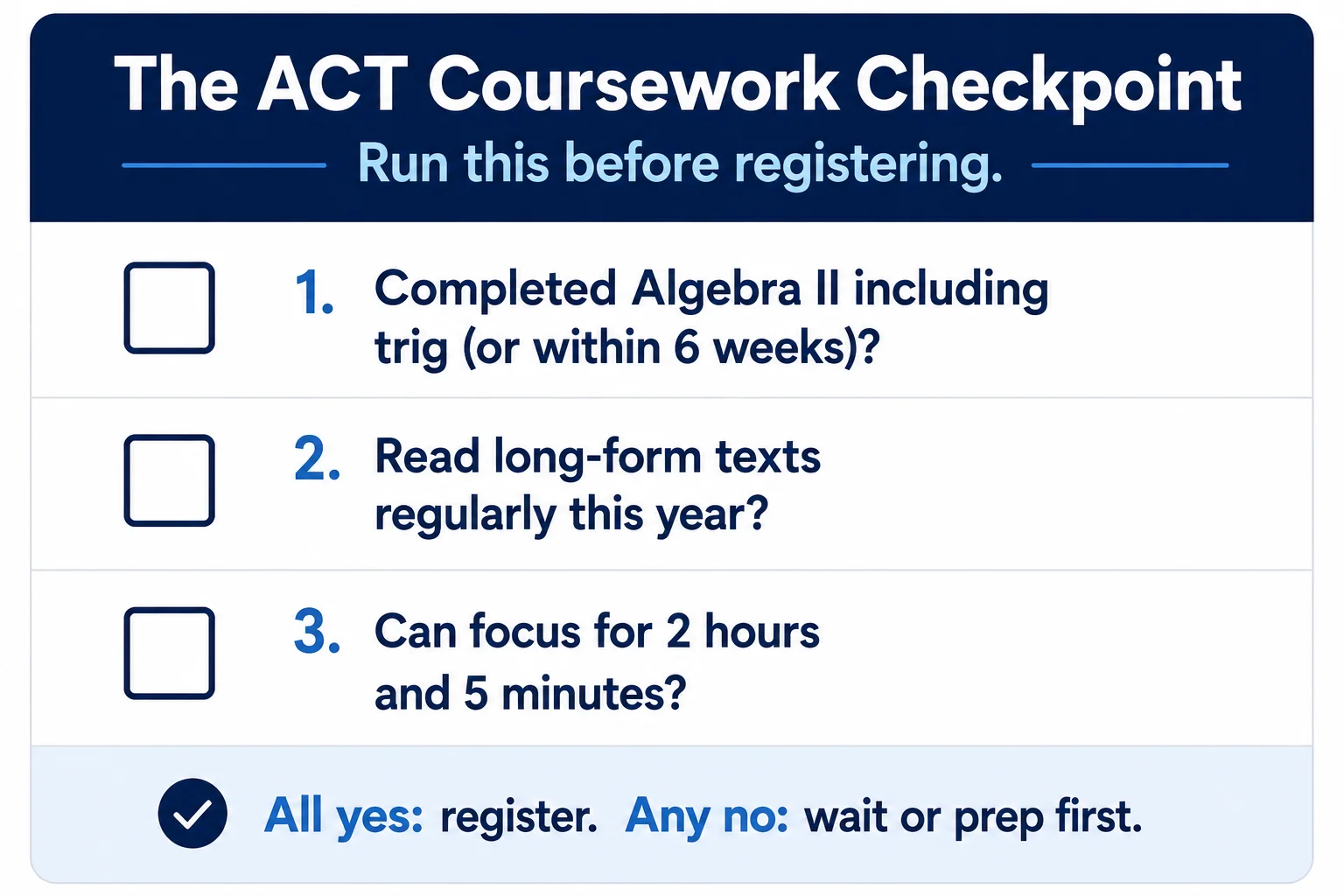
The ACT Coursework Checkpoint
Before you register for a first official ACT, run through this three-question readiness check. Skipping it is the single most common reason students waste an attempt.
The ACT Coursework Checkpoint
Have you completed Algebra II, including a trigonometry unit, or are you within six weeks of finishing it?
Have you read at least a few books or long nonfiction pieces outside of school assignments in the past year?
Can you sit focused for two hours and five minutes without a break?
All three should be yes before you register for an official test date.
Why Algebra II and trig specifically? The ACT Math section covers pre-algebra through trigonometry in a single fixed section. Unlike some other standardized tests, the ACT does not adapt to your performance. Students who haven't seen trigonometry yet are missing a predictable portion of the test every time they sit, and no amount of strategy compensates for an unfinished math sequence. ACT, Inc.'s own test-content descriptions confirm that trigonometry is tested on the Math section.
Isaiah Fuji Brensihan has spent nine-plus years tutoring math, science, computer science, and SAT/ACT prep, and he scored a 36 on the ACT before studying computer science at Harvey Mudd College. His calm, patient style hides a direct opinion about when students are wasting attempts. At NAT, he is the tutor who most often tells families to check the math sequence before they book a test date.
If you're not sure where your child's coursework actually stands against the ACT's math scope, a free strategy session can map that gap before you commit to a date. Book a free ACT strategy session and get a clear readiness assessment before you pick your first test date.
Knowing what ACT score to aim for before your first attempt also helps you set a realistic target and understand what a meaningful retake gain would look like.
When should you take the ACT for the first time?
For most juniors, the two best first-attempt windows are December of junior year (as an early baseline) or April of junior year (after a full semester of prep). The goal is to take your first attempt with enough runway for at least one retake before fall application deadlines.
Everleigh started ACT prep in early February with a 23 composite and took her first official test in April, then a second in June. Between the two attempts, her tutor Brian Min used the real-test data to recalibrate her prep plan. She finished with a 31 composite superscore. That's the two-attempt junior-year path in action: a spring baseline, targeted work in between, and a follow-up date already on the calendar.
You can read Everleigh's ACT improvement story in full.
The Backward Calendar approach:
NAT's ACT Tutors after covering 60000 hours make this approach for ACT. Start at your application deadline and work back:
Identify your earliest college or scholarship application deadline (often November 1 for EA/ED).
Subtract two to four weeks for ACT score release.
That gives you your last safe test date. For a November 1 deadline, that's the September or October test.
Subtract one full test cycle (the next earlier test date) for your retake buffer.
Subtract two to three months of focused prep before your first attempt.
The result is your target first-attempt date.
ACT, Inc. recommends taking the ACT at least two months before your earliest college and scholarship application deadlines, per its official registration guidance.
For a broader prep strategy to use between your first and second attempts, our guide to how to ace the ACT covers the full prep arc. And if you want to estimate your composite before registering, the ACT score calculator lets you model different section-score scenarios.
Should you take the ACT in junior year?
Yes, for almost every student. Junior year gives you the fullest prep window and the most retake room before application deadlines. The one scheduling conflict to plan around is AP exams, which cluster in May.
Spring junior year: the AP exam balance
Month | Priority | What to watch |
|---|---|---|
February | Good first-attempt window | Ample prep time after fall semester; no AP conflicts |
April | Strong window | Plan around AP exam registration; test lands just before AP season begins |
May | AP season | Avoid scheduling ACT prep or ACT dates during peak AP exam weeks |
June | Good retake window | AP exams are done; focused recovery period available |
If your first attempt goes well in April, a June retake works cleanly around the AP calendar. If your first attempt is December or February, an April retake is a natural follow-up.
Juniors who live in states with a state-administered ACT (see the in-school section below) often get a free official test in the spring, which can serve as a baseline even if the score isn't submitted to colleges.
Is sophomore year too early to take the ACT?
For most students, yes. ACT, Inc. places no grade restriction on the ACT and explicitly states that sophomores can take it, but most tenth graders have not yet covered the math and reading content the test expects. A sophomore attempt typically produces a score that doesn't reflect real readiness, and the registration fees add up.
There are specific situations where a sophomore attempt makes sense: students pursuing dual credit who need a qualifying score, students in accelerated math programs who have already completed Algebra II and trig, or students whose school offers the PreACT as a diagnostic and they want a real-test comparison.
Isaac Yang earned a 35 on the ACT and a 1560 on the SAT and now tutors chemistry, biology, and test prep while studying pre-medicine at UIUC, with roughly five years of teaching behind him. He works with many accelerated students and their parents, who are often the first to raise the sophomore-year question. His answer is more conditional than most families expect.
If the ACT Coursework Checkpoint passes in tenth grade, a sophomore attempt is defensible. If it doesn't, waiting until junior year almost always produces a better first official score with less wasted cost.
When is the latest you can take the ACT?
For Early Action or Early Decision deadlines (typically November 1), the September or October test of senior year is the last safe window. ACT scores release about two to four weeks after the test date, which means a September 19 test produces scores by mid-to-late October, leaving only days of buffer for a November 1 deadline.
For Regular Decision deadlines (typically January 1 to February 1), the December test usually works, but it leaves no room for a retake if the score comes back lower than expected.
Latest-safe-date guide
Application type | Typical deadline | Last safe ACT test | Notes |
|---|---|---|---|
Early Action / Early Decision | November 1 | September 19, 2026 | Scores typically available mid-October; very tight buffer |
Regular Decision | January 1–February 1 | December 12, 2026 | No retake room; score must land right |
Rolling admission | Varies | October 17 or December 12 | Check each school's specific score deadline |
Scholarship-specific | Varies widely | Check scholarship deadline | Some scholarships close in October |
Work backward from your earliest deadline and add a two-week buffer beyond ACT's standard release window. The ACT recommends registering at least two months before your earliest deadline, per its official registration page.
2026-2027 ACT test dates at a glance
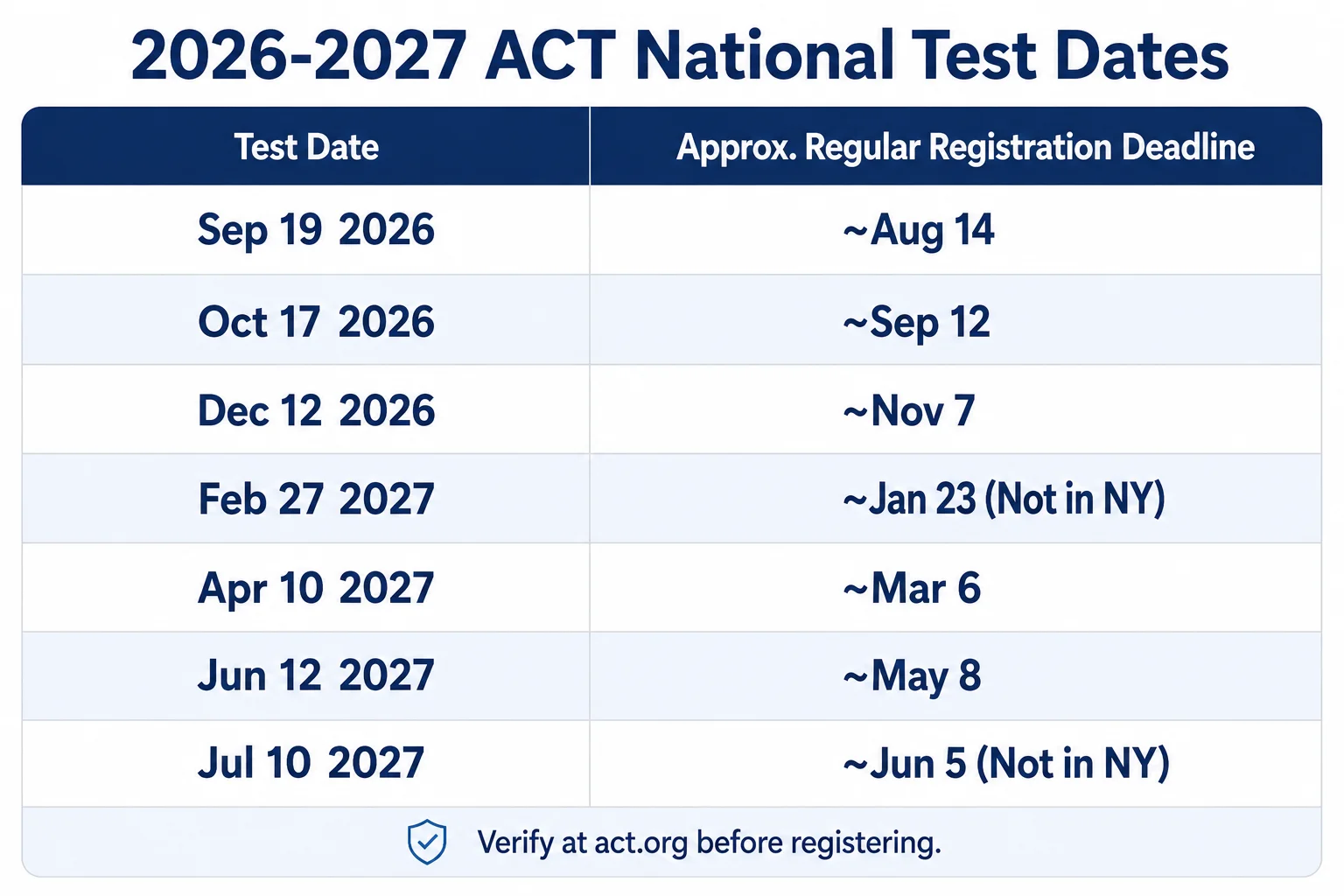
The ACT is offered seven times each year. All seven 2026-2027 national test dates are listed below with regular registration deadlines. Confirm exact late deadlines and current fees at ACT's official 2026-2027 test-dates page before registering, as deadlines and fees can change.
Test date | Regular registration deadline | Notes |
|---|---|---|
September 19, 2026 | ~August 14, 2026 | First date of 2026-2027 cycle; strong senior-fall window |
October 17, 2026 | ~September 12, 2026 | Last safe date for many EA/ED deadlines |
December 12, 2026 | ~November 7, 2026 | Last option for most Regular Decision deadlines |
February 27, 2027 | ~January 23, 2027 | Not offered in New York; good junior retake window |
April 10, 2027 | ~March 6, 2027 | Strong junior first-attempt or retake window |
June 12, 2027 | ~May 8, 2027 | Clean post-AP retake date |
July 10, 2027 | ~June 5, 2027 | Not offered in New York; final date of cycle |
Registration deadlines fall approximately five weeks before each test date. A late registration window follows the regular deadline and carries an added fee. Confirm the current late deadline and late fee at act.org before registering.
For a detailed breakdown of what happens on test day and how long each section takes, see our complete ACT timing guide.
How the Enhanced ACT changed your timing strategy
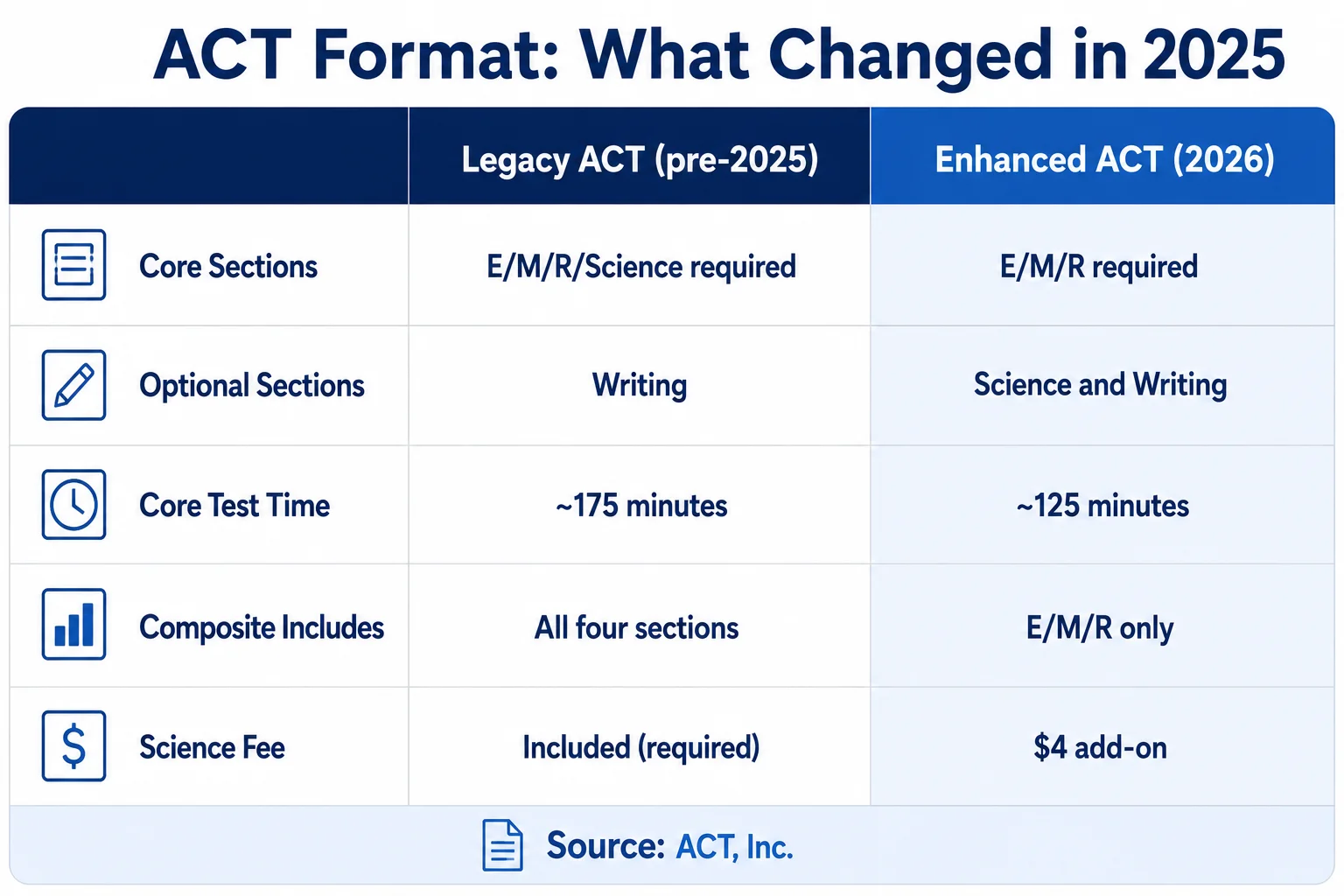
Most timing advice you'll find online was written for the original ACT, which ran 3+ hours and covered four required sections. The current Enhanced ACT, fully rolled out across all administrations as of spring 2026, is a different test. The core runs for two hours and five minutes across English, Math, and Reading. Science and Writing are now optional and do not affect your composite.
Legacy ACT (pre-2025) | Enhanced ACT (2026) | |
|---|---|---|
Core sections | English, Math, Reading, Science (required) | English, Math, Reading (required) |
Optional sections | Writing | Science, Writing |
Core time | ~175 minutes | ~125 minutes |
Composite includes | Average of E/M/R/Sci | Average of E/M/R only |
Science add-on fee | N/A (required) | $4 (per ACT, Inc. registration page) |
This changes timing strategy in two ways. First, the shorter core test reduces stamina pressure, which means the old advice to "pick spring because you need the whole year to build endurance" no longer applies in the same way. Second, the optional Science decision requires its own timing consideration: if your target schools want a Science score, you need to budget for it, register for it specifically, and decide whether to prep for it. Our article on whether to add ACT Science covers that decision in full.
Maya Campbell scored a 36 on the ACT and teaches SAT, ACT, math, and English at North American Tutors, with seven years of classroom and one-on-one experience across age groups. Her Columbia University neuroscience background makes her attentive to how fatigue and scheduling pressure interact. She is one of the NAT tutors who watched the Enhanced ACT change the calendar advice she gives families.
The practical takeaway: schedule around application deadlines and the optional Science decision, not around the old endurance assumption.
How many times should you take the ACT?
Most students take the ACT two to three times. The standard path is a first attempt in the fall or spring of junior year, a retake in the spring of junior year or fall of senior year, and occasionally a third attempt in the fall of senior year if the score is still short of a target.
Taking it more than three times is usually not productive. Score gains after a third attempt tend to be small, and the financial and scheduling costs add up. Focused prep between attempts produces far more movement than repeated testing without a changed preparation plan.
Superscore: many colleges combine your highest section scores across test dates into a superscore, which means a second attempt is almost always worth taking if your first attempt produced any low section scores. Check whether your target schools superscore before deciding whether to retake. You can track your section scores and estimate composite combinations using the ACT score calculator.
For context on where your composite sits relative to other test-takers, ACT score percentiles shows the distribution by section and composite.
The free in-school ACT (state and district testing)
Many states and school districts administer the ACT to all juniors for free during the school day. This is one of the most overlooked timing opportunities available. If your state or district participates, your child may take an official ACT at no cost during junior year, often in the spring.
State-administered ACTs are official tests. The scores are real, they can be sent to colleges, and they count for admissions. They are also offered at a time when most students have finished core coursework, which makes junior spring the natural baseline window.
To find out if your school offers a free in-school ACT:
Ask your high school counselor directly.
Check your state education department's website for ACT state testing programs.
Check ACT's state and district testing information for program availability.
Confirm the test date and whether scores are automatically submitted or optional.
Policies vary by state. Some programs automatically send scores to the state for accountability purposes but let students decide whether to release them to colleges. Confirm this with your counselor before the test date.
Should you take the ACT or SAT first?
Both are accepted by virtually every four-year college in the United States. The right starting test is the one that fits your strengths, not the one with a more convenient test date.
Decision table: ACT or SAT first?
Signal | Take the ACT first | Take the SAT first |
|---|---|---|
Your state/school requires one | Yes, if ACT required | Yes, if SAT required |
You prefer a straight math section (no calculator early) | — | SAT (calculator permitted earlier) |
You are stronger in science data interpretation | ACT advantage | — |
You want more time per question | ACT (especially Math at 67 sec/q) | — |
Your school or district offers a free test | Take the free one first | — |
You're unsure | Take a timed practice test of each first | — |
If you're unsure which test to start with, take a timed practice version of each. The one that produces a stronger relative performance with less effort is usually the better fit. Our SAT vs ACT comparison walks through the differences in full, and which test is easier for you covers how individual strengths map to each format. For the SAT's own timing guide, our when to take the SAT guide covers the same grade-by-grade planning logic for the SAT.
Timing is otherwise similar for both: a first attempt in junior year with a retake window in senior fall.
Do you have to take the ACT?
No. The ACT is not a universal requirement. A student is required to take the ACT only if their state, school district, or specific target colleges require an ACT score. Many colleges are test-optional, meaning they will review an application without a test score.
Even under test-optional admissions, a strong ACT score can help in two ways: it can strengthen a college application when the rest of the file is competitive, and it often qualifies students for merit-based scholarships that do require a score. That is why many students whose target schools are test-optional still choose to take the ACT.
If you are unsure whether your state requires the ACT for high school graduation or whether your target colleges want a score, your school counselor is the most reliable source. College Board and ACT, Inc. both maintain updated lists of score-reporting policies, but those policies can change year to year.
How to register for the ACT
Registration opens through MyACT at myact.org. The process takes about 15 minutes.
Create or log in to your MyACT account.
Select your test date and find a test center near you.
Choose your sections: the core (English, Math, Reading) is included; add Science (+$4) or Writing (+$25) if needed.
Upload a photo per ACT's requirements, as it is required before you can test.
Pay the registration fee. The base fee is $68 for the core test. Fee waivers are available for eligible students through your school counselor.
Confirm your registration confirmation email and note your test center address.
Register by the regular deadline, which falls approximately five weeks before the test date. A late registration window follows with an added fee. If you miss the late deadline, standby testing may be available but is not guaranteed.
The bottom line on ACT timing
The decision of when to take the ACT comes down to three things: finishing the coursework (Algebra II and trig), choosing a first date that leaves one retake in the calendar, and working backward from your earliest application deadline so you are not scrambling in senior fall.
For most students that means a first attempt in the fall or spring of junior year, a retake in the spring or early fall, and finishing testing by October of senior year. The 2026-2027 dates that fit this path best are September 19 or October 17, 2026 as a senior-fall target, and April 10 or June 12, 2027 as junior-spring windows.
If you are unsure whether your child has hit the Coursework Checkpoint, or if a previous attempt didn't move the score as expected, a free strategy session with NAT includes a written diagnostic of where the gaps are and a test-date plan built around your application calendar. NAT tutors scored 34 to 36 on the ACT and work one-on-one with students. Book a free strategy session and leave with a specific date plan, not a general one.
You can also browse free ACT resources or view NAT's ACT tutors to find a specialist by section.