When Do You Take the SAT?
"I keep getting mixed answers." That's what a student posted on r/highschool after asking their mom, dad, and grandma when to take the SAT. If that sounds familiar, you're not alone.
When do you take the SAT? It's the most-Googled question in college admissions prep, and the answer is simpler than it feels. According to the College Board's 2025 participation report, over 2 million students sat for the SAT in 2025. Of those, 68% tested through SAT School Day at their own school, and 97% took the fully digital version. Participation has returned to pre-pandemic levels, which means the competition is back, and timing matters more than ever.
But knowing the test dates is not the same as knowing your best date. Some students just want to get it over with. Here's why rushing can backfire. This guide gives you a grade-by-grade timeline, the real readiness signals NAT tutors look for, and a simple rule to stop peer pressure from pushing you into a test you're not ready for.
What grade do you take the SAT?
Most students take the SAT in 11th grade, specifically in the spring. The College Board recommends March, May, or June of junior year for a first attempt. Seniors should aim for August, September, or October to retake the test or take it for the first time. Sophomores should generally take the PSAT instead.
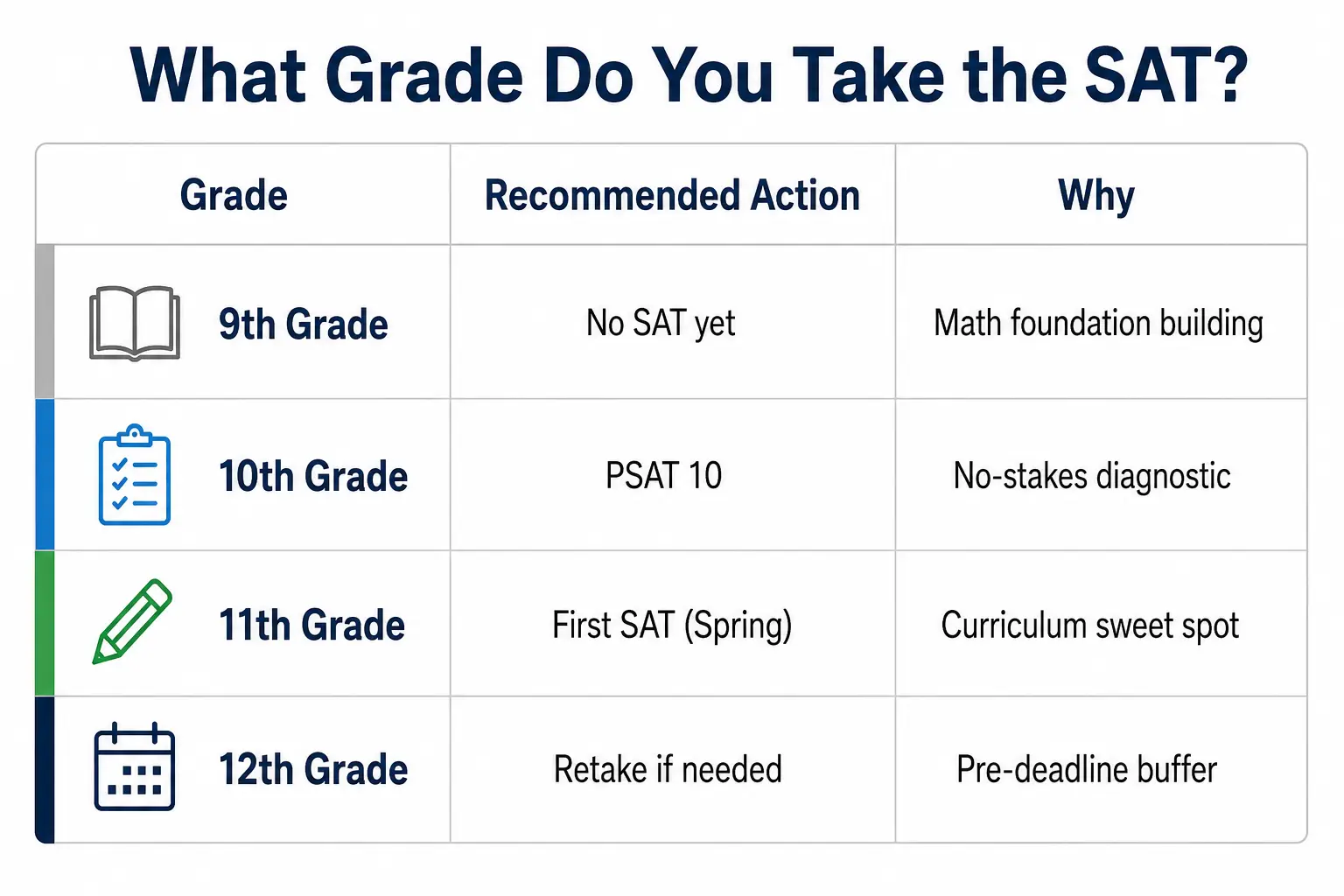
Grade level matters because the SAT tests math and reading skills that build across 9th, 10th, and 11th grades. Most 10th graders have not yet covered the Algebra II content that the test draws heavily from. The College Board's official test calendar lists seven annual test dates, and the spring window (March through June) consistently draws the most junior-year test-takers because it aligns best with the high school curriculum cycle.
Here's a quick-reference breakdown by grade:
Grade | Recommended Action | Why |
|---|---|---|
9th | No SAT yet | Math foundation still building |
10th | PSAT 10 | No-stakes diagnostic; builds familiarity |
11th | First SAT attempt (spring) | Curriculum alignment hits sweet spot |
12th | Retake if needed (fall) | Buffer before application deadlines |
If you're wondering how your target score compares to national averages, check our breakdown of average SAT score by state for the Class of 2025.
When should I take the SAT for the first time?
Take your first SAT in the spring of your junior year (March, May, or June). This timing provides a perfect balance of academic readiness and flexibility, as you will have covered most of the tested math and reading concepts and will still have plenty of time for retakes.
The logic is straightforward. Spring of 11th grade hits the sweet spot between curriculum coverage and timing. You've had enough math to handle the harder adaptive modules. You still have a full retake window available. And you're not scrambling against senior-year application deadlines.
Before committing to a test date, use the PSAT you took in October of junior year as a diagnostic baseline. Students who prep for 8 to 10 weeks before a spring test consistently outperform students who cram in the final two weeks. Deciding how many SAT practice tests to take before your official date is one of the most impactful decisions you can make.
Owen E., who scored 1580 on the SAT and now tutors students targeting 1500+, puts it directly:
Is sophomore year too early to take the SAT?
Sophomore year is generally considered a bit early for the official SAT, as most students have not yet covered all the tested material. However, taking it can make sense if you are an advanced student who has already completed Algebra II, or if you use the test simply to establish a baseline score.
When does taking the SAT in 10th grade make sense?
There are three situations where a sophomore attempt is worth considering:
Talent search programs such as the Center for Talented Youth (CTY) or Duke TIP, which require official scores for eligibility
Accelerated math tracks where the student has already completed Algebra II by the end of 10th grade
National Merit positioning, where a student wants extra official attempts before the PSAT/NMSQT in the junior fall
Outside of these three situations, wait. The PSAT 10 provides the diagnostic data you need without the pressure.
Why the PSAT is usually the better choice for sophomores
Taking the PSAT in 10th grade (via the PSAT 10 or PSAT/NMSQT) is highly recommended because it provides a zero-pressure diagnostic baseline. It builds testing endurance, familiarizes students with the digital format, and identifies academic weaknesses without affecting college admissions or National Merit eligibility.
Should you take the SAT in junior year?
Yes. Junior year is the ideal time for a first SAT attempt. By spring of 11th grade, you've covered the math and reading skills the SAT evaluates. Testing in March, May, or June leaves your entire senior fall free for retakes, superscoring, and college applications without deadline pressure.
Best test dates for juniors
Test Date | Best For | Watch Out For |
|---|---|---|
March | First attempt; early baseline | AP exam prep starts soon after |
May | Strong coursework completion | Overlaps with AP exam season |
June | Final junior attempt; summer prep buffer | End-of-year fatigue |
March is the safest choice if you have a heavy AP load in May. May works well if you have a lighter spring schedule. June gives you the full year of coursework behind you, which is especially valuable if your math sequence runs through the spring semester.
How to balance SAT prep with AP exams and finals
The three rules NAT tutors recommend:
If you're sitting 3 or more AP exams in May, register for March.
If your AP load is light, May gives you more time to prepare.
If you need the full year of coursework, June is your date, and summer becomes your retake window.
According to the College Board's 2025 Annual Report, the mean SAT composite score was 1029, and only 39% of test-takers met both the math and reading/writing college readiness benchmarks. Knowing your target score relative to those benchmarks tells you how much prep time you actually need. Our guide on what is a good SAT score gives you a full breakdown by school selectivity.
One student, Elizabeth G., improved from 1370 to 1480 after targeted junior-year prep with NAT, closing a 110-point gap over just a few focused sessions. Strategic timing plus focused tutoring creates results that cramming alone can't match.
How do you know if you're ready to take the SAT? The Algebra II Checkpoint Rule
We call it the Algebra II Checkpoint Rule, and it's the single biggest predictor of whether a student will hit their target score on the first attempt.
The Rule: Do not take your first official SAT until you have completed Algebra II, or are within 6 weeks of completing it.
NAT tutors observe that students who test before this checkpoint score an average of 80 to 120 points lower on the Math section than their diagnostic potential would predict. This is not about intelligence. It's about curriculum alignment. The SAT's advanced math section (Module 2) pulls heavily from Algebra II content: quadratic functions, exponential growth, systems of equations, and data analysis. Without that coursework, students guess or skip those questions. The adaptive algorithm then places them in a lower performance band for the remaining questions, compounding the damage.
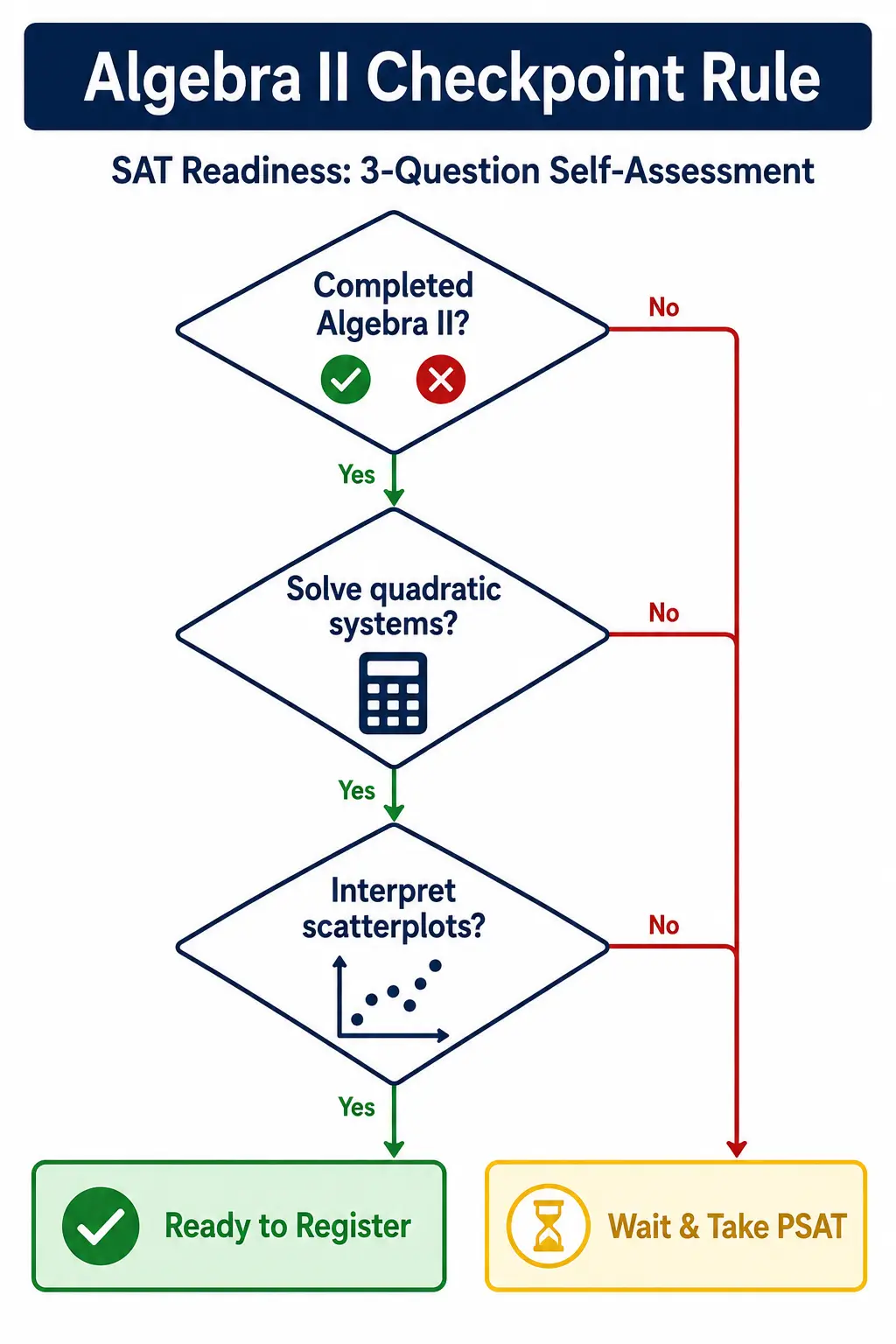
The 3-Question Self-Assessment:
Before you register for an official SAT date, answer these three questions honestly:
Have you completed a full year of Algebra II, or are you in the final unit?
Can you solve a system of quadratic equations without a calculator?
Can you interpret a scatterplot and write a line-of-best-fit equation?
If you answered "no" to any of these, wait. Take the PSAT instead, or use the time to finish your math sequence. A month of waiting is far less costly than an 80-point deficit on an official score.
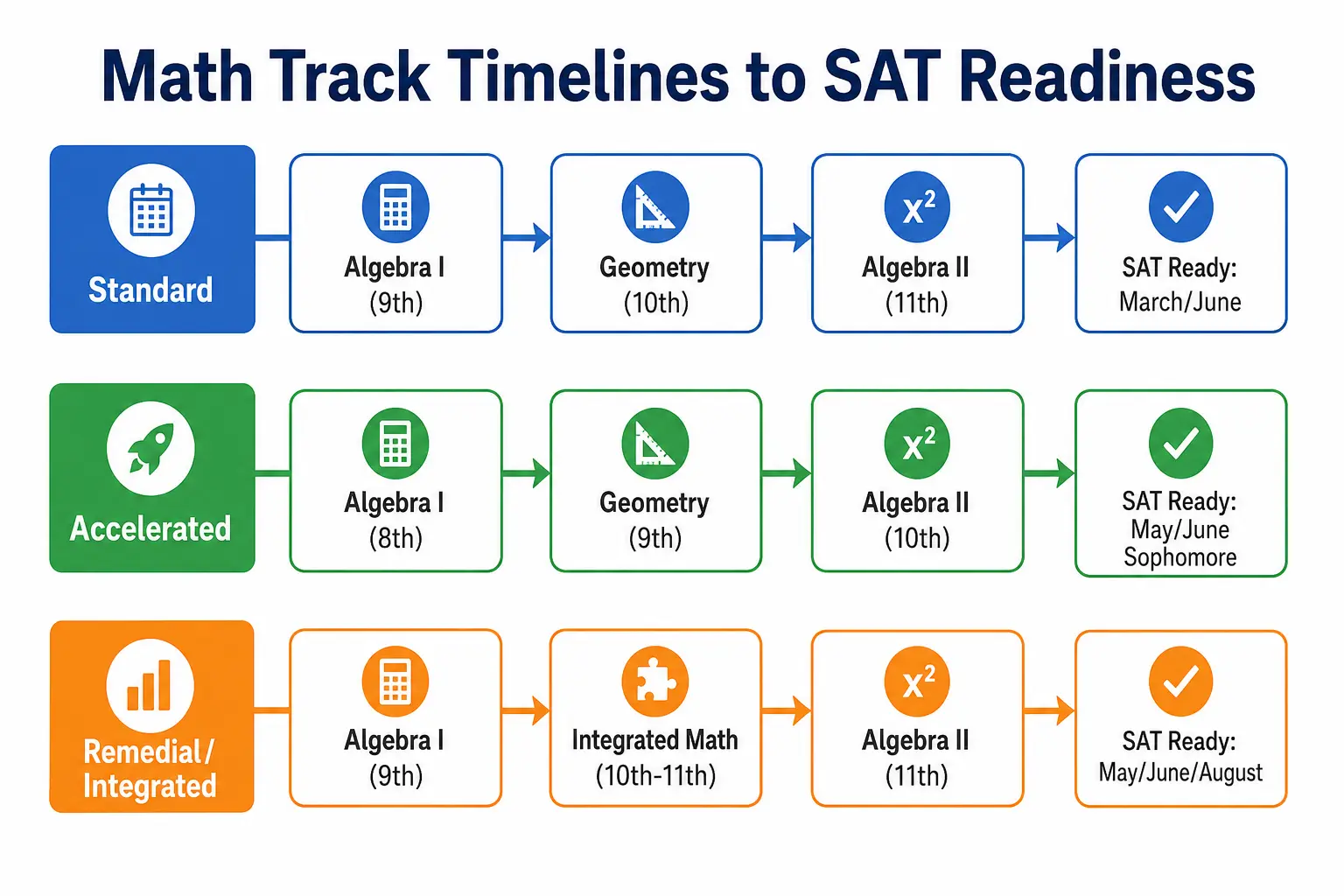
Math track timelines: standard, accelerated, and remedial
Standard track: Algebra I (9th grade) → Geometry (10th grade) → Algebra II (11th grade) → SAT ready: March or June of junior year
Accelerated track: Algebra I (8th grade) → Geometry (9th grade) → Algebra II (10th grade) → SAT ready: May or June of sophomore year (rare but valid, especially for talent search programs)
Remedial or integrated track: Algebra II spans 10th to 11th grade → SAT ready: May or June of junior year, or August of senior year if finishing late
If you're behind in school on the math sequence, don't panic. The August senior-year date still leaves the full fall window open. Use the time you have. Our digital SAT calculator can help you model your current trajectory and figure out exactly how many points you need from each section.
What changed about SAT timing in 2026?
Three things changed for 2026. First, the SAT is now fully digital for all test-takers, with no paper option remaining. Second, SAT School Day expanded to more districts, with 68% of students testing in school in 2025. Third, scores are sent streamlined: most colleges now accept self-reported scores during applications, with official verification required only after admission is offered.
Here's what each change means for your timing:
Digital SAT: The test is now 2 hours and 14 minutes, shorter than the old paper format. It's adaptive: if you perform well in Module 1, Module 2 becomes harder. Prep using the College Board's free Bluebook app, which simulates the real test interface. Practice in the same environment you'll test in.
School Day growth: More students now test in March and April. If you prefer less foot traffic at your test center, May or June weekend dates may work better.
Self-reported scores: You no longer need to send official scores before applying to most schools. This reduces the urgency around score sends, but it doesn't change your testing timeline. Test early enough to retake if needed.
For a full breakdown of what changed with the format, see our guide on the digital SAT differences. And if you're setting score goals, our posts on what is the highest SAT score and what is the lowest SAT score give you a clear picture of the full scoring range.
The bottom line on SAT timing
Spring of junior year. Retake in the senior fall if needed. Don't test before Algebra II. Use the Algebra II Checkpoint Rule to confirm you're ready before you register.
These aren't arbitrary rules. They're the patterns NAT tutors see across hundreds of students every cycle. Students who time their testing right, when their coursework is up to date, and their preparation has had enough time, are the ones who leave the test center with a score they can be proud of.
If you're still unsure about your timeline, talk to someone who has guided thousands of students through it. NAT tutors come from Harvard, Stanford, MIT, Princeton, and other top universities. There are no long-term contracts, and your first consultation is free.
Schedule your free consultation at northamericantutors.com/contact-us.
Your grades are now our responsibility.