What is the lowest SAT score, and what does it mean?
Date:
Date:
TL;DR: The lowest possible SAT score is 400, which comes from scoring 200 on both the Reading and Writing section and the Math section. Even if you leave every question blank, the College Board's scoring floor prevents a 0. A 400 sits below the 1st percentile, but almost no one actually hits it. Students scoring in the 400β800 range can realistically improve 200β400 points with targeted, one-on-one prep.
You opened the score report, and your stomach dropped. Whether the number is 500, 700, or somewhere below the national average, a low SAT score can feel like a verdict on your child's entire future. It isn't.
The lowest SAT score you can get is 400. That number has a specific technical reason for existing, and understanding it actually tells you a lot about how the test works and how improvable any score really is. In this post, we'll cover why 400 is the floor, what it means in context, why almost no one ever hits it, and what a realistic path forward looks like for students scoring in the low range.
What is the lowest SAT score you can get?
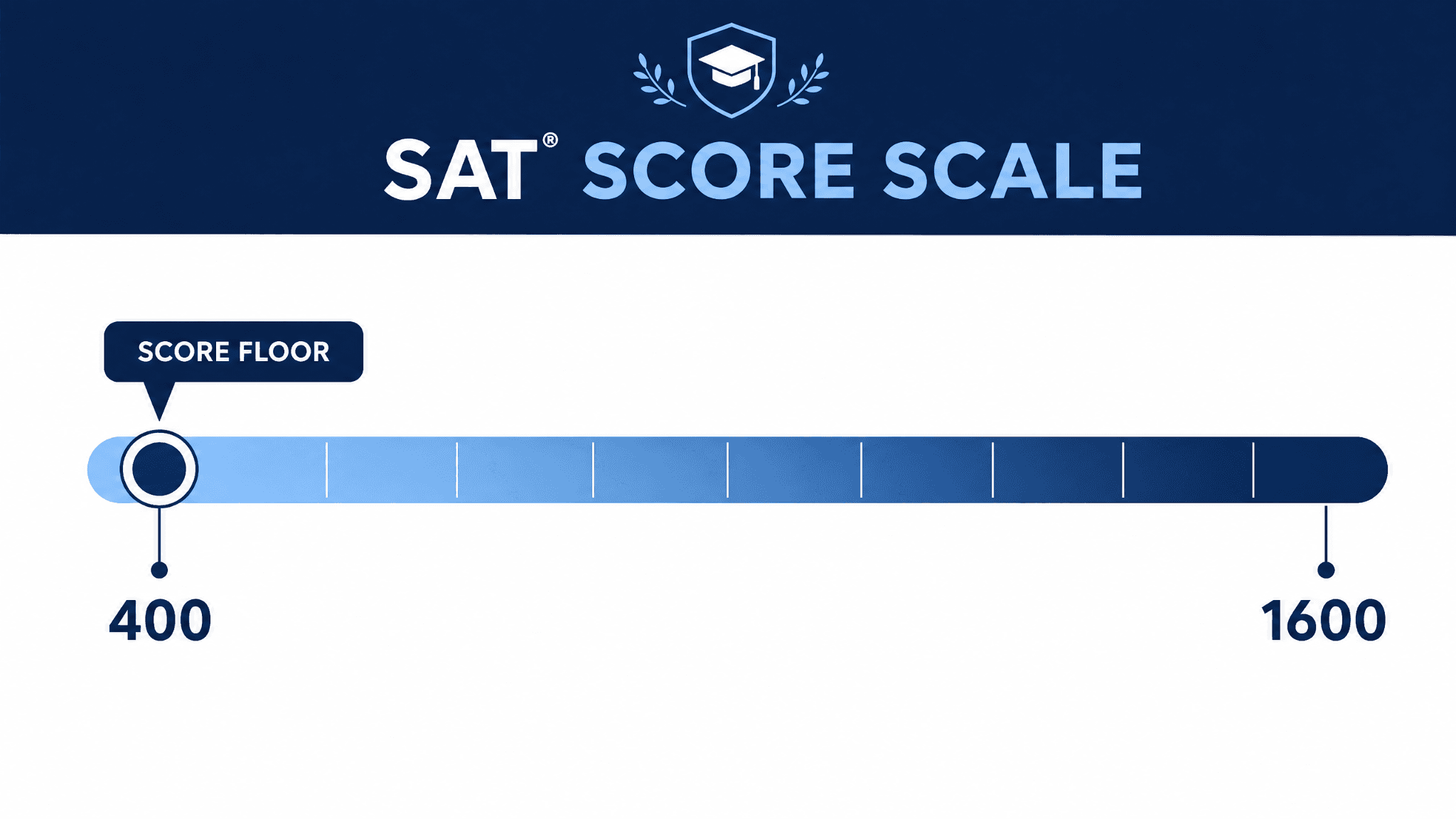
The lowest SAT score is 400. The SAT is scored in two sections, Reading and Writing and Math, and each section has a minimum scaled score of 200. Add those together and you get 400 as the total floor. The College Board sets this minimum deliberately, which means a student who answers every question incorrectly or who submits a completely blank test still receives a 400. A score of zero on the SAT is mathematically impossible.
This is part of how the Old SAT vs New Digital SAT works at its foundation: the 400β1600 total scale and the 200β800 per-section scale are baked into the College Board's scoring system regardless of format, whether the test is paper or digital. According to the College Board's official score guide, the total range has always been 400β1600, with each section contributing equally to that floor.
Why is 400 the lowest possible score and not zero?
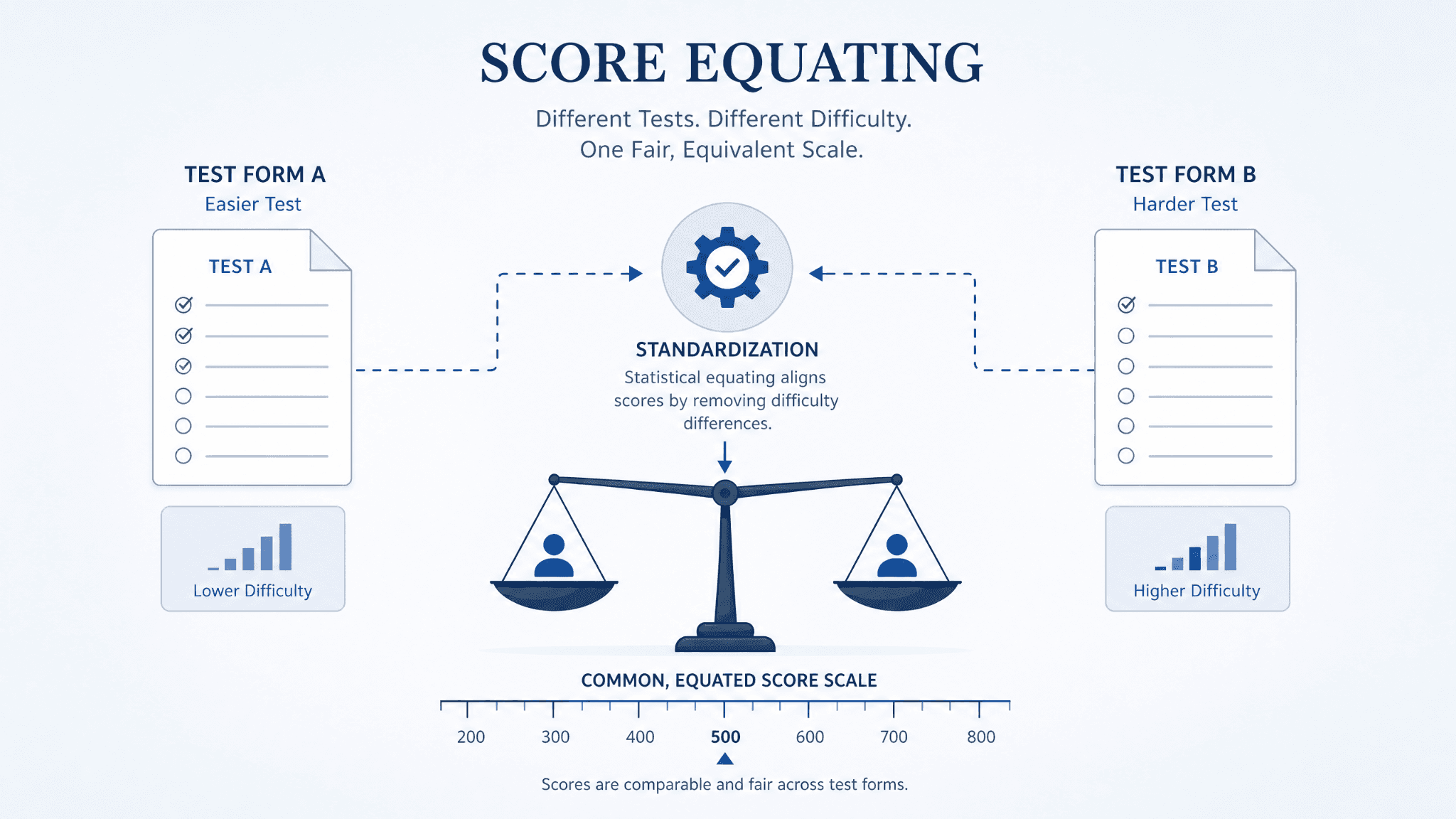
The 400 floor is not arbitrary. It exists because of a process called score equating, a psychometric method the College Board uses to make sure a 1200 on one test date means the same thing as a 1200 on another test date, even if one version of the test was slightly harder.
Raw scores (how many questions you got right) get converted to scaled scores through this equating process. Because no two test forms are identical, the conversion curve shifts slightly from sitting to sitting. Setting the floor at 200 per section creates a stable baseline for that conversion. If the floor were 0, the equating math would produce negative scores in edge cases. The College Board described its intent as designing the scale so the mean sits near 500 per section with a standard deviation of roughly 100, which places almost all real-world results comfortably above 400.
The PSAT to SAT score conversion follows the same logic on a compressed 320β1520 scale, which also reflects this psychometric design rather than a percentage-correct calculation.
Our best SAT tutor, Alexander L., whose score on the SAT is 1600, explains this during a one to one session with an SAT student:
"Students are often surprised when I point out that their section score is not a simple percentage of questions answered correctly. A student who gets 35 out of 54 Reading and Writing questions correct could score anywhere from 590 to 650, depending on the form they took and how difficult that form was. The equating process is the reason why two students with the same raw score might sometimes have different scaled scores.β
How does a 400 compare to the national average and percentile rankings?
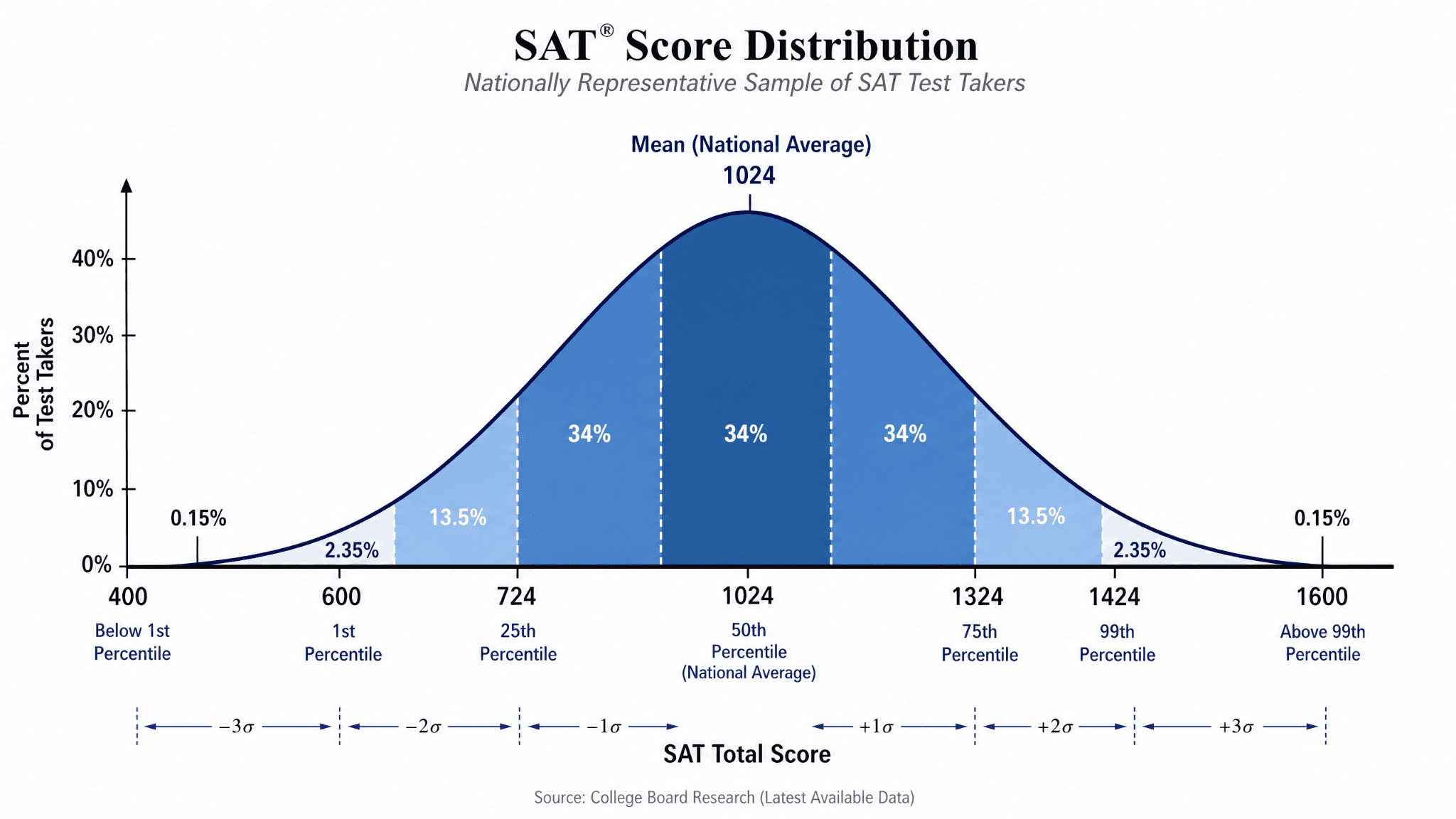
A 400 SAT score places a student below the 1st percentile, meaning that fewer than 1% of test takers score that low. The national average SAT score for the class of 2024 was 1024, and for the class of 2025 it rose to 1029 according to Magoosh, who tracks College Board data annually. A 400 falls roughly 600 points below that average.
For context on what these percentile bands actually look like:
SAT Score | Approximate Percentile |
400 | Below 1st |
600 | 1stβ2nd |
800 | ~10th |
1000 | ~40th |
1024 | ~50th (national average) |
1200 | ~74th |
1400 | ~94th |
1600 | 99th+ |
Source: PrepScholar percentile data, College Board 2025 Total Group Report.
On the other end of the scale, the highest SAT score possible is 1600, achieved by roughly 7 in 10,000 test takers each year. The gap between the floor and the ceiling is real, but so is the distance between a 400 and where a motivated student lands after structured prep.
Can you actually score 400, or does guessing prevent it?
Almost no student ever scores exactly 400. Here's why: on the digital SAT, purely random guessing across all questions statistically yields a total score closer to 460β640, not 400. The adaptive format of the digital SAT routes lower-scoring students to an easier second module, which means a student who guesses randomly on module one will likely face questions calibrated for their approximate ability in module two. That routing tends to keep random-guess scores above the absolute floor.
Scoring 400 requires either leaving every single question blank or answering every question incorrectly with no lucky guesses at all. Because the digital SAT uses four-answer multiple choice for most questions, random guessing produces correct answers about 25% of the time by chance alone. A true 400 is, in practice, extraordinarily rare.
NAT SAT tutor Tabassum Sami provides insight: "In diagnostic sessions with students who report scores below 700, we almost never see blank-question patterns across both sections. The more common issue is time pressure on Math causing students to leave 8β12 questions unanswered in module two, which contributes a significant chunk of lost points. That's fixable, usually within 2β3 sessions of targeted pacing work."
What should you do if your score is in the low range?
First: a score in the 500β800 range is not a floor. It's a starting point. 92% of NAT students improved by 90 or more SAT points, and students starting in the lower ranges often have the most room to grow because their current score does not reflect their potential. It's reflecting a gap between what they know and what the test requires.
NAT tutors consistently see three patterns in students scoring 400β700:
1. Time panic causing blank answers. Students run out of time on Math module two and leave 10+ questions blank. Each blank question is a 0, whereas guessing would have yielded a 25% chance of credit. This is a pacing and test strategy issue, not a knowledge issue.
2. Ignoring the built-in Desmos calculator. The digital SAT includes a Desmos graphing calculator embedded directly in the testing platform. Many students in the low range never open it. Problems that would take 2 minutes by hand take 15 seconds with Desmos.
3. Missing 3β4 repeatable grammar rules. The Reading and Writing section tests a small set of grammar and punctuation patterns repeatedly. Students who haven't isolated those patterns lose points on questions that a tutor can train in two to three sessions.
If you're deciding whether to retake the SAT or switch to the ACT, our comparison of SAT vs ACT walks through that decision systematically. And if you're building a retake prep plan, our guide on how many SAT practice tests to take covers the research on practice volume and score gains.
What is the lowest SAT score colleges will accept?
There is no universal minimum SAT score for college admission. Test-optional schools, which now number over 1,800 in the US according to FairTest's current database, accept students with no SAT score at all. Among schools that require SAT scores, open-admission and less selective colleges typically enroll students with totals between 800 and 1000. A score of 400 would present a serious barrier at virtually every four-year institution that requires the SAT, but community colleges and vocational programs generally do not use the SAT for admission at all.
For students with strong ambitions, our breakdown of SAT score requirements for Ivy League schools puts the competitive range in clear context. The floor for those schools sits near 1500, which is why the distance between 400 and a competitive application is measured in structured months of prep, not years.
The score is one data point, not a verdict
A 400 is the mathematical minimum the College Board allows. It's also, in practical terms, almost impossible to hit. Most students who feel like they "bombed" the SAT are sitting in the 600β900 range, which is improvable. The students NAT works with who start below 900 regularly reach 1100β1300 with six to twelve weeks of one-on-one work targeting their specific gaps.
If your child's score left you wondering where to begin, a free consultation with an NAT tutor starts with a diagnostic, not a sales pitch. We'll identify which of the three patterns is limiting their score and build a prep plan around that. Book a free consultation to get started.
Your child's grades are now our responsibility.
TL;DR: The lowest possible SAT score is 400, which comes from scoring 200 on both the Reading and Writing section and the Math section. Even if you leave every question blank, the College Board's scoring floor prevents a 0. A 400 sits below the 1st percentile, but almost no one actually hits it. Students scoring in the 400β800 range can realistically improve 200β400 points with targeted, one-on-one prep.
You opened the score report, and your stomach dropped. Whether the number is 500, 700, or somewhere below the national average, a low SAT score can feel like a verdict on your child's entire future. It isn't.
The lowest SAT score you can get is 400. That number has a specific technical reason for existing, and understanding it actually tells you a lot about how the test works and how improvable any score really is. In this post, we'll cover why 400 is the floor, what it means in context, why almost no one ever hits it, and what a realistic path forward looks like for students scoring in the low range.
What is the lowest SAT score you can get?
The lowest SAT score is 400. The SAT is scored in two sections, Reading and Writing and Math, and each section has a minimum scaled score of 200. Add those together and you get 400 as the total floor. The College Board sets this minimum deliberately, which means a student who answers every question incorrectly or who submits a completely blank test still receives a 400. A score of zero on the SAT is mathematically impossible.
This is part of how the Old SAT vs New Digital SAT works at its foundation: the 400β1600 total scale and the 200β800 per-section scale are baked into the College Board's scoring system regardless of format, whether the test is paper or digital. According to the College Board's official score guide, the total range has always been 400β1600, with each section contributing equally to that floor.

Why is 400 the lowest possible score and not zero?
The 400 floor is not arbitrary. It exists because of a process called score equating, a psychometric method the College Board uses to make sure a 1200 on one test date means the same thing as a 1200 on another test date, even if one version of the test was slightly harder.
Raw scores (how many questions you got right) get converted to scaled scores through this equating process. Because no two test forms are identical, the conversion curve shifts slightly from sitting to sitting. Setting the floor at 200 per section creates a stable baseline for that conversion. If the floor were 0, the equating math would produce negative scores in edge cases. The College Board described its intent as designing the scale so the mean sits near 500 per section with a standard deviation of roughly 100, which places almost all real-world results comfortably above 400.
The PSAT to SAT score conversion follows the same logic on a compressed 320β1520 scale, which also reflects this psychometric design rather than a percentage-correct calculation.

Our best SAT tutor, Alexander L., whose score on the SAT is 1600, explains this during a one to one session with an SAT student:
"Students are often surprised when I point out that their section score is not a simple percentage of questions answered correctly. A student who gets 35 out of 54 Reading and Writing questions correct could score anywhere from 590 to 650, depending on the form they took and how difficult that form was. The equating process is the reason why two students with the same raw score might sometimes have different scaled scores.β
How does a 400 compare to the national average and percentile rankings?
A 400 SAT score places a student below the 1st percentile, meaning that fewer than 1% of test takers score that low. The national average SAT score for the class of 2024 was 1024, and for the class of 2025 it rose to 1029 according to Magoosh, who tracks College Board data annually. A 400 falls roughly 600 points below that average.
For context on what these percentile bands actually look like:
SAT Score | Approximate Percentile |
400 | Below 1st |
600 | 1stβ2nd |
800 | ~10th |
1000 | ~40th |
1024 | ~50th (national average) |
1200 | ~74th |
1400 | ~94th |
1600 | 99th+ |
Source: PrepScholar percentile data, College Board 2025 Total Group Report.
On the other end of the scale, the highest SAT score possible is 1600, achieved by roughly 7 in 10,000 test takers each year. The gap between the floor and the ceiling is real, but so is the distance between a 400 and where a motivated student lands after structured prep.

Can you actually score 400, or does guessing prevent it?
Almost no student ever scores exactly 400. Here's why: on the digital SAT, purely random guessing across all questions statistically yields a total score closer to 460β640, not 400. The adaptive format of the digital SAT routes lower-scoring students to an easier second module, which means a student who guesses randomly on module one will likely face questions calibrated for their approximate ability in module two. That routing tends to keep random-guess scores above the absolute floor.
Scoring 400 requires either leaving every single question blank or answering every question incorrectly with no lucky guesses at all. Because the digital SAT uses four-answer multiple choice for most questions, random guessing produces correct answers about 25% of the time by chance alone. A true 400 is, in practice, extraordinarily rare.
NAT SAT tutor Tabassum Sami provides insight: "In diagnostic sessions with students who report scores below 700, we almost never see blank-question patterns across both sections. The more common issue is time pressure on Math causing students to leave 8β12 questions unanswered in module two, which contributes a significant chunk of lost points. That's fixable, usually within 2β3 sessions of targeted pacing work."
What should you do if your score is in the low range?
First: a score in the 500β800 range is not a floor. It's a starting point. 92% of NAT students improved by 90 or more SAT points, and students starting in the lower ranges often have the most room to grow because their current score does not reflect their potential. It's reflecting a gap between what they know and what the test requires.
NAT tutors consistently see three patterns in students scoring 400β700:
1. Time panic causing blank answers. Students run out of time on Math module two and leave 10+ questions blank. Each blank question is a 0, whereas guessing would have yielded a 25% chance of credit. This is a pacing and test strategy issue, not a knowledge issue.
2. Ignoring the built-in Desmos calculator. The digital SAT includes a Desmos graphing calculator embedded directly in the testing platform. Many students in the low range never open it. Problems that would take 2 minutes by hand take 15 seconds with Desmos.
3. Missing 3β4 repeatable grammar rules. The Reading and Writing section tests a small set of grammar and punctuation patterns repeatedly. Students who haven't isolated those patterns lose points on questions that a tutor can train in two to three sessions.
If you're deciding whether to retake the SAT or switch to the ACT, our comparison of SAT vs ACT walks through that decision systematically. And if you're building a retake prep plan, our guide on how many SAT practice tests to take covers the research on practice volume and score gains.
What is the lowest SAT score colleges will accept?
There is no universal minimum SAT score for college admission. Test-optional schools, which now number over 1,800 in the US according to FairTest's current database, accept students with no SAT score at all. Among schools that require SAT scores, open-admission and less selective colleges typically enroll students with totals between 800 and 1000. A score of 400 would present a serious barrier at virtually every four-year institution that requires the SAT, but community colleges and vocational programs generally do not use the SAT for admission at all.
For students with strong ambitions, our breakdown of SAT score requirements for Ivy League schools puts the competitive range in clear context. The floor for those schools sits near 1500, which is why the distance between 400 and a competitive application is measured in structured months of prep, not years.
The score is one data point, not a verdict
A 400 is the mathematical minimum the College Board allows. It's also, in practical terms, almost impossible to hit. Most students who feel like they "bombed" the SAT are sitting in the 600β900 range, which is improvable. The students NAT works with who start below 900 regularly reach 1100β1300 with six to twelve weeks of one-on-one work targeting their specific gaps.
If your child's score left you wondering where to begin, a free consultation with an NAT tutor starts with a diagnostic, not a sales pitch. We'll identify which of the three patterns is limiting their score and build a prep plan around that. Book a free consultation to get started.
Your child's grades are now our responsibility.
Ready to Start Your Ivy League Journey?
Work with our top ivy league tutors to increase your scores and set on your journey towards your dream school
Book a free consultation
Trending Topics
Trending Topics
Trending Topics
SAT
SAT
What is the lowest SAT score, and what does it mean?
College Admissions
College Admissions
THE World University Rankings by Subject 2026 Explained
SAT
SAT
Google Gemini SAT Practice Tool Review | Is It Reliable?
Physics
Physics
AP Physics 1 Unit 3 Cheat Sheet: Circular Motion and Gravitation
College Admissions
College Admissions
Harvard Drops to 3rd in Global Rankings 2025 | What It Means
Frequently Asked Questions
Can you get a 0 on the SAT?
No. The SAT has a scoring floor of 400 total, with a minimum of 200 points in each section. Even a student who leaves every question blank or answers every question incorrectly receives a score of 400. The College Board designed this floor as part of the psychometric equating system that keeps scores comparable across different test dates.
Can you get a 0 on the SAT?
No. The SAT has a scoring floor of 400 total, with a minimum of 200 points in each section. Even a student who leaves every question blank or answers every question incorrectly receives a score of 400. The College Board designed this floor as part of the psychometric equating system that keeps scores comparable across different test dates.
Is 400 a good SAT score?
A 400 is not a competitive score for college admission. It sits below the 1st percentile, meaning fewer than 1% of SAT test takers score this low. The national average SAT score for the class of 2025 was 1029. That said, a 400 is an extremely rare result, and most students who feel they performed poorly are well below this floor.
Is 400 a good SAT score?
A 400 is not a competitive score for college admission. It sits below the 1st percentile, meaning fewer than 1% of SAT test takers score this low. The national average SAT score for the class of 2025 was 1029. That said, a 400 is an extremely rare result, and most students who feel they performed poorly are well below this floor.
What is the lowest SAT score Harvard accepts?
Harvard does not publish a minimum SAT score, but the middle 50% of admitted students in recent cycles scored between 1500 and 1580. A score below 1400 would be highly unusual in Harvard's admitted class. Harvard is currently test-optional for the class of 2030, though strong test scores remain a meaningful part of a competitive application.
What is the lowest SAT score Harvard accepts?
Harvard does not publish a minimum SAT score, but the middle 50% of admitted students in recent cycles scored between 1500 and 1580. A score below 1400 would be highly unusual in Harvard's admitted class. Harvard is currently test-optional for the class of 2030, though strong test scores remain a meaningful part of a competitive application.
Should I retake the SAT if I scored below 900?
Yes, in most cases. Scores below 900 fall well below the national average and will limit college options at selective institutions. Students scoring in the 600β900 range typically have identifiable skill gaps in pacing, strategy, or a small set of content areas, all of which respond well to one-on-one prep. A retake with structured preparation usually produces a meaningful improvement.
Should I retake the SAT if I scored below 900?
Yes, in most cases. Scores below 900 fall well below the national average and will limit college options at selective institutions. Students scoring in the 600β900 range typically have identifiable skill gaps in pacing, strategy, or a small set of content areas, all of which respond well to one-on-one prep. A retake with structured preparation usually produces a meaningful improvement.
Get the Ivy League Advantage
Work with elite tutors who have walked the path you are on. Personalised strategy for extraordinary results.
Book a free consultation
Related Articles

SAT
What is the lowest SAT score, and what does it mean?
Read article

College Admissions
THE World University Rankings by Subject 2026 Explained
Read article

SAT
Google Gemini SAT Practice Tool Review | Is It Reliable?
Read article