How high-performing students use data and mastery to ace AP exams

Preparing for an AP exam can quickly start to feel like a numbers game. Students track hours studied, complete streaks on practice apps, and count questions answered. But more activity does not automatically mean more learning. A student who completes 300 random practice questions without analyzing their errors is training their fingers, not their thinking.
The better approach is to use performance data to identify specific weak skills, target those skills deliberately, and confirm genuine mastery before moving forward. This turns study time into a personalized learning path rather than a checklist of completed tasks.
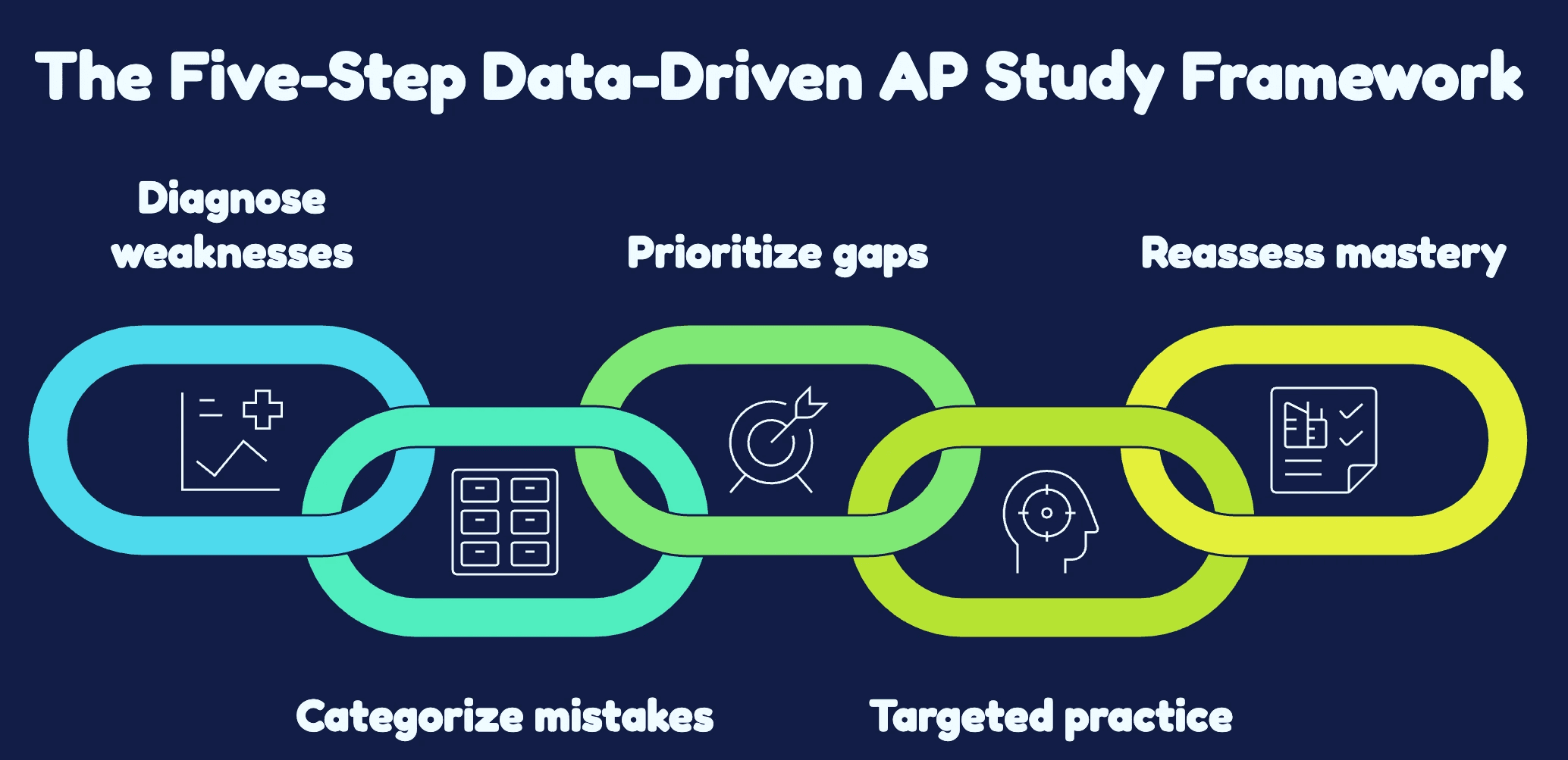
The most effective AP study strategy follows five steps:
Diagnose → Categorize → Prioritize → Practice → Reassess
Each step depends on the one before it. Skip the diagnosis and you waste practice time on topics you already understand. Skip the reassessment and you confuse completion with mastery. This guide walks through exactly how high-performing students execute each step, and where expert guidance makes the difference that technology alone cannot.
Who designs effective mastery-based learning?
Mastery-based learning does not happen automatically through technology. The frameworks that make it work, deciding which skills students need, how those skills should be assessed, and what genuine proficiency looks like, are built by curriculum designers, assessment experts, and educational leaders.
Professionals who pursue an accredited online EdD degree, such as the program at American International College, develop expertise in curriculum design, instructional technology, assessment, and educational leadership. These are exactly the skills needed to build systems that connect performance data to meaningful instructional decisions.
This expertise matters at the classroom level too. When students repeatedly struggle with a concept, a skilled educator can determine whether they need more practice, different instruction, or stronger foundational knowledge before moving forward. As adaptive learning platforms and AI tools enter more classrooms, this human judgment becomes more important, not less, because technology can organize data but it cannot decide what the data means for a specific student.
The five-step data-driven AP study framework
Step 1: Diagnose your actual weaknesses
Before building a study schedule, take a full diagnostic practice test under timed conditions. Your overall score gives you a baseline, but it does not tell you what is actually costing you points.
Look at the specific topics and skills behind every missed question. A student who scores a 3 on a practice AP Calculus exam may be making errors in one specific topic rather than struggling uniformly across the entire course. Without a diagnostic, they will spread their study time across material they already understand while the real problem goes unaddressed.
A 2026 review of adaptive and personalized learning examined how diagnostic information supports more individualized learning and teacher-guided interventions. The finding is straightforward: identifying gaps before committing to a study plan makes every subsequent hour of preparation more productive.
For students who want an expert to run this diagnostic process with them, NAT's AP tutors work one-on-one with students to identify exactly where points are being lost and build a targeted preparation plan from that data.
Step 2: Categorize your mistakes
Not every wrong answer on an AP practice test means you need to re-read an entire chapter. The reason behind each mistake determines what you should do about it.
There are five distinct mistake types, and each requires a different response:
Knowledge gap: You did not understand the concept at all. You need instruction, not more practice.
Application gap: You understood the concept but could not apply it to the question format. You need worked examples and guided practice.
Reasoning error: You misread the question or misunderstood what was being asked. You need to slow down during reading and practice parsing question language carefully.
Careless error: You knew the answer but made an avoidable mistake in execution. You need to build a checking habit, not more content review.
Timing issue: You could not complete the task efficiently. You need paced practice under real time constraints, not untimed review.
A student who treats all five of these as the same problem will apply the wrong solution to most of them. Categorizing mistakes before choosing what to do next is what separates productive study from busy work.
NAT's post on AP Chemistry exam format is one example of how understanding exactly what a specific AP exam tests, at the question-type level, makes categorizing mistakes far more precise.
Step 3: Prioritize the highest-impact gaps
Once you know your weaknesses, resist the temptation to study everything equally. Equal time across all topics is rarely the right strategy, because not all topics carry equal weight and not all weaknesses carry equal cost.
Prioritize skills that appear frequently in the exam, affect multiple question types, or serve as prerequisites for other concepts. A gap in a foundational skill will compound: it will cost you points in every question that builds on it.
A practical example: an AP Calculus student who repeatedly misses questions involving prerequisite algebra may need to fix that foundation before any calculus-specific preparation will hold. The calculus is fine; the algebra underneath it is not. Fixing the algebra unlocks the calculus. For AP History, a student who knows the facts but consistently loses free-response points for weak analysis should spend more time on historical reasoning practice than memorizing additional dates.
The unit weighting guides published by the College Board for each AP subject are useful here. They tell you exactly how many exam points each topic cluster is worth. Cross-reference those weights with your personal error data to decide where your limited study time produces the most return.
NAT's guide on what is on the AP Calculus exam breaks down unit weights and question types in exactly this way, giving students the data they need to prioritize intelligently.
Step 4: Practice the specific problem
Now turn your diagnosis into targeted practice. Review the underlying concept, work through related examples, and then apply the skill to unfamiliar questions you have not seen before.
Avoid returning to random practice across the full syllabus. The goal of targeted practice is to isolate the skill you identified as a weakness and build genuine proficiency in it before moving on. Study apps can support this step by providing questions and immediate feedback, but only if you use them to practice the specific skill your data identified, not to maintain a streak across topics you already understand.
A 2025 study published in ScienceDirect examined mastery-based testing in a general chemistry course. Students could retake unit tests while using digital course resources between attempts. Students who engaged more actively with the mastery-based system tended to achieve higher final exam scores. The mechanism is not mystery: deliberate, targeted practice followed by reassessment produces learning that random repetition does not.
NAT's post on the hardest AP Chemistry topics and how to master them is one example of how targeted skill work, focused on the specific concepts that cost students the most points, produces faster improvement than general review.
Step 5: Reassess before moving on
Do not assume you have mastered a topic because you eventually answered one question correctly. Familiarity with a specific practice question is not the same as genuine skill. Test yourself with new, unfamiliar questions on the same skill and compare your performance to your original diagnostic baseline.
If you still struggle, return to the earlier steps. You may have misdiagnosed the problem, or you may need a different type of practice than what you tried first. If your performance consistently reaches the benchmark you set at the beginning, you have confirmed real mastery and can move forward.
This is the distinction that most students miss: completing a topic and mastering it are not the same thing. The reassessment step is what closes that gap.
What data-driven preparation looks like by subject
The five-step framework applies across all AP subjects, but what you track varies by exam.
AP Math and Science
Look beyond right and wrong answers. Identify whether each error involves a missing concept, an incorrect formula, a calculation mistake, or difficulty applying a concept to a new situation. Repeated errors in specific problem types often reveal a prerequisite gap that needs to be fixed before the surface-level material will make sense.
NAT's AP Chemistry stoichiometry guide and the what is on the AP Biology exam breakdown are both built around exactly this kind of question-level error analysis.
AP History and Social Sciences
Track skills such as evidence use, contextualization, historical reasoning, and argument development. A student can know every relevant historical fact and still lose free-response points because their response does not connect the evidence to an argument clearly. Targeted writing practice on the specific reasoning skill costing them points will produce faster improvement than additional content reading.
AP English
Identify recurring weaknesses in analysis, evidence selection, organization, or argument construction. Rather than simply writing more essays, students can focus on the specific element that is costing them rubric points and then use a new passage or prompt to test whether the improvement transfers to unfamiliar material.
Where technology helps, and where it falls short
Technology makes the mastery cycle easier to manage. Digital tools can deliver practice questions, track performance patterns, provide immediate feedback, and surface trends across multiple sessions. These are genuine advantages, particularly for students preparing independently.
But technology alone does not guarantee better learning. A recent experiment in San Antonio Unified School District during the 2025-26 school year tested Coursemojo, an AI-based platform designed to personalize reading and writing instruction across four middle schools. Results varied significantly by campus. Tafolla Middle School's sixth-grade reading pass rate rose from 32% to 45%, while other schools saw more limited gains. Teachers continued to monitor and supplement the platform throughout.
AI researcher Fei-Fei Li has warned that excessive reliance on AI tools can undermine students' motivation and autonomy. Her argument is not that AI is unhelpful, but that it is most valuable when it supports motivated students rather than replacing their thinking.
For AP students, this distinction is practical. Let technology handle repetitive delivery, feedback, and progress tracking. Keep the diagnosis, categorization, and decision-making in your own hands. And when you hit a gap that practice alone is not closing, bring in a human who can interpret what the data actually means for your specific situation.
Common mistakes that slow AP progress
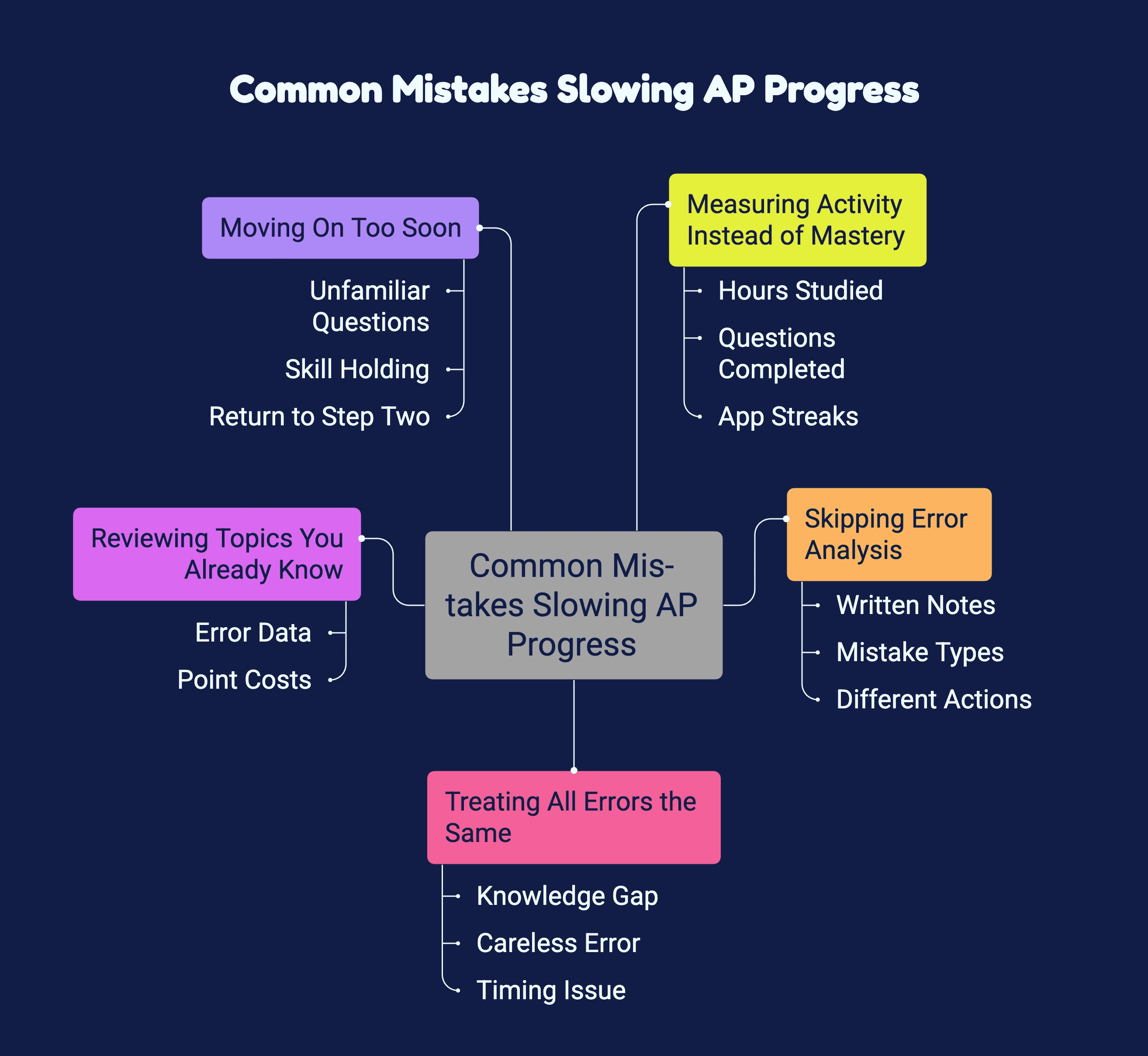
Measuring activity instead of mastery. Hours studied, questions completed, and app streaks do not prove understanding. They prove time spent. Track improvement on specific skills, not volume of practice.
Skipping error analysis. Checking a score and moving to the next topic is the single most common reason students repeat the same errors for months. Every missed question deserves a written note explaining what type of mistake it was and what you would do differently.
Treating all errors the same. A knowledge gap requires instruction. A careless error requires a checking habit. A timing issue requires paced practice. Applying the same solution to every mistake type is inefficient at best and counterproductive at worst.
Reviewing topics you already know. Spending equal time across all topics means spending most of your time on material that is not costing you points. Your error data tells you where the time should go.
Moving on too soon. One correct answer does not confirm mastery. Reassess with unfamiliar questions. If the skill holds, move forward. If it does not, return to step two.
Students who want expert support building and executing a data-driven AP prep plan can schedule a free consultation with North American Tutors. NAT's Ivy League-educated tutors work one-on-one with students on exactly this kind of targeted, mastery-based preparation.