How to Improve Your SAT Score: A 100-to-300-Point Plan by Score Band Before November 7
How to improve your SAT score depends on where you start, and most advice ignores that. A student at 1150 and a student at 1420 can follow the same routine and see very different results, because they lose points for different reasons.
Scores below 1200 usually reflect gaps in content and habits that need to be rebuilt. Above 1350, most lost points come from execution errors, which is why another practice test rarely changes the score. Students in the middle bands often face both issues and need to identify which one matters more.
That is why "add 300 points" means little without a starting score. Realistic gains narrow as the score rises, and no gain is guaranteed.
The four NAT tutors quoted in this guide come from Columbia, Johns Hopkins, Stanford, and Washington & Lee, and NAT builds its plans on a named four-phase method. What follows helps you find your band, fix what caps it, and plan the weeks before the November 7 SAT. It also shows what each band's gains have looked like in NAT's own student case studies, including the limits of those cases.
What "100 to 300 points" really means
How many points you can gain depends on where you start, and independent research finds that the average gain from test preparation is modest. NAT's case studies show gains of 60 to 250 points for students with clear, fixable gaps, but no gain is guaranteed.
The independent evidence is more cautious than most tutoring marketing. A 2009 review for the National Association for College Admission Counseling found that test preparation has a positive but small effect, with average gains closer to 30 points than to 100. It also noted that the standard error of measurement on an SAT section is about 30 points and that some high-quality programs may do better than average. The research predates the digital SAT, so read the case gains below as examples of what focused work has looked like for individual students, not as a forecast.
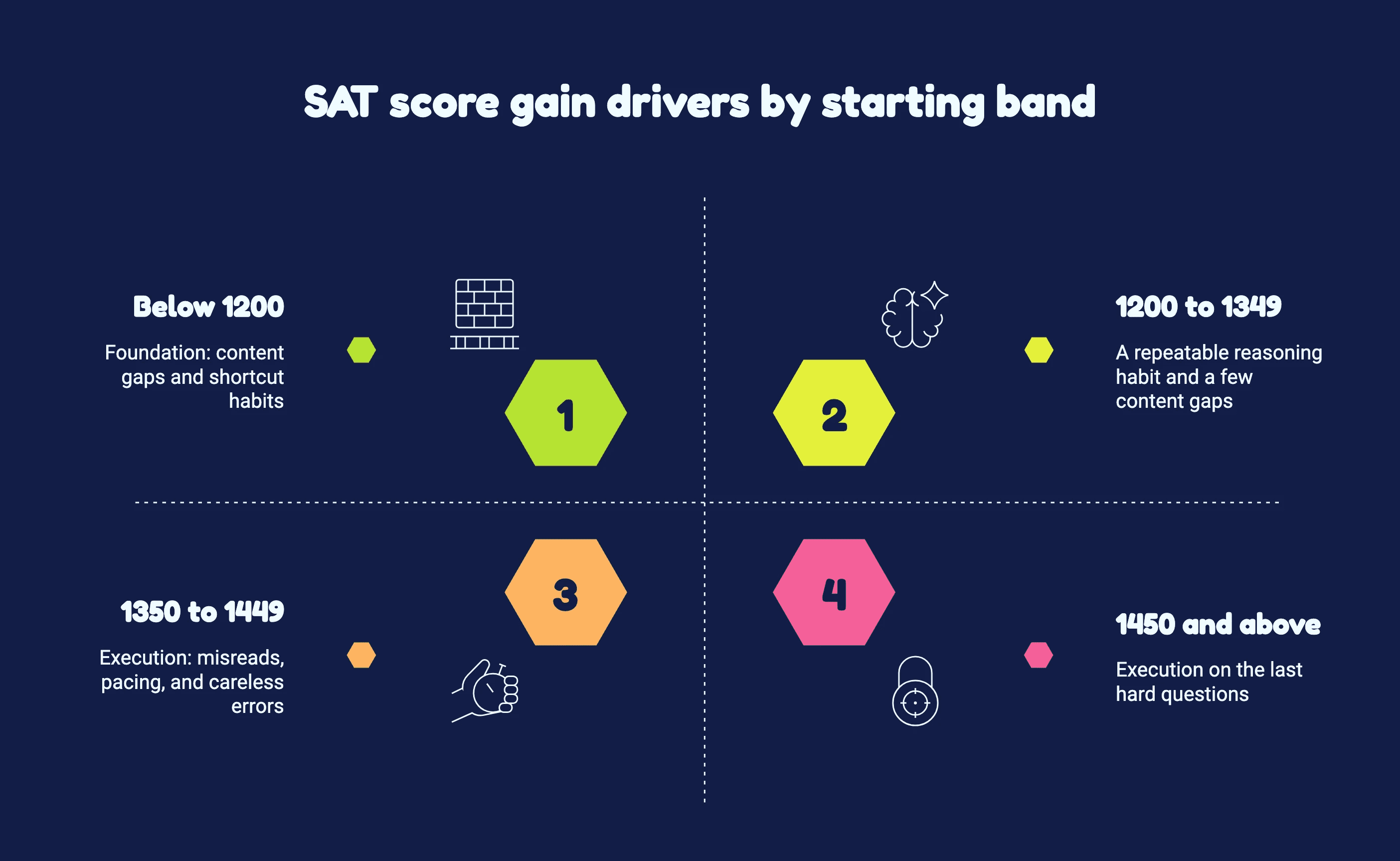
College Board puts the national average around 1050 and says 1350 or higher is in the top 10 percent. The closer you start to the top, the fewer easy points remain, so the last ones depend more on execution than on new content.
Starting band | What usually drives the gain | NAT case examples |
|---|---|---|
Below 1200 | Foundation: content gaps and shortcut habits | Milena K: 1170 to 1420 (+250) |
1200 to 1349 | A repeatable reasoning habit and a few content gaps | Avery H: 1250 practice score, 1420 first official |
1350 to 1449 | Execution: misreads, pacing, and careless errors | Eli A: +150; Austin L: +60; Natasha S: about +210 |
1450 and above | Execution on the last hard questions | Guntas S: +150 from a start in the 1400s |
The examples come from NAT case pages, and each has limits. Avery's 1250 was a practice score, and Guntas's page states his start only as the 1400s.
Do you need a tutor at all? College Board says you do not need a private tutor or prep class to improve and that the best way to practice for the digital SAT is free. NAT's tutors page says the same for a 30- to 40-point goal with six to eight weeks of self-study. One-on-one diagnosis tends to earn its place when a score has stalled after real practice, when the runway is short, or when one section will not move.
NAT's guide to the most effective SAT prep resources compares options if you are choosing where to practice.
Find your starting band (a two-minute self-check)
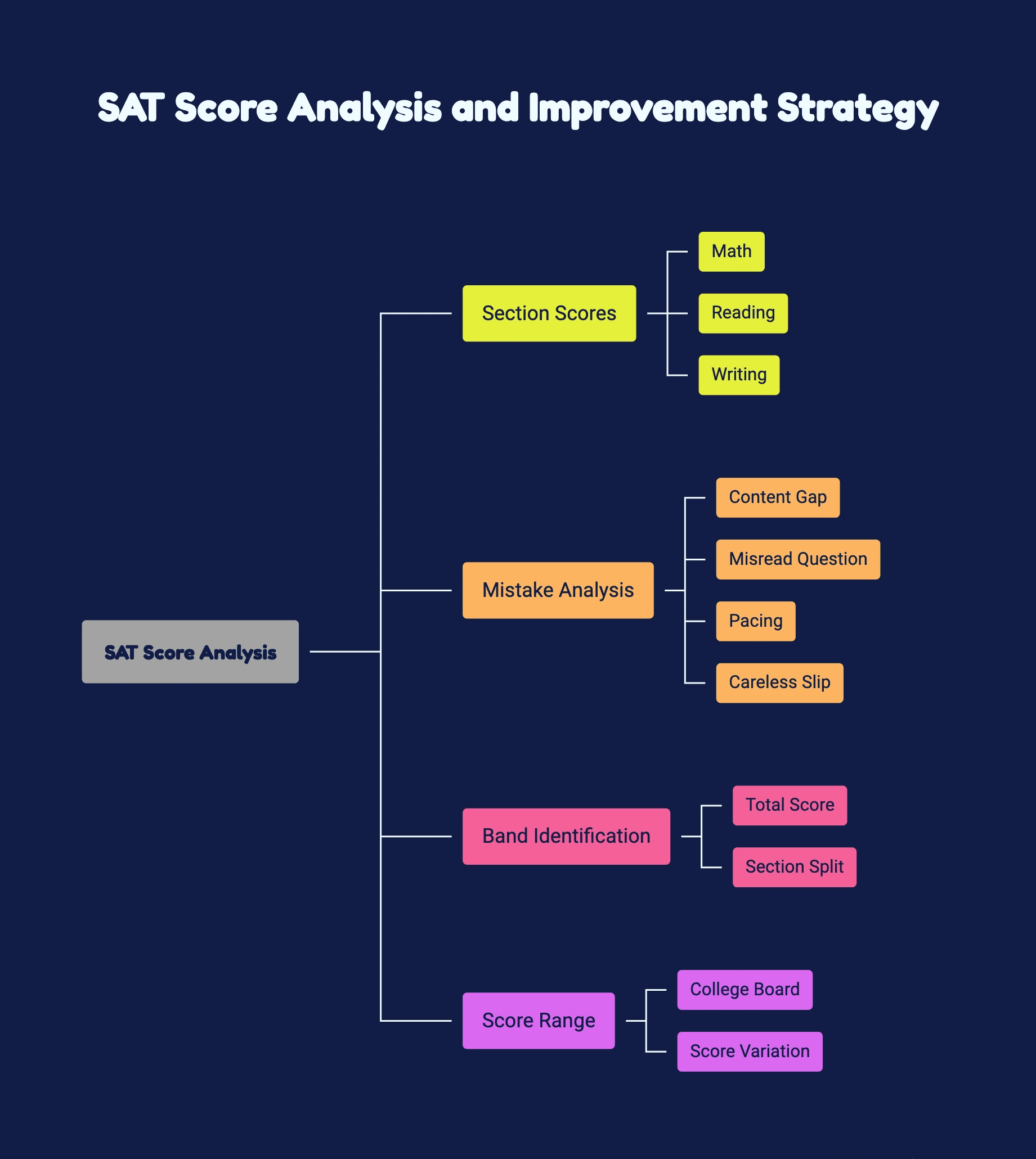
Identify your band using your section scores, not just the total. Write down your Math, Reading, and Writing scores, then sort your recent mistakes by cause: content gap, misread question, pacing, or careless slip. This sorting determines what you should fix first.
Four steps take about two minutes:
Write down your Math, reading, and Writing section scores. A 1300 built from 750 and 550 is a section problem, not a general one.
Pick your band from the table above using the total, then let the section split override it.
Note your score range, which the College Board says shows how much your scores would likely vary on a different administration.
Sort your last ten misses by cause, using four columns: test and question, section and domain, cause, and fix.
An error log requires only four columns. The example below shows how to fill out a row.
Test and question | Section and domain | Cause | Fix |
|---|---|---|---|
Example: Test 1, Module 2, question 14 | Math, Advanced Math | Slipped sign | Write each step and check the sign before submitting |
NAT's guide to what to do after your SAT score explains how to read the full report.
If your misses cluster in Math, the reason Module 1 accuracy shapes your score matters for every band.
An error log is only useful if you can interpret it a week later. Kristina Ayers, a Johnson Scholar and Biology graduate of Washington & Lee University, completed public health research in the Netherlands through the Fulbright Program. She tutors SAT and MCAT students, works as a clinical research assistant at Virginia Commonwealth University, and has tutored SAT students for four years, helping over 100 students. Her focus on organization is exactly what makes an error log effective.
Starting below 1200: build the foundation first
Below 1200, the tempting move is to look for a shortcut. Brian Min scored a 1570 on the SAT, with a perfect 800 in Math, and earned a perfect PSAT score, then graduated from Columbia University with a degree in Economics and French, earning summa cum laude and Phi Beta Kappa honors. He has worked as a college admissions mentor and academic tutor for more than six years, working with roughly 100+ students, and he coached the Milena K case, where the obstacle was not talent but the search for shortcuts.
Milena K started from an official 1170, with 570 in Reading and Writing and 600 in Math. Working with NAT tutors Frances O'Grady and Brian Min, she built a missed-questions log and rebuilt algebra, geometry, and grammar fundamentals. She reached an official 1420, a 250-point increase, with 730 in the verbal section and 690 in Math. The order mattered: foundation first, volume second.
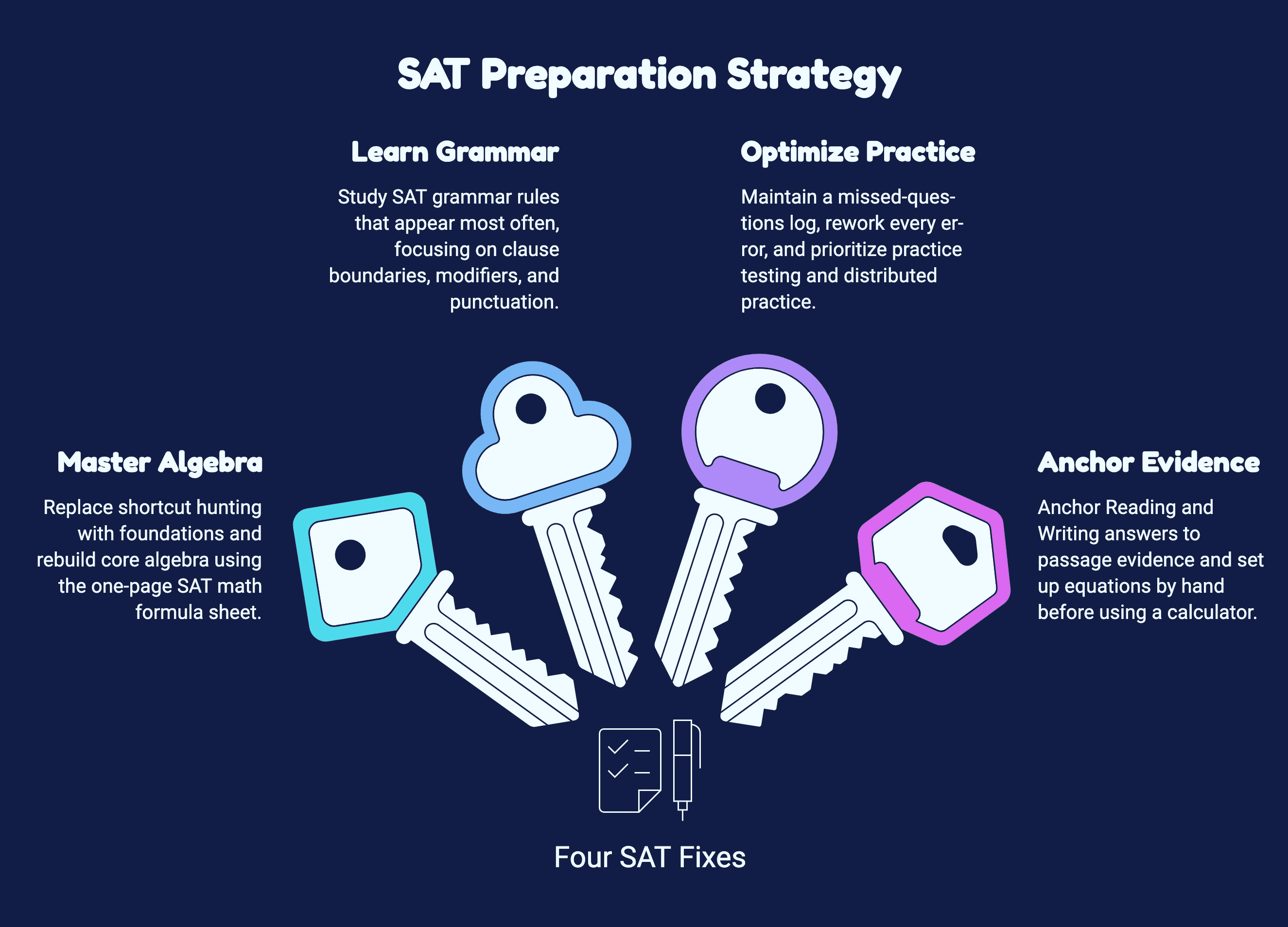
Four fixes are most important at this band:
Replace shortcut hunting with foundations, and rebuild core algebra using the one-page SAT math formula sheet until you can explain why each formula works.
Learn the SAT grammar rules that appear most often, starting with clause boundaries, modifiers, and punctuation.
Keep a missed-questions log, rework every error, and space out your sessions. A major review of learning techniques rated practice testing and distributed practice as high utility and underlining and rereading as low.
Anchor each Reading and Writing answer to evidence in the passage, and set up equations by hand before reaching for the calculator.
You're six weeks below 1200
Begin with Concept Repair: spend the first three weeks addressing diagnosed gaps, and take a full timed test in week five. If you find large gaps in both sections, consider the December 5 test, which gives you about ten weeks.
Starting from 1200 to 1349: close the content and reasoning gap
A score stuck in the 1200s often looks like a knowledge problem and behaves like a habit problem. Sajiv Harikrishnan is a Johns Hopkins University student in Biomedical Engineering on the pre-medical track, and NAT's tutors page lists his SAT score as 1600. He has tutored SAT students for 4+ years, working with roughly 50 students. His approach centers on the reasoning behind each question, not memorization.
Avery H shows the other half of this band: she had never taken an official SAT, and her only data point was a 1250 on an early practice test. Reading and Writing sat in the low 700s, while Math was weaker, especially timing, geometry, and algebra execution. Weekly work with NAT tutor Brian Min covered vertex form, discriminants, circle geometry, and pacing in Math Module 2. Her first official SAT was a 1420, with 750 in Reading and Writing and 670 in Math.
Treat this as a comparison from practice to official test, not as an official-to-official score gain.
Four fixes for this band:
Find the repeatable reasoning habit first, using your error log rather than a guess.
Repair the two or three content gaps behind it by question type, not by textbook chapter.
Slow down on Module 1, because its results shape how hard Module 2 will be.
Use timed drills by question type, then one full test to check pacing; NAT's guide to how many practice tests you need and its guide to the three error patterns behind score plateaus go deeper.
Your six weeks from 1200 to 1349
Split Concept Repair across weeks two to four, spend week four on Module 1 accuracy, and finish a full timed simulation by week five.
Starting from 1350 to 1449: fix execution, not content
By the time a score reaches the 1350s, most of the content is in place, and the points leak elsewhere. Ella Yan Wen is a Stanford University student in biomechanical engineering who scored a 1560 on the SAT in her sophomore year and earned the AP Scholar with Distinction award after taking 13 AP exams. She has tutored students from kindergarten through 12th grade for four consecutive years, taught MathCounts to middle schoolers for four years, and tutors SAT and competitive math for NAT.
Three NAT case pages start in or near this band, and none of them describes a content overhaul:
Student | Starting point | What the case page says changed | Result |
|---|---|---|---|
First official 1360 | A missed-questions log, then a review of why each error happened across official Digital SATs #8 through #10 | 1510 on the June SAT | |
High 1300s | Targeted work on vertex form, discriminants, and participle-versus-verb grammar, plus pacing on hard modules | 1450, a 60-point gain in about one month | |
Around 1350 | Strategy over more content, including Craft and Structure questions and misread graphs and tables | 1560, over several months |
The timelines differ, so do not read one case as a six-week promise. Austin's gain took a month, while Natasha's took several.
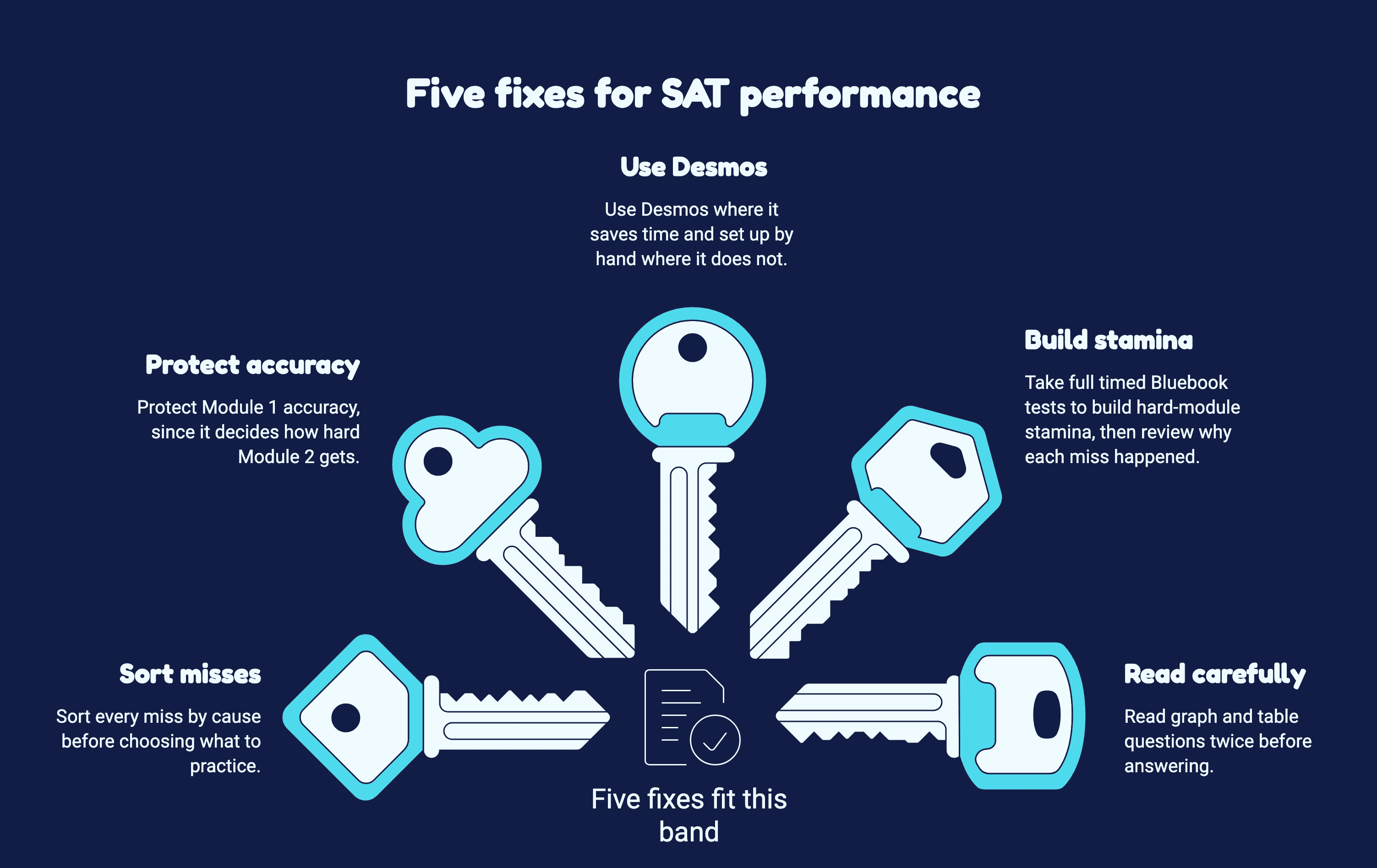
Five fixes fit this band:
Sort every miss by cause before choosing what to practice.
Protect Module 1 accuracy, since it decides how hard Module 2 gets.
Use Desmos where it saves time and set up by hand where it does not, following NAT's Desmos tips for the digital SAT.
Take full timed Bluebook tests to build hard-module stamina, then review why each miss happened.
Read graph and table questions twice before answering.
Your six weeks from 1350 to 1449
Compress Concept Repair into weeks two and three, then extend Module Strategy Training and Test-Day Simulation across the rest of the window.
Starting at 1450 and above: chase the last points
At this level, treat every miss as an execution event. Guntas S was already scoring in the 1400s when he began working with NAT tutor Brian Min, who found careless errors and weak spots in advanced algebra and geometry. Guntas then reached an official 1560, with 790 in Math and 770 in Reading and Writing, a 150-point gain from his first attempt.
His gain is larger than the typical range for this band, and his page states his start only as the 1400s. Treat him as an upper-band example, not a benchmark for a 1450-plus starter. Natasha S's tutor described her final stretch in similar terms: the difference between 750 and 800 in a section.
Four fixes for this band:
Log every miss by cause; at this level most will be execution, not content.
Practice timing on the hardest questions under timed Bluebook conditions.
Keep Module 1 accuracy high so you reach the harder second module.
Decide whether another attempt is worth it. If your score already sits inside your colleges' range, the hours may pay off more elsewhere. Superscoring varies by college, and an economics study of retaking found that policies counting only the highest submitted score give applicants strong incentives to retest.
Which section should you fix first?
Use the section split to choose, and start with the section that holds the total below your target. The table shows where each band usually looks first.
Band | Look first at | Why |
|---|---|---|
Below 1200 | Content gaps in both sections | Milena K's page describes gaps in algebra and geometry and in grammar and reading habits |
1200 to 1349 | Reading reasoning habits and Math timing | Avery H's verbal score was strong, so Math timing and fundamentals were the lever |
1350 to 1449 | Math execution and data-question misreads | Austin L's and Natasha S's pages point to hard-module Math and graph or table errors |
1450 and above | Whichever section holds the total below target | The remaining misses are few, so the gap usually sits in one section |
Across the case pages, one Math topic recurs. Avery H's, Milena K's, and Austin L's pages all list vertex form and discriminants as weak spots. On the verbal side, the same pages mention sentence boundaries, semicolons, transitions, subject-verb agreement, and modifiers.
How to improve your SAT score in six weeks: what changes by band
A six-week plan can fit the November 7 SAT: registration closes October 23, and scores release November 20. If your deadlines are later, the December 5 test allows about ten weeks, and its registration closes November 20. NAT's September 2026 score release timeline covers release-day details.
This table shows what changes by band. NAT's Score Stack Method always follows the same order: Diagnostic Mapping, Concept Repair, Module Strategy Training, and Test-Day Simulation.
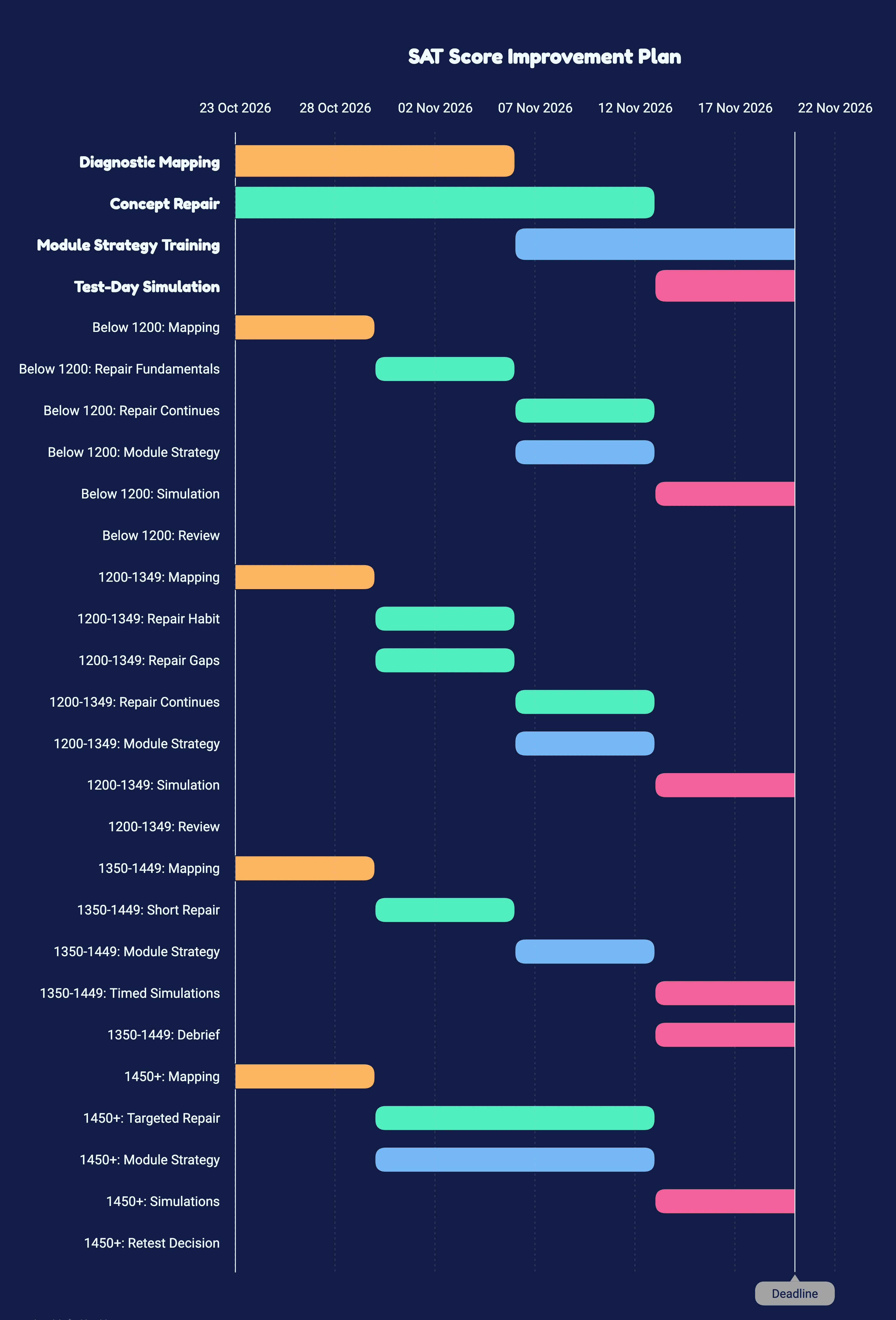
Band | Weeks 1 and 2 | Weeks 3 and 4 | Weeks 5 and 6 |
|---|---|---|---|
Below 1200 | Diagnostic Mapping, then Concept Repair on fundamentals | Concept Repair continues; Module Strategy Training starts in week 4 | One full simulation in week 5; review only in week 6 |
1200 to 1349 | Diagnostic Mapping, then Concept Repair on the habit and top gaps | Concept Repair; Module Strategy Training on Module 1 accuracy | Full simulation by week 5; review in week 6 |
1350 to 1449 | Diagnostic Mapping and a short Concept Repair | Module Strategy Training | Full timed simulations, each followed by a debrief |
1450 and above | Diagnostic Mapping aimed at execution errors | Targeted repair with Module Strategy Training | Simulations, then decide whether to retest or stop |
Test date | Register by | Scores arrive |
|---|---|---|
November 7, 2026 | October 23 | November 20 |
December 5, 2026 | November 20 | December 18 |
The master week-by-week calendar lives in NAT's November 7 retake plan.
Use NAT's SAT score calculator to convert practice test results and College Board's free full-length practice tests for simulations.
Khan Academy's research on Official SAT Practice associates three habits with substantial improvement when students practice for at least 6 hours: leveling up skills, taking a full-length test, and following personalized practice recommendations.
Book a free SAT strategy session so NAT can place you in the right band, identify the errors capping your section, and schedule these six weeks to align with your test date.
Mistakes that stall a score gain
Most stalled gains trace back to acting before diagnosing. These five are worth avoiding.
Mistake | What it costs | Fix |
|---|---|---|
Practicing without a diagnosis | Weeks go to topics you already know | Sort misses by cause first |
Drilling content when the loss is execution | Effort rises and the score does not | Check for misreads, slips, and pacing before drilling |
Ignoring the section split | You fix the wrong section | Start with the section holding the total below target |
Cramming in the final week | Fatigue replaces practice you needed earlier | Keep the last week for review and sleep |
Trusting an inflated point-gain promise | You plan around a number no one can guarantee | Ask for the starting band and the timeline behind any promised gain |
Regarding sleep, the CDC reports that the American Academy of Sleep Medicine recommends 8 to 10 hours per night for ages 13 to 18. Enough sleep, CDC adds, supports the ability to focus at school.
Turn the plan into points
Three points matter most. Your starting band determines what to fix first. At higher scores, execution is usually the main issue, not content. A diagnosis is more valuable than another untargeted practice test.
Not sure which band you are in and what is capping your section? Book a free SAT strategy session with NAT to find the question types costing you the most points and leave with a plan sized to your test date. The session is free, there is no long-term contract, and NAT states that its SAT tutors scored between 1540 and 1600 on the digital SAT.