September 2026 SAT Scores: When Are Scores Released and What to Do Next?
September SAT scores for the September 12, 2026 test will post on Friday, September 25, in your College Board student account. If you tested that Saturday, you already know the wait feels longer than the calendar says. One number will shape which colleges look realistic and whether a retake belongs on your fall schedule, and parents are usually weighing a quieter question: whether extra help would change the outcome.
Two facts change how you should spend this week. Scores are not posted all at once because the College Board staggers them throughout release day. And two deadlines land before the scores do: your free score sends can be used or changed only until Monday, September 21, and late registration for the October 3 SAT closes Tuesday, September 22.
The score report also holds more than most students read. The NAT tutors quoted here scored between 1570 and 1600 on the SAT, and they treat the report as a diagnosis rather than a verdict. What follows takes you from release day to a retake decision.
When will September SAT scores come out?
College Board releases September 12, 2026 SAT scores to students on Friday, September 25, 2026, in the student score portal. Weekend scores post in batches, with some available as early as 6 a.m. and all generally available by 8 p.m. on release day. Educators receive the same scores on Monday, September 28.
Many students expect scores at midnight or in one morning batch. College Board's own guidance on release-day timing says weekend scores are staggered through the day to manage traffic on the scores site. A friend who sees a score at 9 a.m. tells you nothing about when yours will appear.
College Board publishes both the release dates and the registration deadlines for each fall 2026 weekend SAT, and your retake options depend on both.
Test date | Registration deadline | Student score release | Educator score release |
|---|---|---|---|
September 12, 2026 | August 28 (closed) | Friday, September 25 | Monday, September 28 |
October 3, 2026 | September 18; late registration September 22 | Friday, October 16 | Monday, October 19 |
November 7, 2026 | October 23 | Friday, November 20 | Monday, November 23 |
December 5, 2026 | November 20 | Friday, December 18 | Monday, December 21 |
College Board's general rule is that most weekend scores arrive two to four weeks after test day. Every fall 2026 date on the published schedule releases 13 days after the test.
How to access your SAT score
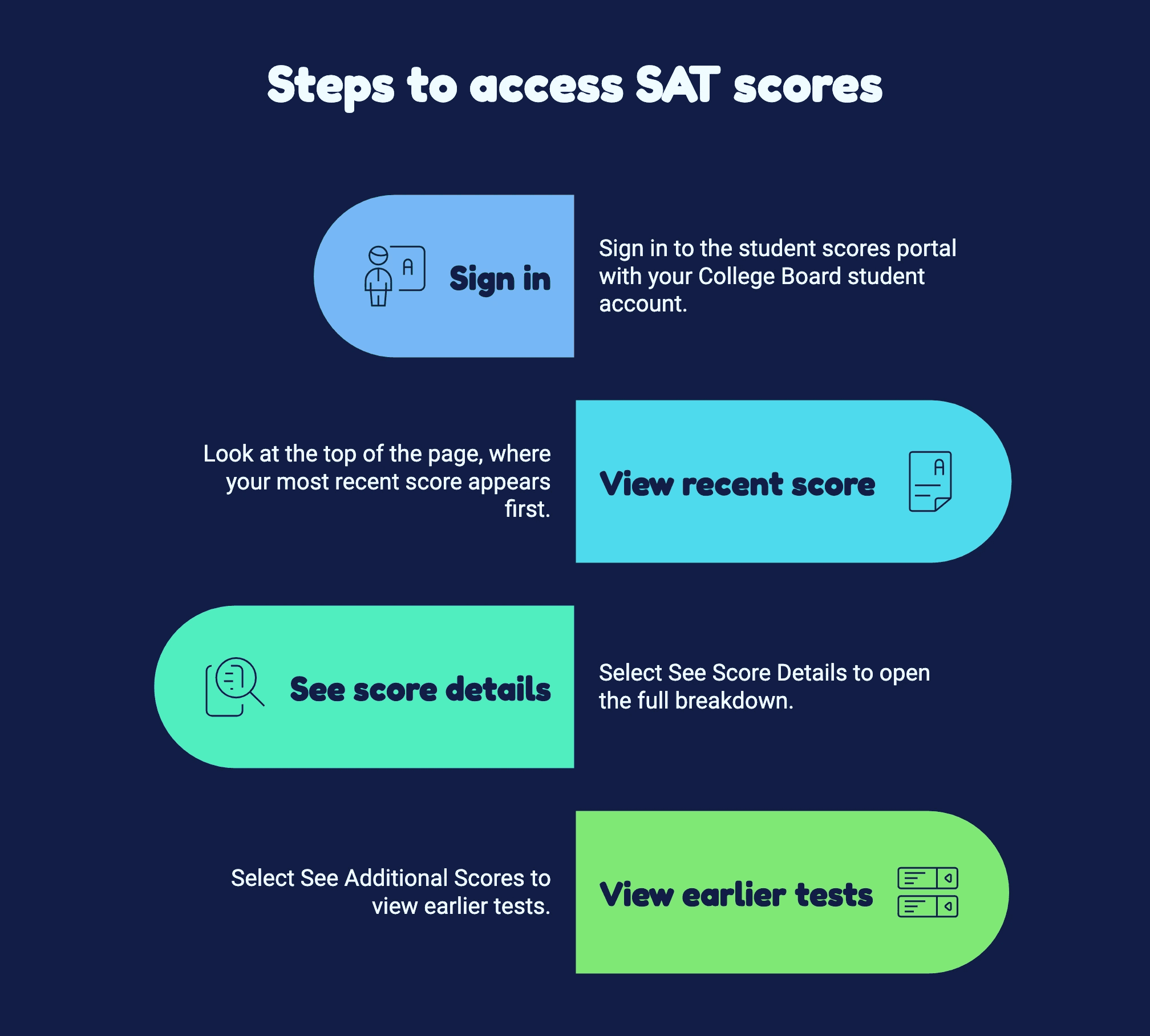
You need the College Board student account you used to register. College Board's instructions for getting weekend scores are short:
Sign in to the student scores portal with your College Board student account.
Look at the top of the page, where your most recent score appears first.
Select See Score Details to open the full breakdown.
Select See Additional Scores to view earlier tests.
If your score is not there yet
A missing score on release day is usually a timing or account issue, not a cancellation. Use this table to sort out which one you are dealing with.
What you see | What it usually means | What to do |
|---|---|---|
No score, and it is still release day | Scores post in batches, so your batch may not be live yet | Check again later. All scores are generally available by 8 p.m. |
No score after 8 p.m. | You may be signed into a different College Board account, or your account details may be out of date | Confirm the account, then use College Board's Find Your Scores tool to check your account information |
A message that your score is under review | College Board says this does not necessarily mean it is canceling the score, only that it needs more information to determine whether it can validate it | Treat it as a wait, not a verdict. The College Board page does not give a timeline |
Free score sends close before scores post
Each time you register for a weekend SAT, you can send your score to up to four organizations for free. College Board gives you until nine days after the test to use or change your free score sends, which for the September 12 test is Monday, September 21. After that, sends cost a fee.
Once scores are out, College Board says it forwards them to your selected colleges within 10 to 12 days. So for a September 25 release, you can expect delivery by roughly October 7.
Whether to spend free sends before you see your score depends on each college's policy. NAT's step-by-step guide to sending SAT scores to colleges walks through that decision.
What your SAT score report tells you
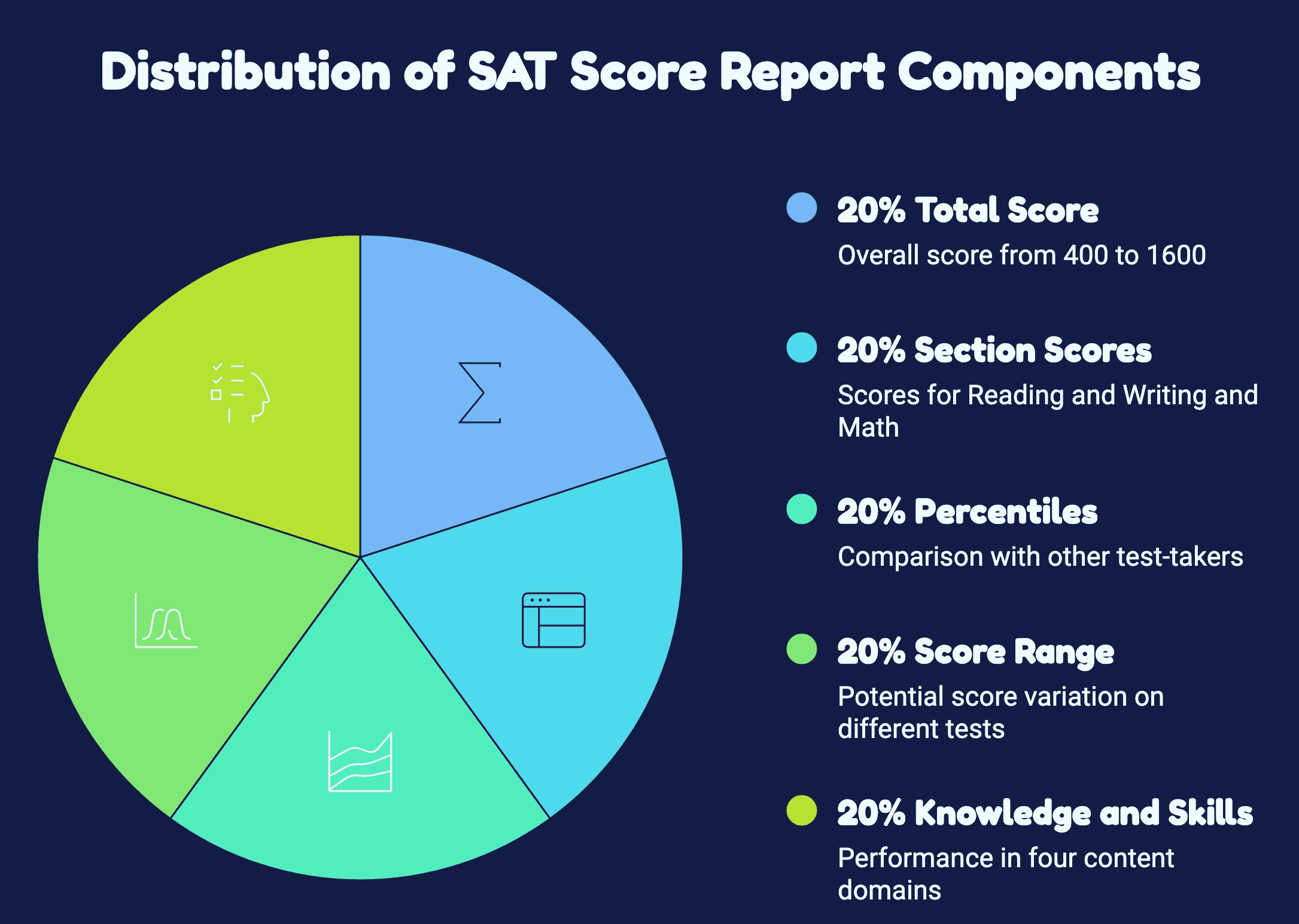
An SAT score report shows a total score ranging from 400 to 1600 and section scores ranging from 200 to 800 for Reading and Writing and Math. It also shows percentile comparisons and a Knowledge and Skills view of your performance in four content domains per section. The total shows how many points you earned, and the domain breakdown shows where the rest went.
Report element | What it shows | How to use it |
|---|---|---|
Total score | 400 to 1600 | Compare it with the middle range of each college on your list, not with a national average |
Section scores | 200 to 800 each for Reading and Writing and for Math | Shows whether the gap sits in one section or both |
Percentiles | How you compare with other students who took the same test | Gives national context, which is different from a college's own expectations |
Score range | How much your scores would likely vary on a different administration | A reason not to over-read a small gap between your score and a target |
Knowledge and Skills | Your performance in four content domains for each section | The part that points to a plan, because it shows where questions were missed |
Percentiles and the score range give context, but the Knowledge and Skills view is where a plan begins.
College Board says the average SAT score is around 1050 and a 1350 or higher is in the top 10 percent, while each school sets its own expectations. NAT's guide to what counts as a good SAT score breaks those expectations down by college tier.
Gia Kim scored a 1570 on the SAT and has tutored for three years, working with roughly 100+ students while studying Chemistry and Chemical Biology, with a minor in English, at Cornell University. When a Reading and Writing score trails the Math score, she points to one habit first.
If Reading and Writing is your softer section, pull five missed questions and ask whether each correct answer was proven by a line in the passage or only sounded right. The pattern in those five tells you more than the section score does.
What if your score is lower than expected?
A score below your target is not a verdict on your ability. It is a list of missed questions, and what you do with that list matters more than the number. Before you drill more problems, sort every miss by why it happened.
Eli A's first official SAT was a 1360, with 660 in Math and 700 in Reading and Writing, after a few weeks of foundational work with NAT tutor Frances O'Grady. His next phase, with tutor Zachary Wagner, put diagnosis first: advanced algebra, geometry, graph interpretation, word problems, and reading inference, with the toughest problems walked through together instead of answer-first. The first score was the input for that phase, not the end of the plan.
Here is a five-row sort you can run on your own report. Put each missed question in one row, then circle the largest.
Why it was missed | What it looks like | First fix |
|---|---|---|
Content gap | You could not start the problem, or you hit a wall halfway | Repair that topic with real College Board questions, then retest it |
Misread question | You solved correctly but answered something the question did not ask | Mark what the question asks before solving, and reread it before you submit |
Pace | Misses cluster near the end of a module | Practice timed sets and set a checkpoint for the halfway point |
Careless execution | You knew the method and slipped on arithmetic, a sign, or a transcription | Show your work and verify with a second method or Desmos |
Early-module slip | You missed easier questions in Module 1 | Slow down on Module 1, where accuracy shapes how hard Module 2 will be |
NAT tutors sort point loss by question type, module, and timing, and this five-row sort is a simplified version you can run at your desk. NAT's guide to why Module 1 accuracy shapes your whole section score explains the adaptive structure behind the last row.
A perfect 800 on the Math section is rare, and Wanning Lu earned one on her way to a 1570. She graduated summa cum laude from UC San Diego with a B.S. in Mathematics and Computer Science and worked as an instructional assistant for several computer science classes. After 5 years and roughly 50+ students of SAT tutoring, she has a plain answer for anyone staring at a stuck Math score.
Count each row, circle the largest, and write one sentence about what would have changed each answer. That list, not the total score, is your study plan.
What if your score is higher than expected?
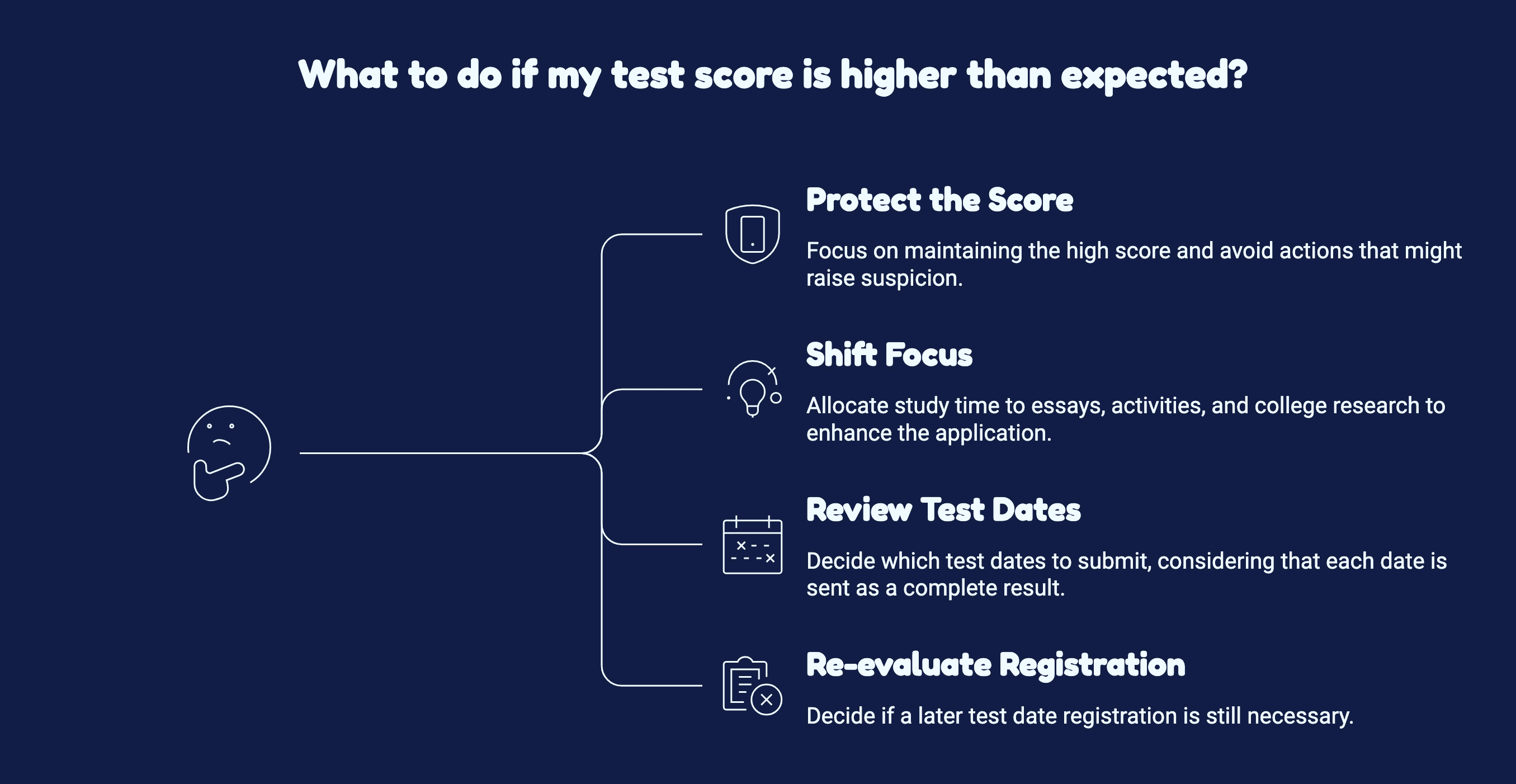
A score at or above your target changes the job. The goal becomes protecting the score and moving your attention to the parts of an application a test cannot show.
Some students worry that a big jump looks suspicious. College Board says it never reviews scores because they are high, and that it is uncommon for it to cancel any score. Its review process looks for things like unusual agreement among two or more students who took the same test.
Use this checklist before you close the tab:
Compare your total and both section scores with the middle range of each college on your list.
Decide which test dates to send, keeping in mind that each date is sent as a complete result and that sections cannot be mixed across dates.
Look at any registration you already hold for a later test date and decide whether it still serves you.
Move your study hours to essays, activities, and college research.
Even strong scorers have room to improve. Guntas S made a 150-point gain to a 1560, with 790 in Math and 770 in Reading and Writing. His NAT tutor, Brian Min, worked with him on careless errors, advanced algebra and geometry, and grammar structures such as modifiers and participle phrases. The case study describes a student who knew the higher-level math and needed more practice with execution.
Should you retake the SAT?
Retake the SAT if the gap to the middle of your colleges' score ranges is real, one section explains most of it, and a test date fits before your deadline. A score already inside your range rarely needs another attempt.
The dates matter as much as the scores. Late registration for the October 3 SAT closes Tuesday, September 22, three days before your September scores are released, and College Board notes that additional fees may apply. That makes an October 3 retake a choice you would have to make before you see your score. November 7 is the earliest date you can choose with your report in hand, since registration runs through October 23.
Retake date | Register by | Scores arrive | Fits deadlines that fall |
|---|---|---|---|
October 3, 2026 | September 18; late registration September 22 (fees may apply) | October 16 | After October 16 |
November 7, 2026 | October 23 | November 20 | After November 20 |
December 5, 2026 | November 20 | December 18 | After December 18 |
Many Early Action and Early Decision deadlines fall in early to mid-November, but each college sets its own. Read the admissions page for the exact date, and check whether the college accepts scores received after that date.
Use the table below to weigh the score, the section split, and the calendar together.
Your situation | Lean | Why |
|---|---|---|
Well below your colleges' range, and one section explains most of the gap | Retake, with prep aimed at that section | A single-section fix is the most direct route to a higher total |
Below range, and both sections trail | Retake only if the calendar allows a full prep cycle | Repairing two sections takes more time than repairing one |
Inside or above your range | Stop testing | The hours are worth more on the rest of your application |
Your colleges superscore | A retake of the weaker section can help | Superscoring combines highest section scores across test dates |
A deadline falls before the next score release | Apply with the score you have | No retake can arrive in time unless the college accepts later scores |
Read the table from top to bottom and stop at the first row that describes you.
Superscoring is a college policy, not a College Board feature. College Board sends the complete result from each test date you choose, and it says some institutions consider your highest section scores across multiple dates. You cannot send Math from one date and Reading and Writing from another; the college handles the combining.
Retake advice often comes in the form of "always" or "never," which is why Alexander Joseph's approach stands out. Alexander Joseph scored a perfect 1600 on the SAT and a 524 on the MCAT, and he has tutored both exams for over six years across roughly 100+ students. He is now a second-year student at Brown University's Warren Alpert Medical School and a summa cum laude Biochemistry graduate of Northeastern University, and he describes his method as methodical and frameworks-first.
Students who tested in August faced this same decision, and NAT's guide to August SAT scores walks through it for that group.
Book a free SAT strategy session to bring your score report, find the section holding back your total, and leave with a retake plan sized to your deadlines.
What to do before the next SAT
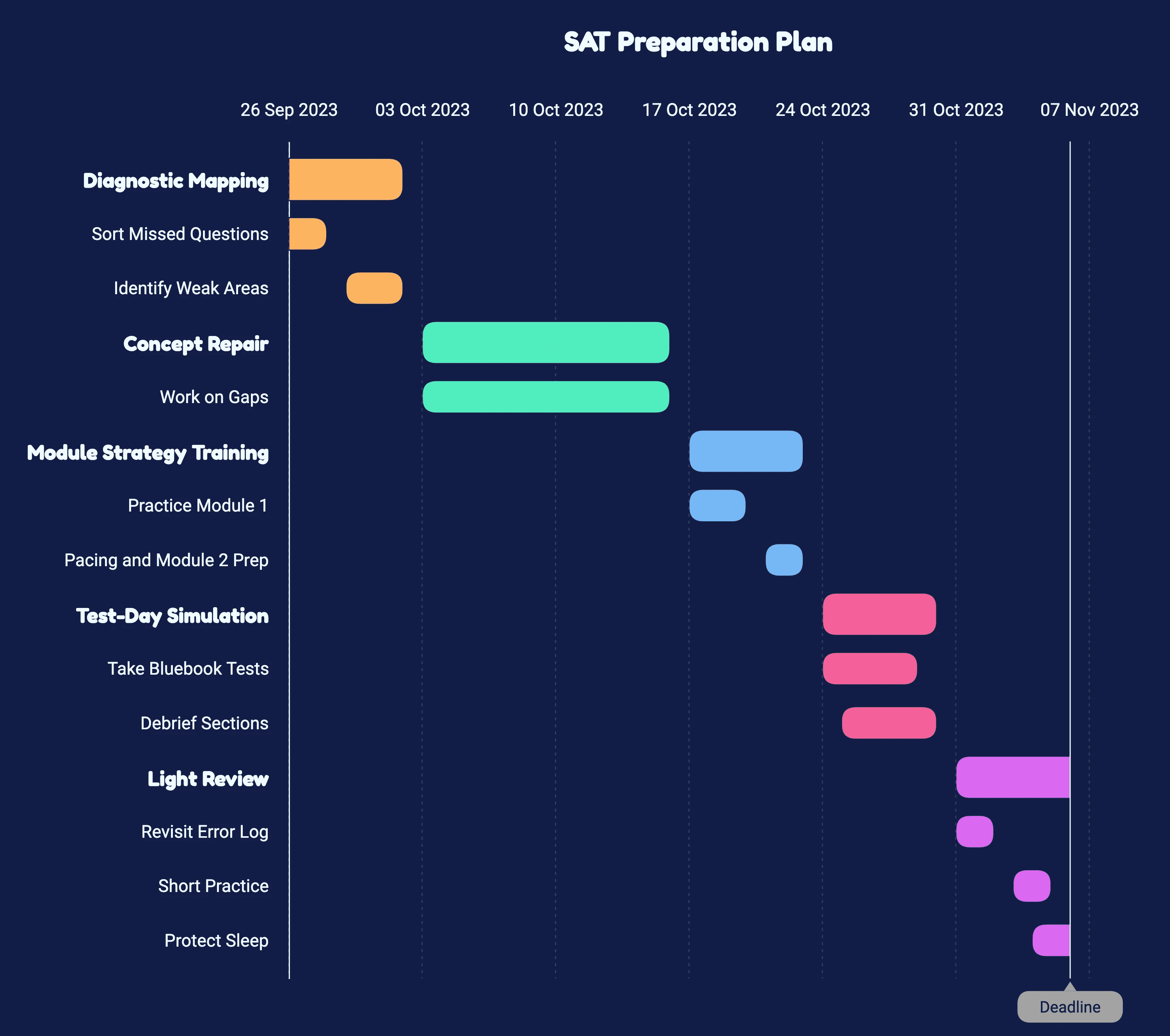
With a November 7 test date, you have about six weeks between your scores on September 25 scores and test day, and about ten weeks if you aim for December 5. NAT's Score Stack Method organizes SAT preparation into four phases: Diagnostic Mapping, Concept Repair, Module Strategy Training, and Test-Day Simulation. Here is one way to fit those phases into the six weeks leading up to November 7.
Week 1, Diagnostic Mapping. Sort every missed question, then write down the five to ten areas costing you the most points.
Weeks 2 and 3, Concept Repair. Work only the gaps on that list, using real SAT questions from College Board materials and Bluebook practice tests.
Week 4, Module Strategy Training. Practice reading Module 1 conditions, pacing for accuracy, and setting yourself up for a harder Module 2.
Week 5, Test-Day Simulation. Take full-length timed Bluebook tests under real conditions, and debrief each section afterward.
Week 6, Light review. Revisit your error log, keep practice short, and protect your sleep.
If you choose December 5 instead, the same four phases run over ten weeks, and Concept Repair simply gets more time. If you already hold an October 3 registration, you have eight days after your scores arrive. That is usually enough for Diagnostic Mapping and a narrow slice of Concept Repair on your single weakest section, not for the full cycle.
Two NAT resources fit the Math half of that plan: the Desmos tips that save time in Module 2, and the one-page SAT math formula sheet.
The sequence worked for Eli A, who moved from 1360 to 1510. His work included a missed-questions log, a habit close to what Diagnostic Mapping asks for, and a question-by-question review of official Digital SATs #8 through #10. He scored a 1500 on a final practice test, then a 1510 on the June SAT, with 760 in Math and 750 in Reading and Writing.
Students who want a tutor to build this sequence around their own report can see how one-on-one SAT tutoring runs the same four phases.
How an SAT tutor can help analyze your score
A tutor's first job is to read your score report the way you just did, but faster and with more context. In NAT's Score Stack Method, the first phase produces a written score leak report that names the five to ten areas costing you the most points. Concept Repair then covers only those gaps, and parents receive bi-weekly progress reports.
The tutors quoted in this guide each read a report differently. Wanning Lu sorts Math misses by cause; Gia Kim starts Reading and Writing with evidence from the passage; and Alexander Joseph frames the retake decision around the gap, the section, and the calendar. NAT matches each student with one of our SAT tutors, and tutor changes are free if the fit is wrong.
Parents often ask whether six weeks is enough. It depends on the gap and where it sits, and no honest tutor can promise a number. A focused plan can aim all six weeks at the areas costing the most points.
Parents also ask whether a student can self-study with Bluebook. Yes, and Bluebook practice tests belong in any plan. What a tutor adds is the diagnosis of why a question was missed, and the leak report and bi-weekly updates show whether the right areas are moving.
Bring your score report, leave with a plan
Between now and September 25, two dates need attention: your free score sends close Monday, September 21, and late registration for the October 3 SAT closes Tuesday, September 22. After September 25, the work changes. Open the score report, sort the missed questions by why you missed them, and match the results to a retake date that fits your deadlines.
Just got your SAT score? Get a personalized SAT strategy session. In a free, no-pressure session, an NAT tutor reviews your score, target, and test date with you and maps the sections costing you the most points into a plan you can act on. You can meet your tutor before you commit to a paid session.