How to send SAT scores to colleges: a step-by-step guide for 2026

Date:
Date:
Written by:
Written by:
Written by:
GCSE | NAT Tutor Reviewed by the NAT Editorial Team
TL;DR
You can send SAT scores to colleges in three ways: four free score sends during registration or within nine days after a weekend test, paid reports after scores release at $15 each through your College Board account, or rush delivery for $31 extra. Most students should wait to see their scores before designating recipients, use Score Choice strategically, and send at least three weeks before application deadlines. Always verify receipt through your college applicant portal.
TL;DR
You can send SAT scores to colleges in three ways: four free score sends during registration or within nine days after a weekend test, paid reports after scores release at $15 each through your College Board account, or rush delivery for $31 extra. Most students should wait to see their scores before designating recipients, use Score Choice strategically, and send at least three weeks before application deadlines. Always verify receipt through your college applicant portal.
Here is a stat worth knowing before you click anything: students routinely send official scores to test-optional schools without first checking that school's 25th-75th percentile range. Our tutors at North American Tutors see this happen every cycle. The result is a $15 score that quietly weakens a holistic application instead of strengthening it. A quick check against what is the average SAT score? gives you the national baseline before you benchmark any single college.
Knowing how to send SAT scores to colleges is one part of the process. Knowing when to send, which scores to send, and whether to send at all is the part that actually changes admissions outcomes. This guide covers all three, including the Bluebook School Day walkthrough that no other SEO resource addresses and a "Send or Sit Out?" decision framework that saves families $60-100 per student in unnecessary report fees.
How do I send my SAT scores to colleges through my College Board account?
To send your SAT scores, sign in to your College Board account at satsuite.collegeboard.org, navigate to "Send SAT Scores," search for your target colleges by name or four-digit code, select which test dates to send using Score Choice, review your order, and pay $15 per official score report. Electronic delivery to most colleges takes 5 to 10 business days after your order is processed.
That is the core process. This guide unpacks the decisions underneath it, including which scores to send, when to order, and whether to pay for rush reporting.
What you'll need before you start
Before you log in and begin designating recipients, gather these four things:
Your College Board username and password
Your target colleges' four-digit College Board codes (or their names for the search bar)
A credit card, or a fee waiver code if you qualify
A decision on which test dates you want to send
That last item is the one students skip. Going in without a Score Choice strategy means either sending every test date by default or second-guessing yourself at checkout. Spend five minutes reviewing your score history before you open the portal.
Step-by-step walkthrough
Sign in at satsuite.collegeboard.org
Click "Send SAT Scores" from your dashboard
Search for each college by name or four-digit code
Select test dates to include (this is your Score Choice selection)
Review your order summary and total cost
Submit payment and save your order confirmation number
Save that confirmation number. If a college claims they never received your scores, that number is the fastest way to resolve it.
Difference between free score sends vs. paid score reports
Free score sends let you designate up to four colleges during SAT registration or within nine days after a weekend test, but scores ship automatically before you see them. Paid reports cost $15 each, require no deadline, and let you review your scores first, choose specific test dates with Score Choice, and send to any number of colleges.
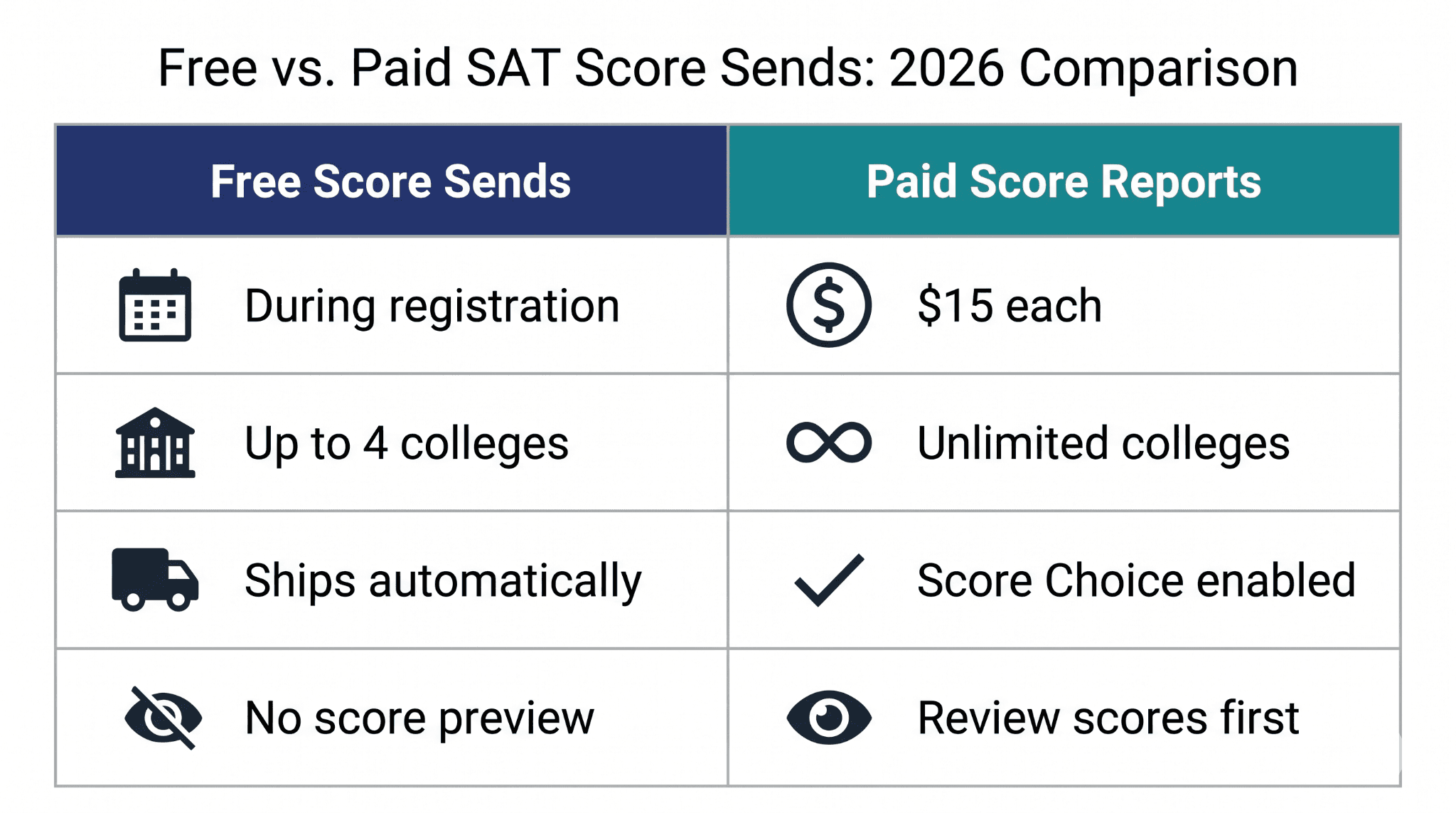
The financial difference is clear. The strategic difference is what most students miss.
The 9-day window explained
The nine-day window for free score sends opens the moment you finish your weekend SAT and closes at 11:59 p.m. ET nine days later. For a Saturday test, that means the following Monday night. You can change your designated colleges during this window, but you cannot add more than four total recipients.
Here is the confusion our tutors hear constantly: students think ordering a score report after scores release is still free. It is not. Free score sends require you to designate recipients before you see your scores. The moment you can view your results online, you are in paid-report territory for any college not already on your free list.
In advising sessions with juniors, we consistently find that students confuse the 9-day window with a post-score review opportunity. They believe they can wait, check their score, then use the free sends if satisfied. The window does not work that way. Students who have a finalized college list before test day are the ones who actually benefit from free score sends. If your list is still shifting, paid reports give you control; free sends do not.
When free score sends make sense (and when they don't)
Scenario | Use Free Sends? | Reason |
|---|---|---|
You have a finalized college list before test day | Yes | Save $60 on four schools |
Applying Early Decision to a test-required school | Yes | Speed matters; score is already expected |
Unsure about your score or college list | No | Wait for paid reports and Score Choice control |
Applying test-optional to 8+ schools | No | Strategic selection matters more than saving $15 |
Retaking the SAT and waiting to compare scores | No | Free sends go out before you can compare |
Fee waiver eligibility
Students who received an SAT fee waiver get unlimited free score sends with no cap on the number of colleges. Contact your school counselor to confirm your eligibility and get the waiver code before test day. Fee waiver students never need to pay the $15 per-report fee, regardless of when they send it.
How do I send SAT School Day scores through the Bluebook app?
For SAT School Day tests, sign in to the College Board's free Bluebook app within three days of testing, go to "Your Tests," select your test date, tap "SAT Score Sends," search for colleges by name or four-digit code, and submit. After the three-day window closes, scores send automatically to any colleges already selected. Additional schools require a $15 paid report through your regular College Board account.
This section covers a process that the other guides you may have read simply skip.
The 3-day window and sign-in ticket
School Day students receive a sign-in ticket via their school email address. You must log in to Bluebook within three days of your test date to access the score send portal. That window is significantly shorter than the nine-day window available to weekend SAT takers.
The most common reason students miss this window: they do not check their school email. School counselors send the sign-in ticket there, not to a personal Gmail account. If you took the SAT on a school day, check your school email immediately after test day and treat that three-day window as a deadline, not a suggestion.
We regularly work with students in the weeks after their School Day SAT who did not realize they had a three-day score send window at all. By the time they come to us, the window has closed, and any additional college on their list costs $15 per official report. This is one of the most preventable extra costs in the college application process. Set a reminder on your phone the evening of your School Day test.
What happens if you miss the window
If you do not log into Bluebook within three days, your scores still send automatically to any colleges you designated before test day. You have not lost anything for schools already on your list. But you cannot retroactively add schools using the free sends after the window closes. Any college you want to add after three days requires a $15 paid report through your regular College Board account.
How long does it take to send SAT scores to colleges?
Standard SAT score reports take 5 to 10 business days to reach colleges after you place your order. Rush reporting delivers within 1 to 4 business days at an additional $31 fee. Free score sends ordered during registration typically process within 10 days of your score release date. After scores arrive at the college, allow an additional 3 to 7 days for the college to process them into your applicant file.
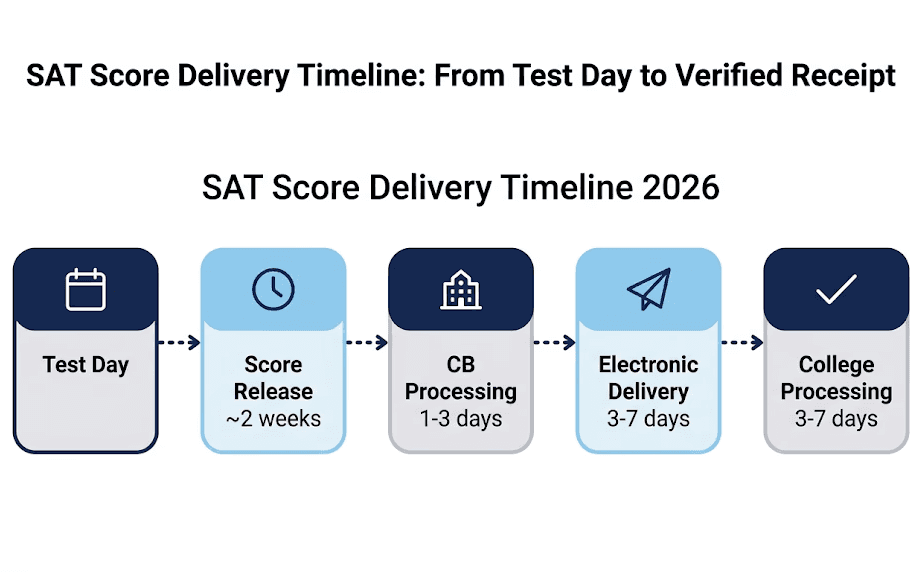
The total window from test day to a confirmed "scores received" status in your college portal is typically three to five weeks. Plan backwards from every deadline.
Standard delivery timeline
Step | Timeline | Notes |
|---|---|---|
Test date to score release | About 2 weeks | Digital SAT releases faster than the paper SAT did |
Order placement to College Board processing | 1 to 3 days | Non-rush orders ship on Wednesdays only |
College Board to college receipt | 3 to 7 business days | Electronic delivery to most institutions |
College processing into your application file | 3 to 7 days | Check your applicant portal, not just your email inbox |
Total: test day to verified receipt | 3 to 5 weeks | Use this number when planning backwards from deadlines |
One detail PrepScholar's timeline research confirms: non-rush score batches ship from College Board once weekly, on Wednesdays. That is why "5-10 business days" is not a guaranteed window. If you order on a Thursday, your report may sit until the following Wednesday before it even leaves College Board. Rush orders ship Monday, Wednesday, and Friday, which is why they arrive faster.
Should I use Score Choice or send all my SAT scores?
Score Choice is a College Board policy that lets you select which SAT test dates to include in each official score report. You send only the dates you choose. Colleges receive no indication that other test dates exist. You cannot, however, hide individual sections within a single test date: if you send a date, both the Reading and Writing and the Math scores from that date go together.
The strategic question is not just how Score Choice works. It is whether sending any scores at all is the right move.
How Score Choice works
When you place a paid score send order, you see a list of every SAT test date associated with your College Board account. You check the dates you want included and leave the others unchecked. That is your Score Choice selection. Colleges receive only the dates you selected, and they do not know how many times you have tested unless their policy requires you to disclose it.
College policies that override Score Choice
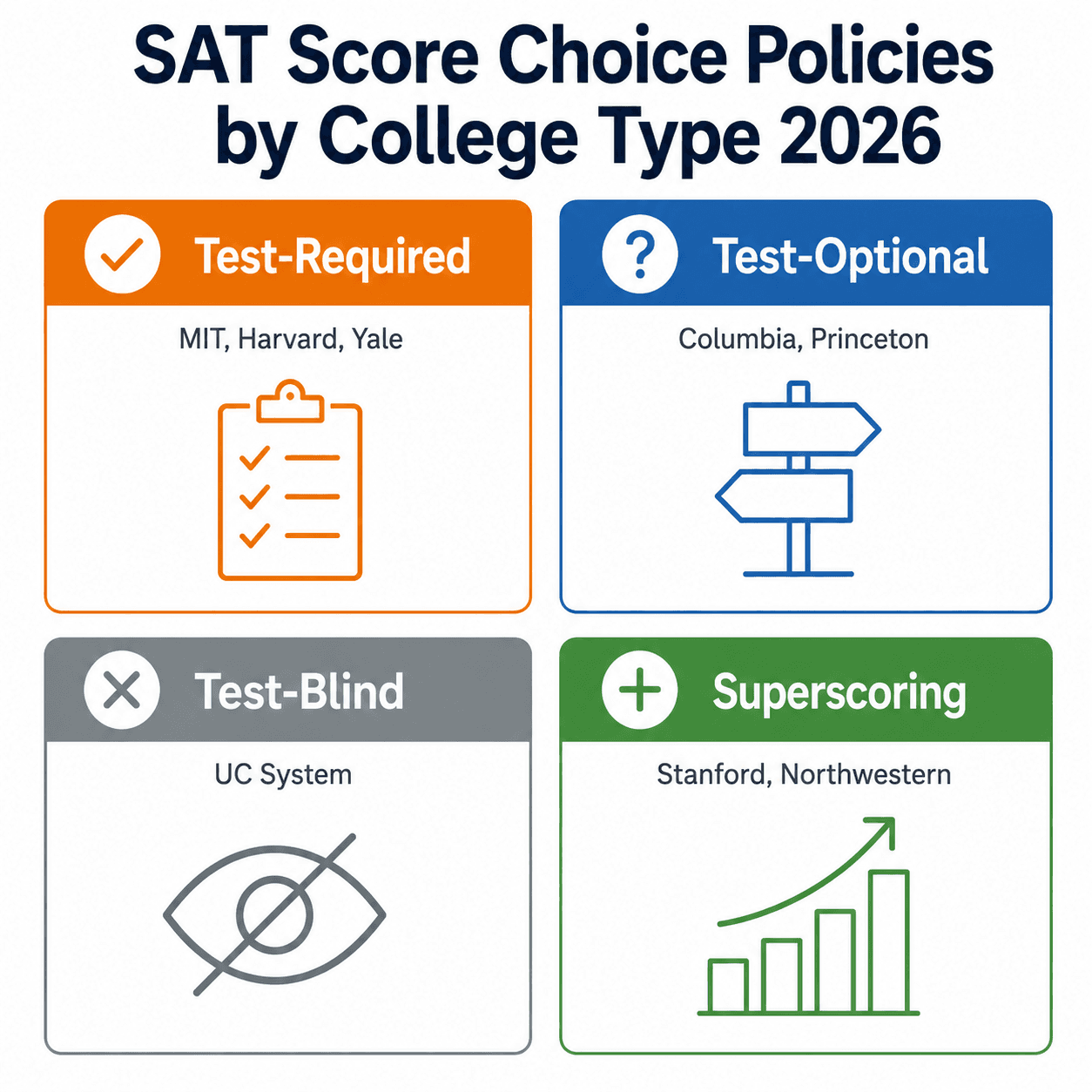
Some colleges require you to send all scores regardless of College Board's Score Choice policy. Always check each school's specific testing policy before you order.
College Type | Policy | What It Means for You |
|---|---|---|
Test-required (MIT, Harvard, Yale) | Varies: Score Choice or all scores required | Check each school's admissions website directly |
Superscoring schools (Stanford, Northwestern) | Accept highest section scores across multiple dates | Send all dates with competitive sections |
Test-optional (Columbia, Princeton for 2026) | Score submission is your choice | Use the "Send or Sit Out?" framework below |
Test-blind (UC system) | Scores not considered in admissions | Do not send; save the $15 per school |
According to FairTest, more than 90% of ranked U.S. four-year colleges are test-optional for Fall 2026, and the UC system is test-blind. That is a large share of applications where sending scores is a strategic choice, not a requirement. The framework below helps you make it.
For Ivy League applicants specifically, Crimson Education's 2026 policy breakdown confirms that Harvard, Yale, Brown, Dartmouth, UPenn, and Cornell require tests for Fall 2026, while Princeton and Columbia are test-optional. Check each school individually, every cycle.
The NAT "Send or Sit Out?" framework
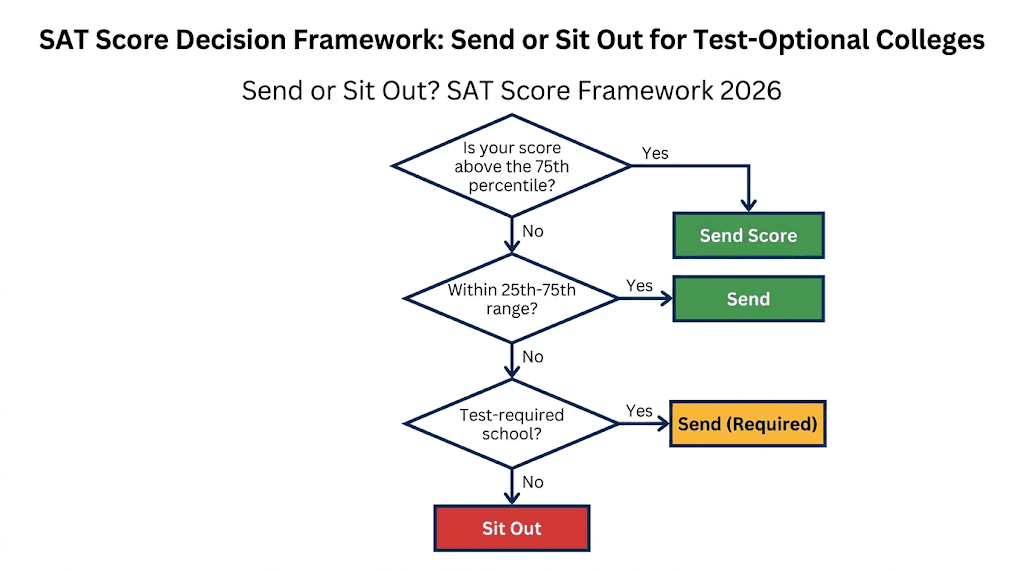
Before you spend $15 on a score report for a test-optional school, look up that college's Common Data Set. Find the 25th-75th percentile SAT range for admitted students. Then use this table.
Your Score vs. the 25th-75th Percentile Range | Action | Rationale |
|---|---|---|
Above the 75th percentile | Send | Your score is a competitive strength |
Within the 25th-75th range | Send | You're in the competitive band; scores help |
Below the 25th at a test-required school | Send (required) | Scores are mandatory; consider retaking |
Below the 25th at a test-optional school | Sit out | Score may weaken your holistic review |
Below the 25th with strong GPA and essays | Sit out | Your other components carry the application |
Our online SAT tutors find that this single check, which takes under five minutes per school, saves families between $60 and $100 per student in score report fees that would have done more harm than good. If your score falls below the 25th percentile at a test-optional school, sending it is not strategic honesty. It is giving admissions readers an easy reason to hesitate.
Get Personalised Help for Your Target Colleges
Build a stronger college application strategy with expert help on SAT scores, deadlines, essays, and admissions planning
Book a free consultation
Get Personalised Help for Your Target Colleges
Build a stronger college application strategy with expert help on SAT scores, deadlines, essays, and admissions planning
Book a free consultation
What should I do if my SAT scores arrive after the application deadline?
More students panic about late official scores than need to. Most colleges build a grace period of one to two weeks into their operations, particularly for Regular Decision. The first step is not rush reporting. It is self-reporting your score on the Common App, then contacting the admissions office proactively with your College Board order confirmation number.
Grace periods and reality
According to NACAC's research on admission factors, only 5% of colleges rate test scores as having "considerable importance" in the admissions decision. That context matters when thinking about how much urgency late score delivery warrants.
In practical terms, Stanford's admissions office accepts self-reported scores via portal update after application submission. Their Restrictive Early Action last test date is October, and Regular Decision is December. Most selective schools with similar policies build in flexibility because they understand that score delivery is controlled by a third party, not the applicant.
How to contact admissions offices
If you are concerned about a late score arrival, email the admissions office rather than calling. Include:
Your full legal name as it appears on your application
Your Common App ID or applicant ID from the college's portal
Your SAT test date
Your College Board order confirmation number
A direct, single question: "Can you confirm receipt or let me know the next steps?"
Keep the email under five sentences. Admissions officers deal with volume. A clear, well-organized email with all the relevant details gets a faster response than a long one.
Sending scores is logistics. Strategy is the part that matters.
Here are the three things to take from this guide. First, know your college's policy before you spend a dollar on a score report. Test-optional is not a reason to automatically send; it is a reason to check the Common Data Set first. Second, send official scores at least three weeks before every application deadline and verify receipt in each school's portal, not just your email inbox. Third, use Score Choice and the "Send or Sit Out?" framework together. A score below the 25th percentile at a test-optional school is not a neutral submission.
If you are navigating a test-optional strategy as part of a broader college application plan, or if you are looking to improve your score before the next test date, our tutors can help. Book a free consultation, and we'll match you with the right tutor for your target schools. 92% of NAT students improve by 90 or more points. Your scores are worth getting right.

TL;DR
You can send SAT scores to colleges in three ways: four free score sends during registration or within nine days after a weekend test, paid reports after scores release at $15 each through your College Board account, or rush delivery for $31 extra. Most students should wait to see their scores before designating recipients, use Score Choice strategically, and send at least three weeks before application deadlines. Always verify receipt through your college applicant portal.
Here is a stat worth knowing before you click anything: students routinely send official scores to test-optional schools without first checking that school's 25th-75th percentile range. Our tutors at North American Tutors see this happen every cycle. The result is a $15 score that quietly weakens a holistic application instead of strengthening it. A quick check against what is the average SAT score? gives you the national baseline before you benchmark any single college.
Knowing how to send SAT scores to colleges is one part of the process. Knowing when to send, which scores to send, and whether to send at all is the part that actually changes admissions outcomes. This guide covers all three, including the Bluebook School Day walkthrough that no other SEO resource addresses and a "Send or Sit Out?" decision framework that saves families $60-100 per student in unnecessary report fees.
How do I send my SAT scores to colleges through my College Board account?
To send your SAT scores, sign in to your College Board account at satsuite.collegeboard.org, navigate to "Send SAT Scores," search for your target colleges by name or four-digit code, select which test dates to send using Score Choice, review your order, and pay $15 per official score report. Electronic delivery to most colleges takes 5 to 10 business days after your order is processed.
That is the core process. This guide unpacks the decisions underneath it, including which scores to send, when to order, and whether to pay for rush reporting.
What you'll need before you start
Before you log in and begin designating recipients, gather these four things:
Your College Board username and password
Your target colleges' four-digit College Board codes (or their names for the search bar)
A credit card, or a fee waiver code if you qualify
A decision on which test dates you want to send
That last item is the one students skip. Going in without a Score Choice strategy means either sending every test date by default or second-guessing yourself at checkout. Spend five minutes reviewing your score history before you open the portal.
Step-by-step walkthrough
Sign in at satsuite.collegeboard.org
Click "Send SAT Scores" from your dashboard
Search for each college by name or four-digit code
Select test dates to include (this is your Score Choice selection)
Review your order summary and total cost
Submit payment and save your order confirmation number
Save that confirmation number. If a college claims they never received your scores, that number is the fastest way to resolve it.
Difference between free score sends vs. paid score reports
Free score sends let you designate up to four colleges during SAT registration or within nine days after a weekend test, but scores ship automatically before you see them. Paid reports cost $15 each, require no deadline, and let you review your scores first, choose specific test dates with Score Choice, and send to any number of colleges.

The financial difference is clear. The strategic difference is what most students miss.
The 9-day window explained
The nine-day window for free score sends opens the moment you finish your weekend SAT and closes at 11:59 p.m. ET nine days later. For a Saturday test, that means the following Monday night. You can change your designated colleges during this window, but you cannot add more than four total recipients.
Here is the confusion our tutors hear constantly: students think ordering a score report after scores release is still free. It is not. Free score sends require you to designate recipients before you see your scores. The moment you can view your results online, you are in paid-report territory for any college not already on your free list.
In advising sessions with juniors, we consistently find that students confuse the 9-day window with a post-score review opportunity. They believe they can wait, check their score, then use the free sends if satisfied. The window does not work that way. Students who have a finalized college list before test day are the ones who actually benefit from free score sends. If your list is still shifting, paid reports give you control; free sends do not.
When free score sends make sense (and when they don't)
Scenario | Use Free Sends? | Reason |
|---|---|---|
You have a finalized college list before test day | Yes | Save $60 on four schools |
Applying Early Decision to a test-required school | Yes | Speed matters; score is already expected |
Unsure about your score or college list | No | Wait for paid reports and Score Choice control |
Applying test-optional to 8+ schools | No | Strategic selection matters more than saving $15 |
Retaking the SAT and waiting to compare scores | No | Free sends go out before you can compare |
Fee waiver eligibility
Students who received an SAT fee waiver get unlimited free score sends with no cap on the number of colleges. Contact your school counselor to confirm your eligibility and get the waiver code before test day. Fee waiver students never need to pay the $15 per-report fee, regardless of when they send it.
How do I send SAT School Day scores through the Bluebook app?
For SAT School Day tests, sign in to the College Board's free Bluebook app within three days of testing, go to "Your Tests," select your test date, tap "SAT Score Sends," search for colleges by name or four-digit code, and submit. After the three-day window closes, scores send automatically to any colleges already selected. Additional schools require a $15 paid report through your regular College Board account.
This section covers a process that the other guides you may have read simply skip.
The 3-day window and sign-in ticket
School Day students receive a sign-in ticket via their school email address. You must log in to Bluebook within three days of your test date to access the score send portal. That window is significantly shorter than the nine-day window available to weekend SAT takers.
The most common reason students miss this window: they do not check their school email. School counselors send the sign-in ticket there, not to a personal Gmail account. If you took the SAT on a school day, check your school email immediately after test day and treat that three-day window as a deadline, not a suggestion.
We regularly work with students in the weeks after their School Day SAT who did not realize they had a three-day score send window at all. By the time they come to us, the window has closed, and any additional college on their list costs $15 per official report. This is one of the most preventable extra costs in the college application process. Set a reminder on your phone the evening of your School Day test.
What happens if you miss the window
If you do not log into Bluebook within three days, your scores still send automatically to any colleges you designated before test day. You have not lost anything for schools already on your list. But you cannot retroactively add schools using the free sends after the window closes. Any college you want to add after three days requires a $15 paid report through your regular College Board account.
How long does it take to send SAT scores to colleges?
Standard SAT score reports take 5 to 10 business days to reach colleges after you place your order. Rush reporting delivers within 1 to 4 business days at an additional $31 fee. Free score sends ordered during registration typically process within 10 days of your score release date. After scores arrive at the college, allow an additional 3 to 7 days for the college to process them into your applicant file.

The total window from test day to a confirmed "scores received" status in your college portal is typically three to five weeks. Plan backwards from every deadline.
Standard delivery timeline
Step | Timeline | Notes |
|---|---|---|
Test date to score release | About 2 weeks | Digital SAT releases faster than the paper SAT did |
Order placement to College Board processing | 1 to 3 days | Non-rush orders ship on Wednesdays only |
College Board to college receipt | 3 to 7 business days | Electronic delivery to most institutions |
College processing into your application file | 3 to 7 days | Check your applicant portal, not just your email inbox |
Total: test day to verified receipt | 3 to 5 weeks | Use this number when planning backwards from deadlines |
One detail PrepScholar's timeline research confirms: non-rush score batches ship from College Board once weekly, on Wednesdays. That is why "5-10 business days" is not a guaranteed window. If you order on a Thursday, your report may sit until the following Wednesday before it even leaves College Board. Rush orders ship Monday, Wednesday, and Friday, which is why they arrive faster.
Should I use Score Choice or send all my SAT scores?
Score Choice is a College Board policy that lets you select which SAT test dates to include in each official score report. You send only the dates you choose. Colleges receive no indication that other test dates exist. You cannot, however, hide individual sections within a single test date: if you send a date, both the Reading and Writing and the Math scores from that date go together.
The strategic question is not just how Score Choice works. It is whether sending any scores at all is the right move.
How Score Choice works
When you place a paid score send order, you see a list of every SAT test date associated with your College Board account. You check the dates you want included and leave the others unchecked. That is your Score Choice selection. Colleges receive only the dates you selected, and they do not know how many times you have tested unless their policy requires you to disclose it.
College policies that override Score Choice

Some colleges require you to send all scores regardless of College Board's Score Choice policy. Always check each school's specific testing policy before you order.
College Type | Policy | What It Means for You |
|---|---|---|
Test-required (MIT, Harvard, Yale) | Varies: Score Choice or all scores required | Check each school's admissions website directly |
Superscoring schools (Stanford, Northwestern) | Accept highest section scores across multiple dates | Send all dates with competitive sections |
Test-optional (Columbia, Princeton for 2026) | Score submission is your choice | Use the "Send or Sit Out?" framework below |
Test-blind (UC system) | Scores not considered in admissions | Do not send; save the $15 per school |
According to FairTest, more than 90% of ranked U.S. four-year colleges are test-optional for Fall 2026, and the UC system is test-blind. That is a large share of applications where sending scores is a strategic choice, not a requirement. The framework below helps you make it.
For Ivy League applicants specifically, Crimson Education's 2026 policy breakdown confirms that Harvard, Yale, Brown, Dartmouth, UPenn, and Cornell require tests for Fall 2026, while Princeton and Columbia are test-optional. Check each school individually, every cycle.
The NAT "Send or Sit Out?" framework

Before you spend $15 on a score report for a test-optional school, look up that college's Common Data Set. Find the 25th-75th percentile SAT range for admitted students. Then use this table.
Your Score vs. the 25th-75th Percentile Range | Action | Rationale |
|---|---|---|
Above the 75th percentile | Send | Your score is a competitive strength |
Within the 25th-75th range | Send | You're in the competitive band; scores help |
Below the 25th at a test-required school | Send (required) | Scores are mandatory; consider retaking |
Below the 25th at a test-optional school | Sit out | Score may weaken your holistic review |
Below the 25th with strong GPA and essays | Sit out | Your other components carry the application |
Our online SAT tutors find that this single check, which takes under five minutes per school, saves families between $60 and $100 per student in score report fees that would have done more harm than good. If your score falls below the 25th percentile at a test-optional school, sending it is not strategic honesty. It is giving admissions readers an easy reason to hesitate.
Get Personalised Help for Your Target Colleges
Build a stronger college application strategy with expert help on SAT scores, deadlines, essays, and admissions planning
Book a free consultation
What should I do if my SAT scores arrive after the application deadline?
More students panic about late official scores than need to. Most colleges build a grace period of one to two weeks into their operations, particularly for Regular Decision. The first step is not rush reporting. It is self-reporting your score on the Common App, then contacting the admissions office proactively with your College Board order confirmation number.
Grace periods and reality
According to NACAC's research on admission factors, only 5% of colleges rate test scores as having "considerable importance" in the admissions decision. That context matters when thinking about how much urgency late score delivery warrants.
In practical terms, Stanford's admissions office accepts self-reported scores via portal update after application submission. Their Restrictive Early Action last test date is October, and Regular Decision is December. Most selective schools with similar policies build in flexibility because they understand that score delivery is controlled by a third party, not the applicant.
How to contact admissions offices
If you are concerned about a late score arrival, email the admissions office rather than calling. Include:
Your full legal name as it appears on your application
Your Common App ID or applicant ID from the college's portal
Your SAT test date
Your College Board order confirmation number
A direct, single question: "Can you confirm receipt or let me know the next steps?"
Keep the email under five sentences. Admissions officers deal with volume. A clear, well-organized email with all the relevant details gets a faster response than a long one.
Sending scores is logistics. Strategy is the part that matters.
Here are the three things to take from this guide. First, know your college's policy before you spend a dollar on a score report. Test-optional is not a reason to automatically send; it is a reason to check the Common Data Set first. Second, send official scores at least three weeks before every application deadline and verify receipt in each school's portal, not just your email inbox. Third, use Score Choice and the "Send or Sit Out?" framework together. A score below the 25th percentile at a test-optional school is not a neutral submission.
If you are navigating a test-optional strategy as part of a broader college application plan, or if you are looking to improve your score before the next test date, our tutors can help. Book a free consultation, and we'll match you with the right tutor for your target schools. 92% of NAT students improve by 90 or more points. Your scores are worth getting right.

Ready to boost your score?
Schedule a free consultation with our Ivy League experts and get a personalized study plan.
Book a free consultation
Join 5,000+ Students
Get weekly academic tips and test prep resources delivered to your inbox.
Trending Topics
Trending Topics
Trending Topics
College Admissions
College Admissions
How to send SAT scores to colleges: a step-by-step guide for 2026
SAT
SAT
What is the average SAT score?
SAT
SAT
What is the lowest SAT score, and what does it mean?
College Admissions
College Admissions
THE World University Rankings by Subject 2026 Explained
Frequently Asked Questions
Can I send SAT scores after submitting my college application?
Yes, you can send SAT scores after your college application has been submitted. Many students self-report their scores on the initial application or send official score reports later to catch up with impending deadlines.
Can I send SAT scores after submitting my college application?
Yes, you can send SAT scores after your college application has been submitted. Many students self-report their scores on the initial application or send official score reports later to catch up with impending deadlines.
Do I need to send official scores if I self-reported on the Common App?
Not necessarily. Most colleges allow you to self-report SAT, ACT, or AP scores on the Common App during the initial review process. You usually only need to pay the testing agency (like College Board or ACT) to send official scores after you have been accepted and decide to enroll.
Do I need to send official scores if I self-reported on the Common App?
Not necessarily. Most colleges allow you to self-report SAT, ACT, or AP scores on the Common App during the initial review process. You usually only need to pay the testing agency (like College Board or ACT) to send official scores after you have been accepted and decide to enroll.
How much does it cost to send SAT scores to one college?
Sending one official SAT score report to a college costs $15 through your College Board account for the 2025-2026 cycle. Rush reporting adds $31 to your order total, but that $31 covers all colleges in a single rush order, not $31 per school. Students with SAT fee waivers receive unlimited free score sends.
How much does it cost to send SAT scores to one college?
Sending one official SAT score report to a college costs $15 through your College Board account for the 2025-2026 cycle. Rush reporting adds $31 to your order total, but that $31 covers all colleges in a single rush order, not $31 per school. Students with SAT fee waivers receive unlimited free score sends.
Can I send only my Math score from one test date and my Reading and Writing score from another?
No. Score Choice lets you select which test dates to send, but you cannot separate sections within a single date. If you send a test date, both the Reading and Writing score and the Math score from that date are included together. To combine your best individual section scores, you need to send multiple test dates and apply to schools with a superscoring policy, which takes the highest section score across all dates you submitted.
Can I send only my Math score from one test date and my Reading and Writing score from another?
No. Score Choice lets you select which test dates to send, but you cannot separate sections within a single date. If you send a test date, both the Reading and Writing score and the Math score from that date are included together. To combine your best individual section scores, you need to send multiple test dates and apply to schools with a superscoring policy, which takes the highest section score across all dates you submitted.
What happens if I send my SAT scores to the wrong college?
If you send your SAT scores to the wrong college, don't panic. If you applied to the wrong school entirely, that college will simply ignore the scores because they don't have an application on file, and the scores will be discarded. If you made a mistake between two colleges you are applying to, you can easily correct it.
What happens if I send my SAT scores to the wrong college?
If you send your SAT scores to the wrong college, don't panic. If you applied to the wrong school entirely, that college will simply ignore the scores because they don't have an application on file, and the scores will be discarded. If you made a mistake between two colleges you are applying to, you can easily correct it.
Related Resources:
Related Resources:
Get the Ivy League Advantage
Work with elite tutors who have walked the path you are on. Personalised strategy for extraordinary results.
Book a free consultation
Related Articles

College Admissions
How to send SAT scores to colleges: a step-by-step guide for 2026
Read article

SAT
What is the lowest SAT score, and what does it mean?
Read article