The Module 2 Cliff: Why Your SAT Score Dropped 80 Points Despite Acing Module 1

Introduction
"I walked out of the test feeling great. Module 1 was much easier than I expected. Then I saw my score, and it was 80 points lower than my last practice test." If that sounds familiar, you are not alone. Reddit is full of students describing this exact shock: the ones who say they were "stuck at 1300" after grinding for months, or the ones venting that "Math Module 2 sucks" the day scores are released.
The digital SAT, which launched nationally in March 2024, uses multistage adaptive testing. Your performance on Module 1 determines whether you get the harder or easier one. Module 2. Most students know this process in theory. Almost no one knows the specific threshold that separates the two paths, or why the hard Module 2 questions feel so different from the ones they practiced at home.
In 2025, more than 2 million students in the class of 2025 took the SAT, with a mean score of about 1029. But the students who search "why did my score drop" are not near the mean. They are the ones who were scoring 1400 or higher on practice tests and walked away with a 1320. This post explains exactly why that happens and what to do about it.
How does SAT adaptive testing actually work?
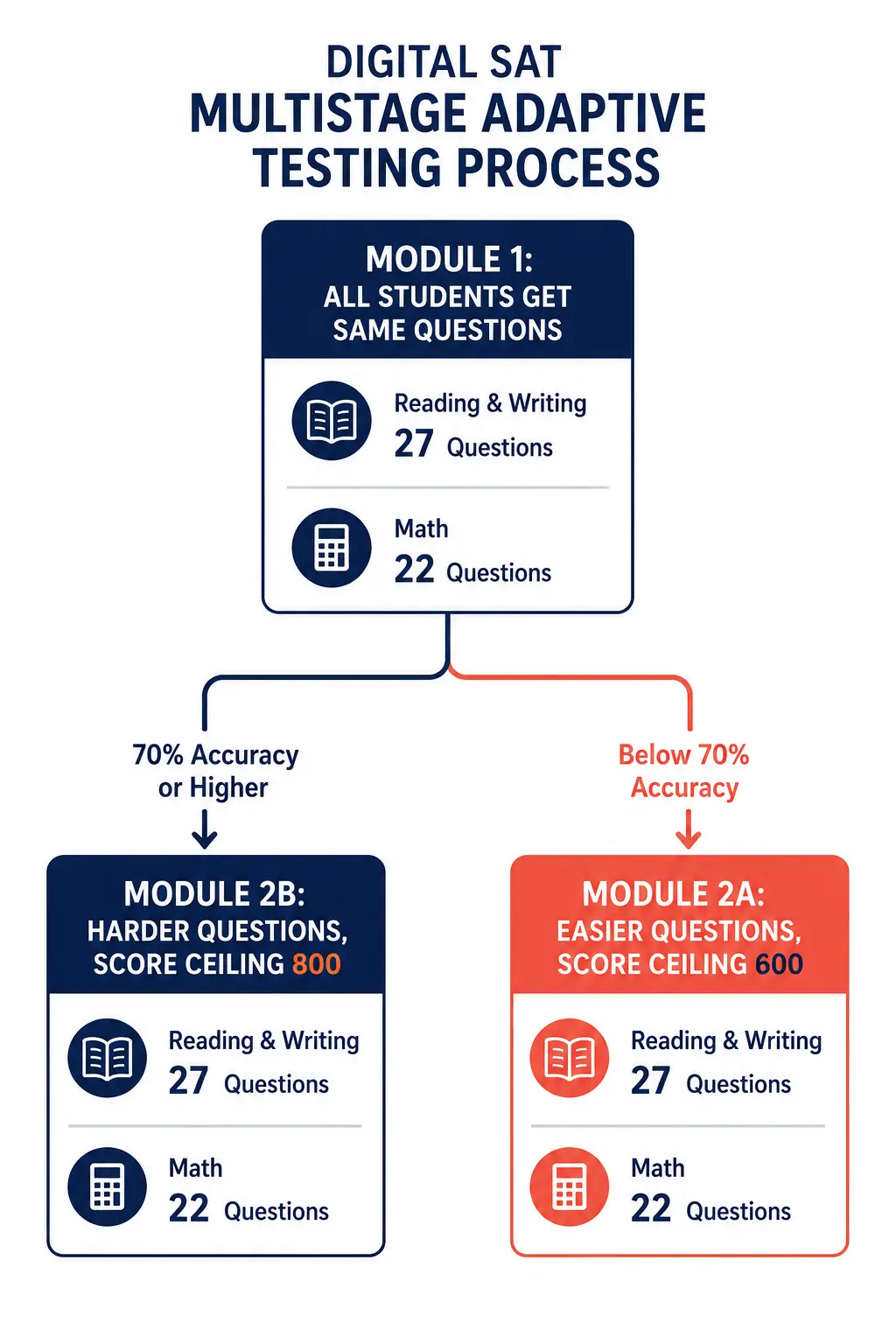
The digital SAT uses multistage adaptive testing. Every student gets the same Module 1 for each section. Based on your Module 1 performance, the test routes you to either a harder Module 2, which has a score ceiling up to 800, or an easier Module 2, capped around 560 to 600 per section. Your total score depends on which path you took and how you performed on both modules.
The College Board explains this design in its Digital SAT Suite technical documentation, which describes the module-scoring process and the statistical model behind it. The system uses item response theory, a method that weighs each question by difficulty rather than treating every correct answer the same. A correct answer on a hard question carries more information about your ability than a correct answer on an easy one.
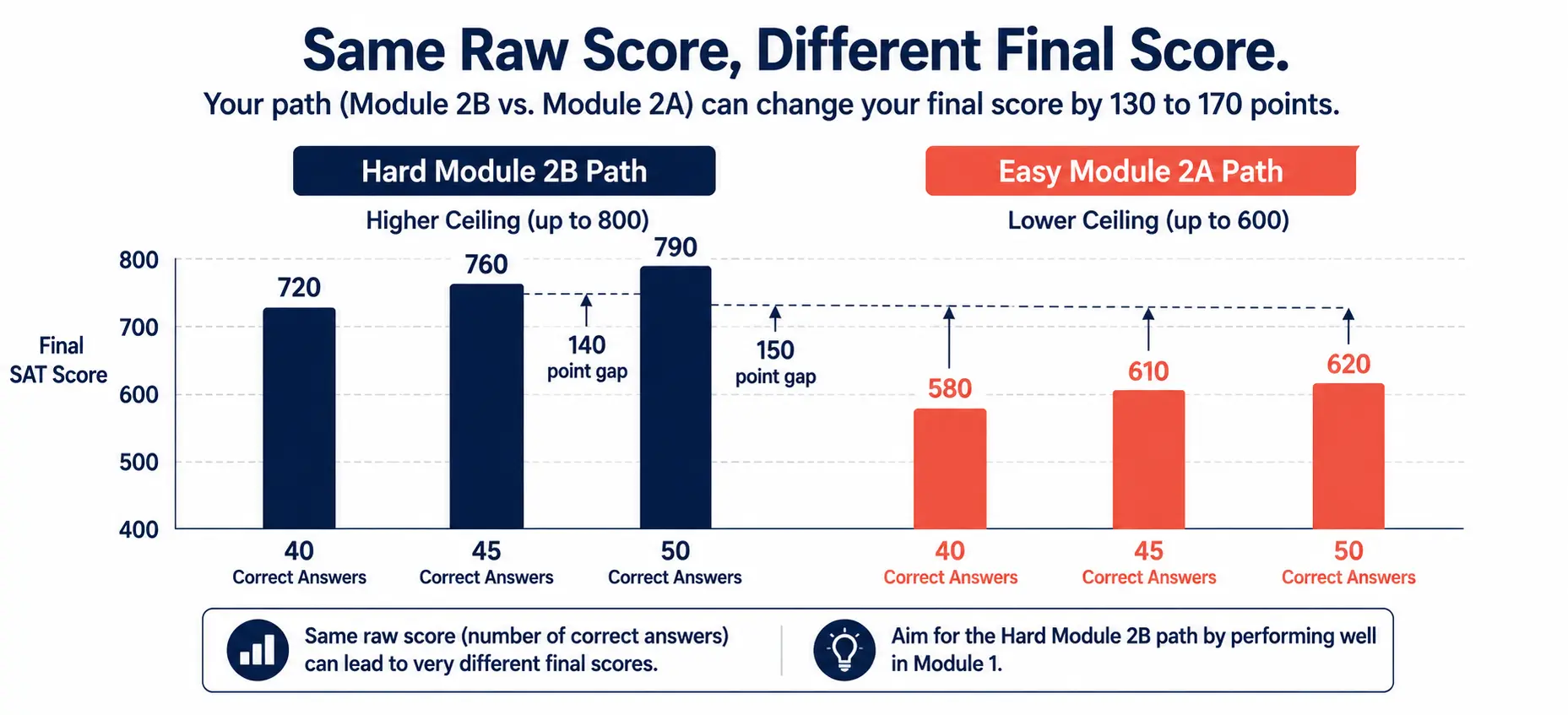
That is also why two students can answer the same number of questions correctly and end up with different scaled scores. The digital SAT score calculator lets you test the outcome directly: plug in different Module 1 and Module 2 combinations and watch how the same raw count produces very different results depending on which Module 2 you were routed to.
What counts as Module 1 and Module 2?
Module 1 has 27 Reading and Writing questions or 22 Math questions, and every student in that test administration sees a comparable version. Module 2 is the adaptive piece. It is either Module 2A, the easier version with a compressed score ceiling, or Module 2B, the harder version with access to the full 200 to 800 range.
What is the exact threshold for getting the harder Module 2?
Research from tutoring platforms and student-reported data points to a threshold of roughly 70 percent accuracy on Module 1, corresponding to a raw score of approximately 570 to 600 points. For Math Module 1, this threshold typically means missing no more than 5 to 6 questions out of 22. For Reading and Writing, this means missing no more than 6 to 7 questions out of 27.
Applerouth's breakdown of the adaptive format places the hard Module 2 range at roughly 450 to 800, while the easy Module 2 tops out in the low 600s. Test-Ninjas and Makon report similar figures, both landing near the same 570 to 600 cutoff. Piqosity's analysis of practice test data lands on a similar mark, about two thirds correct.
None of these sources are College Board itself, since the exact cutoff is not published. But five independent estimates converging on the same range is a strong signal. If you are aiming for the highest possible SAT score, missing that threshold in even one section makes an 800 mathematically impossible for that section, no matter how well you do afterward.
Why does the hard Module 2 feel so much harder than practice?
This is the part that catches students off guard. They studied the content. They drilled the practice questions. Then they sit down for the real Module 2, and it feels exponentially harder, not because the topics have changed but because the questions are built differently.
Alexander, who scored 1570 on the SAT and 36 on the ACT, has been tutoring SAT students at NAT for 5 years and has worked with over 50 students on this exact pattern. He told the NAT team about the sounds-right trap:
That distractor design is also why timing breaks down in the hard module. One analysis of completed practice tests found that accuracy drops 25 to 30 percent from Module 1 to a hard Module 2, even among students in the 90th percentile on Module 1. The drop is not a knowledge gap. Students answer wrong Module 2 questions almost as fast as they answer correct ones, because the trap answer feels obvious.
The College Board has acknowledged this dynamic directly. In a blog post addressing lower than expected scores, the organization notes that missing easier questions can cost you more than missing harder ones, since the scoring factors in the difficulty of each answer. For more on the math side specifically, NAT's free one-page SAT math formula sheet is built around the exact question types that most often appear in hard Module 2.
How many Module 1 questions can I miss and still hit my target score?
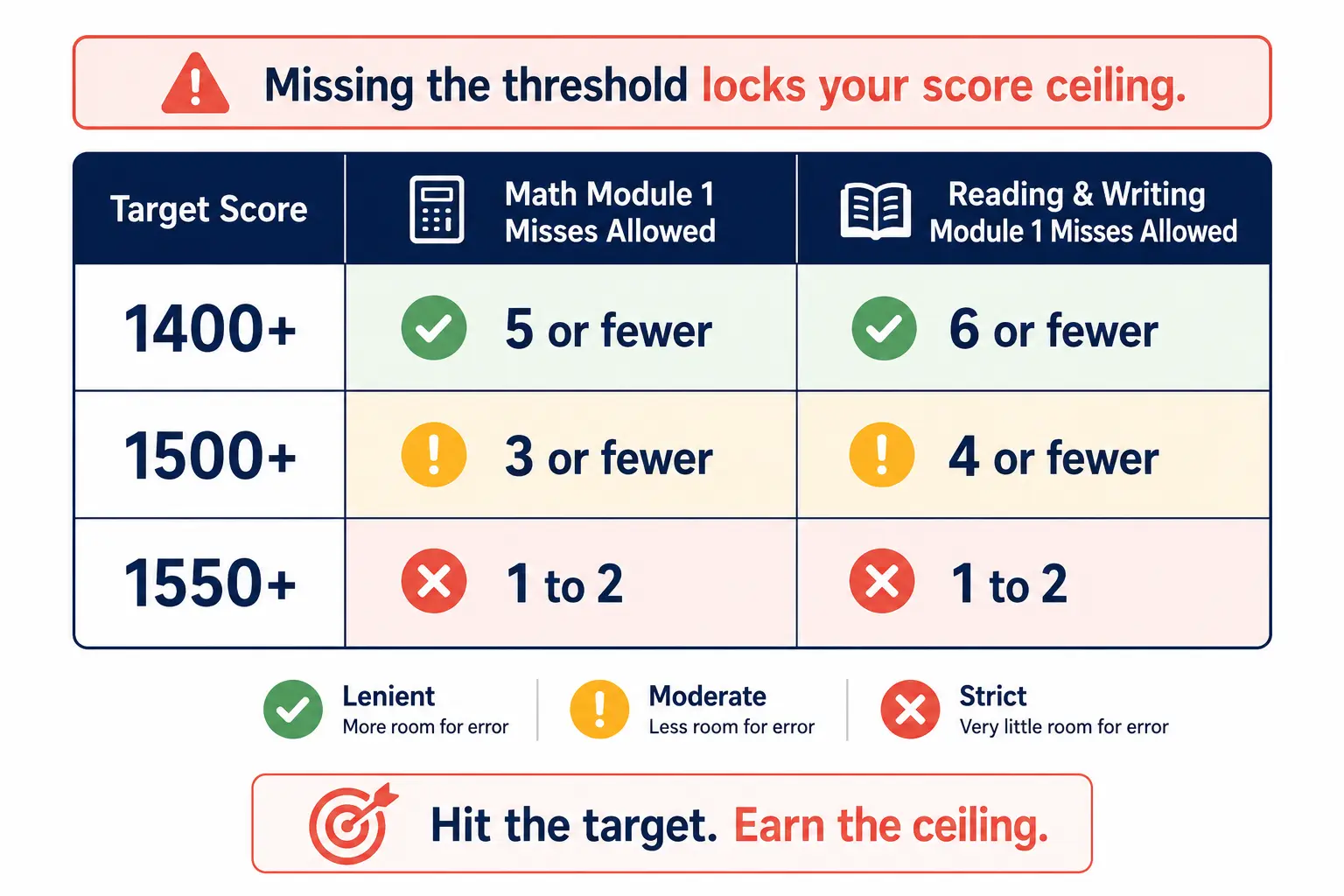
It depends on your target. For a total of 1400 or higher, you need the hard Module 2 in both sections, which means missing roughly 5 or fewer questions in each Module 1. For 1500 or higher, that drops to 3 or fewer misses. For 1550 or higher, you need a Module 1 performance with 1 to 2 misses at most, with zero misses in your stronger section.
Target score | Math Module 1 misses allowed | R&W Module 1 misses allowed |
|---|---|---|
1400+ | 5 or fewer | 6 or fewer |
1500+ | 3 or fewer | 4 or fewer |
1550+ | 1 to 2 | 1 to 2 |
These figures sit inside NAT's broader guide on what counts as a good SAT score, but the Module 1 tolerance is the piece most students never see until they are already locked into the easy track.
Wanning, with a 1570 SAT and a Stanford PhD, has worked with 80+ students preparing for 1500-plus scores. Her thoughts about this exact tolerance gap:
The NAT Module 1 Discipline Threshold
No published guide breaks down Module 1 tolerance by topic and target score because doing so requires real tutoring session data from hundreds of students. NAT built that breakdown from its own coaching logs, and we are publishing the framework here for the first time.
The NAT Module 1 Discipline Threshold sets a miss limit by topic area for students targeting scores of 1400+, 1500+, and 1550+:
Topic area | 1400+ target | 1500+ target | 1550+ target |
|---|---|---|---|
Algebra | 2 misses max | 1 miss max | 0 misses |
Advanced Math | 2 misses max | 1 miss max | 0 to 1 miss |
Problem Solving and Data Analysis | 1 miss max | 1 miss max | 0 misses |
Geometry and Trigonometry | 1 miss max | 0 to 1 miss | 0 misses |
R&W: Information and Ideas | 2 misses max | 1 miss max | 0 to 1 miss |
R&W: Standard English Conventions | 2 misses max | 1 miss max | 0 misses |
NAT tutors use a short diagnostic checklist in the first session to spot whether a student's errors are concentrated in Module 1 territory or Module 2 territory, since the fix for each is completely different.
Module 1 Discipline Checklist (used in NAT tutoring sessions):
Review every Module 1 miss from your last 3 practice tests and label each one as careless or content-based.
If more than half are careless, the fix is pacing and rechecking, not new content.
Time yourself finishing Module 1 with 3 to 5 minutes left over, not zero.
Track your Module 1 accuracy separately from your overall section accuracy for at least 4 practice tests.
Do not move on to dedicated Module 2 practice until Module 1 accuracy is consistently above your target threshold.
What should I do if I got routed to the easier Module 2?
If your score report shows a section score below 620, you were likely routed to the easier Module 2. Your next step is not to study harder content. It is to master Module 1 accuracy. Run timed Module 1-only practice sprints, track every miss by topic, and aim for 85 percent or higher accuracy before touching another Module 2 question.
Octavia M., one of NAT's students, improved from a 1280 to a 1470 after her tutor identified a Module 1 timing issue in their first diagnostic session. She was rushing through the first 15 questions of Math Module 1 and making careless errors that led her into the easier Module 2 every time. After 6 weeks of Module 1-only sprints built around the checklist above, she scored 750 on Math.
The College Board's free Bluebook app includes 8 full-length practice tests, and you can isolate Module 1 sections within those tests to run the same kind of sprint Octavia's tutor assigned her. The goal is not finishing faster. It is finishing accurately with time left to recheck.
Is the SAT harder now because of adaptive testing?
Not harder in raw content, but harder to predict. The digital SAT format tests the same skills as the paper SAT, but the adaptive structure means a single rough patch in Module 1 can shrink your score ceiling before you even reach the back half of the test. For students weighing the SAT against the ACT's fixed format, NAT's guide to digital SAT versus ACT for STEM students breaks down how the two tests differ in structure.
How long should I spend on Module 1 versus Module 2?
Spend whatever time it takes to finish Module 1 accurately, with 3 to 5 minutes left for rechecking, even if that means moving slightly faster through Module 2 later. Module 1 sets your ceiling. Module 2 only determines how close you get to it. If you are still deciding between test prep paths, NAT's one-on-one SAT tutoring program builds pacing drills around this exact split.
Conclusion
Module 1 is not a warm-up. It is the gatekeeper. The threshold is real, the trap gap inside hard Module 2 is real, and most score drops are not about missing knowledge. They are about discipline in the first 22 to 27 questions. Fixing that discipline is a faster path to a higher score than another round of content review.
Schedule your free consultation, and we will diagnose exactly which Module 1 patterns are capping your score, then match you with a tutor who has already solved this for students aiming at your target.