What to do after your SAT score: a complete next-steps guide
What to do after your SAT score comes in depends on something most students skip: what the score report actually says. Seeing the number is the easy part. The harder questions follow right behind it: whether it is good enough, whether a retake is worth another Saturday, and which colleges should receive it. Parents ask the same questions with a calendar attached, wondering whether there is still time and whether help would change the outcome.
The first choices you make with a score, mainly which colleges receive it and whether a retake goes on your calendar, shape the next three months. Some of them are also time-limited, because College Board's free score sends expire nine days after test day. And the total is the least informative number on the report, since the section split and the domain breakdown are where the plan lives.
This guide is written for U.S. college applications and leaves out visa and I-20 paperwork for international applicants. It follows the order NAT's tutors, who scored between 1570 and 1600 on the SAT, use with families: read the report, benchmark it, decide on a retake, then plan or send.
Your score report, decoded
Read your SAT score report in this order: section scores, Knowledge and Skills domains, percentiles, score range, and only then the total. You sign in to the student scores portal with your College Board account, where your most recent score appears at the top and See Score Details opens the full breakdown.
Read this | What it shows | The question to ask |
|---|---|---|
Section scores | 200 to 800 each for Reading and Writing and for Math | Which section is lower, and by how much? |
Knowledge and Skills | Your performance in four content domains for each section | Which domain shows the most missed questions? |
Percentiles | How you compare with other students who took the same test | Where do I stand nationally? |
Score range | How much your scores would likely vary on a different administration | Is my gap to a target bigger than normal variation? |
Total score | 400 to 1600 | How does it sit against each college's middle range? |
College Board describes each of these elements on its page about what the SAT score report includes. The order matters because the total is the sum of two section scores, and a sum hides which part is moving.
Wanning Lu earned a perfect 800 on the SAT Math section. She went on to graduate summa cum laude from UC San Diego with a B.S. in Mathematics and Computer Science. After 5 years and roughly 300+ students of SAT tutoring, she begins a score review in a place most families do not expect.
Put your official section scores next to the breakdown from your last full-length practice test. If the same domain shows up weak in both, you have found a real pattern rather than a bad day. Read them in that order and the report stops being a number and starts being a to-do list.
What to do while scores are processing
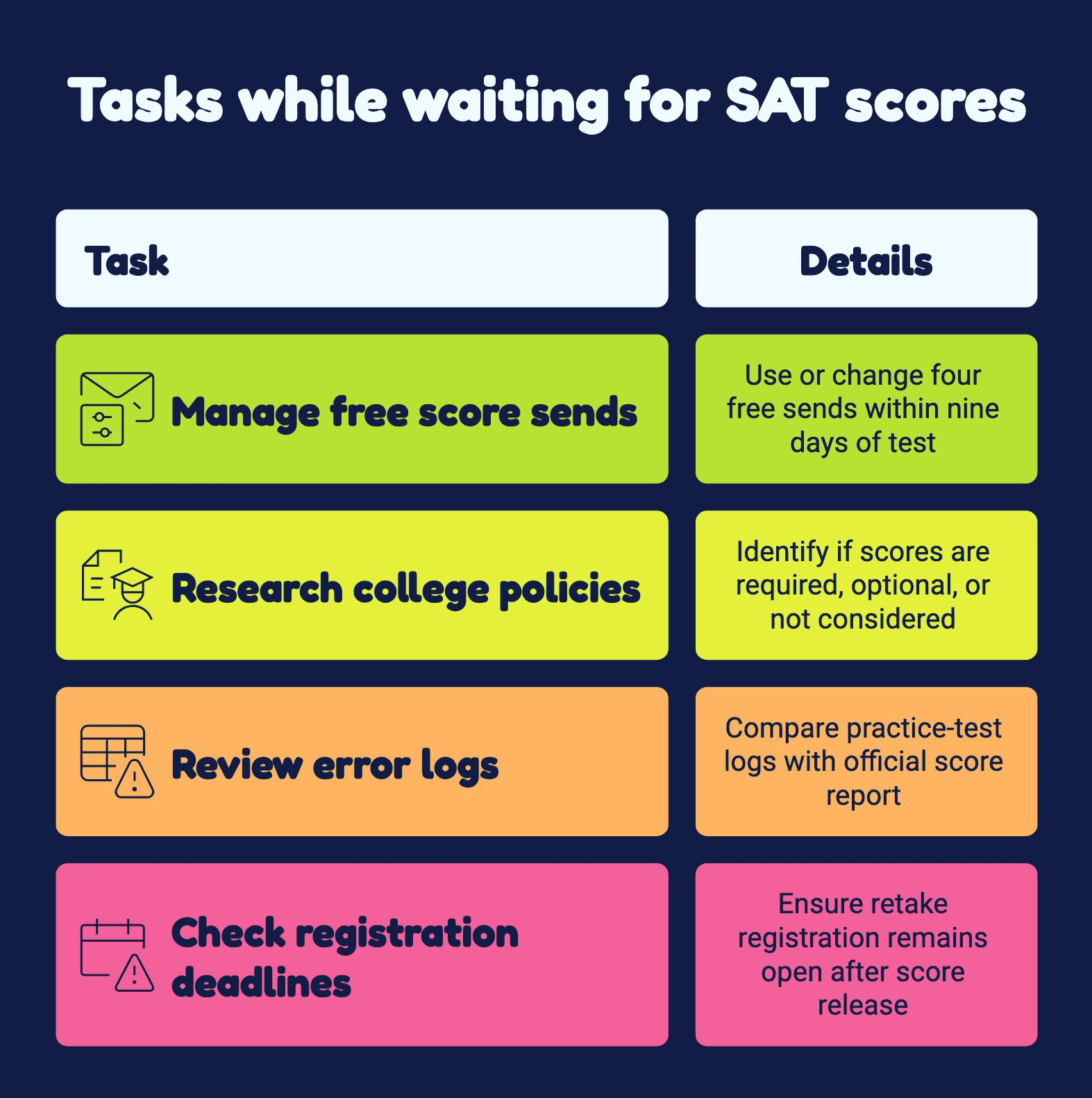
College Board says most weekend scores are released two to four weeks after test day. The wait is short enough to use well:
Decide on your free score sends before the nine-day window closes. Each weekend registration includes four free sends, and they can be used or changed until nine days after the test.
Write down your college list and each college's score policy: required, optional, or not considered.
Save your practice-test error logs so you can compare them with the official report.
Check the registration deadline for the next SAT so the calendar does not close a retake before you have seen your score.
Release dates change each cycle, so NAT publishes a timing guide for each one. The September 2026 SAT scores guide covers the current cycle.
Earlier cycles are archived in NAT's August SAT scores guide and its August 2025 score release post.
Compare your score to your college list
Compare your score with the middle range of admitted students at each college on your list, not with the national average. A national number tells you how you rank among all test takers, while a college's range tells you how you compare with the students it actually admits.
College Board gives the national context: the average SAT score is around 1050, and a 1350 or higher is in the top 10 percent. It also points students to BigFuture for college-specific averages, and many colleges publish their middle range on their admissions pages. NAT's guide to what counts as a good SAT score explains how those ranges shift by college tier.
Place your score against each college's middle range, then sort the list into three groups.
Where your score lands | What it usually signals | Your next move |
|---|---|---|
Above the college's middle range | Your score supports the application | Plan your send, and consider stopping testing |
Inside the middle range | Your score is competitive for that college | Retake only if a specific section or goal justifies it |
Below the middle range | Your score may pull the application down | Go to the retake decision, or check whether the college is test-optional |
Most students end up with a mixed list, with a score that sits above the range at some colleges and below it at others. That mix is normal, and it is why the retake decision depends on which colleges matter most to you.
Retake or move on? The decision framework
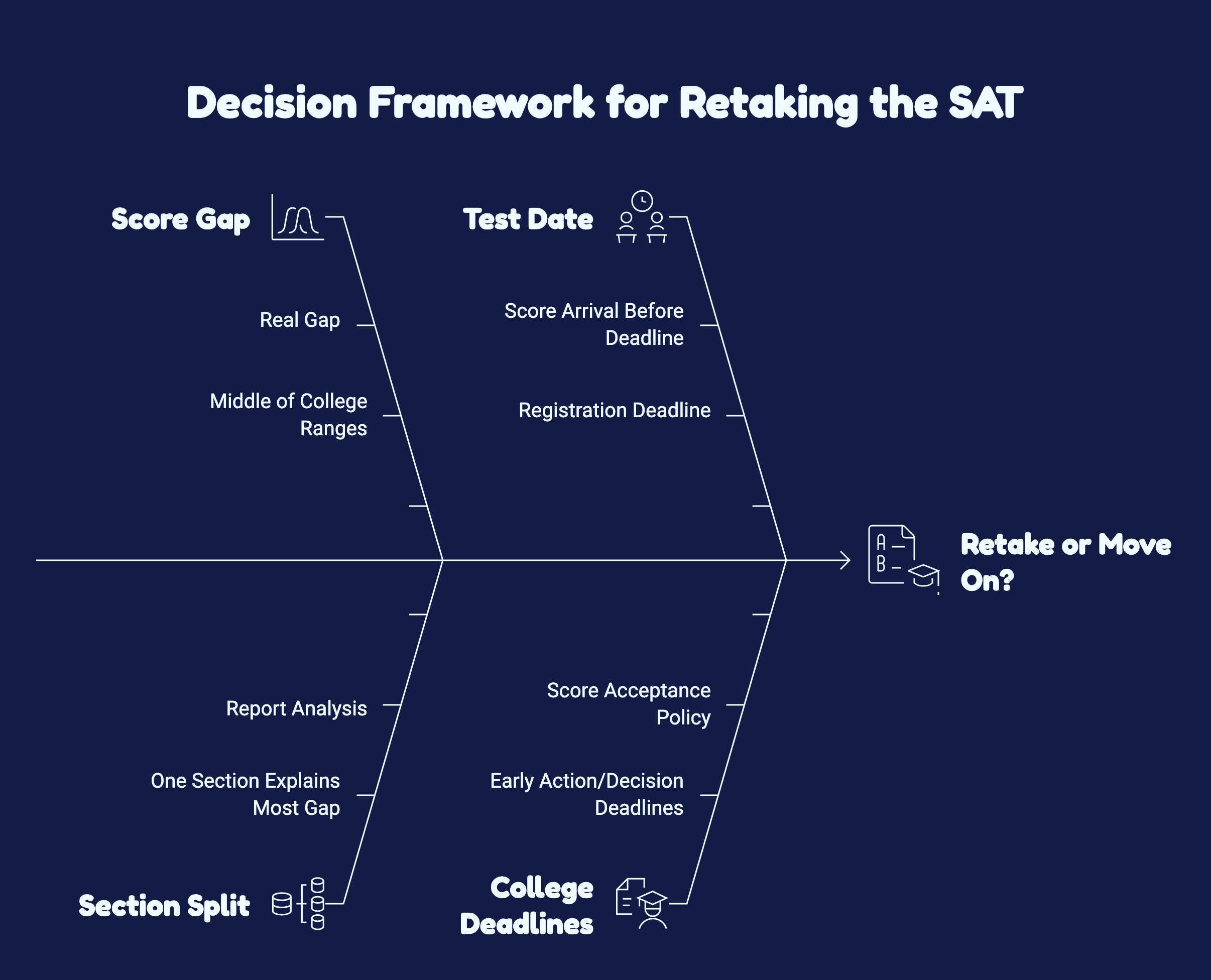
Retake the SAT when three things line up. You need a real gap between your score and the middle of your colleges' ranges, one section or skill area that explains most of that gap, and a test date whose score arrives before your deadline. If any of the three is missing, you usually get better results by spending your time elsewhere.
The gap comes from the benchmarking you just did. The section split comes from the report. The deadline is arithmetic: take the next test's registration deadline, then add the time for scores to arrive, which is about two weeks, since each fall 2026 weekend release lands 13 days after the test. Colleges set their own Early Action and Early Decision deadlines, so check each admissions page for the exact date and for whether it accepts scores that arrive after it.
Your situation | Lean | Why |
|---|---|---|
Well below your colleges' range, and one section explains most of the gap | Retake, with prep aimed at that section | A single-section fix is the most direct route to a higher total |
Below range, and both sections trail | Retake only if the calendar allows a full prep cycle | Repairing two sections takes more time than repairing one |
Slightly below range, sections balanced | Weigh the time cost against the rest of your application | A small gain may not change your list of realistic colleges |
Inside or above your range | Move on | The hours are worth more on essays and activities |
A deadline arrives before the next score release | Apply with the score you have | No retake can reach the college in time |
Read the table from top to bottom and stop at the first row that describes you.
Retaking carries less risk than many families assume. College Board says students can take the SAT as many times as they want, and its superscoring guide adds that colleges do not look unfavorably upon retaking. The risk is not in the extra attempt. The risk is repeating the same preparation and expecting a different result.
Families who ask Alexander Joseph whether to retake tend to get a question back. He scored a perfect 1600 on the SAT and a 524 on the MCAT, and he has tutored the SAT and MCAT for over six years across roughly 100+ students. He is now an M2 at Brown's Warren Alpert Medical School after graduating summa cum laude from Northeastern University.
A first score can be the starting point for that decision. Eli A's first official SAT was a 1360, with 660 in Math and 700 in Reading and Writing, after a few weeks of foundational work with NAT tutor Frances O'Grady that included a missed-questions log. He then moved to advanced diagnosis with tutor Zachary Wagner and reviewed official Digital SATs #8 through #10. He scored a 1500 on a final practice test and a 1510 on the June SAT, with 760 in Math and 750 in Reading and Writing.
Some students find that the ACT suits them better. NAT's guide to choosing between the SAT and ACT compares practice scores using official concordance tables, and the SAT to ACT conversion chart shows the equivalents.
Book a free SAT strategy session to review your score report with an NAT tutor and leave with a retake decision and a plan sized to your deadlines.
If you're retaking, build the improvement plan
NAT's Score Stack Method organizes SAT preparation into four phases. Diagnostic Mapping identifies point-loss patterns by question type, module, and timing, and produces a written score leak report of the five to ten areas costing the most points. Concept Repair covers only those gaps, using real SAT questions from College Board materials and Bluebook practice tests. Module Strategy Training focuses on the adaptive structure of the digital SAT, and Test-Day Simulation uses full-length timed Bluebook tests with section-by-section debriefs.
How you spend those phases depends on how many weeks you have between your score and the next test date.
Weeks available | Where to spend them |
About 2 weeks | Diagnostic Mapping and Concept Repair on your single weakest section, with one timed practice set at the end |
About 6 weeks | All four phases, with Concept Repair getting the middle weeks |
10 weeks or more | All four phases, with extra Concept Repair and more than one full-length simulation |
Use the row that matches your calendar, not the one that matches your ambition.
NAT's September 2026 guide lays out a six-week version of this plan, week by week.
Steady structure beats cramming, and Avery H's case shows it. Her early practice test scored 1250. Weekly tutoring with NAT tutor Brian Min focused on timing and on fundamentals such as vertex form, discriminants, and circle geometry, and by late September she was consistently scoring in the 1400+ range on practice tests. Her first official SAT was a 1420, with 750 in Reading and Writing and 670 in Math.
Two NAT resources support the Math side of the plan. The Desmos tips save time in the calculator-allowed modules, and the one-page SAT math formula sheet covers the extras worth memorizing.
The guide to how many practice tests you really need keeps practice volume honest. Students who want a tutor to run the sequence can see how one-on-one SAT tutoring applies it.

If you're done: sends, superscoring, and test-optional strategy
If you have decided to stop testing, your next job is deciding which colleges receive the score. College Board's rules make that decision more flexible than most students expect.
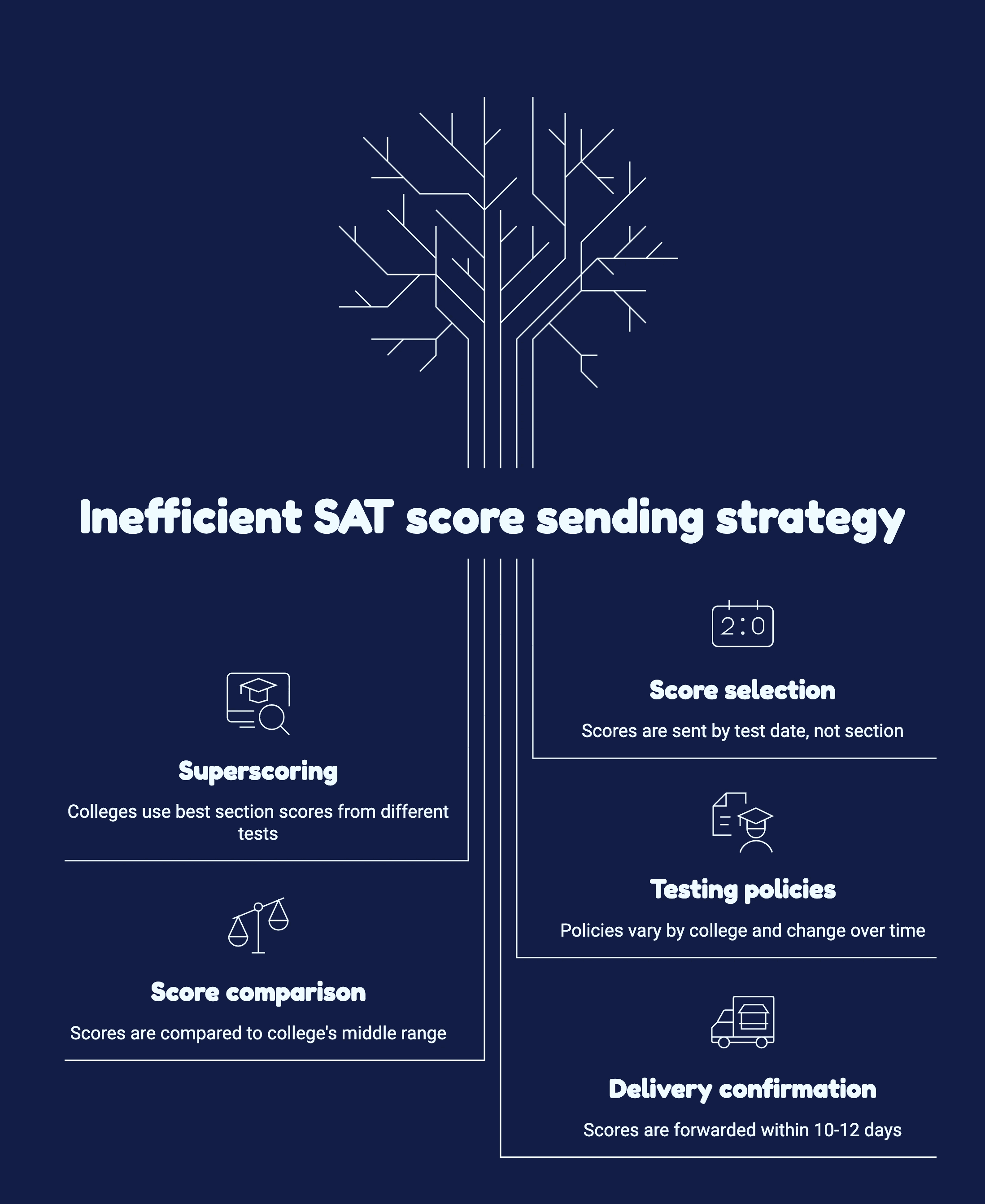
Each time you register for a weekend SAT, you can send your score to up to four organizations for free, and you have until nine days after the test to use or change those free sends. After that, College Board lists additional score reports at $15 each, with unlimited free reports for students with fee waivers. Fees can change, so confirm the amount before you order.
You choose scores by test date, and each date goes out as a complete result. You cannot send Math from one date and Reading and Writing from another. Superscoring is what some colleges do with multiple dates: colleges that superscore use your best section-level scores, even if they come from different tests. College Board adds that it varies by college, so review the score-use policy for each school on your list.
Testing policies differ as well. Some colleges require scores, many are test-optional, and some systems do not consider them at all: the University of California says it does not consider SAT or ACT test scores when making admissions decisions. Policies change from one admissions cycle to the next, so check each college's current page.
At a test-optional college, a good approach is to compare your score with that college's middle range. Sending your score can strengthen your application if it sits at or above the middle. If your score falls below the range, you may choose to apply without it where the policy allows.
Use this checklist for every college on your list:
Confirm whether the college requires, accepts, or ignores SAT scores.
Compare your score with the college's middle range.
Check whether the college superscores or considers all test dates.
Use your free sends first, and add paid reports only where the plan calls for them.
Confirm delivery, since College Board says it forwards scores to your selected colleges within 10 to 12 days after they are released.
Run those steps in order and no college gets a score you did not choose to send.
NAT's step-by-step guide to sending SAT scores to colleges walks through the process in more detail.
What to do with your score, by score band
The right next step depends on where your score sits, so this table sorts the decision by band. Each row pairs the decision logic with a verified NAT example where one exists.
Score band | Decision logic | Plan | NAT case |
|---|---|---|---|
1200 to 1390 | A targeted retake often makes sense when one section trails and a deadline allows it | Concept Repair on the weaker section, then timed practice | Eli A: a first official 1360 to a 1510 |
1400 to 1490 | Depends on your list. You may be inside the range at some colleges and below it at others | Fix the section holding the total back, and add timing work if Module 2 pacing slips | Avery H: a first official 1420 |
1500 and above | Usually the done-testing band, unless a specific goal still matters | If you retake, hunt execution errors rather than new content | Guntas S: a 150-point gain to a 1560 |
Find your band, then read its row before you read anything else in this section.
NAT's guide to what the lowest SAT score means is worth reading if your score is in the first row, because low scores can be improved with targeted preparation.
If Reading and Writing is the lagging section
After scoring a 1570 on the SAT, Gia Kim went on to study Chemistry and Chemical Biology, with a minor in English, at Cornell University. She has tutored for three years, working with roughly 150+ students. Her guidance on Reading names one habit that costs strong students points.
If your Reading and Writing score trails your Math score in any band, pull five missed questions and check whether each answer was proven by a line in the passage or only sounded right.
The 1500 and above band
High scorers gain by removing execution errors. Guntas S made a 150-point gain to a 1560, with 790 in Math and 770 in Reading and Writing. His NAT tutor, Brian Min, worked with him on silly mistakes and recurring weak spots in advanced algebra and geometry, and he scored a 1570 on one of his final Bluebook tests. His case study's advice for test day is simple: do nothing the day before, warm up on test morning, and walk in with clarity.
Mistakes students make after getting their score
Most post-score mistakes come from acting on the number before reading the report. These six are common, and each has a simple fix.
Mistake | Why it costs you | Fix |
|---|---|---|
Sending scores to every college right away | Free sends cover four recipients, and extra reports cost money | Match sends to each college's policy and your score against its range |
Retaking without changing the diagnosis | The same preparation gives you the same information twice | Sort the missed questions by cause before choosing a study plan |
Treating one official score as a final verdict | A single sitting has normal variation, and the report shows where points went | Use the score range and domain breakdown to set the next step |
Assuming test-optional means scores never matter | At a test-optional college, a strong score can still help your application | Compare your score with the college's middle range before deciding |
Fixating on the total | Two students with the same total can need very different plans | Start with section scores and Knowledge and Skills |
Expecting practice scores to match automatically | Practice taken without real timing can misjudge your level | Take full-length, timed Bluebook tests before judging your level |
How an SAT tutor analyzes a score report
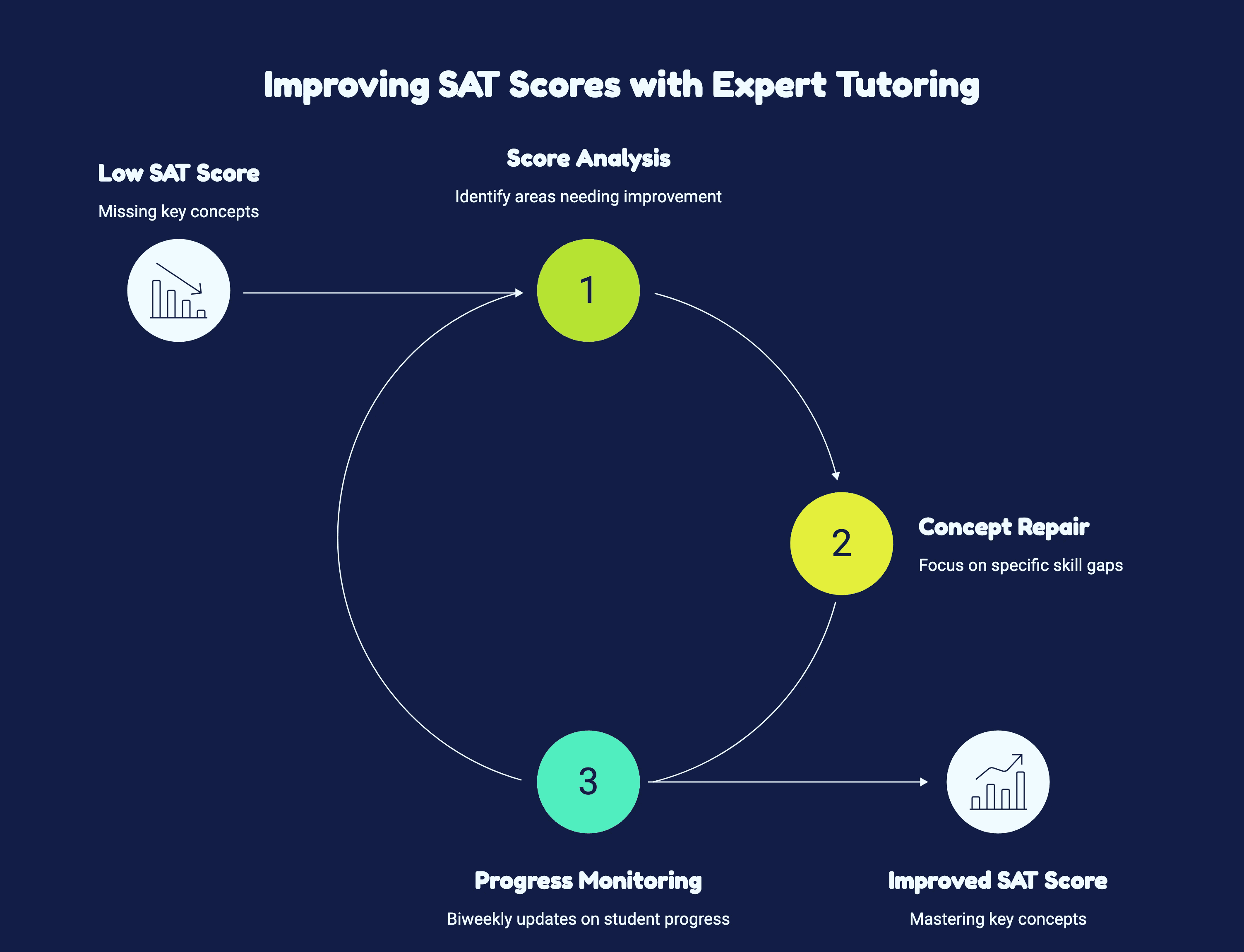
A tutor's first job is to read your report the way you just did, but faster and with more context. In NAT's Score Stack Method, that first phase produces the written score leak report, which names the five to ten areas costing you the most points. Concept Repair then covers only those gaps, and parents receive biweekly progress reports.
The three tutors quoted in this guide read a report differently. Wanning Lu sorts Math misses by cause, Gia Kim starts Reading and Writing with the evidence in the passage, and Alexander Joseph frames the retake decision around the gap, the section, and the calendar. NAT matches each student with one of our SAT tutors, and tutor changes are free if the fit is wrong.
Parents often ask whether a tutor is worth it after a score is already in. It depends on the gap and where it sits, and no honest tutor can promise a number. What a tutor adds is the diagnosis of why questions were missed, and the leak report and bi-weekly updates let you see whether the right areas are moving. Families comparing cost can review NAT's SAT tutoring pricing.
Turn your score into a plan
The steps run in a fixed order. Read the report by section and domain, benchmark the score against your college list, decide on the retake with the gap, section, and calendar in view, and then plan or send.
Need someone to review your score report? Book a free SAT strategy session with an NAT tutor to find the areas that cost you the most points, and leave with a plan you can act on. The tutors quoted in this guide scored between 1570 and 1600 on the SAT. The session is free and no-pressure, and you can meet your tutor before you commit to a paid session.