SAT Tutor for 1500+: What Changes When You Score 1400

A 1400 is a strong score, and that is precisely what makes it frustrating. You are close enough to see 1500, yet the study habits that carried you this distance have stopped producing points. The next 100 points rarely come from working harder. They come from fixing a small number of specific errors that general prep never touches.
If your October 2026 SAT score lands near 1400, a November SAT retake is probably on your mind, and that is the situation this guide addresses. Families searching for a SAT tutor for 1500+ are usually right about one thing: a specialist, not another review book, is the likely answer. This guide explains what changes at this level, how an elite SAT tutor works, and how to use the November SAT 2026 date and the December 5 date well. The NAT tutors quoted here scored between 1540 and 1600 on the SAT, so they know this territory from the inside.
Why 1400 is the hardest score to leave behind
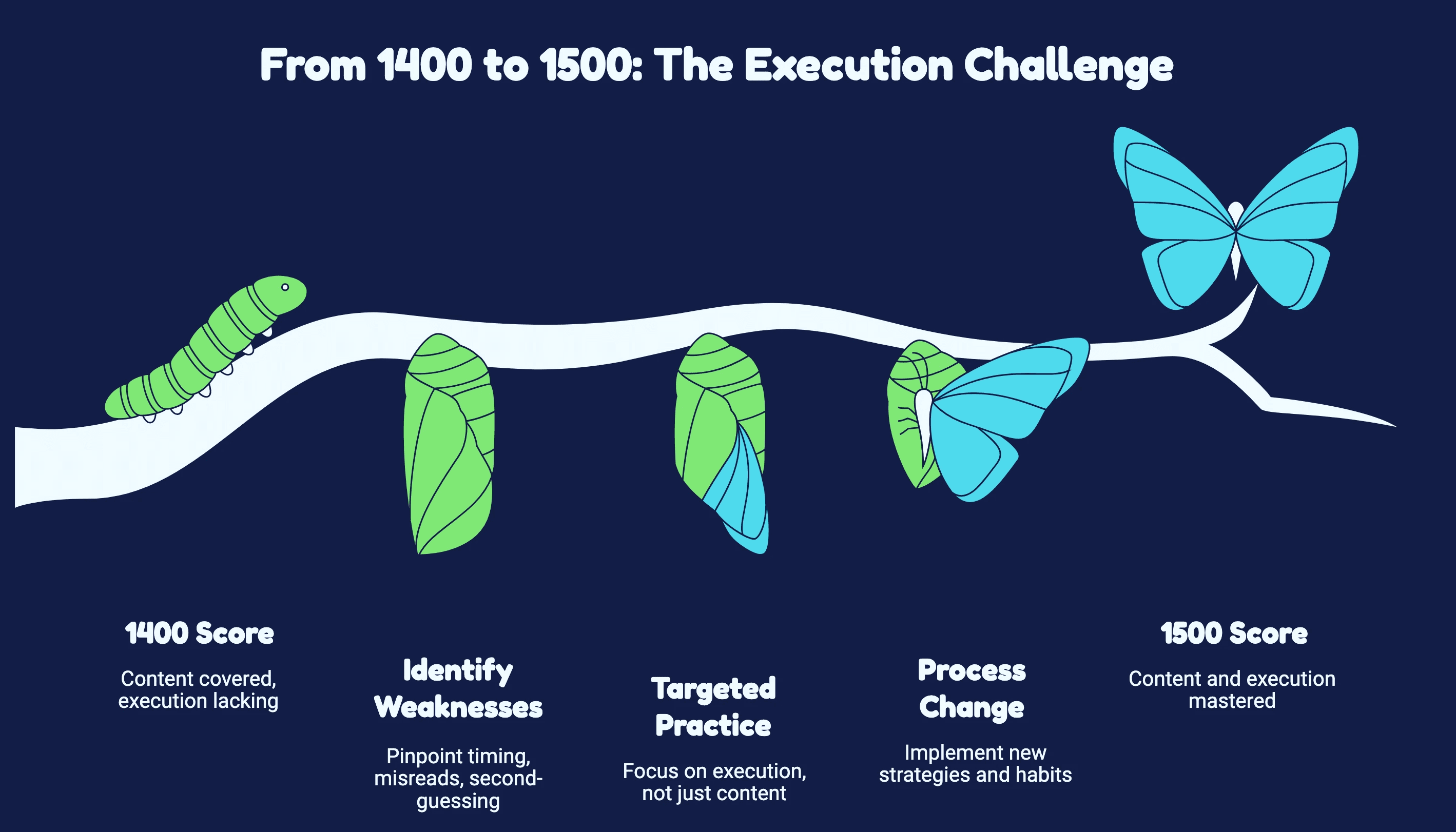
The climb from 1200 to 1400 is mostly about coverage. You learn the content, practice enough, and the score rises. Improving from 1400 to 1500 works the opposite way, because almost all of the content is already in place and the remaining points are hidden in execution.
At 1400, you are usually not missing whole topics. You are losing a handful of points per section to timing, misreads, and second-guessing. Those losses are small, repeatable, and nearly invisible to a student studying alone, which is why the score can sit still for months.
Part of the stillness is also statistical. College Board's score report includes a score range, which shows how much your scores would likely vary on a different administration of the test under identical conditions. A 1400 on one Saturday and a 1430 on the next may reflect the same student with the same habits. Real movement needs a change in process.
There is a psychology trap too. High scorers practice what they are already skilled at because it feels productive. A student who drills familiar material all week can finish feeling sharp and still score the same on test day.
The specific errors that hold high scorers back
Plateaus at this level come from a short list of predictable mistakes. See how many you recognize.
Error | What it looks like | The rule that fixes it |
|---|---|---|
Time sink | You refuse to abandon a hard question and rush the last ones in the module | Flag it, move on, and return only if time remains |
Answer changing | You change a correct answer during review because you doubt reasoning that was already sound | Change an answer only when you can state the specific reason in one sentence |
Misread clause | You miss one clause in a dense passage and lose an easy point | Mark what the question asks before you read the choices |
Skipped check | You skip a check step in math on a problem you actually know | Reread the question and plug your answer back in before you move on |
None of these is a knowledge gap. Each is a decision-making error, and decisions are coachable. The work is less about teaching new content and more about installing rules that hold up under time pressure. On the digital SAT, early slips also carry extra weight, because Module 1 accuracy shapes the module that follows.
Zachary Wagner scored a 1540 on the SAT, with 790 in Reading and Writing and 750 in Math, and earned seven perfect AP scores of 5. He studies Operations Research and Financial Engineering at Princeton University, has tutored for 5 years, and has worked with roughly 100+ students. He took over Eli A's preparation in a second phase built around diagnosis over repetition, which is the approach he describes for a student who already knows the material.
What an elite SAT tutor does differently
An elite SAT tutor does not start with a curriculum. They start with your last two or three score reports and your marked-up practice tests, then rebuild your test-day decision process.
Expect a tutor at this level to study your timing as closely as your accuracy. They will ask which questions you flagged, how long you spent on them, and what you told yourself before changing answers. The pattern behind your misses matters more than any single wrong answer.
They will also teach you to protect easy points. At 1400, most students lose more points to avoidable slips than to genuinely hard questions, so a good tutor builds check habits and question-selection rules before touching advanced content. NAT's Score Stack Method follows this order. It opens with Diagnostic Mapping, where the tutor identifies point-loss patterns by question type, module, and timing, and it closes with Test-Day Simulation on full-length timed Bluebook tests.

Finally, an honest tutor sets a target that matches your timeline. A march to 1500 in four weeks looks different from a two-month plan, and the tutor should say so.
Alexander Joseph scored a perfect 1600 on the SAT and a 524 on the MCAT. He graduated summa cum laude in Biochemistry from Northeastern University and is a second-year student at Brown University's Warren Alpert Medical School. He has tutored the SAT and MCAT for more than six years, working with roughly 150+ students, and his page describes a methodical, frameworks-first approach.
Why grouped courses and apps fail at this level
Group test prep courses are for the middle of the distribution. They pace themselves to fill big content gaps for many kids at one time. If your gaps are small and personal, you don't have much time in a group setting to spend on the two things costing you points.
From the other direction, apps have a similar limit. They can ask questions to test you, but they can't watch you think. They won’t know that you rushed the last five questions in Reading or over-invested in a single math problem. A private SAT coach sees the process, not just the answer.
High scorers, in fact, have problems with generic tools. The other problems are so specific that another person watching your work is usually the fastest way to name them! For this level, a SAT tutor is often the best option for score improvement.
What changes in the first 1500+ diagnostic session
The first session of private SAT tutoring at this level should feel like an evaluation, not a lesson. You bring your scores, your practice tests, and your goals, and the tutor searches for the pattern behind the plateau. NAT's SAT page describes this stage as the first one to two sessions of Diagnostic Mapping.
You should leave with three things.
A ranked list of the errors costing you the most points.
A realistic target for the next test date, whether that is November 7 or December 5.
A weekly plan with timed checkpoints, so you can see whether you are on track.
If a tutor starts selling lessons before diagnosing, treat that as a warning sign. At this level, the value lies in the diagnosis. A good first session tells you what is broken and whether it can be fixed in your window.

SAT tutoring for high scorers: the sprint before November 7
With a November 7 test date, you have a short runway, so focus beats volume. College Board lists October 23 as the registration deadline for the November 7 SAT, with late registration through October 27 and additional fees. Counting back from test day, here’s how a four-week sprint can run.
Counting back from November 7 | Focus |
|---|---|
Four weeks out (by October 10) | Diagnosis: rank your top two error patterns from your score reports and marked-up tests |
Three weeks out (by October 17) | Repair: build and drill one fixing rule for each pattern, under timing |
Two weeks out (by October 24) | Full timed Bluebook modules, and review every timing mistake as carefully as every content mistake |
Final week (October 31 to November 6) | Pacing, light review, and sleep. Do not learn new material |
If you start after October 10, compress the plan instead of skipping steps, and keep the diagnosis first. Learning new material in the last week usually adds anxiety without adding points. This is also the structure that makes a November SAT tutor or SAT retake tutor useful: a short, defined list of fixes with checkpoints. Anything open-ended in four weeks tends to turn into more of the same practice.
If you are aiming at the December 5 sitting
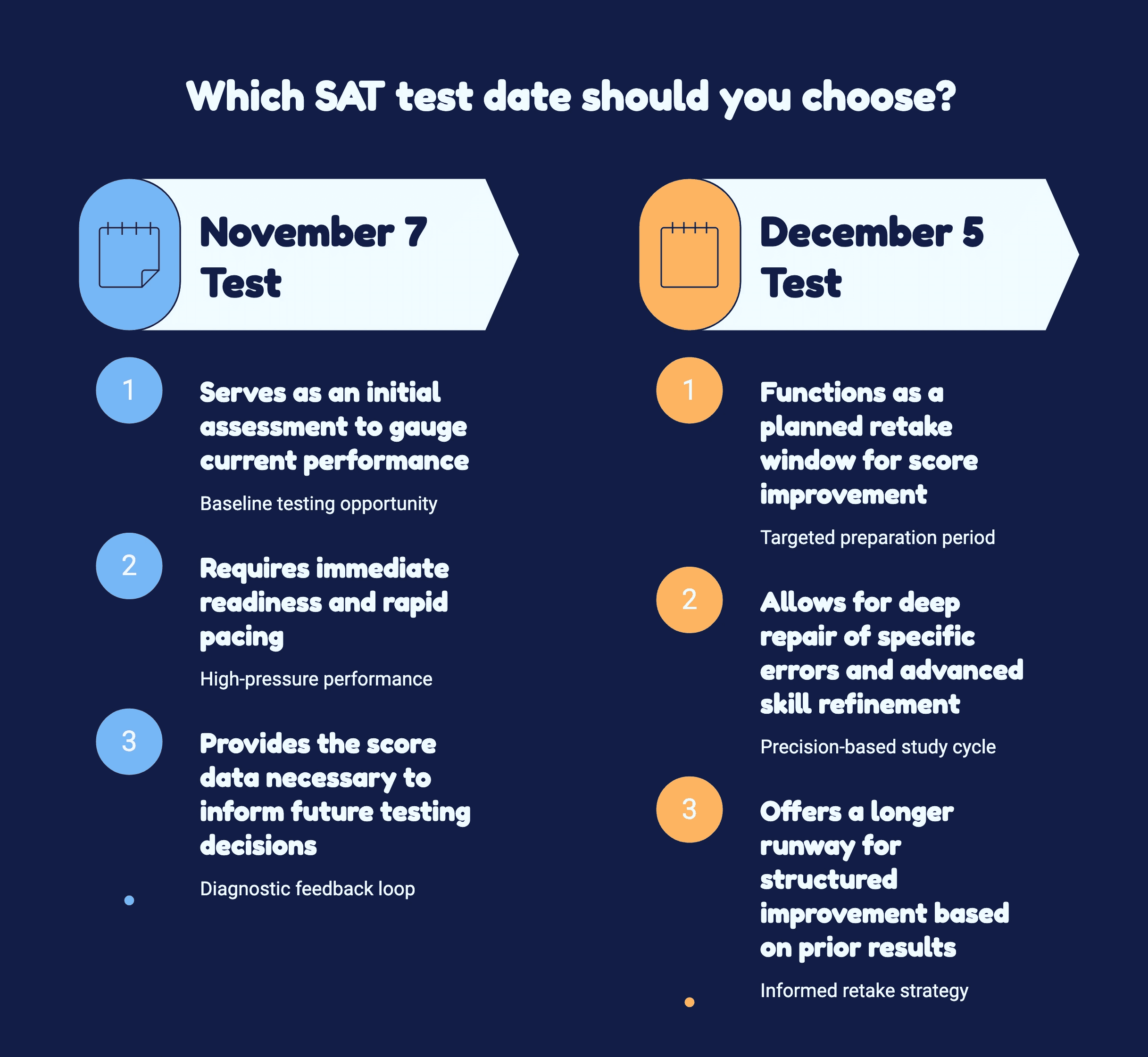
The December 5 test date buys more room, and that changes the strategy. You can afford a deeper repair of the two or three errors that have been capping your score, plus a full cycle of timed practice to lock in the gains. College Board's schedule shows registration for December 5 closing November 20, with late registration through November 24 and additional fees, and scores arriving December 18.
One detail helps students decide between the two dates. November 7 scores arrive on November 20, the same day that registration for the December 5 test closes at 11:59 p.m. ET. That means you can test in November, see the result, and decide on December with the score in hand. Think of December as a planned SAT retake preparation window, not a panic option.
Use the extra time for precision work: advanced reading inference, the hardest grammar edge cases, and multi-step math under strict timing. Then rehearse pacing until test-day stress cannot pull you back into old habits.
More time only helps if it is structured. Eli A's first official SAT was a 1360, and it took about six months for him to move to a 1510 on the June SAT. His preparation included a "missed questions" log, a second phase with tutor Zachary Wagner that emphasized diagnosis over repetition, and a review of official Digital SATs #8 through #10. A longer runway with no diagnosis just produces more of the same score.
Chasing 1550: precision at the top of the range
The difference between 1500 and 1550 is usually just a few questions. Tutors tend to find it in two places: the hardest questions near the end of each module and a careless-error rate that has to stay near zero. A 1550 SAT tutor focuses on exactly that margin. At this level, protecting three easy points matters as much as cracking one hard one. NAT's guide on whether a 1600 is worth chasing covers the question at the very top.
Guntas S moved from the 1400s to a 1560, a 150-point gain, with 790 in Math and 770 in Reading and Writing. His NAT tutor, Brian Min, began with the "silly mistakes" in math. The first phase also covered advanced algebra and geometry topics such as parabolas, functions, and similarity, plus vocabulary-based reading questions and grammar structures such as modifiers and participle phrases. A second phase focused on strategy, timing, and practicing under pressure, and he scored a 1570 on a final Bluebook practice test. The work ran from July through September, and his test-week routine was to rest the day before and warm up on test morning.
Brian Min scored a 1570 on the SAT with a perfect 800 in Math, and he graduated summa cum laude and Phi Beta Kappa from Columbia University. He has worked as a college admissions mentor and academic tutor for more than six years, with roughly 100+ students. He sees the final stretch as a question of process more than content.
Be realistic as well as ambitious. A move from 1400 toward 1500 is achievable with the right process and enough time, and Guntas's 150 points shows it can happen. A move to 1550 depends on your starting point, your timeline, and how cleanly you execute under pressure.
Research on test preparation is a useful caution. Derek Briggs's review for the Encyclopedia of Education found that test preparation has a statistically significant effect on score changes for students who test at least twice, but that the effect is small, and Education Week has reported that coaching generally produces only modest score improvements. Both sources predate the digital SAT, so read them as a caution against promises. A good tutor gives a conditional, honest estimate.
SAT tutor for top colleges: matching the score to your list
Your target score should come from your college list, not from a round number. A SAT tutor for top colleges starts with what your schools actually expect, then works backward.
That matters more this cycle because testing requirements have tightened. Six of the eight Ivy League schools now require scores, and the table shows where each stands.
School | Testing status | Source |
|---|---|---|
Harvard | SAT or ACT required | |
Yale | Applicants required to submit ACT or SAT scores, announced May 2026 | |
Dartmouth | Required, with results from multiple administrations super-scored | |
Brown | Required beginning with the Class of 2029 | |
Cornell | Required for first-year applicants | |
Penn | Required for fall 2026 admission and after | |
Princeton | Test optional for fall 2027 enrollment, required from the 2027-28 cycle |
Columbia is the other Ivy League school that remains test-optional, according to NAT's guide on why a 1480 no longer gets you into Harvard.

Why would schools bring tests back? One large study of Ivy-Plus colleges found that standardized test scores predict academic outcomes with a normalized slope four times greater than high school GPA. The authors concluded that scores provide information about academic preparation that the rest of the application file does not. For a student targeting that tier, a 1400 can be acceptable in isolation and still sit below the middle range. NAT's analysis puts the middle 50 percent at Harvard for the Class of 2029 at 1510 to 1580.
The right target is specific. Consider a student whose list includes one school that superscores and one that does not. The first school may be satisfied by lifting one section to 780 across two dates, and the second may expect a single strong test. Dartmouth says it will super-score results from multiple administrations, and Yale says applicants may report their highest section scores from across multiple test administrations. A strong tutor helps you find the number each school implies and then builds a plan to reach it.
How to choose an elite SAT tutor
You are hiring a specialist for a short, high-stakes window, so choose with the same care you would for any expert. NAT's broader guide to choosing the right tutor for SAT, AP, and college applications covers the general checklist. For a 1500+ target, ask these questions.
How will you use my existing score reports? A strong answer finds your specific error patterns, not a preset syllabus.
How will progress be measured before test day? Look for timed checkpoints and a clear definition of "on track."
What is your availability before November 7 or December 5? Consistent weekly sessions matter more than a long first week.
What will the final week look like? It should cover pacing, light review, and rest.
What can I realistically expect? Be wary of anyone who guarantees a number and prefer a specific, conditional estimate.
What happens if the fit is wrong? NAT offers free tutor changes, and you can start with a free strategy session before committing.
Expertise should be verifiable. NAT works with tutors from leading institutions, and each tutor's credentials are published on their profile. Browse NAT's SAT tutors and see why a high scorer plateaus, not just that they do.
Find out what stands between you and 1500
If you already score 1400, the next step is not more practice. It is a precise diagnosis of the few errors costing you the most points, matched to the November 7 or December 5 test date that fits your timeline. Bring your score reports and your marked-up practice tests, and a tutor can read them with you against your college list.
At a free strategy session with North American Tutors, you leave with a ranked list of the errors costing you the most points and a realistic target. Sessions are one-on-one, and NAT offers free tutor changes if the match is not right.