October SAT Scores Come Out October 16: When a Private SAT Tutor Is Worth It for the Retake

October SAT scores 2026 post on Friday, October 16, and for many students the number on the screen settles nothing. You can accept the score, or you can use the November SAT 2026 date to go after the result you actually need. The October SAT score release leaves about three weeks before test day, so you have to decide quickly and for the right reasons.
The useful question is not "should I retake?" It is "what exactly cost me points, and can that be fixed by November 7?" A private SAT tutor earns the cost in some situations and wastes it in others, and parents deserve a straight read on which is which. The NAT tutors quoted here scored between 1570 and 1590 on the SAT, and they treat a score report as a diagnosis, not a verdict. What follows takes you from release day to a retake decision and then to a plan.
What your October SAT scores 2026 are really telling you
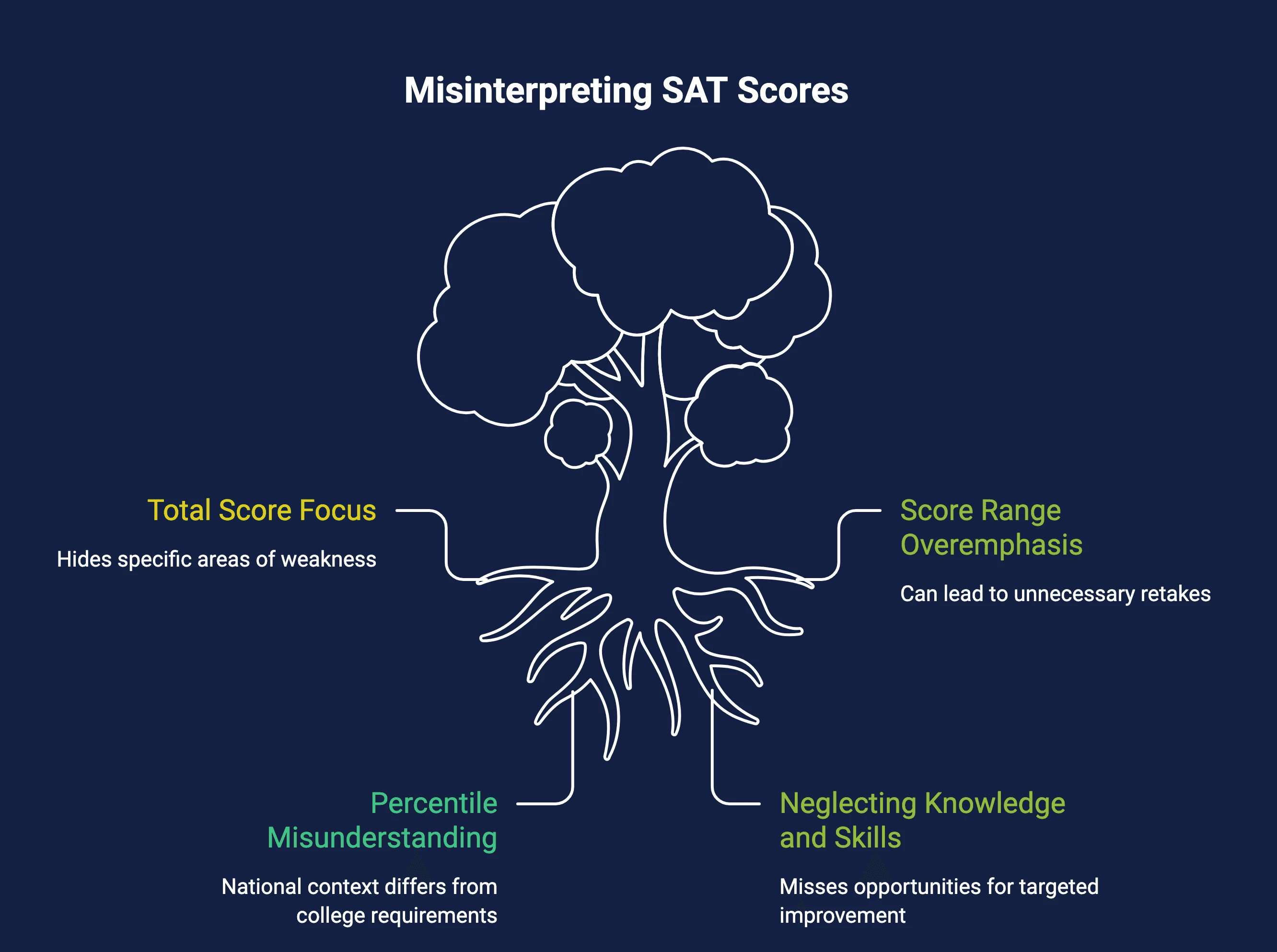
A single score hides the story behind it. A 1230 built on careless mistakes in easy questions is a different problem from a 1230 built on missing algebra or grammar knowledge, and the total cannot tell you which one you have. College Board's score report shows three scores, a total and one each for Reading and Writing and for Math, along with a score range, percentiles, and a Knowledge and Skills graphic covering eight content areas, four in each section.
Report element | What it shows | How to use it for a retake decision |
|---|---|---|
Total and section scores | The total, plus Reading and Writing and Math separately | Shows whether one section or both trail your target |
Score range | How much your scores would likely vary on a different administration under identical conditions | A reason not to over-read a small gap between your score and a target |
Percentiles | How you compare with other students who took the same test | National context, which is different from a college's own score range |
Knowledge and Skills | Your performance in eight content areas, four per section | Where a plan begins, because it shows where the misses cluster |
Open the detailed report, not just the total. If your misses concentrate in one or two content areas, you have a specific, teachable weakness. If they scatter across all eight, suspect pacing, stamina, or test-day execution.
Consider a student who scored 1320, with 700 in Math and 620 in Reading and Writing. If the Reading and Writing misses cluster in two content areas, that student has a section-level repair job. If the Math misses pile up in the last third of each module, test pacing first. The digital SAT adds one wrinkle, because Module 1 accuracy shapes the module that follows, so early slips cost more than they appear to.
Was October your first attempt or a repeat? A flat repeat score after serious preparation says something different from a first attempt: the study method, not the effort, needs to change.
Frances O'Grady scored a 1580 on the SAT herself, then earned a B.A. in English while working as a peer writing instructor. She has tutored for more than four years, mostly focused on SAT preparation, and has worked with roughly 150+ students. Her advice for reading a score report is short.
Should you retake? Reading the November SAT 2026 calendar
Retake in November when the gap to the middle of your colleges' score ranges is real, when a specific problem explains most of it, and when the November 7 date fits your deadlines. A score already inside your range rarely needs another attempt.
The dates determine how much preparation you have. College Board's published schedule gives these deadlines and release dates for the fall 2026 tests.
Test date | Registration deadline | Late registration deadline | Student score release |
|---|---|---|---|
October 3, 2026 | September 18 (closed) | September 22 (closed) | Friday, October 16 |
November 7, 2026 | October 23 | October 27 (additional fees apply) | Friday, November 20 |
December 5, 2026 | November 20 | November 24 (additional fees apply) | Friday, December 18 |

College Board lists October 23 as the registration deadline for the November 7 SAT, with late registration through October 27 and additional fees. Both deadlines expire at 11:59 p.m. ET. October scores arrive 22 days before test day and one week before the standard registration deadline closes, which leaves little time for second thoughts.
Check three things before you commit.
Your registration window. Decide by October 23 to avoid the late fee. The free score sends that come with your October registration also close earlier than most students expect, nine days after the test, which for the October 3 test was October 12.
Your college deadlines. November 7 scores release on November 20, so any deadline before that date cannot count a November SAT unless the college accepts later scores. Policies differ. Yale, for example, says SAT exams completed in October or November are generally available for consideration in its Single-Choice Early Action round. Georgetown asks that all tests be taken by January of senior year so results reach it by early February.
Your colleges' superscoring policies. College Board notes that some institutions use superscoring, which means they consider your highest section scores across multiple test dates. You cannot send Math from one date and Reading and Writing from another, because College Board sends the scores from an entire SAT, so the college does the combining. Yale says applicants may report highest section scores from across multiple test administrations.
Many colleges look at your highest score, and researchers have noticed what that does to behavior. A study of three selective universities found that using only the highest submitted score provides large incentives to retake the test. That is not a reason to retake. It is a reason to check how your colleges handle multiple scores before you spend three weeks on one.
Your situation | Lean | Why |
|---|---|---|
Below your colleges' range, and one section explains most of the gap | Retake, with prep aimed at that section | A single-section repair is the most direct route to a higher total |
Below range, and both sections trail | Retake only if you can start preparing this week, or aim for December 5 | Two sections need more time than three weeks usually gives |
Inside or above your colleges' range | Stop testing | The hours are worth more on essays, activities, and coursework |
Your colleges superscore | A retake of the weaker section can help | A strong section can lift the combined score even if the total moves modestly |
A deadline falls before November 20 | Apply with the score you have, unless the college accepts later scores | No November result can arrive in time otherwise |
Read the table from top to bottom and stop at the first row that describes you. NAT's guides to how to send SAT scores to colleges and what counts as a good SAT score cover the sending rules and the benchmarks in more depth.
When a private SAT tutor is worth it for the retake
A private SAT tutor is worth it when something other than missing effort is holding your score down. More practice doesn't help a student who is practicing the wrong things the wrong way. These are the situations where one-on-one help is most effective.
You have a concentrated content gap. If your October SAT score report shows weakness in a specific content area, such as linear equations, comma rules, or data analysis, a skilled tutor can rebuild that foundation faster than a review book can.
You have plateaued. If you already studied hard and stayed flat, you need a diagnosis, not more volume. A SAT tutor for score improvement watches how you solve problems, finds the reasoning that breaks under time pressure, and replaces it.
You are aiming at a specific target. If you need a 1450 and scored 1320, the gap calls for strategy, not just effort. A tutor works backward from the target to the skills and pacing you need.
You lose points to timing or nerves. A tutor can simulate real conditions and teach decision-making on challenging questions, so you stop losing points you already know how to earn.
You have very little time. Three weeks is enough for focused private SAT tutoring on one or two diagnosed gaps. It is not enough for an unstructured solo scramble.

Uju Kim scored a 1590 on the SAT and a 35 on the ACT, then graduated with honors from Northwestern University in Neuroscience, with a minor in Computer Science. He was elected to Phi Beta Kappa, has four years of volunteer tutoring experience, including standardized test preparation, and has worked with roughly 150+ students. His view fits the student whose problem is the clock, not the content.
When a private SAT tutor is not worth it
Honesty saves money. A private SAT tutor is often the wrong first move when your October score already sits near your personal ceiling after months of serious preparation. After that point, more tutoring yields diminishing returns, and you may be better off spending your time on essays, course rigor, or the rest of your application.
Research on test preparation points the same way. Derek Briggs, writing in the Encyclopedia of Education in 2001, found that test preparation has a statistically significant effect on score changes for students taking the test at least twice. He wrote that the size of that effect is "minimal." He also warned that uncontrolled studies produce estimates four to five times larger than controlled ones. Education Week's coverage of later research reached a similar conclusion: coaching generally produces only modest score improvements.
Those studies predate the digital SAT and measure test preparation broadly, not NAT's one-on-one sessions, so read them as a caution about promises, not as a forecast for you. Tutoring may also not be worth it if the real barrier isn't the SAT at all. A student who is exhausted, over-scheduled, or simply does not want a higher score will not improve through sessions alone.
Be wary of any SAT retake tutor who promises a specific point gain before reviewing your October report. A credible tutor first diagnoses the student's needs and then estimates a potential score increase, while anyone who guarantees a specific number is selling, not teaching.
What a SAT tutor after a low score does in the first two weeks
Families searching for a "SAT tutor after low score" are really asking what the first sessions look like. They should look like an audit, not a regular lesson. NAT's Score Stack Method opens with Diagnostic Mapping, which its SAT page describes as the first one to two sessions in which the tutor identifies point-loss patterns by question type, module, and timing.
In week one, the tutor separates content gaps from strategy gaps and careless errors, then ranks them by how many points each is worth. By the end of that week you should have a written plan with a clear target, a weekly schedule, and checkpoints. If you cannot describe the plan back in your own words, ask for it in writing.
In week two, Concept Repair begins. The Score Stack Method has the tutor work through only the identified gaps, teaching the underlying concept and drilling it with real SAT questions. A timed mini-section at the end of the week confirms whether the fix held. With only 22 days between score release and test day, the plan has to exist by the end of week one, so do not wait for a perfect schedule before you start.

The difference between more practice and real SAT score improvement
Practice builds familiarity. Coaching builds precision. Most students who plateau have plenty of familiarity, and not enough precision, and volume without feedback just repeats the same mistakes at higher speed.
Real SAT score improvement tends to come from three changes. You learn to recognize question types quickly, so your mental energy goes to solving instead of decoding. You learn to choose your battles, flagging questions that cost more time than they pay back. And you build check habits that survive test-day stress, none of which come from doing more problems.
Eli A's first official SAT was a 1360, with 660 in Math and 700 in Reading and Writing. Working first with NAT tutor Frances O'Grady, his sessions covered vocabulary, grammar, equations, and timing, and he tracked errors in a "missed questions" log. His second phase, with tutor Zachary Wagner, emphasized diagnosis over repetition and reviewed official Digital SATs #8 through #10. He scored a 1500 on a final practice test, then a 1510 on the June SAT, with 760 in Math and 750 in Reading and Writing.
Two lessons carry over to a three-week window, and one does not. The missed-question log works at any speed: write down each miss, its content area, why it happened, and the fix. If you cannot say why you missed a question, you are guessing at your study plan. The timeline does not carry over, because Eli's 150-point gain took about six months, so a November SAT retake over three weeks should aim at one or two gaps.
NAT's guide to how many SAT practice tests you really need makes the same point about review: the work after the test matters more than how many tests you take.
Who private SAT tutoring fits best
Private SAT tutoring fits students who need diagnosis and accountability. It fits the student who understands the material in class but freezes on a timed test, and the student with one stubborn section and a short window to fix it.
It also fits families who want a clear answer instead of a guess. A parent facing the October SAT score release often wants to know whether the investment will address the real problem. A good tutor answers with a written plan and measurable checkpoints, and NAT offers one-on-one sessions with a free tutor change if the match is not right.
Private tutoring fits less well for students who only need light review or who already have a strong, working study system. In those cases, targeted self-study with official practice tests can be the smarter, lower-cost path.
Chasing a SAT tutor for 1500+
The 1500+ range is a different game. At that level, nearly every remaining point comes from precision, pacing, and the hardest questions in each module. A SAT tutor for 1500+ focuses on the material most students never master, including advanced grammar edge cases, dense reading passages, and multi-step math under strict timing.
Testing also matters at the top. When Harvard reinstated its testing requirement, Dean Hopi Hoekstra said that strongly predictive information is valuable for identifying talent, as The Harvard Crimson reported in November 2025. NAT's guide to what a good SAT score looks like for Ivy League universities puts those benchmarks in context.
Guntas S moved from the 1400s to a 1560, a 150-point gain, with 790 in Math and 770 in Reading and Writing. His NAT tutor, Brian Min, started with "silly mistakes" in math, advanced algebra and geometry, vocabulary-based reading questions, and grammar structures such as modifiers and participle phrases. A second phase focused on strategy, timing, and practicing under pressure, and he scored a 1570 on a final Bluebook practice test. That work ran from July through September, which is a longer runway than a November retake allows.
Brian Min scored a 1570 on the SAT with a perfect 800 in Math, and he graduated summa cum laude and Phi Beta Kappa from Columbia University with a B.A. in Economics and French Language and Literature. He has worked as a college admissions mentor and academic tutor for more than six years, with roughly [Y] students. For students already in the 1400s, he draws a clear line between what is hard and what is careless.
Be realistic about the ceiling. A gain of 100 points or more is possible with the right diagnosis and enough time, and Guntas's 150 points shows it can happen, but it is not guaranteed for everyone. A SAT tutor for 1500+ should tell you plainly whether your timeline and starting score make the target realistic.
How to choose a SAT retake tutor for November SAT retake preparation
You are hiring a November SAT tutor for a short, high-stakes sprint, so ask these questions before you commit. NAT's broader guide to choosing the right tutor for SAT, AP, and college applications covers the general checklist.
How will you use my actual October score report? A strong answer describes a diagnostic process, not a preset syllabus.
How will progress be measured before test day? Look for timed section checkpoints and a clear definition of "on track."
What is your availability? November SAT retake preparation requires consistent weekly sessions, so please confirm that your schedule matches mine.
What happens in the final week? The last days should cover pacing, review, and rest, not new material.
What can I realistically expect? A specific, conditional estimate beats a guarantee every time.
What if the fit is wrong? NAT offers free tutor changes, and you can meet a tutor through a free strategy session before committing. You can browse NAT's SAT tutors and their credentials first.
A simple three-week SAT retake preparation plan
The calendar gives you 22 days between October 16 and November 7. This plan fits one or two diagnosed gaps into that window. If you started preparing right after the October 3 test, you have more room, and the same sequence stretches naturally.
Week one, October 16 to 22: diagnosis. Review every miss on your October report, rank your weaknesses by point value, and register for November 7 before the October 23 deadline.
Week two, October 23 to 29: repair. Attack your top one or two weaknesses with focused lessons and short drills, then confirm the fix with a timed mini-section. NAT's Desmos tips are worth learning here if Math is your gap.
Week three, October 30 to November 5: integration and sharpening. Practice full modules under real timing, review the mistakes that appear under fatigue, and do one final timed section or two.
November 6: rest. Do light review at most, protect your sleep, and do not learn new content.
If three weeks is not enough, December 5 is the fallback. The College Board's schedule shows registration for that test closing November 20 and scores arriving December 18, which suits deadlines after that date. The honest rule is simple: pick the date that matches the gap.
Get a straight answer about your retake
You do not have to guess whether a retake is worth it. Your October report already shows what went wrong, and a tutor can review it with you against your target colleges and deadlines. At a free strategy session with North American Tutors, you bring that report, and a NAT tutor helps you see which gaps are worth fixing before November 7. You'll also learn what private SAT tutoring involves and whether a retake fits your calendar. Sessions are one-on-one, and NAT offers free tutor changes if the match is not right.