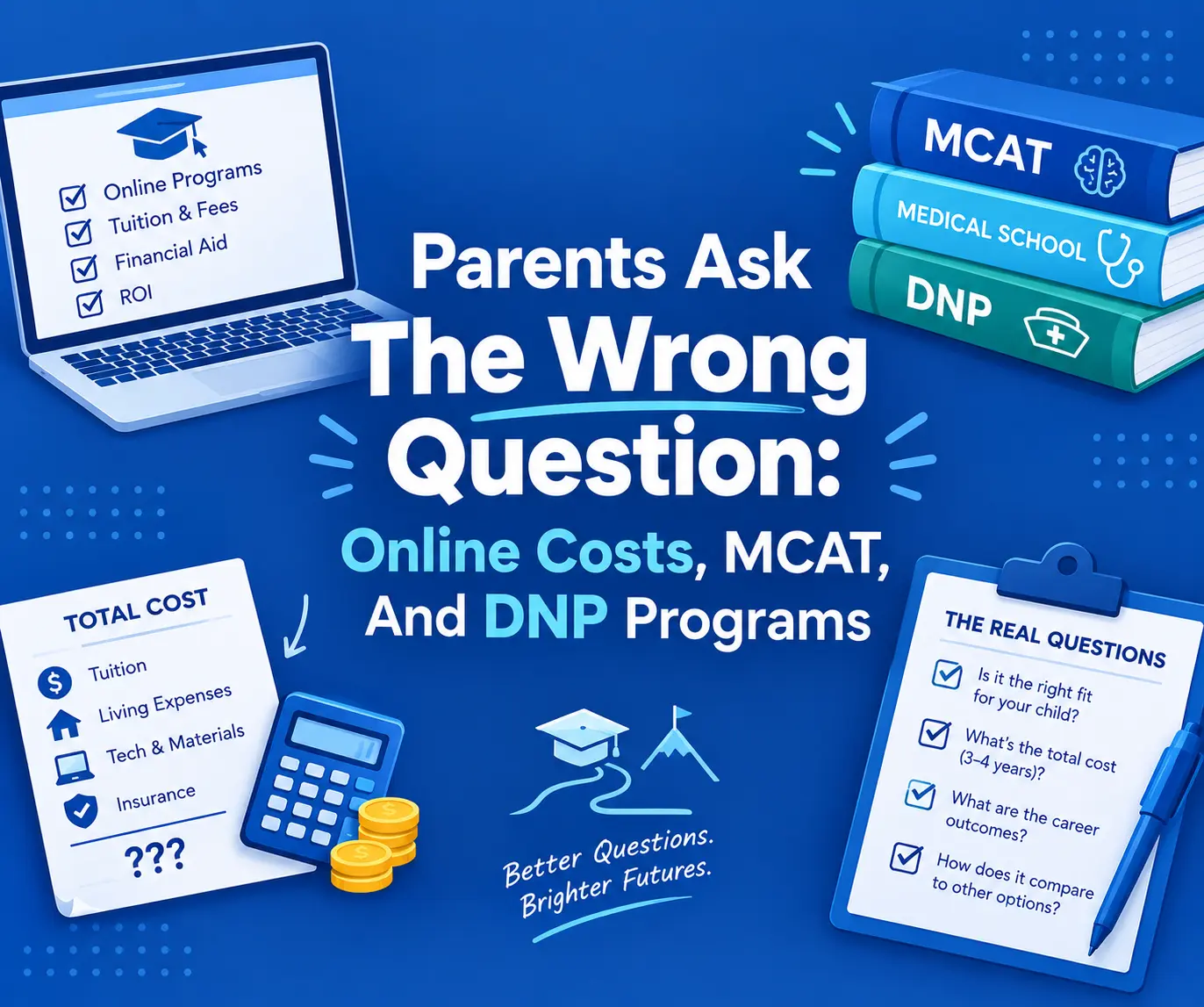
Parents Ask The Wrong Question: Online Costs, MCAT, And DNP Programs
Often, when parents and ambitious students talk about careers in medicine or advanced nursing, the debate focuses on the immediate, visible obstacles. They inquire about test prep, admission rates, and overall tuition at traditional brick-and-mortar institutions. But in higher education, emphasizing these initial markers can blind families to the broader financial picture and the structural changes happening across professional healthcare education.
Parents might ask, “How difficult is the MCAT? How costly is a prestigious degree?
Instead, they should be asking, "How do we build a flexible, sustainable educational pipeline that provides maximum long-term career autonomy while minimizing opportunity cost?"
Changing the focus from short-term prestige to long-term adaptation may help families cope with the reality of modern clinical training, digital learning models, and complex healthcare funding.
The hidden math of healthcare career trajectories
The road to becoming a high-level healthcare provider has evolved substantially in recent years. Traditional advice was straightforward: complete a bachelor’s degree with pre-medical prerequisites, take entrance tests, and then attend a four-year medical school followed by long residency training. This remains a well-established pathway, but it is no longer the only (or always the most feasible) road to advanced clinical practice.
Expanding options beyond medical school
Advanced nursing programs today provide direct routes to high levels of clinical autonomy, specialized practice, and leadership positions, although legal practice authority and clinical autonomy vary by state, role, and certification. But many students get stuck in a preparation bottleneck, taking gap years and potentially spending significant money on medical school admission tests without considering other viable healthcare job options available in modern systems.
Building an early academic plan
People need to look beyond scores to see how academic options fit their goals. For high school students who are trying to get ready for college and figure out how to apply, knowing official SAT dates and registration deadlines early in the year sets a basic schedule that makes future tests, whether for college admissions or professional-school entry, much less stressful when standardized testing is relevant to their target schools.
Rethinking the MCAT and preparation bottlenecks
The Medical College Admission Test (MCAT) is generally a major hurdle before applying to medical school, not the final hurdle in medical education. Sometimes parents pay for prep classes, hoping a high percentile score will strengthen an application. However, focusing solely on exam preparation can obscure other important factors, including clinical hours, research output, and preventing burnout.
Core challenges of the traditional pre-med pathway
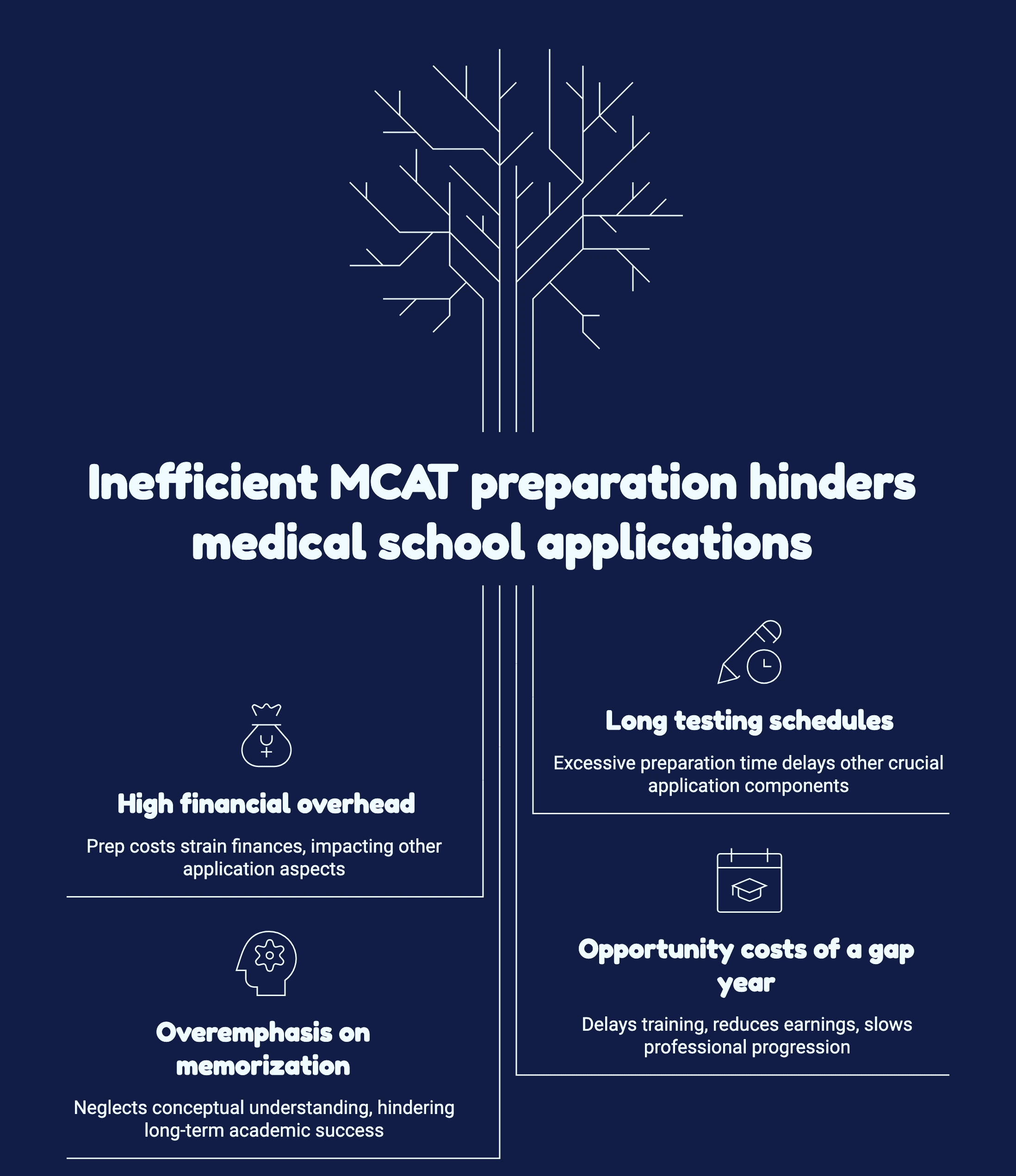
Long testing schedules: People who want to get into professional healthcare programs often spend weeks or months preparing for standardized admissions exams, even if they don't study full-time.
High financial overhead: Commercial test-prep classes, application fees, secondary application fees, and interview-related costs can add up before you even start professional training.
Opportunity costs of a gap year: Repeated admission exams or multiple gap years can delay entry into training, reduce near-term earnings, and slow professional progression in the clinical field.
Developing independent study habits early
In addition, academic readiness for demanding healthcare training takes place well before college graduation. Students form good study habits early by combining structured supervision with new learning tools.
A key insight from examining how students combine tutoring, official practice resources, and self-study apps to improve their AP scores is that understanding difficult scientific concepts independently is worth far more than memorizing answers for tests.
Students who learn to study on their own early can carry those efficient skills into college where they can maintain strong GPAs while investigating multiple clinical alternatives rather than putting all their hopes into one standardized exam.
Evaluating online delivery models and total costs
With tuition rates still changing each year, and not always in line with inflation, families need to examine the effect of educational delivery systems on the overall cost of an advanced degree. Distance education has moved from an alternative to a mainstream part of higher education, especially in nursing and healthcare administration.
Financial and practical advantages of online programs
If you are comparing online degree programs, you will want to look below the headline tuition numbers. Families should total the hidden costs of attendance, such as:
Opportunity cost of lost wages: Working nurses or students enrolled in a traditional, full-time on-campus program often forgo years of income by leaving the profession altogether.
Relocation and housing premiums: High housing costs can accompany living near large academic medical facilities, substantially increasing total student debt loads.
Clinical placement logistics: Strong remote programs clearly explain how clinical placements work, whether the school helps identify local preceptors, and what students must arrange themselves.
Faster program options: Some accelerated formats allow students to complete their coursework at a faster pace, which may mean fewer semesters of tuition and a return to full-time practice sooner.
Selecting the right advanced nursing track
For practicing nurses seeking to advance to the doctoral level of nursing practice, selecting an accredited, well-designed doctoral program is key. To learn more about the hybrid nature of demanding academic work and flexible scheduling in condensed clinical doctorates, families can refer to Research.com guide to shortest online DNP programs.
Understanding broader higher education debt realities
Families need to think about more than just the mechanics of degrees. They also need to consider how the economy as a whole affects student debt. Private student loans and digital credit products require close review because repayment terms, interest rates, and borrower protections can vary by lender.
A 2026 study published in the Digital Journal of Philanthropy and Social Sciences looked at algorithmic credit and borrower welfare. It found that using algorithmic credit makes people more financially stable in the short term, but its long-term benefits depend on people knowing how to use digital money and institutions having clear safety measures in place.
In other cases, when families use private student loans or digital credit systems to pay for college without a clear grasp of repayment terms, the loan cost may far outweigh the financial value of a faster graduation.
Strategic decision-making for graduate education
Choosing the right educational path requires a clear approach that aligns your long-term financial goals with your professional satisfaction. When evaluating programs, parents and students should look at outcome indicators, accreditation status, and career flexibility, not just brand familiarity.
Step-by-step graduate evaluation framework
Here’s a step-by-step evaluation framework families can utilize when considering higher education options:
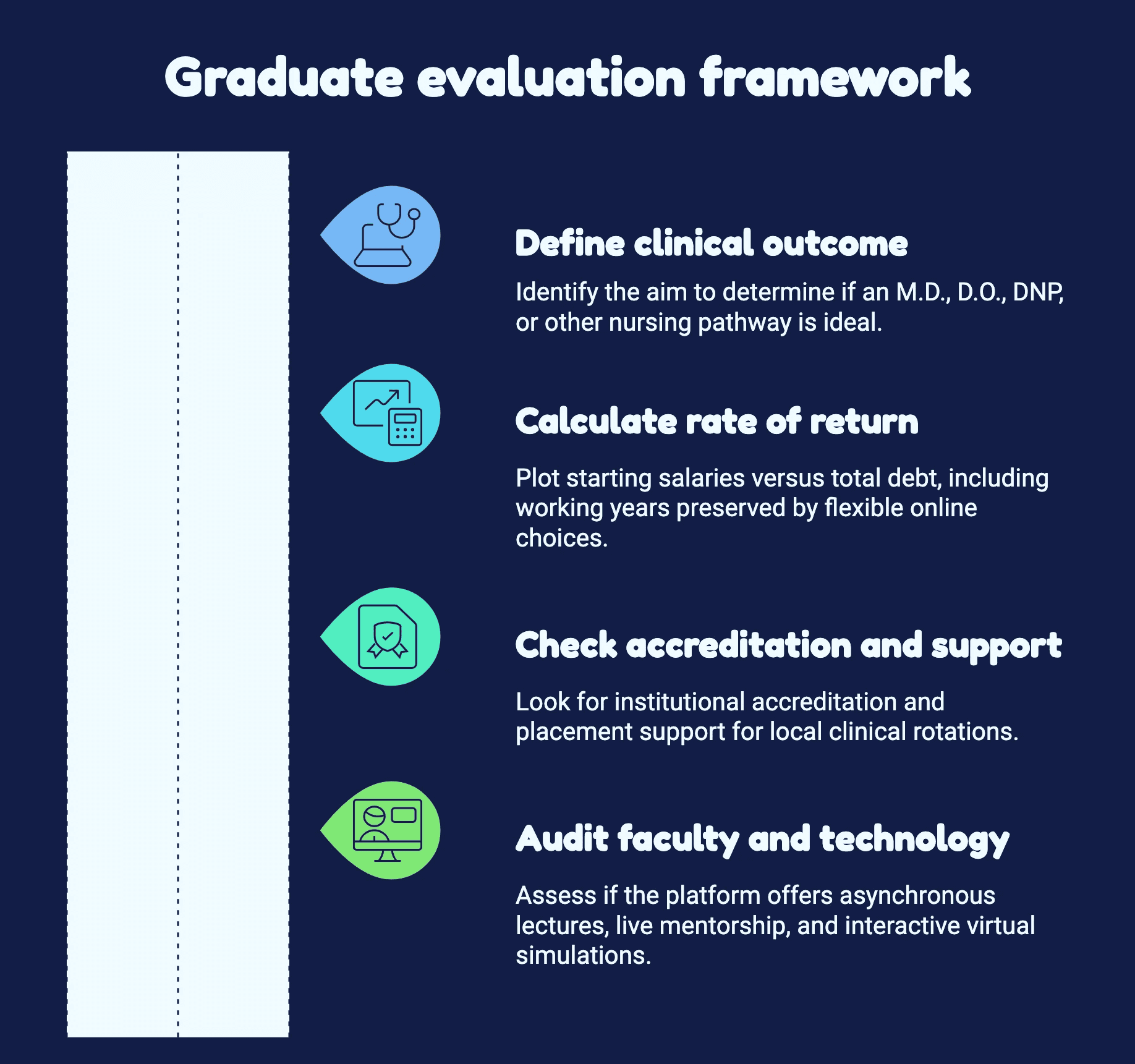
Define the final clinical outcome: Identify whether the aim is direct patient care, surgical practice, healthcare policy, or administrative leadership to determine whether a medical degree, such as an M.D. or D.O., a DNP, or another graduate nursing pathway is ideal.
Calculate the real rate on return: Plot starting salaries versus total debt, including working years preserved by using flexible online delivery choices.
Check for program accreditation and clinical support: Look for schools with recognized institutional accreditation and, when relevant, nursing programmatic accreditation, plus specific placement support for local clinical rotations.
Audit faculty accessibility and learning technology: Does the remote platform offer asynchronous lectures, live mentorship, and interactive virtual simulations that support complex material and different learning needs?
Aligning academic choices with long-term goals
When considering further education, students should analyze how specific degrees align with their professional objectives over time before deciding. Published program data, accreditation records, advising resources, and curriculum details can help students assess institutional performance, network strength, and curriculum relevance before applying to graduate programs to meet their long-term professional goals.
Navigating admissions, mentorship, and application strategy
The college admissions process for both undergraduate preparatory and graduate health programs has remained competitive. Outstanding candidates not only exceed minimum GPA and test score standards, but also tell a clear personal story that demonstrates leadership, compassion, and a sophisticated understanding of contemporary healthcare issues.
Key pillars of a competitive application
Proven clinical competency: Demonstrates current, hands-on experience in patient care or clinical research settings.
Original personal narrative: A strong desire to work in healthcare that ties together choices made in school with future career goals.
Timing of application: Submit materials early and target programs where your academic profile fits with average acceptance metrics.
Leveraging mentorship and application guidance
In this competitive atmosphere, custom mentoring can be useful, but it is not always required. Applicants may work with a trained mentor or seek a skilled tutor for college applications to help them polish their personal essays, highlight relevant clinical experiences, and strategically outline their educational ambitions.
Understanding binding application strategies
Time is also key to application success. High school seniors planning their pre-med or pre-nursing coursework should carefully consider binding application strategies. Knowing the binding and financial aid implications of early decision alternatives allows families to avoid making a binding commitment before they understand costs and compare options.
Helping students find their way to an advanced degree ultimately means asking smarter questions from the outset. When families go beyond admissions exams and typical campus models, they may craft a career strategy that matches academic achievement with financial prudence and long-term professional contentment.