ACT Practice Tests: Free Tests, Scoring, and a Study Plan That Works
No signup needed. Just click to download

You can download an official ACT practice test for free from ACT.org right now. That is not the hard part. The hard part is knowing what to do with it.
Most students who take ACT practice tests don't see their scores improve. They finish the test, check the total, feel relieved or discouraged, and move on. A week later, they take another test and repeat the same mistakes. The score stays flat, not because they aren't working, but because the review never happened.
The test itself does not raise your score. The review is complete. Every wrong answer is a data point about exactly what to study next, and most students never read it.
This guide gives you the full process: where to find real official ACT practice tests, how to take one the way the real exam runs, how to score it and build a section-by-section leak map, and how to convert every mistake into a specific study task. It also covers how many tests you actually need and what to do differently for each section. NAT tutors with ACT scores of 34, 35, and 36 contributed the insights below, and a verified six-point case study shows what the review loop looks like in practice.
Why an ACT practice test is the most accurate tool you have
An ACT practice test is the only prep activity that simulates the real exam: the same sections, timing, format, and question style. Nothing else comes as close to predicting your real score.
ACT Inc. publishes free official practice tests using real retired questions from previous ACT administrations. Because those questions were once on an actual exam, they reflect how the real test reads, paces, and traps test-takers. Third-party questions are written to approximate the ACT, but their accuracy varies. For diagnostic purposes, a question that was never on the ACT is a less reliable indicator.
The most important thing to understand is what a practice test actually does. Taking the test gives you a score. Reviewing the test tells you what to study. Most of the score gain comes from the second step, not the first. If you take a full practice test and skip the review, you've gathered data and then thrown it away.
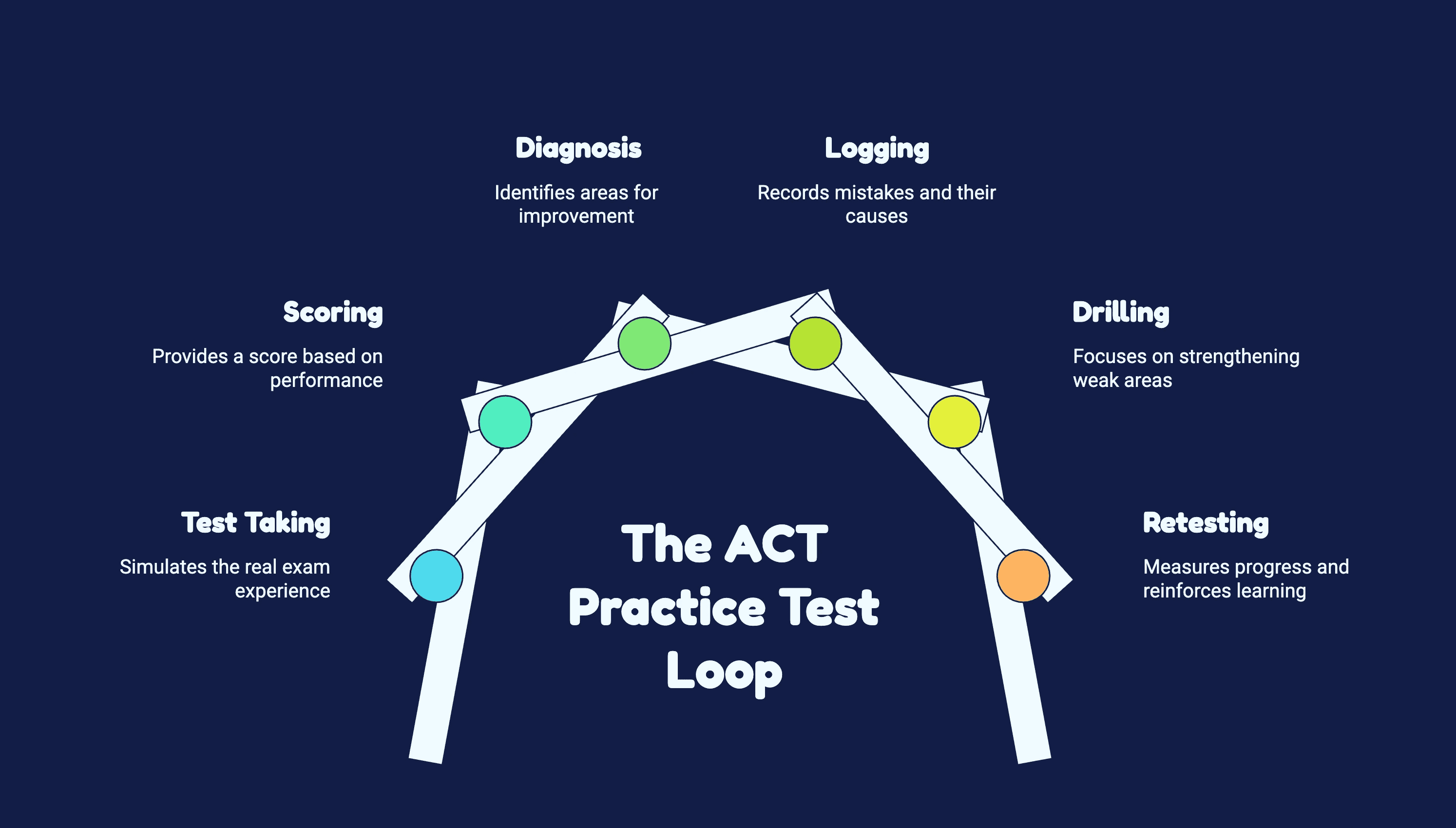
This is why the full process in this article treats the practice test as the starting point of a loop, not a finish line. The loop runs: take the test, score it by section, diagnose your patterns with a leak map, log your mistakes and their causes, drill the identified gaps, and retest. Bellamy W. ran that loop every cycle, raising her ACT composite by six points with tutor Kurtis Lee. Her story appears later in this guide.
Before starting a structured prep plan, you need a baseline. For a full picture of what the ACT requires and how a four-phase preparation plan works, NAT's guide on how to ace the ACT Exam is the companion read.
The 2025-2026 ACT you're practicing for
If your practice materials reference 60 questions in English or 60 minutes for Math, they are outdated. The current ACT format changed in 2025, and the materials you use must match it.
Here is the current 2025-2026 ACT at a glance, verified against act.org:
Section | Questions | Time | Optional? | Affects composite? |
|---|---|---|---|---|
English | 50 | 35 min | No | Yes |
Math | 45 | 50 min | No | Yes |
Reading | 36 | 40 min | No | Yes |
Science | 40 | 40 min | Yes | Yes (when taken) |
Writing | 1 prompt | 40 min | Yes | No |
Your composite score is the average of your English, Math, and Reading section scores on the 1-to-36 scale, plus Science if you take it. Writing does not count toward the composite. You choose whether to include Science and Writing when you register.
For a complete breakdown of what each section tests and how they are timed, the NAT article on what is on the ACT covers the full picture. Verify current test dates and any format updates at act.org before registering.
Where to find real ACT practice tests (free and official)
Not all ACT practice materials are equal. Third-party tests can be useful for drilling specific question types, but they should not replace official tests for your scored practice sessions. Only official tests use real retired questions and are reliable indicators of your actual score range.
Here is the source hierarchy to follow:
Source | What it includes | Cost | Quality | Best use |
|---|---|---|---|---|
ACT.org free prep page | Practice Test 1 and 2 (downloadable); online practice tests; QuizMe; Question of the Day | Free | Highest (official) | Full timed sessions; baseline and mid-cycle tests |
ACT Official Guide | Additional full-length tests with answer explanations | Paid book | Highest (official) | Extra timed sessions if you need more full tests |
ACT.org QuizMe | Section-specific shorter sets | Free | High (official questions) | Targeted section drill between full tests |
NAT free practice question cheat sheets | Free practice questions with answer keys for English, Math, and Science | Free | High | Drilling specific question types between full timed sessions |
Third-party books (Princeton Review, Kaplan, etc.) | Full tests and drills | Paid | Varies | Supplemental practice only; not for baseline measurement |
For official free practice tests, go to ACT's free official practice tests page. Download both Practice Test 1 and Practice Test 2, print them if possible (the real exam is on paper), and save one for your baseline and one for your mid-cycle test.
For section-specific supplemental practice between full tests, NAT's free cheat sheets with practice questions for ACT English, ACT Math, and ACT Science give you targeted material matched to the question types the real test uses. For Math specifically, the ACT math formula sheet is a useful companion during your review. The ACT score calculator will let you convert your raw section scores into scale scores after each timed session.
The single most important rule: use an official ACT practice test for every scored session where you are measuring your baseline, checking your progress, or running a final pre-test simulation. Save the supplemental third-party material for targeted drilling in between.
How to take an ACT practice test under real conditions
Taking a practice test "kind of like the real exam" is not the same as taking it exactly like the real exam. Students who simulate poorly get scores that mislead them. Students who simulate well get scores they can plan around.
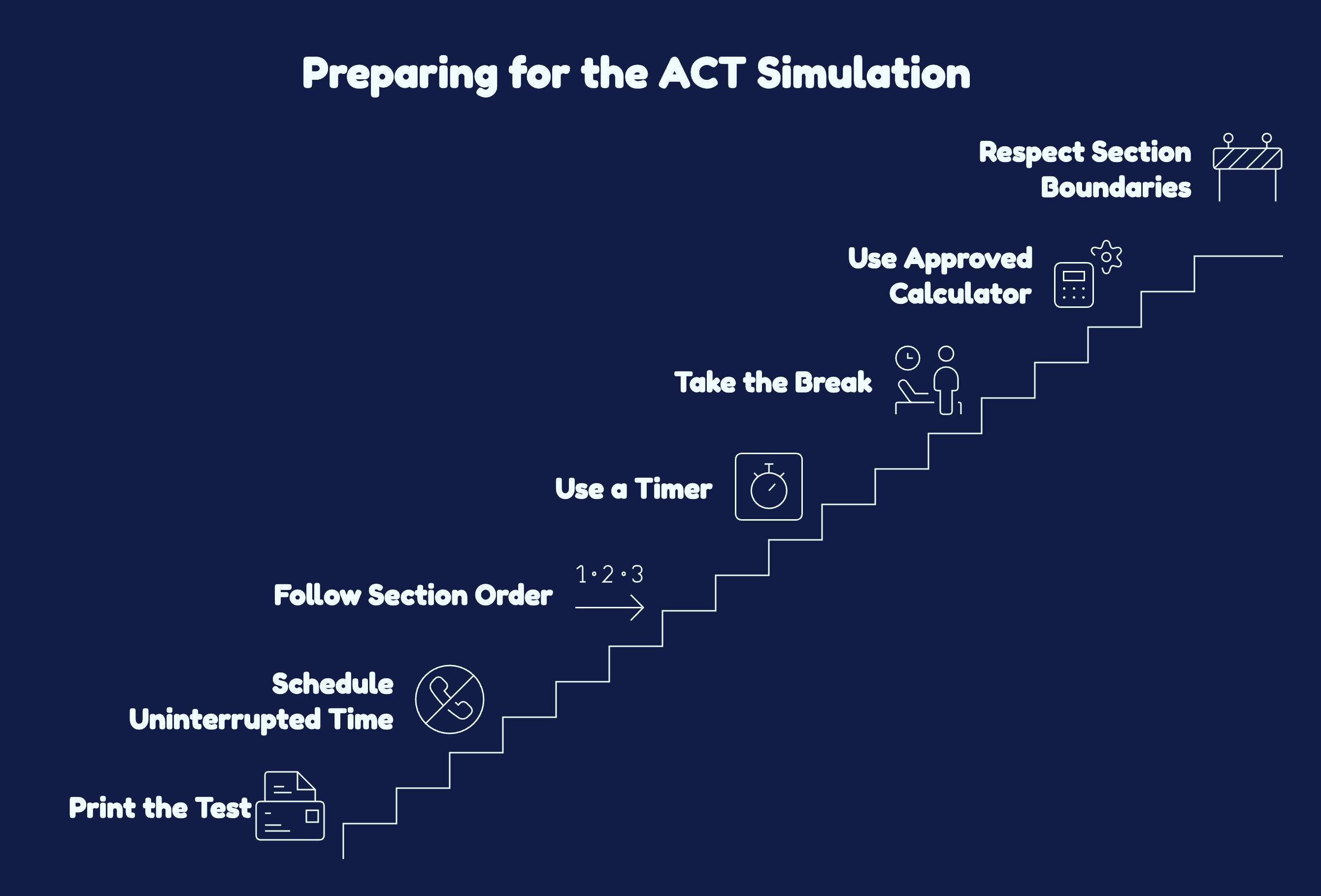
The simulation protocol below is what NAT tutors use. Run all seven steps every time you take a timed session.
The ACT simulation protocol:
Print the test. The real ACT is paper-based. Reading from a screen changes pacing and comprehension patterns. Print the official practice test so the physical experience matches test day.
Schedule a full uninterrupted block. Allow approximately 3 hours and 30 minutes. Block off the time, put your phone in another room, and treat the session as the real exam.
Follow the real section order. English, Math, Reading, and then Science (if you're taking it). Do not skip sections or reorder them.
Use a timer for every section. Set a separate countdown for each section: 35 minutes for English, 50 for Math, 40 for Reading, 40 for Science if included. Stop each section when time is called, even if you are mid-question.
Take the 10-minute break between Math and Reading. The real test includes this break. Taking it trains your stamina pacing.
Use only your approved calculator. Check the current ACT calculator policy before test day. If your calculator is not approved, you need to practice without it.
Do not go back to a section after time is called. Respect the section boundaries exactly as they run on the real exam.
The reason simulation matters is test-taking behavior. The way you manage 50 minutes on the Math section under real pressure is different from how you perform with unlimited time or frequent breaks. You train for the real exam by mimicking it exactly.
For the full breakdown of ACT timing by section and how long the full exam runs, the ACT timing guide covers every detail.
How to score your practice test and find your leak map
Your composite score tells you where you are. Your section scores tell you what to fix. These are two different conversations, and most students only have the first one.
After completing a timed practice session, score it using this sequence:
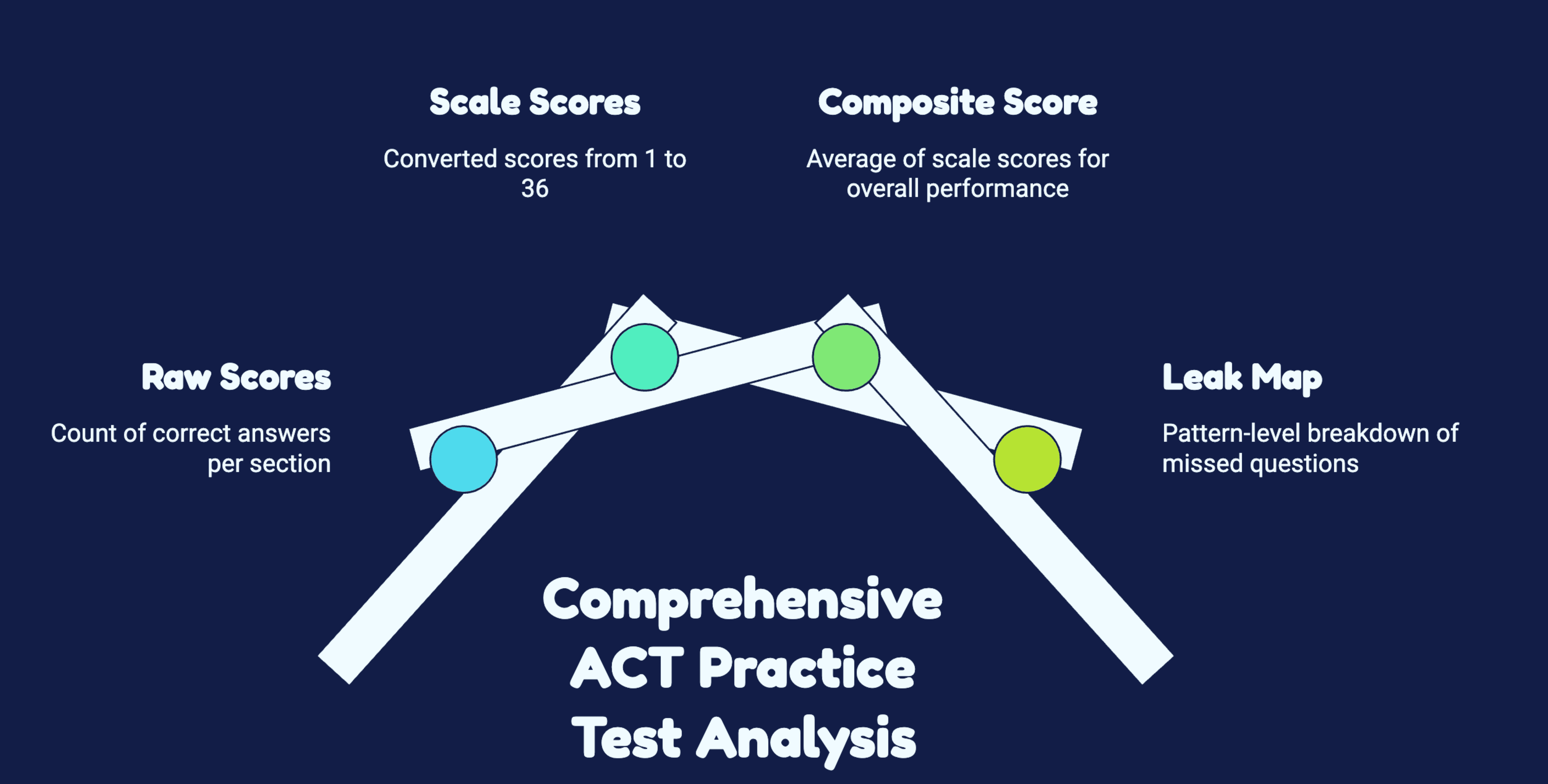
Step 1: Get your raw scores. Count the number of correct answers in each section. Do not subtract for wrong answers. The ACT has no guessing penalty.
Step 2: Convert to scale scores. Use the scoring chart included with the official practice test or the NAT ACT score calculator to convert each raw section score to its 1-to-36 scale score.
Step 3: Calculate your composite. Average your English, Math, and Reading scale scores (plus Science if taken) and round to the nearest whole number. That is your composite.
Step 4: Build your leak map. Your leak map is where your real diagnostic information lives. A leak map converts section scores into a pattern-level picture of where you are losing points. Take your section score, then go deeper: which question types inside that section did you miss most often? Were your misses clustered in a particular passage type, math content area, or reasoning category?
The leak map concept is covered in depth in the NAT article on ACT tips and tricks, and it should be your primary diagnostic tool after every scored session.
Adithya Sivakumar is a medical student at the University of Virginia who completed his undergraduate work in Molecular and Cell Biology at UC Berkeley with Departmental Honors. He has reached 100+ learners through one-on-one and group instruction, and served as a Biochemistry Tutor and Course Liaison at Berkeley's Student Learning Center. The diagnostic pattern he corrects most often is not a content gap. It is a student who is looking at the wrong number.
In NAT terms, that breakdown is your leak map, and it tells you exactly where the next ten points live.
A useful leak map worksheet has three columns: the section, the question types you missed, and the pattern (are the misses random, or do they cluster around specific skills?). After two or three practice tests, your leak map stops being a single-test snapshot and becomes a running picture of your most persistent gaps. Those gaps are where you drill next.
Turn every mistake into a study plan (the mistake log)
Scoring a practice test gives you numbers. Building a mistake log converts those numbers into a study plan. The mistake log is the step most students skip, and it is the step where most score gains come from.
After your leak map shows you which sections and question types are costing you points, open every question you missed and build a log. The structure looks like this:
Question | Section | Why I missed it | The rule or concept | Next drill |
|---|---|---|---|---|
Q12 | Math | Set up the equation wrong | Systems of equations | Review equation-setup strategy; drill 5 systems problems |
Q34 | English | Picked the comma answer; should have been no punctuation | Comma splices and independent clauses | Review comma-splice rule; drill punctuation questions |
Q7 | Reading | Ran out of time; guessed | Pacing on the third passage | Drill timed single-passage reading at 8 minutes |
Q22 | Science | Misread the graph axis | Reading figure labels | Slow down on axis labels; mark the label before answering |
The log does not need to be long. It should be honest. The "why I missed it" column is the one that matters. Students who write "I didn't know the formula" and students who write "I knew the formula but misapplied it to this scenario" need entirely different drills. Knowing which applies to you turns vague studying into specific studying.
Kurtis Lee scored a perfect 36 on the ACT and a 1570 on the SAT and is completing his M.S. in Mechanical Engineering at the University of Illinois Urbana-Champaign. He is also the tutor behind Bellamy's six-point ACT composite gain. The pattern he sees most consistently among students who plateau is not a knowledge problem.
That is the logic behind the mistake log, and it is exactly the loop Bellamy ran before her six-point jump.
Bellamy's six-point ACT jump
Bellamy W. had already taken the ACT before she started working with Kurtis Lee. She felt stuck. Her weak areas covered several fronts: em-dash and tone questions in English, rusty math foundations, slow passage and graph interpretation on Science, and pacing issues across sections. The work she did with Kurtis focused on timed practice tests, with immediate review of mistakes after each one. She rebuilt her math fundamentals, changed how she approached English and Reading strategy, and shifted to a data-first approach for science passages. The result was a six-point composite improvement.
Her path makes the core argument clear: what moved her score was the review loop, not the test volume. You can read Bellamy's six-point ACT jump in full on NAT's success stories page.
How many ACT practice tests do you actually need?
The number of practice tests you need depends on your score goal, your timeline, and how well you're running the review loop. Taking more tests without reviewing them just adds practice hours, not improvement.
A defensible cadence for most students looks like this:
Test | When | Purpose | What to do after |
|---|---|---|---|
Baseline test | Before structured prep begins | Identify section weaknesses; set a realistic starting point | Build leak map; begin targeting your two weakest sections |
Mid-cycle test | After 3-4 weeks of focused review | Check whether targeted study is moving the section scores | Update leak map; adjust which gaps you're drilling |
Final test (first) | 2 weeks before your real test date | Confirm improvement; check pacing and stamina | Log mistakes; light review only |
Final test (second, optional) | 1 week before your real test date | Confidence check; time simulation | Log mistakes; no new content |
The review after each test matters more than the count. A student who takes two tests and reviews both carefully will outperform a student who takes five tests and reviews none.
The other variable is the starting point. If your baseline composite is below 20 and your target is 27 or higher, you will likely need a longer cycle with more tests to close that gap than a student starting at 24 who needs two or three more points. The cadence table above assumes a moderate preparation window of six to ten weeks. For specific guidance on when during high school to schedule each sitting, the NAT article on when to take the ACT maps the full timeline.
What the Bellamy case study adds to this is that the loop, not the count, drove her six-point gain. The right question is not "how many tests should I take?" but "am I reviewing every test the way it deserves?"
Ready to turn your practice scores into a specific preparation plan? If you have a baseline score and want to know exactly which gaps to fix first and in what order, an ACT tutoring session with a NAT tutor will map your leak pattern and leave you with a prioritized drill plan. Explore NAT's ACT tutoring resources to see what that looks like.
Section strategies that make your practice count
A full-length practice test diagnoses you at the composite and section level. Targeted section practice between full tests is how you close the gaps the test revealed. Each section rewards a slightly different approach.
English
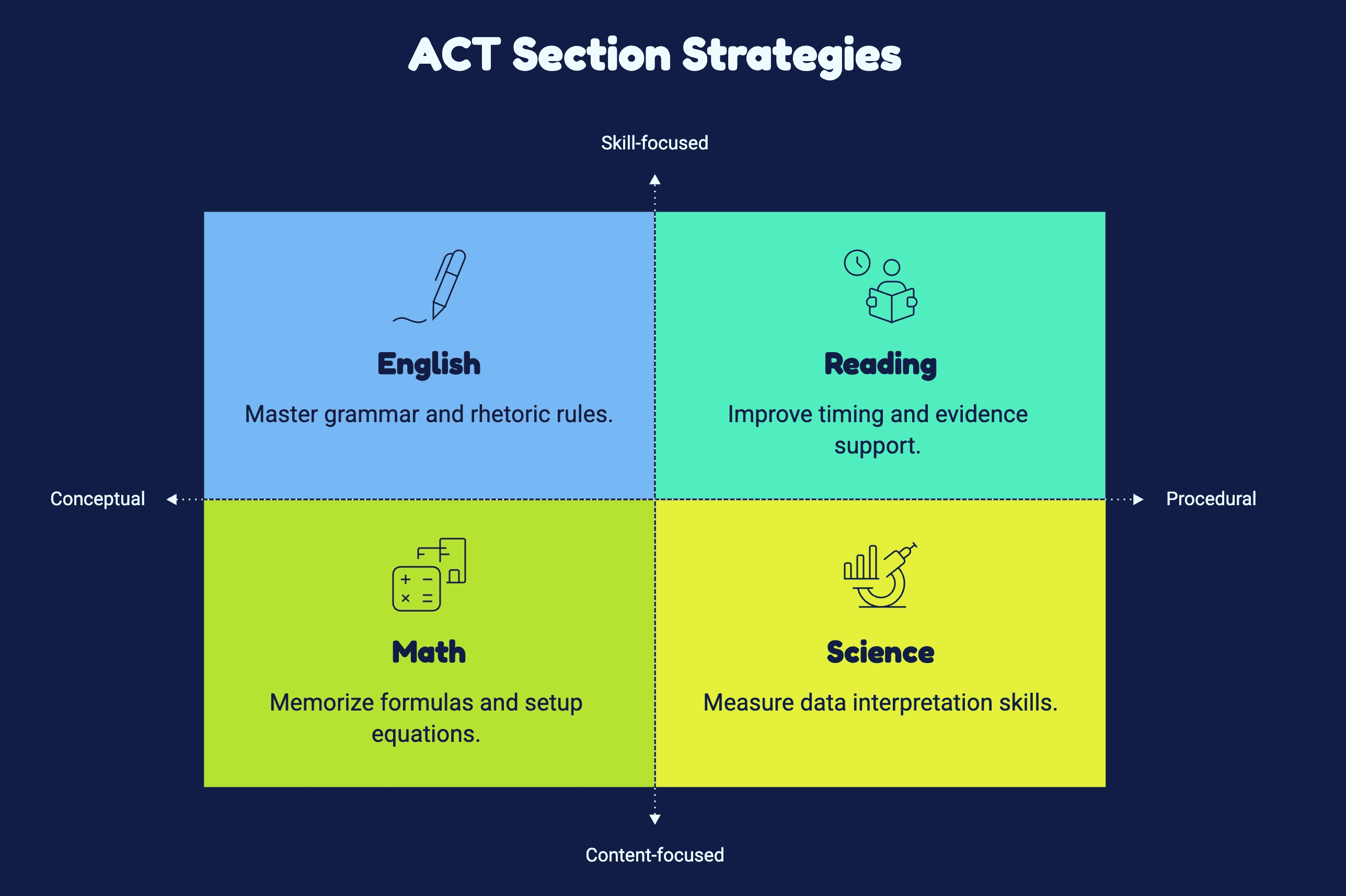
English tests grammar, punctuation, style, and rhetorical skills across five passages. The most common score-limiting pattern is choosing answers that "sound right" rather than applying a rule. When you review English mistakes in your log, categorize each miss by the grammar or rhetoric rule it tested: comma usage, subject-verb agreement, transition logic, sentence structure, relevance.
Drilling English means drilling rules, not just re-reading passages. For targeted English practice questions, NAT's free ACT English practice questions are a good starting point.
Math
The math section is 45 questions in 50 minutes, which gives you roughly 67 seconds per question. The pacing pressure is real, and students who lose time on easier early questions often can't recover in the back half of the section.
Two habits fix most Math plateaus. First: write the equation before you calculate. Setup errors (choosing the wrong mathematical model for a word problem) cause more misses than content gaps. Second: know which formulas are not provided. The ACT does not give you a formula sheet, so trig ratios, quadratic formula, and triangle rules must be memorized cold. The ACT math formula sheet covers the full list. For targeted question practice, see NAT's free ACT Math practice questions.
Reading
Reading is 36 questions across passages in 40 minutes. Pacing collapses for most students on the third or fourth passage. The mistake log pattern for Reading misses usually falls into one of two categories: ran out of time and guessed, or answered a question the passage didn't support.
For the first problem, drill single-passage timing with a hard stop at 8 minutes per passage. For the second, practice underlining the exact line or phrase in the passage that supports your answer before selecting it. If you can't find support in the text, you haven't answered the question yet.
Science
Sal Carlson scored a 35 on the ACT and a 520 on the MCAT (97th percentile) while studying Biology at Duke University with a concentration in Environmental Biology. His research background makes him especially clear-eyed about what the Science section actually measures, and it is not science knowledge.
That data-first approach is the single biggest time saver on the section, and it is trainable through practice. Before reading the passage text, scan the figures and label the axes. Then read the question. In most Science questions, the answer is in a graph or table, not in the prose. Only return to the written passage when a question specifically requires it.
For targeted Science practice, NAT's free ACT Science practice questions provide additional question sets. ACT Inc. also offers free practice quizzes and a Question of the Day that can be used for targeted section drilling between full sessions.
Where can I find a free ACT practice test?
ACT Inc. offers free official practice tests on ACT.org. The free prep page includes two downloadable full-length official practice tests (Practice Test 1 and Practice Test 2) along with online practice tests, QuizMe section quizzes, and a Question of the Day. These use real retired ACT questions, which makes them more accurate for diagnostic purposes than third-party practice materials. No login or purchase is required to download the official practice tests.
How many ACT practice tests should I take?
The number depends on your target score and how much prep time you have. A practical structure is one baseline test before you start structured study, a mid-cycle test after three to four weeks of focused review, and one or two timed tests in the final two weeks before your real test date. Most students get meaningful diagnostic value from three to four complete tests over a six- to ten-week prep cycle. The review you do after each test drives the improvement. Taking more tests without reviewing them does not move the score.
What is a good ACT practice test score?
A good practice score is one that gives you useful information relative to your target. There is no single answer, because the right score depends entirely on where you want to apply. Take your practice composite and your section scores, then compare them to the ranges colleges on your list typically report for admitted students. Your section breakdown is more actionable than your composite at this stage because it shows where improvement is possible. For guidance on interpreting your ACT score in the context of college requirements, NAT's article on what is a good ACT score covers the full range.
Do ACT practice tests predict my real score?
Official ACT practice tests are the most accurate predictor available because they use actual retired questions from previous ACT administrations and match the current test's format, timing, and section structure. That said, expect some variance on test day. Most students see a swing of a few points in either direction. Treat your practice score as a reliable estimate and a planning baseline, not a guaranteed result. A number of factors affect performance on the real test day, including sleep, nerves, and the specific content of that administration.
When should I take my first ACT practice test?
Take your first full-length practice test before you begin any structured prep. The baseline score is what allows you to build a targeted study plan rather than studying everything at once. Without it, you are guessing about which sections to prioritize. After establishing a baseline, schedule your next test at the midpoint of your prep cycle to check whether your study focus is actually moving your section scores. For guidance on when to start taking the ACT in high school, the NAT article on when to take the ACT covers the grade-by-grade timeline.
Putting it into practice
Three things determine whether a practice test raises your score: simulation quality, review depth, and drilling the right gaps.
Take an official test under real conditions. Score it by section. Build a leak map that shows where your points are going. Log every mistake with its cause. Then drill the cause, not just the content area. Retest after two to four weeks of targeted work, and run the loop again.
One complete review cycle from a single practice test beats five tests with no review. That is what Bellamy's six-point gain illustrates, and it is the difference between practicing and preparing.
Format and practice-test facts in this article were verified against act.org at research time. Re-verify current test dates, format details, and superscore policies at act.org before registration, as ACT Inc. updates its policies periodically.
If your practice scores aren't moving and you want to know why, a free strategy session with a NAT tutor will identify the specific pattern costing you points and leave you with a plan for your score range. NAT tutors have scored 34, 35, and 36 on the ACT, with no long-term commitment required. Book a free strategy session.
For next steps on ACT preparation, the ACT tutor collection and ACT tutoring resources are good starting points.