SAT Retake Plan for November 7: Start With a Free Score Review
A free SAT score review is a one-on-one session where you bring your official score report and leave with a plan for your next test. The total on that report is the least useful number on it. It tells you how many points you earned and nothing about where the rest went.
Students feel that gap the moment a score lands, because the number is in hand and the next move is not. Parents feel it with a calendar attached: registration for the November 7 SAT closes October 23, and those scores arrive November 20.
One detail changes how you search. "SAT score review" means three different things, and only one of them is a free session with NAT. Reading your own report, ordering College Board's Score Verification, and sitting down with a tutor solve different problems.
The three NAT tutors quoted in this guide scored between 1570 and 1600 on the SAT, and NAT builds every plan on a named four-phase method. What follows separates the three meanings, shows what a free review covers, and works through the retake decision and a dated plan for November 7.
What "SAT score review" can mean (and which one is free)
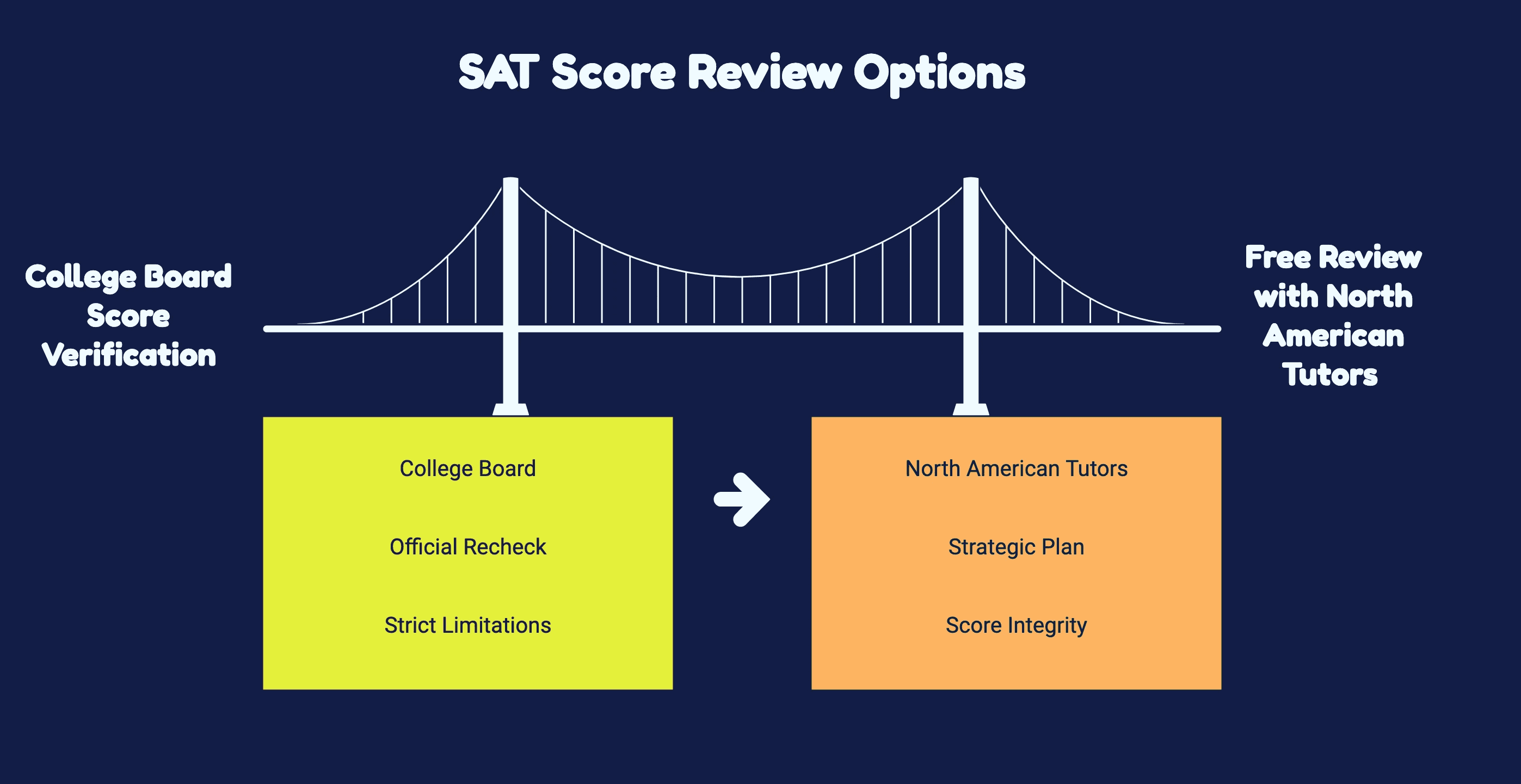
An SAT score review can mean three things: reading your own score report, ordering College Board's Score Verification, or having a tutor analyze your report and build a plan. NAT offers the third as a free session. Score Verification is a separate College Board service ordered by phone.
Reading your own report | College Board Score Verification | Free review with NAT | |
|---|---|---|---|
Who does it | You | College Board | North American Tutors |
What you get | Your total, section scores, percentiles, score range, and Knowledge and Skills areas | An official College Board recheck | A breakdown of the question types costing you points, plus a plan tied to your test date |
Limits | Shows where points went, not why | Performed once per test; order within five months of test day; ordered by phone; the Question-and-Answer Service and Student Answer Service are not available for the digital SAT | A plan, not a recheck; it cannot change a recorded score |
College Board's report guide explains that the report shows a total from 400 to 1600, section scores from 200 to 800, percentiles, a score range, and four content areas per section. NAT's step-by-step guide to what to do after your SAT score decodes each piece, so this guide starts where that one ends.
A score marked "under review" is another situation entirely. College Board says that label does not necessarily mean it is canceling the score, only that it needs more information to validate it. Verification is something you order, while a review flag is something College Board starts.
Strong students often read a low Reading and Writing score as a knowledge problem. Gia Kim sees it differently. She scored a 1570 on the SAT, studies Chemistry and Chemical Biology with a minor in English at Cornell University, and has tutored for three years across roughly 100+ students. Her first question is whether a miss came from content or from reasoning, which is also the first question a review should answer.
Try it on five of your own misses. For each one, can you point to the sentence in the passage that proves the correct answer?
What happens in a free SAT score review
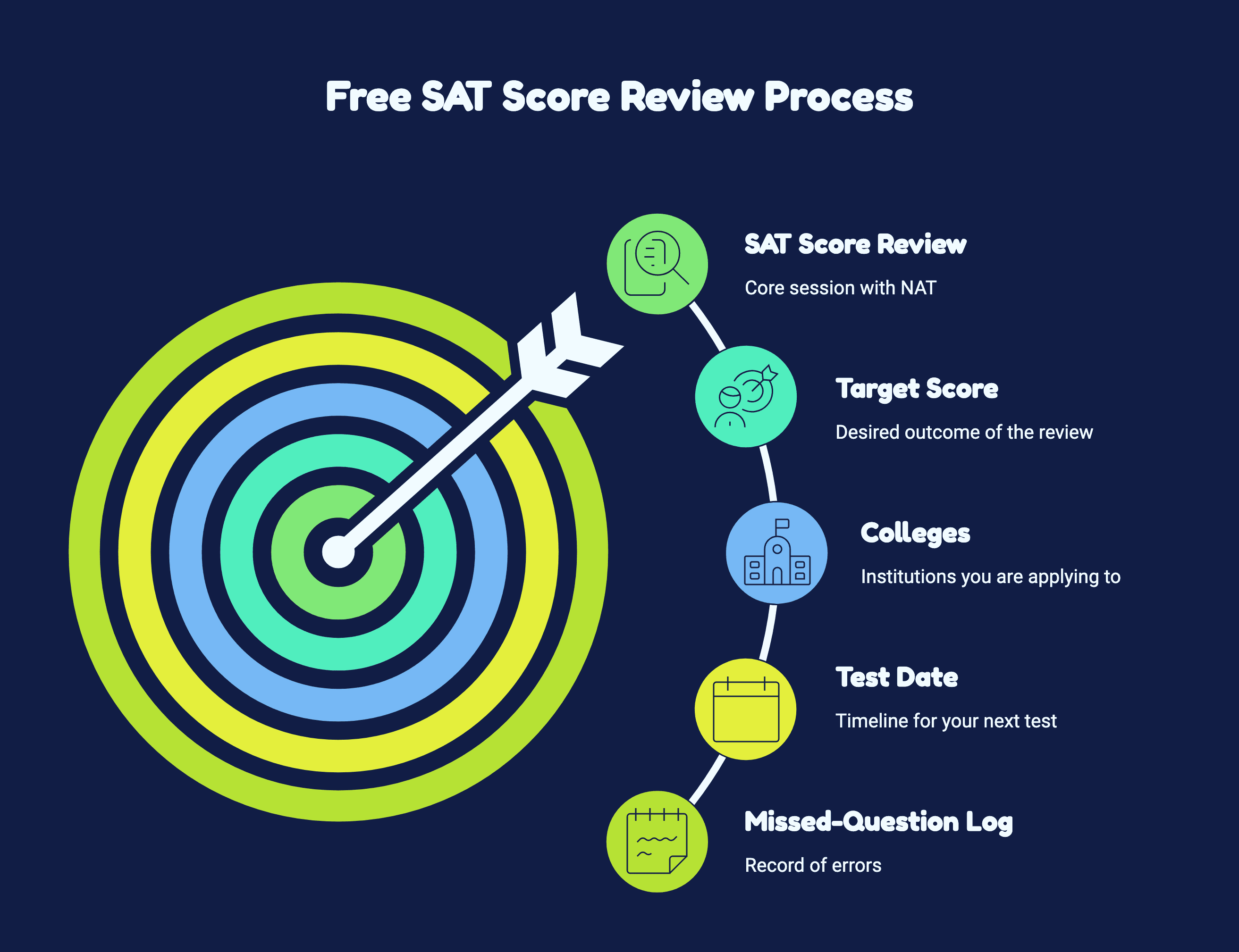
A free SAT score review is a one-on-one session with NAT. You bring your official score report and target score. NAT works out which question types are costing you points, and you leave with a plan tied to your next test date. No long-term contract is required.
The session works best with five items in hand:
Your official score report, or your most recent Bluebook practice test result
Your target score
The colleges you are considering
Your next test date or your earliest application deadline
Your missed-question log, if you keep one
Stage | What happens | What you leave with |
|---|---|---|
Intake | You share your score, target, colleges, and test date | A stated gap between where you are and where you need to be |
Report walk-through | Your section scores and Knowledge and Skills areas are reviewed, along with any practice-test results you bring | The areas costing you the most points |
Pattern check | Misses are sorted by cause: content, misread question, pacing, or careless error | A named pattern instead of "study more" |
Plan handoff | Findings are tied to your test date and deadlines | A roadmap you keep whether or not you continue with NAT |
Each stage ends with something you can use, whether or not you continue with NAT.
The review is not the same as the first tutoring session. Once you are matched with one of our SAT tutors, the first session is a paid 60-minute diagnostic in which the tutor works through a practice test. You meet your tutor before you commit to any paid session.
Families comparing next steps can review SAT tutoring pricing.
Wanning Lu earned a perfect 800 on the SAT Math section and a 1570 overall. She then graduated summa cum laude from UC San Diego with a B.S. in Mathematics and Computer Science and served as an instructional assistant in computer science there. She has tutored SAT students for 5 years across roughly 150+ students. When a Math score stalls, she does not hand out more problems.
Sort your own misses the same way before your session, and the conversation starts a step ahead.
Book a free SAT strategy session to bring your score report, find the question types costing you points, and leave with a plan sized to your test date.
Should you retake, and can November 7 work?
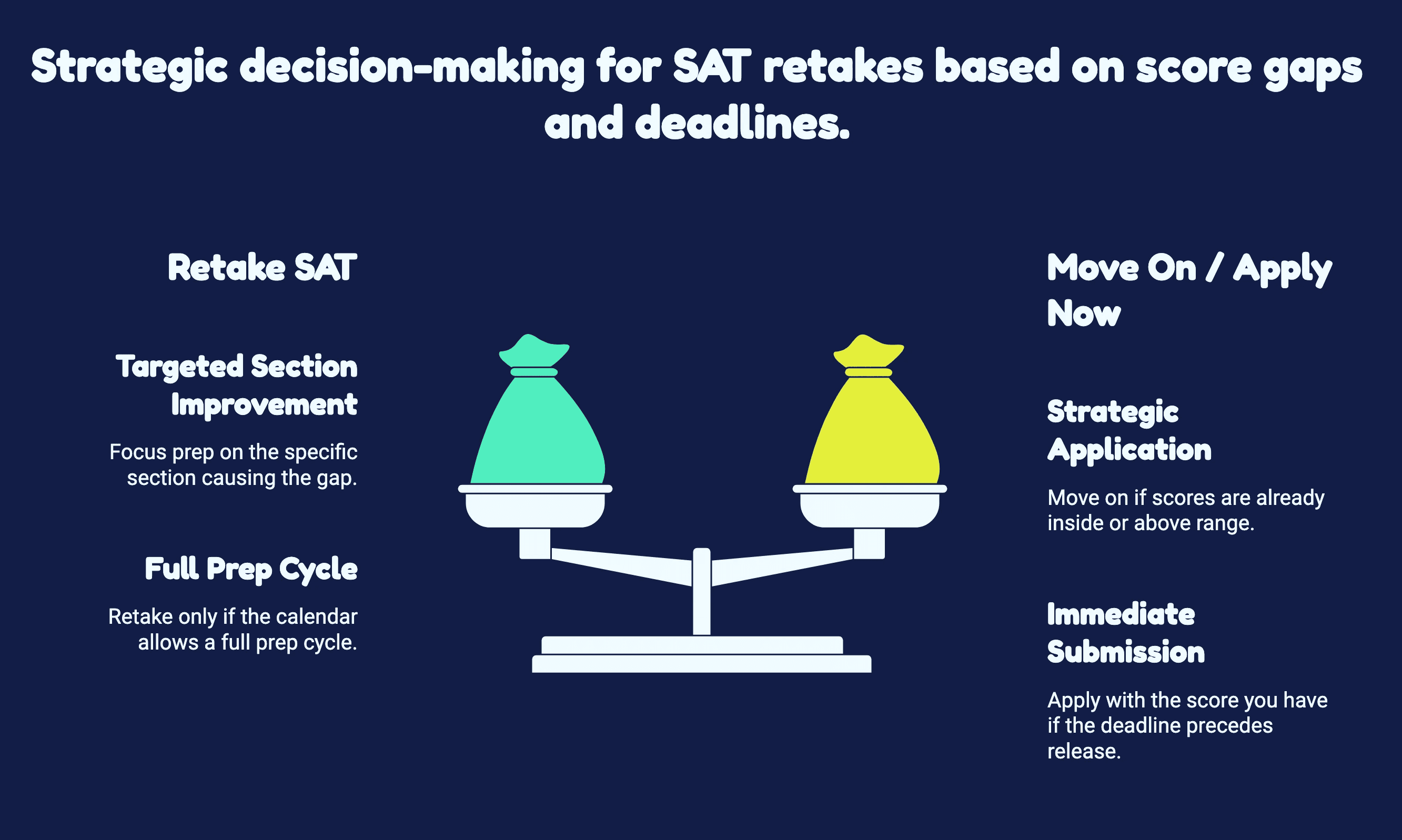
Retake the SAT when the gap to your colleges is real, one section explains most of it, and a score release fits before your deadline. For November 7, register by October 23; scores release November 20.
The gap comes from comparing your score with the range at each college on your list, not with the national average. College Board puts the national average around 1050 and says 1350 or higher is in the top 10 percent, while noting that each school sets its own expectations. NAT's guide to what counts as a good SAT score shows how those ranges shift by college tier.
Your situation | Lean | What the review should settle |
|---|---|---|
Well below your colleges' range, and one section explains most of the gap | Retake, with prep aimed at that section | Which section, and which question types inside it |
Below range, and both sections trail | Retake only if the calendar allows a full prep cycle | Which section to fix first, and whether the weeks allow both |
Inside or above your range | Move on | Whether any remaining gap is execution, and where the hours go instead |
A deadline falls before the next score release | Apply with the score you have | Whether the college accepts later scores, and which score to send |
Start with the row that matches your score gap, then check the calendar before you decide.
Superscoring is a college policy, not a College Board rule: colleges that superscore combine your best section scores from different tests, as College Board's superscore explainer describes. Score Choice lets you choose which test dates go to each college, and NAT's guide to how to send SAT scores to colleges walks through the mechanics. Policies vary, so read the score-use page for every college on your list.
A second attempt is not a red flag on its own, since College Board says colleges do not look unfavorably on retaking.
Test-optional does not mean scores are ignored. A test-optional college applies its own score-use policy to any score you send, while the University of California says it does not consider SAT or ACT scores in admissions decisions or scholarships. Check each college's current policy, because policies change.
Alexander Joseph scored a perfect 1600 on the SAT and a 524 on the MCAT. He graduated summa cum laude in Biochemistry from Northeastern University and is now an M2 at Brown University's Warren Alpert Medical School. He has tutored both exams for over six years across roughly 100+ students, and his teaching is methodical and frameworks-first. Ask him about a retake and the total comes last, after the gap, the section, and the calendar.
A first score can be the starting point for that decision: Eli A's first official SAT was a 1360, with 660 in Math and 700 in Reading and Writing. His plan changed after that: a missed-questions log with NAT tutor Frances O'Grady, then advanced diagnosis with tutor Zachary Wagner and detailed reviews of official Digital SATs #8 through #10. He scored 1500 on a final practice test and 1510 on the official June SAT, with 760 in Math and 750 in Reading and Writing. What changed between his scores was the preparation itself.
Test date | Register by | Late registration (fees apply) | Scores arrive |
|---|---|---|---|
November 7, 2026 | October 23 | October 27 | November 20 |
December 5, 2026 | November 20 | November 24 | December 18 |
College Board deadlines expire at 11:59 p.m. ET. Colleges set their own Early Action and Early Decision deadlines, so a deadline before November 20 will pass before you see those scores, and those schools receive them after that.
If November 7 is your target date
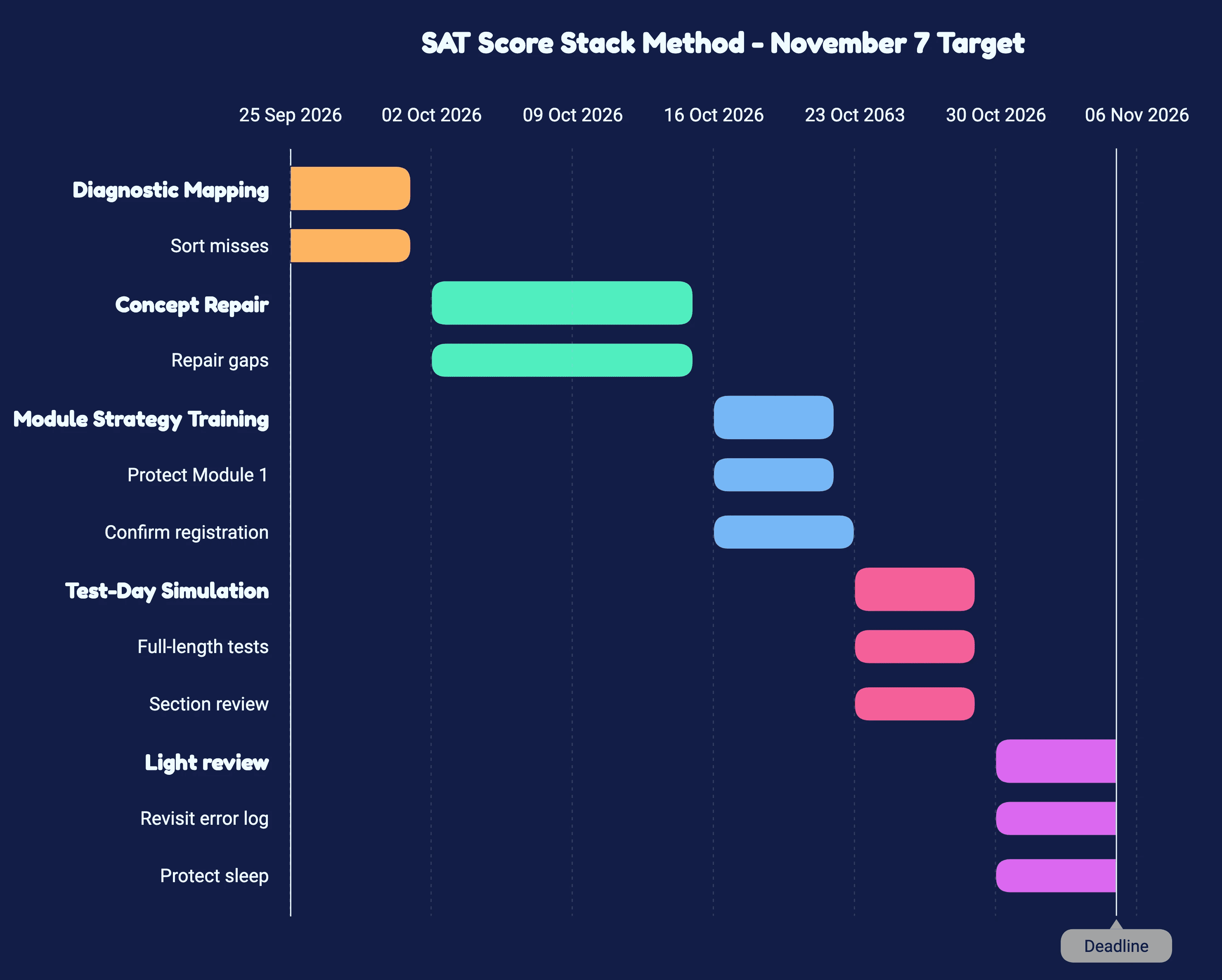
Six weeks separate a score released on September 25 from the November 7 test. NAT's Score Stack Method has four phases, and one way to fit them into that window follows. If your score arrived earlier, add the extra days to Concept Repair, and read NAT's September 2026 SAT score release guide for the release-day timeline.
Week | Dates | Score Stack phase | Focus |
|---|---|---|---|
1 | Sept. 25 to Oct. 1 | Diagnostic Mapping | Sort misses by cause and name the five to ten areas costing the most points |
2 and 3 | Oct. 2 to Oct. 15 | Concept Repair | Repair only those gaps with official questions, Bluebook practice tests, and NAT's free SAT resources |
4 | Oct. 16 to Oct. 22 | Module Strategy Training | Protect Module 1 accuracy, work on pacing, and confirm your registration before October 23 |
5 | Oct. 23 to Oct. 29 | Test-Day Simulation | Full-length timed Bluebook tests, each followed by a section-by-section review; convert raw scores with NAT's SAT score calculator |
6 | Oct. 30 to Nov. 5 | Light review | Revisit your error log, keep practice short, protect your sleep |
If December 5 fits your deadlines better, the same four phases run across about ten weeks, and Concept Repair gets most of the extra time.
High scorers gain differently. Guntas S was already scoring in the 1400s when he started, and NAT tutor Brian Min found careless errors and weak spots in advanced algebra and geometry holding him back. After a summer of work he scored a 1560 on the official SAT, with 790 in Math and 770 in Reading and Writing, a 150-point gain from his first attempt. His case shows that a diagnosis can point to execution instead of content.
If you're a parent
Parents can book the review, and these questions make the conversation shorter and more useful:
Which section explains most of the gap to our target colleges?
What is the plan for the next test date, and is it realistic given the deadlines?
How often will I see progress, and in what form?
What happens if the tutor is not the right fit?
What is free, and where does paid tutoring begin?
A fair worry is paying for help that changes nothing. No tutor can promise a specific score, and a review that does not show you where points went is not worth your evening. Once tutoring starts, NAT sends parents regular progress reports and offers free tutor changes if the match is wrong.
Turn the review into a plan with the Score Stack Method
The Score Stack Method is a four-phase approach that NAT's one-on-one SAT tutoring uses to turn a diagnosis into a plan. Each phase builds on the one before it, so students repair the right things in the right order.
Phase | What happens | What it produces |
|---|---|---|
Diagnostic Mapping | The tutor identifies point-loss patterns by question type, module, and timing | A written score leak report naming the five to ten areas costing the most points |
Concept Repair | Work covers only the identified gaps, using official College Board questions and Bluebook practice tests | Closed gaps, with no time spent on topics already mastered |
Module Strategy Training | Students learn to read Module 1 conditions and pace for accuracy; see why Module 1 accuracy shapes your score | A section-by-section pacing approach |
Test-Day Simulation | Full-length timed Bluebook tests with a section-by-section debrief | Remaining error patterns isolated before test day |
The free review sets the roadmap. The written leak report belongs to Diagnostic Mapping, which takes place in the first one to two tutoring sessions.
For Math, the one-page SAT math formula sheet and the Desmos tips for the digital SAT cover the tools most worth practicing before Test-Day Simulation.
Practice volume matters less than review quality, and NAT's answer to how many practice tests you need explains why.
Mistakes that waste a retake
Most wasted retakes come from acting on the number before reading the pattern behind it. These five are worth avoiding.
Mistake | What it costs | Fix |
|---|---|---|
Retaking without a new diagnosis | You collect the same information twice | Sort misses by cause before choosing what to study |
Drilling content when the loss is execution | Hours go to topics you already know | Check whether misses were misreads, slips, or pacing before drilling |
Fixating on the total | Two students with the same total can need different plans | Start with the section split and the Knowledge and Skills areas |
Letting the calendar decide too late | Registration closes before you have a plan | Note both the registration and score-release dates; November 7 closes October 23 |
Treating Score Verification as a study plan | You order a recheck when the real issue is a pattern | Use a review to find the pattern; use Verification only for a recheck |
Bring your report, leave with a plan
Three points carry the rest. "SAT score review" has three meanings, and a tutor-led review is the one built to produce a plan. A retake makes sense when the gap, the section, and the calendar line up. And a plan beats another practice test taken without a new diagnosis.
Have a score that is not moving? Book a free SAT strategy session with NAT to find the question types costing you the most points and leave with a roadmap sized to your test date. The session is free, there is no long-term contract, and the tutors quoted in this guide scored between 1570 and 1600 on the SAT.